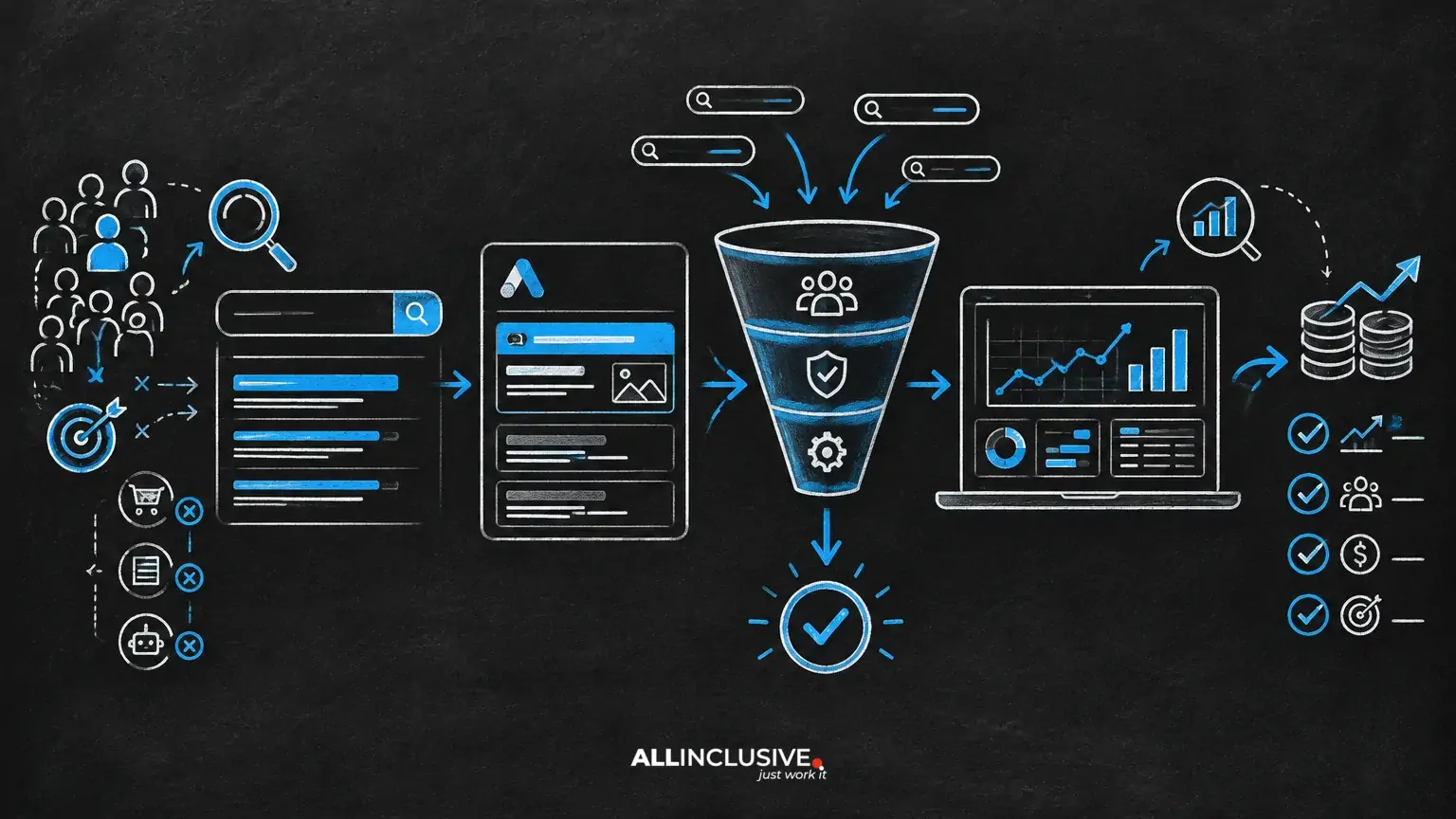
Google Ads non-brand campaigns help businesses reach people who are searching for a problem, category, solution or use case—not yet for the company by name. That makes them a core demand-capture tactic, but also a less forgiving one: non-brand traffic usually costs more to qualify, includes more irrelevant intent and requires stronger measurement than brand search.
The right objective is not simply to generate more clicks. It is to discover and capture commercially relevant demand while protecting budget from broad, ambiguous or low-value searches. That requires disciplined campaign structure, intent-led keyword selection, negative keyword management, conversion-quality feedback and a clear definition of what counts as progress.
This guide explains how to evaluate, launch and optimize google ads non brand campaigns for B2B, SaaS, professional services and other considered purchases.
What makes a non-brand campaign different?
Brand campaigns target searches that already include your company or product name. Non-brand campaigns target searches such as “CRM for financial advisors,” “warehouse automation software” or “paid media agency for B2B.” The user may have strong commercial intent, but they may also be researching, comparing options or looking for a solution your business does not actually provide.
Because the advertiser is not benefiting from existing brand recognition, non-brand campaigns typically need to solve four problems:
- Relevance: Does the keyword describe a problem or category the business can credibly address?
- Intent: Is the searcher exploring, evaluating or ready to take a commercial action?
- Efficiency: Can the account acquire qualified demand at an acceptable cost?
- Attribution: Can downstream lead quality, revenue or pipeline be connected back to the campaign?
These questions are strategic rather than purely mechanical. Google Ads can help match ads to searches, but it cannot determine whether a lead fits your sales model, service area, implementation capacity or commercial priorities.
Start with demand categories, not a keyword dump
A useful non-brand account begins with the way prospects describe their needs. Build keyword themes around distinct demand categories rather than placing every relevant phrase into one campaign.
1. Category and solution searches
These searches identify the type of product or service the prospect is considering: “B2B demand generation agency,” “inventory management software” or “commercial insurance broker.” They can be valuable, but category terms vary widely in intent and competition. They need tightly matched landing pages and careful query review.
2. Problem and pain-point searches
Problem searches describe an operational challenge, such as “reduce SaaS churn” or “how to improve qualified lead volume.” They can uncover demand earlier in the buying process. However, informational intent is often mixed with commercial intent, so these themes should not be judged by lead volume alone.
3. Use-case and industry searches
Use-case terms connect the solution to a specific context, such as “analytics software for healthcare” or “Google Ads for nonprofits.” These searches may be narrower and easier to qualify when the business has a genuine specialization, relevant proof and a landing page that addresses the audience directly.
4. Comparison and alternative searches
Searches containing terms such as “best,” “alternative,” “pricing,” “agency” or “services” can signal active evaluation. They may also attract users seeking editorial content, free tools or low-cost options. Treat them as high-potential themes that require clear messaging and qualification—not as automatic winners.
Use intent tiers to control budget
Not every non-brand keyword deserves the same bid, budget or conversion expectation. A practical structure separates themes by likely commercial proximity.
- High intent: Service, provider, demo, consultation, pricing and solution-specific searches.
- Mid intent: Category, comparison, implementation and use-case searches.
- Early intent: Educational, definition, strategy and problem-awareness searches.
High-intent campaigns are usually the best starting point when budget is limited because the path to a business outcome is easier to evaluate. Mid-intent campaigns can expand reach once the account has enough evidence about qualified conversion patterns. Early-intent campaigns should have a specific role—such as content engagement, remarketing audience development or assisted demand creation—rather than being expected to perform like bottom-funnel search.
Keep the tiers analytically distinct. If early- and late-stage keywords share campaigns, blended performance can hide where budget is actually working.
Design campaign structure around decisions
Campaign structure should make it possible to answer practical questions: Which demand theme creates qualified opportunities? Which audience needs different messaging? Which landing page supports the strongest conversion quality? Over-segmentation creates management overhead, while under-segmentation makes those answers difficult to find.
Separate campaigns when there is a meaningful difference in:
- Intent or buying stage
- Geography, language or service availability
- Budget ownership or business priority
- Landing page and offer
- Audience qualification or sales process
- Target efficiency or conversion value
Do not create a separate campaign merely because two keywords use different wording. If the same audience, message, landing page and business outcome apply, an ad-group or theme-level distinction may be sufficient.
Match the ad to the searcher’s problem
Non-brand ads need to establish relevance quickly without pretending the prospect already knows the company. Strong messaging usually connects four elements:
- The problem, category or use case reflected in the query
- The business outcome the solution supports
- A credible differentiator, such as expertise, process or fit
- A next step appropriate to the buying stage
For example, an ad for a high-intent service query might emphasize an assessment or consultation. An ad for a mid-funnel category search might lead with a practical guide or solution overview. The offer should match the user’s readiness rather than forcing every visitor into a sales call.
Use landing-page alignment as a quality control. If a keyword refers to nonprofit advertising, the destination should explain relevant experience, constraints and objectives—not send the user to a generic services page. Better alignment can improve the user experience even when it does not immediately lower media costs.
Build negative keyword management into the launch
Negative keywords are a central protection against wasted non-brand spend, but they should be applied thoughtfully. Begin with obvious exclusions that conflict with the business model, such as employment, training, free downloads, support requests or unrelated product meanings. The correct list depends on the offer and audience.
Review search terms regularly for:
- Queries outside the service area or market
- Unqualified business sizes or industries
- Research-only phrasing with no useful commercial role
- Competitor, support or existing-customer intent that belongs elsewhere
- Ambiguous terms producing repeated irrelevant clicks
Avoid blocking an entire concept because of one poor query. First determine whether the issue is the keyword, match coverage, ad promise, landing page or qualification process. Negative keyword lists should reduce known waste without preventing valuable variations from entering the account.
Measure lead quality, not just conversions
Non-brand search can appear efficient when the account counts every form submission equally. That is a dangerous simplification for businesses with long sales cycles or variable lead quality.
Define a conversion hierarchy that distinguishes between:
- Primary business outcomes, such as qualified opportunities, purchases or completed applications
- Intermediate actions, such as consultation requests, demo bookings or calls
- Micro-conversions, such as downloads, engaged visits or email subscriptions
Micro-conversions can be useful for learning, particularly when volume is limited, but they should not be treated as equivalent to revenue-producing outcomes. Where possible, connect advertising data to CRM stages and evaluate campaigns by qualified pipeline, sales acceptance, revenue or another agreed business metric.
Also inspect the quality distribution behind aggregate results. A campaign with fewer conversions may be more valuable if those conversions are better aligned with target account size, geography, need and buying authority.
Set budget using evidence and constraints
Budget decisions should reflect the value of a qualified outcome, the available search demand and the organization’s ability to follow up. A larger budget cannot create more relevant demand where the market is narrow, nor can it repair weak positioning or slow lead handling.
Before launch, document:
- The commercial outcome the campaign is expected to support
- The maximum acceptable cost for a qualified lead or opportunity
- The conversion lag between click, lead and sales outcome
- The minimum data needed before making a change
- The portion of budget reserved for proven themes versus exploration
Use a testing allocation for new themes, but define a review rule in advance. A test should be paused, refined or expanded based on search relevance and business quality—not only on short-term click-through rate.
For broader guidance on planning investment across search and other channels, see our paid media strategy resources and Google Ads budget guide.
Optimization priorities after launch
The first optimization cycle should focus on whether the campaign is attracting the intended demand. Review search terms, landing-page behavior, lead details and sales feedback before making aggressive bid or budget changes.
Prioritize query quality
Identify recurring irrelevant patterns and add exclusions where appropriate. Also find valuable queries that deserve new ad groups, tailored copy or dedicated landing pages.
Improve message and destination alignment
If qualified users click but do not progress, examine the promise made in the ad, the clarity of the offer, proof, form friction and mobile experience. Do not assume the auction is the only constraint.
Separate learning from scaling
Keep experimental themes identifiable. Scaling a campaign before its lead quality is understood can turn an attractive surface metric into expensive operational noise.
Use sales feedback as a recurring input
Ask sales which leads were relevant, which objections appeared and which searches indicate poor fit. This feedback often reveals distinctions that platform metrics cannot show, especially in B2B accounts.
Non-Brand Search Campaigns: Mistakes to Watch For
- Starting with broad coverage before defining qualification: More reach can multiply irrelevant demand.
- Sending every keyword to one landing page: Generic destinations weaken relevance and make intent analysis harder.
- Optimizing to form volume alone: Cheap leads are not necessarily valuable leads.
- Mixing brand and non-brand performance: Existing demand can make an account look healthier than its acquisition activity really is. See our guide to Google Ads brand campaigns.
- Copying a B2B structure into every market: SaaS, ecommerce and nonprofit campaigns may require different offers, qualification signals and conversion paths. Our Google Ads for B2B guide covers the additional measurement considerations.
Non-Brand Search Campaigns: Pre-Launch Checklist
- Define the audience, offer, market and commercial outcome.
- Group demand by category, problem, use case and buying stage.
- Prioritize high-intent themes before expanding into broader research terms.
- Create ad and landing-page messaging that matches each meaningful theme.
- Install primary and secondary conversion tracking with clear ownership.
- Prepare an initial negative keyword framework and search-term review process.
- Separate campaigns where budget, audience, geography or outcome requires it.
- Set review thresholds for relevance, lead quality and qualified pipeline.
- Use sales feedback to refine targeting and qualification.
- Scale only the themes that demonstrate repeatable business value.
How to decide whether non-brand search is working
A successful campaign does more than produce incremental traffic. It creates a defensible path from relevant search demand to a business outcome. That path may begin with a qualified lead, a sales-accepted opportunity, a purchase or another outcome appropriate to the organization.
Evaluate the campaign at three levels: coverage—whether it reaches relevant demand; efficiency—whether media costs are controlled; and quality—whether the resulting actions contribute to the pipeline or revenue model. If one level is weak, the solution may involve targeting, messaging, landing pages, measurement or sales operations—not simply a bid change.
For organizations considering a broader acquisition program, our paid search strategy hub provides a related framework for evaluating channel roles and campaign priorities.