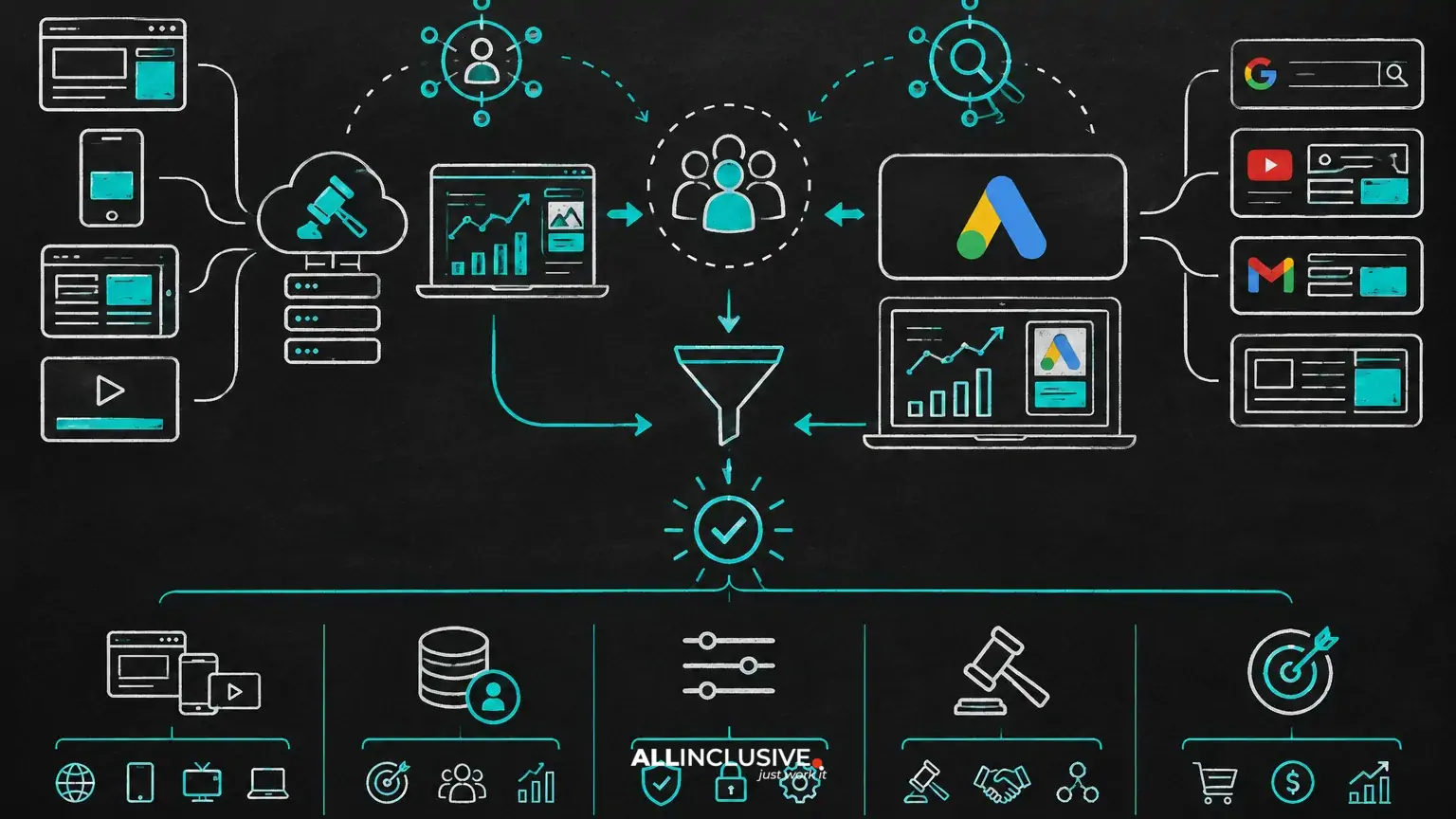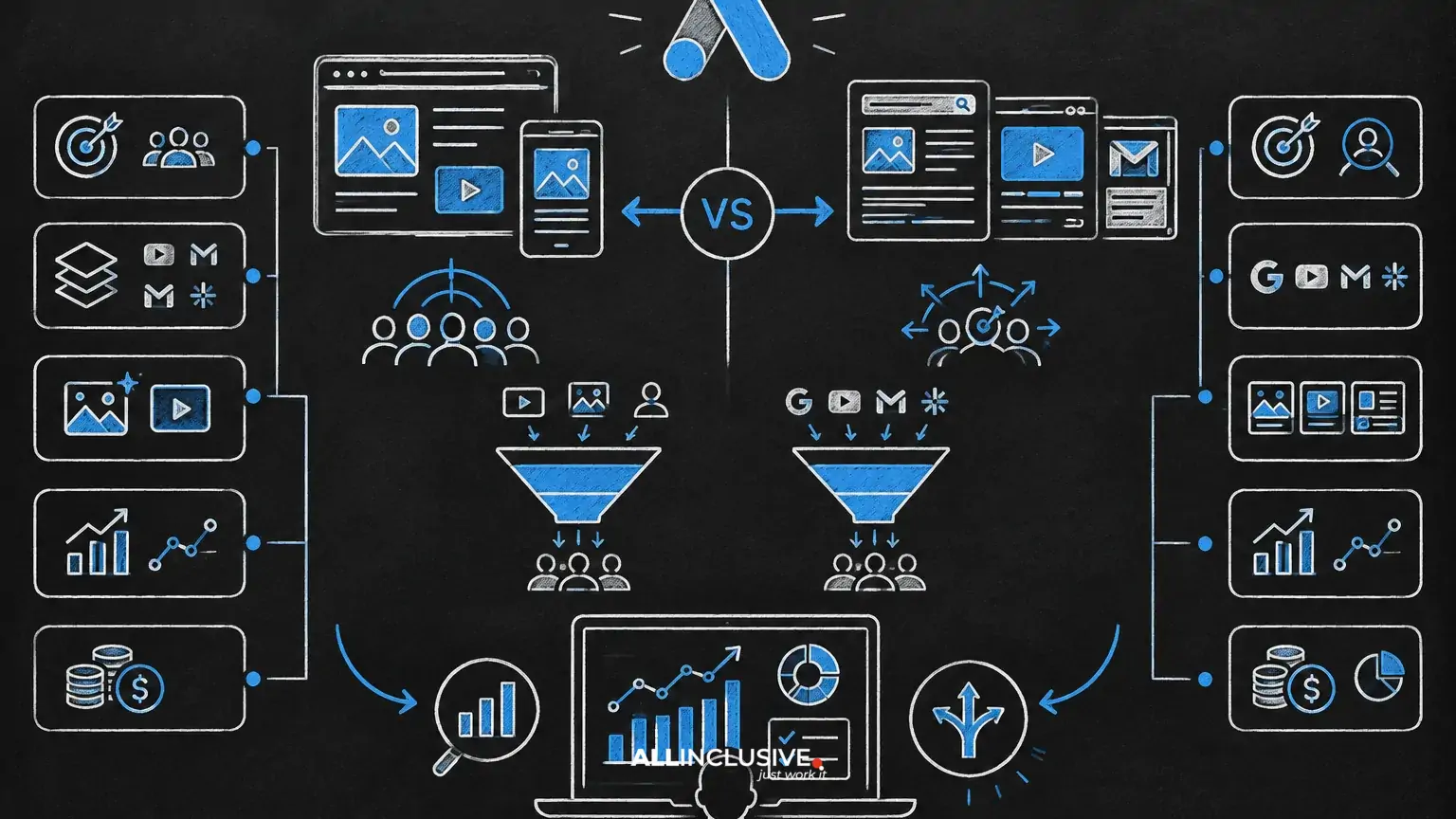
When comparing demand gen vs performance max, the most important question is not which campaign type is better. It is which job you need the campaign to perform.
Demand Gen is generally suited to creating consideration and re-engaging audiences across visually led Google surfaces. Performance Max is designed to pursue conversion goals across multiple Google inventory types using automation, audience signals, creative assets and conversion data. The two can support the same business objective, but they approach it from different angles.
For most advertisers, the decision comes down to five factors: existing demand, audience intent, creative readiness, conversion quality and the amount of control required. Demand Gen is often the better fit when you need to influence or re-engage an audience before it is ready to convert. Performance Max is often the better fit when you have reliable conversion tracking, sufficient asset coverage and a clear goal for automated acquisition.
Demand Gen vs. Performance Max at a glance
- Primary role: Demand Gen supports discovery, consideration and audience-led re-engagement; Performance Max supports conversion-focused reach across eligible Google inventory.
- Typical user state: Demand Gen can reach people who are interested but not actively searching; Performance Max can capture users at multiple stages, including those closer to conversion.
- Creative emphasis: Demand Gen relies heavily on visual, social-style creative and audience sequencing; Performance Max requires a broader asset set that can adapt across placements.
- Control profile: Demand Gen generally offers a more audience- and creative-led planning framework; Performance Max depends more heavily on automated placement and bidding decisions.
- Best starting point: Demand Gen for a defined audience and a persuasive creative proposition; Performance Max for a measurable conversion objective and adequate first-party or conversion signals.
These are strategic distinctions, not guarantees. Actual delivery depends on account history, targeting, creative quality, conversion volume, eligibility, competition and settings.
What Demand Gen is designed to do
Demand Gen campaigns are built around visual discovery and audience engagement. They can be useful when the buying journey requires education, comparison or repeated exposure rather than a single response to an explicit search query.
Common use cases include:
- Introducing a category, product or service to a qualified audience.
- Supporting a product launch or new-market entry.
- Re-engaging site visitors, customer lists or other consented audiences.
- Creating demand for a high-consideration B2B offer.
- Testing different creative angles before scaling conversion activity.
Demand Gen should not be treated as a simple replacement for non-brand Search. Search campaigns respond to expressed queries. Demand Gen typically works earlier in the decision process, where the advertiser must earn attention and make the next step feel relevant.
Demand Gen strengths
- Audience-led planning: You can organize campaigns around prospect groups, customer stages or remarketing objectives.
- Visual storytelling: The format is appropriate for demonstrations, comparisons, customer problems and product narratives that need more than a text ad.
- Consideration support: It can give prospective buyers useful context before they search for a solution or visit a product page.
- Creative testing: Different hooks, proof points, formats and calls to action can be evaluated against the same audience hypothesis.
Demand Gen limitations
Demand Gen can generate valuable assisted activity without producing immediate conversions at the same rate as lower-funnel campaigns. It also places a high burden on creative quality. Weak opening frames, generic messaging, unclear offers or poor landing-page continuity can make an audience-led campaign look inefficient even when the underlying strategy is sound.
Measurement therefore needs to reflect the intended role. A demand-creation campaign should not be judged only by last-click conversions during a short window. That does not mean accepting vague performance; it means defining the primary action, conversion quality and evaluation period before launch.
What Performance Max is designed to do
Performance Max is a conversion-oriented campaign approach that can use multiple Google inventory types within one campaign framework. It uses automation to make decisions about bids, placements, audiences and combinations of supplied assets in pursuit of the selected business goal.
Performance Max can be appropriate when:
- The account has a clearly defined conversion objective.
- Conversion tracking is accurate and tied to meaningful business outcomes.
- The advertiser can provide enough text, image and video assets for the relevant formats.
- There is sufficient data, or a realistic plan to build data, for automated optimization.
- The business wants to expand beyond manually managed keyword and placement structures.
Its broad reach does not make it a substitute for strategy. Automation can optimize toward the signals it receives, but it cannot repair incorrect conversion definitions, weak economics, poor landing pages or a proposition that does not distinguish the offer.
Performance Max strengths
- Cross-inventory reach: It can pursue the selected objective across eligible Google surfaces rather than relying on one channel.
- Automation: Bidding and delivery decisions can respond to signals that are difficult to manage manually at scale.
- Conversion focus: The campaign structure is useful when the main question is how to generate more qualified actions within a defined goal.
- Expansion potential: It can help identify additional demand beyond the terms, audiences or placements an advertiser has already planned.
Performance Max limitations
Performance Max can provide less granular control over where every impression appears and how budget is distributed among inventory types. Reporting and diagnosis also require discipline: a campaign may show strong aggregate performance while concealing differences in audience quality, creative contribution or marginal efficiency.
Do not launch it simply because it appears to reduce campaign-management complexity. Before using it, verify the conversion hierarchy, exclude low-value actions from primary optimization where appropriate, and establish how lead quality or revenue will be reconciled with platform reporting.
Channel and intent differences
The clearest distinction in demand gen vs performance max is the relationship between the user and the advertiser.
Demand Gen often begins with a planned audience or interest hypothesis. The user may not have expressed a precise need in a search query. The campaign must use relevance, creative and context to earn attention.
Performance Max is goal-led rather than tied to one intent signal. It can find users across different stages and surfaces, using the campaign’s objective and available data to guide delivery. That makes it more flexible, but also makes the quality of the objective especially important.
Consider a B2B compliance software company:
- A Demand Gen campaign could introduce a new compliance workflow to operations leaders with a short product demonstration and an educational guide.
- A Performance Max campaign could pursue qualified demo submissions or offline-qualified opportunities, provided those actions are tracked and suitable for optimization.
- A Search campaign could capture users actively looking for compliance software, implementation help or alternatives.
These campaigns may share a proposition, but they should not share identical expectations. The first creates or develops interest, the second seeks scalable conversion activity, and Search captures explicit demand.
Creative requirements are different
Creative is central to both campaign types, but the creative problem is not identical.
Demand Gen creative
Demand Gen creative needs to stop the scroll or interrupt passive consumption with a clear reason to care. Strong concepts usually make the audience, problem and benefit apparent quickly. Useful testing variables include:
- Problem-led versus outcome-led openings.
- Product demonstration versus expert explanation.
- Customer proof versus category education.
- Short-form video versus static or multi-asset storytelling.
- Direct response versus lower-friction content offer.
Landing-page continuity matters. If an ad promises a diagnostic, comparison or specific business outcome, the destination should deliver that experience rather than redirecting users to a generic homepage.
Performance Max creative
Performance Max requires an asset system that can work across different contexts and formats. Prepare concise headlines, longer descriptions, product or service imagery, video where appropriate, logos and clear calls to action. Avoid treating asset quantity as a substitute for message quality.
Organize assets around distinct themes or audience needs, and ensure that every combination remains accurate when viewed independently. Claims should be supportable, and the landing page should reflect the same offer and qualification requirements.
How to choose between them
Use the following decision criteria before allocating budget.
Choose Demand Gen when:
- You need to build consideration for a complex or unfamiliar offer.
- You have a defined audience and a clear creative hypothesis.
- Visual demonstration or education is important to the sale.
- You want to re-engage known users with a tailored message.
- You can evaluate engagement and downstream quality over an appropriate time horizon.
Choose Performance Max when:
- Your primary objective is a measurable conversion or revenue outcome.
- Conversion tracking is reliable and meaningful.
- You have enough creative coverage for multiple inventory contexts.
- You are prepared to accept greater automation in exchange for reach and optimization.
- You can monitor lead quality, margin or offline outcomes rather than relying only on reported volume.
Use both when their jobs are distinct
Running both can make sense when Demand Gen develops or re-engages audiences and Performance Max pursues conversion outcomes. Separate the roles in the account plan. Define which campaign owns prospecting, which owns remarketing, what each campaign is allowed to optimize toward and how overlap will be assessed.
Do not assume that more campaigns automatically create incremental demand. Review marginal conversions, audience overlap, assisted activity and lead quality. If both campaigns are reaching similar users with similar creative and the same optimization goal, the added complexity may not produce a clear benefit.
Measurement and testing framework
Start with business outcomes, then map platform actions to them. For lead generation, distinguish a form completion from a qualified opportunity, accepted lead or revenue event. For ecommerce, separate transactions from profitable transactions where the data allows.
- Audit conversion tracking. Confirm that primary actions are intentional, deduplicated and connected to the actual business objective.
- Define the campaign role. Document whether the campaign is creating consideration, re-engaging an audience or generating direct conversions.
- Set a realistic evaluation window. Account for sales cycles, conversion lag and the time needed for creative learning.
- Use controlled tests where possible. Change one major variable at a time, such as campaign type, audience strategy, creative concept or landing page.
- Evaluate marginal value. Look beyond blended account averages to incremental conversions, qualified pipeline, revenue and cost at the margin.
Before increasing spend, an account-level review can expose tracking, query, budget and landing-page issues. See our Google Ads audit checklist for a practical set of checks.
Budget allocation and operating sequence
Budget should follow the role of each campaign, not the novelty of the format. Protect efficient, high-intent activity where it produces qualified outcomes, then allocate test budget to Demand Gen or Performance Max according to the growth constraint you are trying to solve.
A sensible sequence may be:
- Establish accurate conversion measurement and business-quality feedback.
- Capture existing demand through relevant Search activity and strong landing pages.
- Test Demand Gen when awareness, consideration or re-engagement is the constraint.
- Test Performance Max when the objective is clear and the account can support automation.
- Compare incremental business value, not only platform-attributed conversions.
For broader planning across acquisition channels, see our paid media strategy guide. For the relationship between explicit query capture and audience-led activity, our guide to non-brand Search campaigns provides useful context.
Demand Gen vs. Performance Max: Decision Summary
Demand Gen and Performance Max are not interchangeable labels for more reach. Demand Gen is usually the stronger strategic fit when the challenge is attention, education, consideration or audience re-engagement. Performance Max is usually the stronger fit when the challenge is conversion-focused expansion and the account has reliable data, suitable assets and a willingness to use automation.
Choose the campaign that matches the user’s decision stage, the evidence available to optimize and the level of control your business requires. Then measure the result against qualified business outcomes rather than campaign type alone.
For implementation planning, place the work within your broader paid search strategy, where campaign roles, budget, tracking and landing-page readiness can be evaluated together.