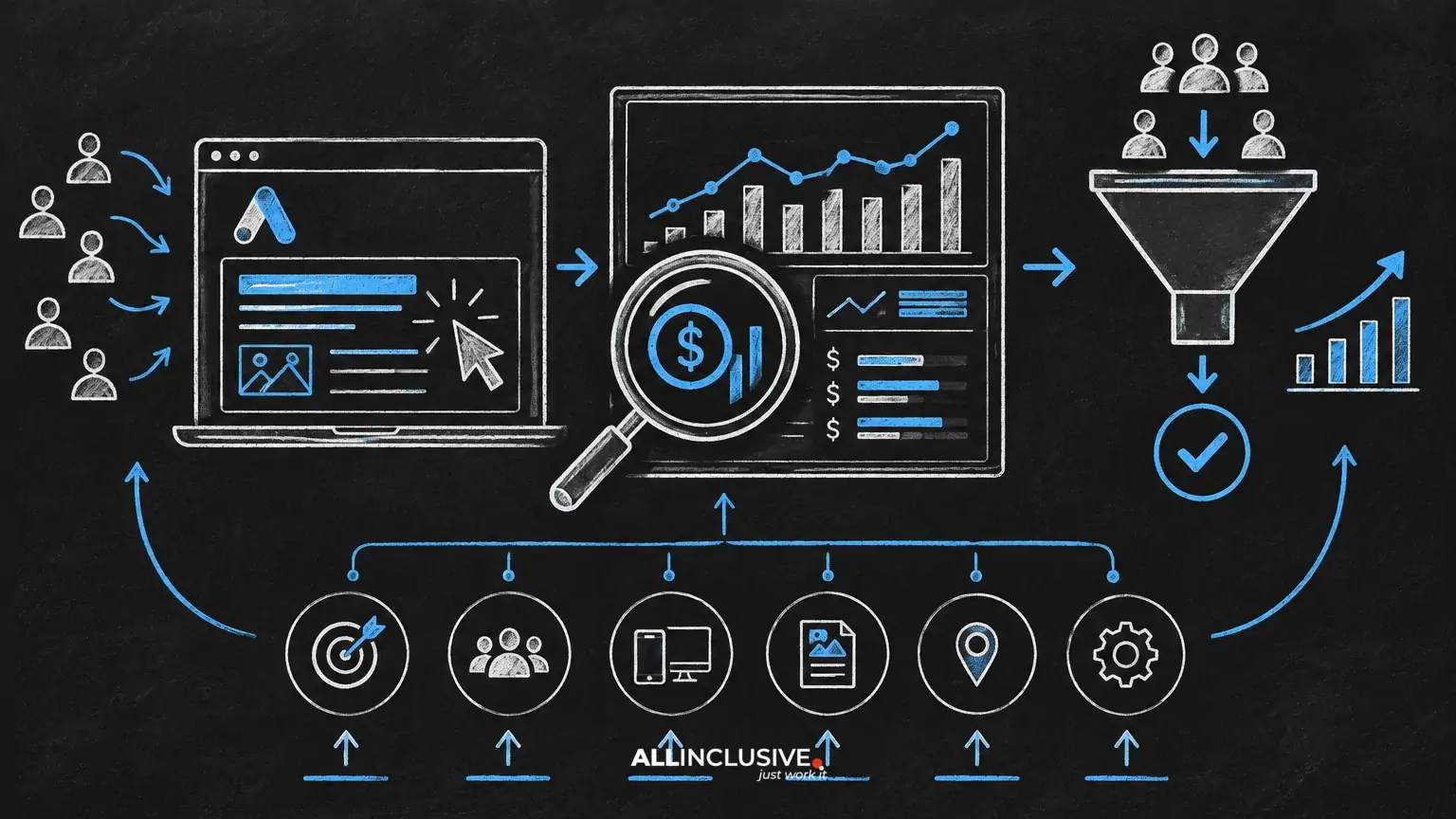
Google Ads CPC—cost per click—is the amount an advertiser pays when someone clicks an ad. It is a useful efficiency metric, but it is not a budget strategy by itself. A low CPC can still produce expensive customers if traffic is poorly qualified; a higher CPC can be commercially sensible when it generates valuable conversions.
The practical question is therefore not “How do we get the lowest CPC?” It is “What CPC can this campaign afford while producing the right business outcome?” That answer depends on auction competition, query and ad relevance, landing-page experience, bidding approach, conversion measurement and the value of each conversion.
What determines Google Ads CPC?
Google Ads uses an auction each time an eligible search occurs. The exact mechanics and available controls can change, so treat the following as strategic drivers rather than a fixed formula. In general, your actual CPC is influenced by the competitiveness of the auction, the quality and relevance of your ad experience, your bid or bid constraints, and the context of the search.
1. Auction competition
More advertisers competing for the same query or audience usually creates greater pressure on bids. Competition often varies by:
- Keyword and query intent, with commercial searches commonly attracting more bidders.
- Industry economics, including customer value and expected margins.
- Location, device, seasonality and time of day.
- Brand versus non-brand demand.
- The number and quality of eligible ads in a particular auction.
Competition is not necessarily a reason to avoid a keyword. If the search has strong purchase or lead intent, a higher CPC may still be justified. Compare CPC with conversion rate, conversion value and cost per acquisition rather than evaluating it in isolation.
2. Ad and landing-page relevance
Google evaluates the expected usefulness of the ad experience. Relevance includes the relationship between the search, keyword or targeting signal, ad content and landing page. Closely aligned messaging can improve the likelihood that the click is useful and may support more efficient participation in the auction.
Relevance is not created by repeating a keyword mechanically. It comes from answering the user’s specific problem, setting accurate expectations and making the next step clear. For practical guidance, see our article on Google Ads Quality Score.
3. Bid strategy and constraints
Different bidding approaches optimize for different outcomes. Manual controls can offer direct bid management, while automated strategies use signals and conversion data to pursue goals such as conversions or conversion value. The strategy affects how aggressively the account competes and which auctions it prioritizes.
A bid strategy does not eliminate the need for sound inputs. If conversion tracking is incomplete, values are unreliable or the campaign has insufficient relevant data, automation may optimize toward an outcome that does not reflect business quality. Review the differences between approaches in Google Ads bidding strategies.
4. Auction context
The same keyword can produce different CPCs depending on the context of the search. Location, device, language, timing, competition and the user’s query all influence eligibility and performance. This is why account-level averages can hide meaningful differences between segments.
Average CPC is not the same as maximum CPC
Advertisers often confuse three related concepts:
- Average CPC: total click cost divided by the number of clicks over a selected period.
- Maximum CPC or bid: the amount an advertiser is willing to use as a bidding input, depending on the campaign and strategy.
- Target CPA or target ROAS: an efficiency goal used by certain automated bidding approaches, not a direct price paid for each click.
Your average CPC is a reporting result, not necessarily a manually selected price. It should be interpreted alongside impression share, conversion rate, cost per conversion and conversion value. A rising CPC may be acceptable if conversion quality and value rise faster. Conversely, a stable CPC may conceal declining performance if the campaign is attracting less qualified clicks.
How to calculate the CPC your campaign can afford
Start with economics, not a generic industry benchmark. A simple planning model is:
Break-even CPC = allowable cost per conversion × conversion rate
For example, if the business can afford $120 per qualified lead and the campaign converts clicks into qualified leads at 4%, the implied break-even CPC is $4.80. This is a planning estimate, not a guarantee of auction cost or profitability. It also depends on whether the conversion rate represents a meaningful business outcome rather than a low-value action such as an unqualified form submission.
For ecommerce, you can use expected contribution margin or allowable acquisition cost instead of lead value. If the campaign has multiple conversion types, assign values that reflect their relative business importance and confirm that reported conversions match the events used for optimization.
How to diagnose an expensive Google Ads CPC
High CPC is a symptom, not a diagnosis. Use a structured review before changing bids.
Check the search intent
Separate high-intent searches from research, informational or irrelevant queries. A campaign may have a reasonable overall CPC while wasting spend on broad queries with weak commercial intent. Review the search terms report, group queries by intent and add exclusions where appropriate. Our guide to Google Ads search terms covers a practical process for this analysis.
Compare CPC by segment
Break performance down by campaign, ad group, keyword theme, device, location, brand status and landing page. Look for combinations with high CPC and weak conversion quality. Also identify segments with higher CPC but stronger downstream value; cutting these automatically can reduce growth.
Review the conversion definition
Confirm that primary conversions represent actions the business can act on. For lead generation, a form completion may be less useful than a qualified opportunity. For nonprofits, a donation, volunteer registration or email signup may each have different value. The relevant question is whether the conversion being optimized corresponds to the organization’s actual objective.
Inspect relevance and user experience
Check message match between query, ad and landing page. Look for slow or confusing pages, unclear calls to action, unnecessary form friction and content that does not answer the user’s question. CPC reduction is rarely durable when the post-click experience remains weak.
Ways to control Google Ads CPC without damaging performance
1. Improve query and ad-group structure
Organize campaigns around meaningful intent and commercial differences. Tighter structure can make it easier to write relevant ads, select appropriate landing pages and identify wasted spend. Avoid creating so many small groups that the account becomes difficult to manage or each segment lacks useful data.
2. Prioritize negative-keyword management
Regularly review search terms for irrelevant research, employment, support, educational or low-value queries. Build shared exclusion lists only when the rule genuinely applies across campaigns. Negative keywords should protect intent, not remove legitimate variations simply because they are unfamiliar.
3. Improve the landing-page path
Better post-click relevance can improve conversion efficiency, which raises the CPC the campaign can economically support. Align the headline and offer with the ad, make the next action obvious, reduce avoidable friction and ensure the page works for the dominant device mix. More landing-page guidance is available in Google Ads landing pages.
4. Match bidding to data quality
Use a bidding approach that fits the volume, reliability and value of your conversion data. Manual controls may be useful when measurement is immature or traffic must be tightly managed. Automated approaches may be appropriate when the account has dependable signals and a clearly defined objective. Avoid switching strategies repeatedly before there is enough time and comparable data to evaluate a change.
5. Separate brand and non-brand analysis
Brand searches often have different intent, competition and conversion behavior from non-brand searches. Combining them can make average CPC and return metrics look healthier than the acquisition activity really is. Report them separately so that budget and performance decisions reflect their different roles.
6. Use budget and targeting controls thoughtfully
If spend is constrained, prioritize campaigns and query themes using expected business value rather than CPC alone. Narrowing locations or schedules may reduce waste, but only when the excluded segments are consistently less valuable after accounting for conversion quality. A low-volume campaign can have a higher observed CPC simply because it contains fewer auctions; assess trends over an appropriate period.
Google Ads CPC for nonprofits
Nonprofit advertisers should evaluate CPC against the action being funded, not only against traffic volume. A click that leads to a donation, recurring donor, volunteer application or high-value email subscriber may justify a different cost than a general website visit.
If an organization uses a grant or restricted advertising program, review the current eligibility, policy and account requirements directly in the relevant official documentation. Do not assume that a program’s stated limits or permitted features apply universally, and do not treat free advertising capacity as evidence that every click is valuable. Strong conversion definitions, clear landing pages and disciplined search-term review remain essential.
A practical CPC management workflow
- Define the business outcome. Choose the conversion or value event that should guide decisions.
- Set an allowable acquisition cost. Use margin, lead value, donor value or another defensible commercial constraint.
- Estimate affordable CPC. Multiply allowable acquisition cost by a realistic conversion rate.
- Segment the account. Separate brand, non-brand, intent themes, locations and other material differences.
- Audit search terms and tracking. Remove irrelevant demand and validate that reported conversions are trustworthy.
- Improve relevance. Align query, ad and landing page before making aggressive bid cuts.
- Test one major change at a time. Record the date, rationale, affected segment and success criteria.
- Evaluate business quality. Review qualified leads, revenue, margin or donor value—not CPC alone.
What good CPC management looks like
Effective CPC management balances three questions: Are we buying the right searches? Are those clicks turning into valuable outcomes? Can the business afford the resulting acquisition cost? The best answer is not always the lowest CPC. It is a stable, measurable relationship between auction cost and business value.
For a broader view of channel planning, measurement and optimization, explore our paid search pillar and the wider paid media hub. Use CPC as an early diagnostic, then let qualified conversion data and unit economics determine where to scale, refine or stop spending.