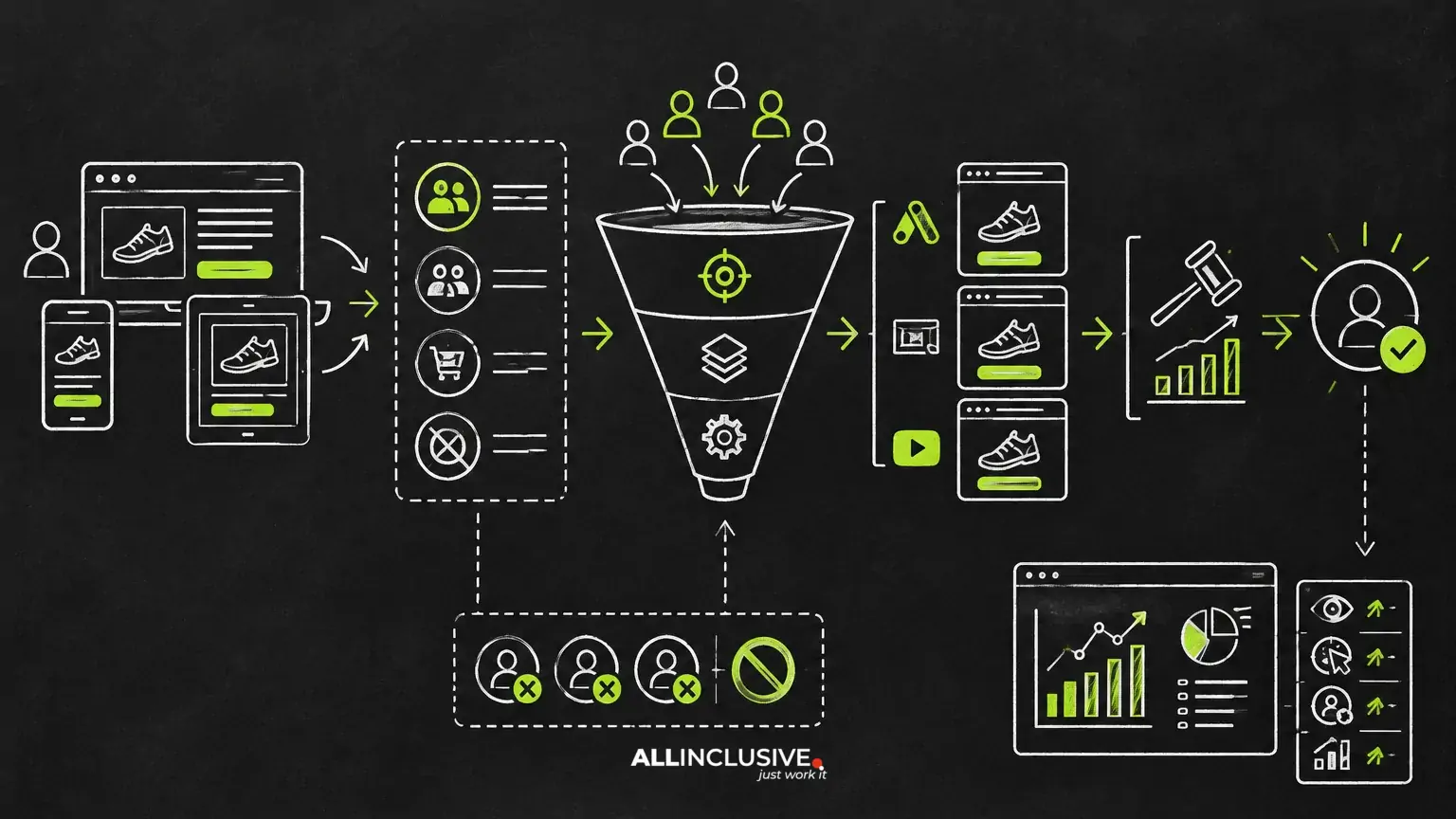
A strong ppc remarketing strategy does more than show another ad to everyone who visited your website. It separates audiences by intent, gives each group a relevant next step, controls frequency and evaluates whether paid exposure is contributing to qualified business outcomes.
For most advertisers, the strategic work comes before campaign settings. Decide which behaviors indicate meaningful intent, how long that intent remains useful, what message should follow each action and when a person should leave the remarketing pool. Then translate those decisions into Google Ads audiences, campaign structure, creative and bidding rules.
This guide explains a practical framework for planning and implementing that process without treating remarketing as a standalone shortcut around weak offers, poor tracking or unclear conversion goals.
What a PPC remarketing strategy should accomplish
Remarketing is most useful when it addresses a specific gap in the buying journey. A visitor may have researched a category, viewed a product, started a form, downloaded an asset or reached a pricing page without converting. Each action can support a different follow-up plan.
A sound strategy should help you:
- Prioritize audiences by demonstrated intent rather than recency alone.
- Match ad messaging to the action a prospect has already taken.
- Use landing pages and offers that move the prospect toward the next decision.
- Exclude people who have converted or no longer fit the campaign objective.
- Measure incremental business value instead of relying only on last-click conversions.
Remarketing cannot repair a confusing landing page or an unattractive offer. It can, however, create a more deliberate sequence for prospects who already know something about your business.
Start with audience intent, not campaign settings
Build audience definitions from user behavior and business value. A simple hierarchy is often more useful than a large collection of narrowly divided lists.
1. Low-intent visitors
These users may have visited a blog article, an informational page or a broad category page. Their visit provides context, but not necessarily buying intent. Use educational content, problem framing or comparative resources rather than an immediate hard-sell message.
2. Consideration audiences
These users viewed product or service pages, reviewed capabilities, engaged with a case study or returned to the site. They may respond to proof, implementation details, product comparisons, FAQs or a consultation offer.
3. High-intent audiences
Pricing-page visitors, demo-page visitors, checkout starters and users who began a lead form generally deserve a more direct follow-up. The message should reduce friction: clarify fit, explain the next step, address objections or provide a reason to complete the action.
4. Existing customers and qualified leads
Customers may require retention, cross-sell or expansion messaging, while open opportunities may belong in a separate account-based or sales-support program. Do not assume that all known users should receive the same remarketing treatment as anonymous prospects.
Audience definitions should reflect your sales cycle. A short consideration cycle may justify tighter windows and more direct sequencing. A complex B2B purchase may require longer windows, but longer membership does not automatically mean the same bid or message should continue indefinitely.
Build lists around actions and time windows
Useful lists typically combine an action with a recency window. For example, “pricing page visitors in the last 14 days” is more actionable than “all website visitors.” The right duration depends on buying behavior, product type, sales process and the expected time between research and conversion.
Consider creating separate audiences for:
- All relevant visitors, used as a broad baseline.
- Key page viewers, such as product, service, pricing or comparison pages.
- Engaged visitors who viewed multiple pages or spent meaningful time on the site, where measurement supports that definition.
- Lead-form starters who did not submit.
- Checkout or cart abandoners for ecommerce.
- Content downloaders or event registrants who have not reached the next funnel stage.
- Converted users, maintained primarily for exclusion or post-conversion campaigns.
Use overlapping lists deliberately. If a user qualifies for several audiences, campaign priority and exclusions should determine which message they see. Otherwise, the account can bid against itself or deliver a generic ad when a more relevant stage-specific message exists.
Choose a campaign structure that reflects the decision journey
There is no single correct account structure. The goal is to create enough separation for different messages, budgets and bids without fragmenting data into too many small campaigns.
Option one: one campaign with audience segmentation
This can work when budgets are limited, creative is shared and the primary objective is efficient reach across a relatively simple funnel. Use audience segments, exclusions and reporting dimensions to identify performance differences.
Option two: separate campaigns by intent tier
Separate low-, mid- and high-intent audiences when they require different budgets, creative, landing pages or bidding priorities. This structure offers stronger control but demands sufficient volume and disciplined exclusion logic.
Option three: separate campaigns by business objective
For organizations with distinct objectives, it may be more practical to separate lead completion, ecommerce revenue, customer expansion and brand protection programs. Each objective can then use its own conversion definition and evaluation method.
Use the fewest campaigns that preserve meaningful control. Splitting by every URL, device, audience duration and message theme often creates thin data and complicates diagnosis.
Map creative to the next decision
Remarketing creative should acknowledge what the user has already done without making assumptions that feel intrusive. The ad should answer: why return now, and what will happen next?
Examples include:
- Product-page visitor: highlight differentiators, proof points, implementation information or a relevant use case.
- Pricing-page visitor: clarify packaging, buying process, support or qualification requirements.
- Form starter: reduce friction by explaining the form, response process or information required.
- Content downloader: offer a related assessment, webinar, product resource or sales conversation.
- Cart abandoner: remove uncertainty around delivery, returns, payment or product fit rather than relying on urgency alone.
Build a message sequence when the buying cycle supports it. An initial ad can reinforce relevance, a later ad can address an objection and a final ad can present a clear conversion path. Set an exit condition so the sequence does not continue after conversion or after the audience has become stale.
For feed-based product programs, creative and product data need to work together. The dynamic remarketing guide covers how feeds, audiences and creative interact.
Set bidding priorities by expected value
Bidding should reflect both intent and conversion value. A recent pricing-page visitor may be more valuable than a broad visitor, but that does not mean every high-intent audience should receive an aggressive bid regardless of economics.
Before choosing a bidding approach, clarify:
- Which conversion action represents business value?
- Are leads qualified consistently after submission?
- Can revenue or pipeline value be passed back to the advertising platform?
- Is there enough reliable conversion data to support automated optimization?
- What is the acceptable cost per lead, acquisition or qualified opportunity?
When measurement is immature, begin with a controlled approach and validate tracking before making major bid changes. When conversion quality and volume are dependable, automated bidding may help optimize toward the selected goal, but it still requires appropriate conversion definitions, exclusions and review periods.
Do not use bids to compensate for weak segmentation. A high bid on an audience with an irrelevant message can increase waste rather than improve performance.
Control reach with exclusions and frequency discipline
Exclusions are a core part of remarketing architecture. At minimum, review whether to exclude:
- Recent converters from prospecting campaigns.
- Unqualified or disallowed users, where business and privacy requirements call for it.
- Employees, agencies or internal traffic if it contaminates measurement.
- Audiences already assigned to a higher-priority sequence.
- Users who have exceeded a reasonable engagement or recency window.
Frequency controls are equally important. Excessive exposure can waste budget, reduce user experience and make performance appear stronger through repeated impressions without meaningful incremental action. Review reach, frequency, impression distribution and conversion behavior by audience and placement where reporting allows.
Use a suppression framework rather than adding exclusions reactively. Document who is eligible, who is excluded, which campaign has priority and when the rule should be reviewed.
Measurement: evaluate more than last-click conversions
Remarketing often reaches users who were already closer to conversion, so last-click reporting can overstate its incremental contribution. Treat platform-attributed conversions as one input, not the entire answer.
A practical measurement framework includes:
- Delivery metrics: eligible audience size, reach, frequency, impressions and spend.
- Engagement metrics: clicks, landing-page views and engaged sessions, interpreted in context.
- Conversion metrics: completed forms, purchases, qualified leads, opportunities or revenue.
- Efficiency metrics: cost per meaningful conversion, return on ad spend or pipeline efficiency where data supports the calculation.
- Quality checks: lead acceptance, sales progression, repeat purchase or downstream revenue.
Compare audiences using consistent conversion definitions and time periods. Where feasible, use holdouts, geo-based tests, platform experiments or other controlled methods to estimate incremental impact. If controlled testing is unavailable, state the limitation clearly and avoid presenting attributed conversions as proof of causality.
Implementation checklist for Google Ads remarketing
- Define the business objective. Choose one primary outcome for each campaign, such as qualified leads, completed purchases or expansion revenue.
- Audit measurement. Confirm that key events fire correctly, duplicate conversions are controlled and post-lead quality can be reviewed.
- Create behavioral audiences. Start with meaningful pages and actions, then apply recency windows that reflect the buying cycle.
- Define priority and exclusions. Decide which audience wins when users qualify for more than one list.
- Map each audience to a message. Specify the objection, proof point or next action the ad should address.
- Choose the landing experience. Avoid sending every audience to the homepage when a more relevant destination exists.
- Set budget and bidding rules. Prioritize audiences according to expected value and data confidence.
- Launch with a review plan. Establish checks for spend, frequency, audience size, conversion quality and search-term or placement relevance where applicable.
- Refresh deliberately. Update creative, offers and exclusions when performance or buyer behavior changes.
Common PPC remarketing mistakes
Retargeting everyone with one message
Broad visitor pools are easy to build but often difficult to make relevant. Use broad lists as a baseline, not as the only audience definition.
Keeping converted users in prospecting campaigns
Failure to suppress converters can waste spend and create awkward messaging. Treat conversion exclusions as part of launch readiness.
Optimizing for cheap clicks
Low-cost traffic does not necessarily indicate useful remarketing. Review downstream actions and lead quality before scaling.
Over-segmenting the account
Excessive fragmentation can make results unstable and slow learning. Combine audiences when their value, message and budget logic are materially similar.
Ignoring privacy and consent requirements
Audience collection and activation must align with applicable laws, consent choices, company policies and platform requirements. When requirements vary by market or data type, confirm the implementation with qualified legal and privacy stakeholders.
How this strategy fits into a broader remarketing program
Google Ads is one part of a broader paid-media system. Search, display, video, shopping, paid social, CRM activation and sales follow-up may all influence the same buyer. Coordinate audience definitions and conversion stages where possible so channels do not compete for the same user without a clear reason.
For a wider planning framework, see the remarketing strategy hub. If you are building the wider acquisition and measurement system around these campaigns, the paid media hub provides additional context.
Audience-specific use cases may require additional planning. For example, remarketing for healthcare requires especially careful treatment of privacy, audience eligibility and measurement.
Final decision framework
A practical PPC remarketing strategy can be summarized in five decisions: who should be eligible, what action qualifies as intent, what message follows that action, how long the audience remains relevant and what outcome determines success.
Start with a small number of meaningful audience tiers. Build exclusions before launch, connect each tier to a clear next step and validate conversion quality before increasing bids or budget. As the account gathers reliable evidence, test audience windows, sequencing, creative and bidding assumptions rather than changing everything at once.
The strongest remarketing programs are not the ones with the most lists. They are the ones that make the next interaction more relevant than the last and can explain, with appropriate measurement discipline, why that interaction deserves continued investment.