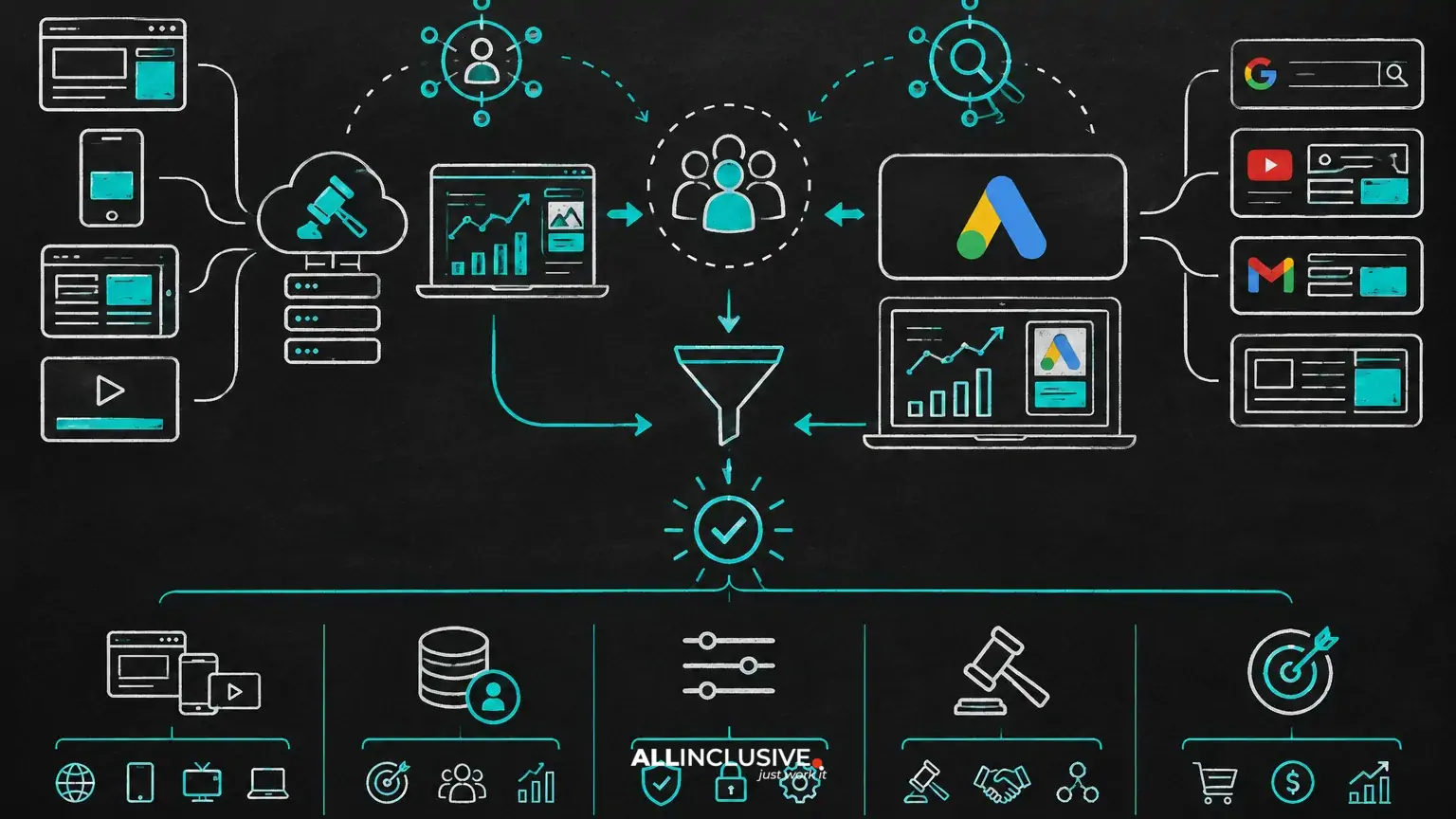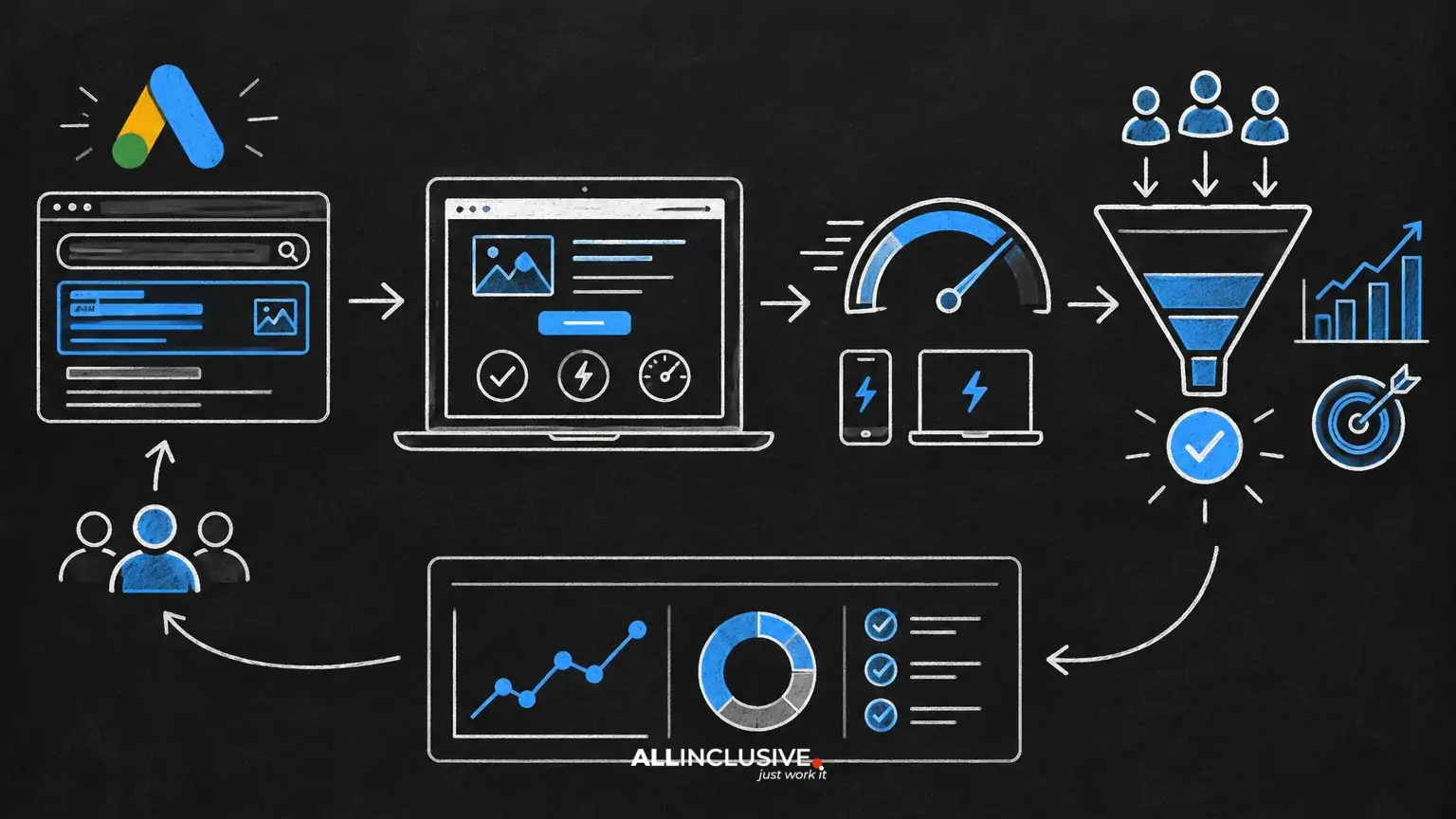
A Google Ads landing page is the page a user reaches after clicking an ad. Its job is not simply to look polished. It must continue the promise made by the search query and ad, help the visitor decide quickly, and make the next action easy to complete.
The strongest pages usually align five elements: search intent, ad-to-page message match, page speed, proof and conversion design. Improving those elements can make paid search traffic more productive without relying only on higher bids or more budget.
What makes a Google Ads landing page effective?
An effective landing page answers three questions almost immediately:
- Am I in the right place? The page reflects the query and ad that brought the visitor there.
- Is this relevant to my situation? The offer, audience and outcome are specific enough to feel credible.
- What should I do next? The primary action is clear, accessible and proportionate to the visitor’s readiness.
This is the central principle of paid-search landing-page design: reduce the distance between the user’s intent and the action you want them to take. A broad campaign may need several dedicated pages rather than one generic destination.
Start with intent, not page design
Before writing copy or choosing a layout, group the traffic by the problem behind the search. Similar-looking keywords can represent very different levels of urgency and commercial intent.
Common intent patterns
- Research intent: The visitor is learning about a category, process or problem. Useful destinations often lead with education, definitions, comparisons or a low-commitment resource.
- Solution intent: The visitor is evaluating approaches. The page should explain fit, methodology, differentiators and likely next steps.
- Provider intent: The visitor is looking for a company or service. The page should make the offer, evidence and contact path immediately clear.
- Action intent: The visitor is ready to request, book, buy or apply. The page should minimize friction and place the relevant conversion path prominently.
For example, a search for “Google Ads for non-profits” may require a different page from a search for “Google Ads management agency.” The first may need eligibility context, practical constraints and an explanation of how the service applies to nonprofit objectives. The second may be closer to a provider-selection decision.
Use the search-term report, campaign structure and ad groups to identify these differences. Do not assume that every keyword containing the same product term deserves the same page.
Build message match from query to conversion
Message match means that the page confirms the visitor made a sensible click. It does not require repeating the keyword mechanically. It requires continuity of meaning.
A useful message-match chain looks like this:
- Query: What problem or outcome did the user express?
- Ad: What promise, qualification or next step did the ad communicate?
- Landing page: Where does the page substantiate that promise?
- Conversion: Does the form, call, purchase or booking represent the next logical step?
Use the headline to confirm relevance
The headline should identify the offer or problem in language that is natural for the audience. If the ad promotes nonprofit Google Ads support, a page that opens with a vague statement about “digital growth” creates unnecessary uncertainty. A more specific headline can establish relevance while leaving room for supporting detail below.
Repeat the important promise, then prove it
Repetition alone is not persuasion. If an ad claims a faster setup, specialized expertise or a particular deliverable, the page should explain what that means and provide appropriate evidence. Evidence may include process detail, examples, qualifications, testimonials, case material or transparent scope. Use only substantiated proof.
Keep the offer consistent
Do not send users to a page that changes the offer, pricing context or call to action without explanation. A “book a consultation” ad should not land on a general homepage where the visitor must search for contact information. Likewise, an ad offering a guide should lead to the guide’s relevant download experience, not a generic service page.
For related ad-writing principles, see our guide to Google Ads ad copy.
Choose the right landing-page architecture
There is no single best layout. The appropriate structure depends on the offer, audience knowledge and conversion risk.
Dedicated campaign page
A dedicated page is usually appropriate when the campaign targets a distinct audience, service or outcome. It gives you control over the headline, proof, objections and call to action. This is often preferable to a homepage when the traffic has a narrow intent.
Relevant service or product page
An existing page can work when it already matches the ad and query closely. Reusing a strong page may be more efficient than creating another destination, provided the page has a clear conversion path and does not force users through irrelevant navigation.
Lead-generation page
For consultation, quote or contact campaigns, a focused lead page can reduce distractions. The form should request information needed for qualification or follow-up—not every detail the business might eventually want.
Content or resource page
For early-stage searches, a guide, assessment or educational page may be more appropriate than a sales-heavy destination. The next step should still be visible, but the page should respect the visitor’s current readiness.
Design the page around one primary conversion
Each page can support secondary actions, but one action should clearly dominate. Typical primary conversions include a form submission, phone call, booking, purchase, application or resource download.
Make the primary action specific. “Get in touch” may be acceptable, but “Request a paid-search account review” communicates more about the outcome and helps qualify expectations. The button label, surrounding copy and confirmation experience should all describe the same action.
Keep forms proportionate
Form length should reflect the value of the offer and the amount of qualification required. A high-consideration service may justify more fields than a newsletter or checklist. If the form is long, explain why the information is requested and consider whether every field is necessary at the first interaction.
Address objections before the action
Common objections include cost, time, fit, implementation difficulty, internal resources and uncertainty about what happens after submission. Use concise sections, FAQs or process explanations to address the objections most relevant to the campaign. Avoid adding unrelated copy simply to make the page longer.
Treat speed as part of conversion design
A page that loads slowly or becomes unstable can lose attention before the visitor sees the offer. Speed is therefore both a user-experience concern and a paid-media efficiency concern. The exact impact varies by device, audience, page type and connection quality, so evaluate the experience with real diagnostics rather than relying on general claims.
Practical speed checks
- Test the page on common mobile devices and realistic network conditions.
- Compress and properly size hero images and other large media.
- Remove unnecessary scripts, tracking tags, widgets and third-party elements.
- Check whether fonts, pop-ups or animations delay access to the main content.
- Review layout stability as assets load.
- Measure the time to an interactive form or primary call to action, not just the initial visual load.
Do not remove measurement blindly. Instead, document which tags are essential, audit their purpose and eliminate duplication. Paid-media tracking should support decisions without overwhelming the page.
Make trust visible and specific
Visitors do not evaluate a landing page in isolation. They assess whether the organization appears capable, transparent and appropriate for their needs.
Useful trust signals can include:
- A clear explanation of who the offer is for and who it is not for.
- Specific process steps and realistic expectations.
- Relevant client examples or testimonials with permission to use them.
- Named expertise, credentials or experience that can be verified.
- Privacy and contact information appropriate to the interaction.
- Clear information about what happens after a form submission or booking.
Avoid decorative badges or unsupported claims. Trust increases when the page explains the buying experience rather than simply asserting superiority.
Account for nonprofit and other constrained audiences
Campaigns aimed at nonprofits, public-interest organizations or resource-constrained teams often need additional context. The landing page should clarify whether the offer supports fundraising, awareness, recruitment, service delivery or another objective. It should also distinguish strategy from platform eligibility, funding programs or account mechanics that may change over time.
Do not imply that access to an advertising program guarantees performance, approval or sufficient volume. Explain what the organization controls—such as goals, creative, conversion tracking and landing-page quality—and what may depend on external review or changing platform conditions.
Measure the landing page beyond click-through rate
A high click-through rate can be misleading if the destination produces poor-quality leads or no meaningful action. Evaluate the full path from click to business outcome.
Useful measures may include:
- Landing-page engagement and form-start behavior.
- Completed forms, calls, bookings or purchases.
- Qualified conversion rate, where qualification can be measured reliably.
- Lead-to-opportunity or lead-to-sale progression.
- Revenue or pipeline contribution when appropriate tracking exists.
- Conversion performance by device, campaign, query theme and audience.
Check tracking before interpreting performance. Confirm that the intended conversion fires once, that key actions are distinguished from micro-events, and that imported outcomes are not duplicated. Conversion data is only useful when its definitions are clear.
For a broader diagnostic framework, read Google Ads conversion rate: benchmarks, diagnosis and improvement. When the page converts but acquisition costs remain problematic, review the factors covered in our Google Ads CPC guide.
Use a structured testing process
Landing-page testing works best when each change has a clear hypothesis. Start with the largest likely source of friction rather than testing button colors at random.
- Identify the problem: For example, strong ad engagement but weak form starts.
- Form a hypothesis: Visitors may not understand the offer or may distrust the next step.
- Choose one meaningful change: Clarify the headline, add relevant proof or simplify the form.
- Define the primary outcome: Use a meaningful conversion, not only time on page.
- Control interpretation: Account for campaign mix, traffic volume, seasonality and tracking changes.
- Document the result: Record what changed, when, for which traffic and what happened next.
Do not declare a winner from a short or unstable period without enough reliable data. If traffic is limited, prioritize qualitative review, search-term analysis and obvious usability issues over an elaborate testing program.
A launch checklist for Google Ads landing pages
- The page matches the intent of the target query group.
- The headline and opening section align with the ad promise.
- The primary offer and next action are immediately understandable.
- The page works on mobile and the form or call action is easy to use.
- Images, scripts and third-party elements have been reviewed for performance impact.
- Relevant proof and objection handling are present and substantiated.
- Form fields are proportionate to the offer and qualification need.
- Privacy, confirmation and follow-up expectations are clear.
- Primary and secondary conversions are defined separately.
- Tracking has been tested across the key user path.
- Search terms and campaign segmentation support meaningful analysis.
Make the landing page part of the paid-search system
A landing page cannot compensate for irrelevant targeting, weak ad copy or poor conversion definitions. It is one part of a connected system that includes query selection, campaign structure, ads, bidding, measurement and the post-conversion sales process.
Begin with the promise the searcher is responding to. Carry that promise consistently into the page, make the next step credible and easy, and measure whether the action produces business value. For the wider strategic context, explore our paid search guide and the broader paid media hub.