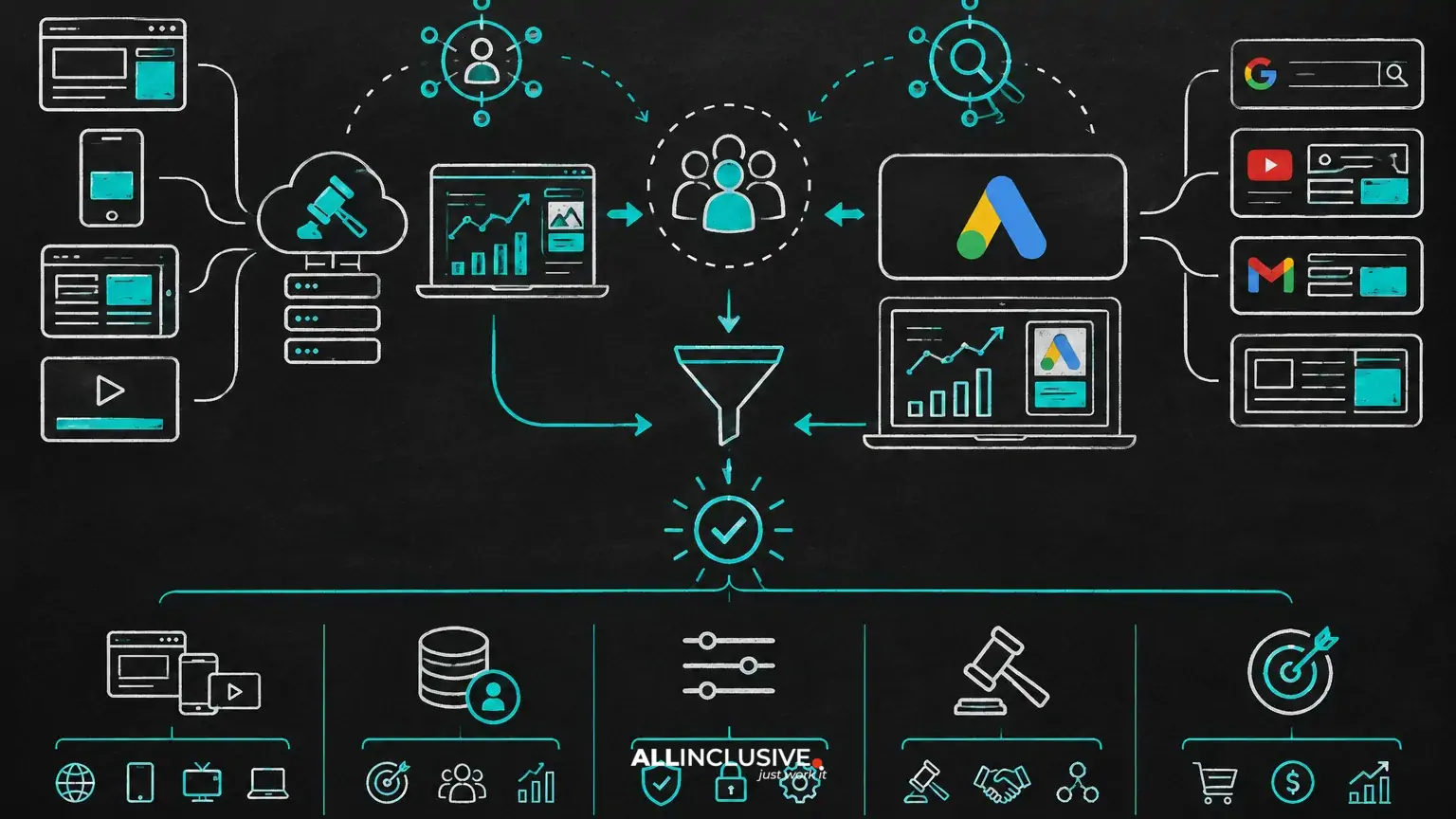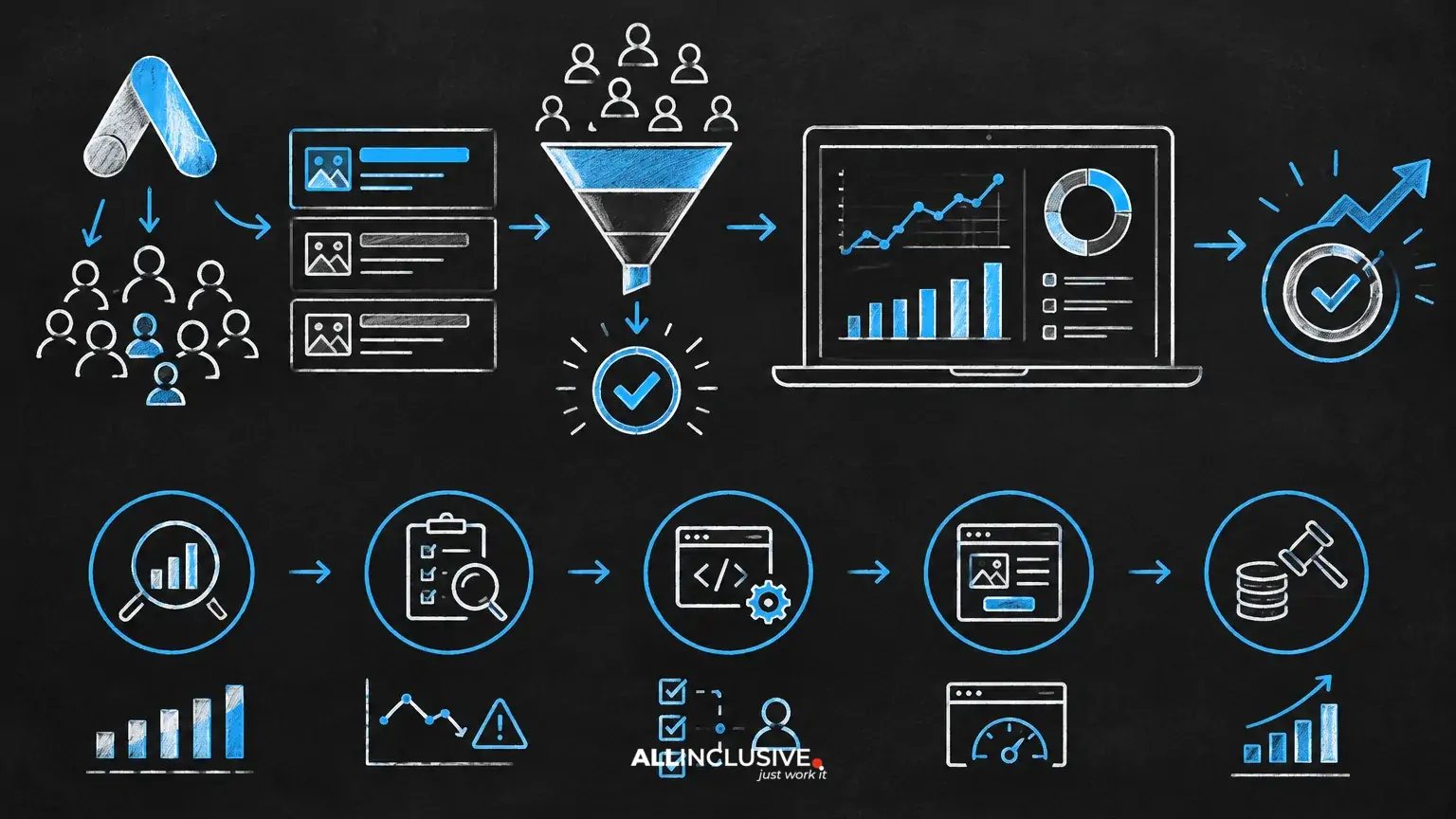
Google Ads conversion rate is the percentage of measured ad interactions that produce a defined conversion. It is useful, but it is not a universal scorecard. A 3% rate may be healthy for one business and poor for another, depending on the conversion, buying cycle, traffic intent, device mix, geography, and measurement setup.
The most reliable way to improve it is to treat conversion rate as a diagnostic signal rather than a target in isolation. First verify that conversions are being recorded correctly. Then separate traffic quality from offer, landing-page, and sales-process issues. Only after that should you change bids or campaign structure.
How to calculate Google Ads conversion rate
The basic calculation is:
Conversion rate = conversions ÷ ad interactions × 100
In many search campaigns, interactions means clicks. However, the exact interpretation depends on the conversion action and the reporting configuration. A lead form submission, phone call, purchase, qualified opportunity, and store visit are not interchangeable outcomes.
For example, if a campaign records 40 form submissions from 1,000 ad clicks, its observed conversion rate is 4%. That number does not tell you whether the leads are qualified, whether duplicate submissions are included, or whether the campaign is generating revenue. Those questions require additional metrics.
Why there is no single good conversion-rate benchmark
Published averages can provide context, but they should not become operating targets without adjustment. Conversion rates vary substantially according to:
- Conversion definition: A newsletter signup usually requires less commitment than a purchase or sales-qualified lead.
- Search intent: Queries containing a clear commercial need often behave differently from educational or early-research queries.
- Industry and offer: A familiar, low-friction product can convert differently from a complex B2B service.
- Audience and geography: Brand familiarity, market maturity, language, and local competition influence response.
- Device and experience: Mobile users may encounter different forms, load times, and checkout constraints.
- Sales cycle: A campaign may appear weak on immediate leads while producing valuable opportunities later.
- Traffic and match controls: Query coverage, match settings, negative keywords, and search partners can change the mix of visitors.
Use your own historical data as the primary reference. Compare like with like: the same conversion action, campaign objective, attribution approach, date range, and traffic segment. A useful benchmark is often a prior period or a comparable campaign—not an industry average detached from your commercial context.
Start with measurement before optimization
A low reported conversion rate can reflect genuine user behavior, but it can also be a tracking problem. Before rewriting ads or changing bids, audit the measurement path.
Check the conversion action
Confirm that the primary conversion represents a meaningful business outcome. If several micro-conversions are included, the headline rate may look stronger while saying little about pipeline or revenue. Separate primary outcomes from supporting actions such as page views, button clicks, or time on site.
Validate tags and event conditions
Test the full journey from ad click to confirmation. Look for missing tags, duplicate firing, incorrect thank-you-page rules, cross-domain issues, consent-related gaps, and events that trigger before an action is completed. Compare platform-reported conversions with the CRM, ecommerce system, call-tracking system, or appointment tool.
Review attribution and conversion windows
Different reporting choices can change when and where conversions are credited. A short evaluation window may understate results for considered purchases, while an overly broad set of actions can obscure campaign quality. Document the setup so comparisons remain consistent.
Separate lead volume from lead quality
For lead generation, add downstream stages such as accepted lead, qualified opportunity, proposal, and closed revenue where possible. A campaign with a lower form conversion rate may be more valuable if it attracts stronger prospects. Optimization should move toward business value, not merely more completed forms.
A practical diagnosis framework
When conversion rate declines, avoid changing several variables at once. Use a funnel sequence to identify where the loss occurs.
1. Is the traffic relevant?
Review search terms, match behavior, negatives, locations, devices, audiences, and network distribution. Look for informational queries entering a lead-generation campaign, irrelevant variants, competitor traffic that does not fit your offer, or geographic areas that cannot be served.
Segment branded and non-branded traffic. Brand searches often have different intent and should not be used to make non-brand acquisition appear healthier than it is. Also compare new versus returning visitors when the available analytics setup supports it.
2. Does the ad promise match the query?
Users should quickly understand that the result addresses their need. Compare the language of the search query, ad, and landing page. A query for emergency commercial plumbing, for example, should not lead to generic home-services language or a broad services page.
Clear qualification can improve efficiency even when it reduces raw click volume. If your offer serves enterprise buyers, a specific statement about company size, implementation scope, or service area may discourage poor-fit clicks and improve the quality of completed actions.
3. Is the landing page reducing friction?
Inspect the first screen, page speed, mobile layout, form fields, proof points, calls to action, and contact options. The page should make the next step obvious and provide enough evidence for the user’s level of risk.
Do not assume every campaign needs a dedicated page. The right destination is the one with the strongest message match and clearest path to action. For a detailed framework, see Google Ads landing pages: message match, speed and conversion.
4. Is the offer appropriate for the intent?
A high-intent search may support a direct purchase, quote request, or consultation. A research-oriented query may respond better to a guide, comparison, calculator, or email sequence. Forcing every visitor into a sales form can suppress conversion rate and produce weak leads.
5. Is the sales or fulfillment process losing demand?
A completed form is not the end of the funnel. Slow follow-up, unclear scheduling, limited inventory, payment friction, or poor call handling can reduce revenue without changing the ad account’s reported conversion rate. Connect paid-search analysis to the operational process that follows the click.
Ways to improve Google Ads conversion rate
Align campaign structure with intent
Group themes according to meaningful differences in user need, offer, or destination—not simply because keywords share a word. Tighter intent groupings make it easier to write relevant ads and send users to appropriate pages. Avoid excessive fragmentation if it prevents campaigns from gathering enough useful data for decision-making.
Use search-term insights to refine targeting
Review actual queries regularly. Add negatives where the intent is clearly unsuitable, and build new ad groups or landing-page themes when a valuable query pattern emerges. This is often more dependable than making broad keyword changes based only on assumptions.
Improve the first decision on the landing page
State what you provide, who it is for, and what happens next. Use a prominent call to action, concise supporting copy, relevant proof, and friction appropriate to the value of the offer. For lead forms, test whether every field is necessary. For complex sales, retain the fields needed for useful qualification but explain why the information is requested.
Test message, not just button color
Prioritize tests that address a business hypothesis: a clearer service promise, stronger qualification, a different proof point, a shorter form, or a more relevant offer. Keep the audience, conversion definition, and evaluation period stable enough to interpret the result.
Use assets to answer objections
Additional ad assets can communicate services, differentiators, coverage, and next steps before the click. They should support the main message rather than create unrelated routes. See the Google Ads assets guide for a practical review of sitelinks, callouts, snippets, and related formats.
Match bidding to data quality and objective
Bidding automation can help pursue conversions, but it cannot repair inaccurate tracking, weak traffic, or an unsuitable conversion goal. Choose a bidding approach based on the amount and reliability of signal available, the campaign’s objective, and the acceptable trade-off between volume, cost, and value. Allow enough time for a controlled evaluation instead of reacting to isolated daily fluctuations.
For the strategic differences among manual CPC, Maximize Conversions, target CPA, and target ROAS, review Google Ads bidding strategies.
How to read conversion rate with other metrics
Conversion rate becomes more useful when paired with adjacent measures:
- Cost per conversion: Shows the media cost required for a recorded action.
- Conversion value or revenue: Helps distinguish volume from commercial impact.
- Conversion rate by segment: Reveals differences by query theme, device, location, audience, and landing page.
- Click-through rate: Can indicate whether the ad earns attention, but it does not prove traffic quality.
- Impression share and lost opportunity: Provide context for scale, not conversion quality.
- Lead-to-opportunity and opportunity-to-close rates: Show whether reported conversions become business outcomes.
Consider the relationship between volume and efficiency. Raising conversion rate by restricting traffic may improve the percentage while reducing total qualified demand. Conversely, expanding into broader queries may lower the rate but increase profitable volume. The correct choice depends on marginal economics and capacity.
A repeatable optimization workflow
- Define the business conversion. Document the action, value, owner, and stage at which it becomes meaningful.
- Audit tracking. Test event firing, deduplication, attribution, imports, and CRM alignment.
- Establish a clean baseline. Compare consistent periods and segment by brand, non-brand, device, geography, query theme, and destination.
- Find the largest constraint. Decide whether the issue is relevance, ad message, page experience, offer, measurement, or downstream handling.
- Form one clear hypothesis. State what will change, why it should help, and which metric will determine success.
- Implement and annotate. Record changes to targeting, ads, pages, conversion actions, and bidding.
- Evaluate quality and value. Review enough data to avoid overreacting to noise, then examine qualified outcomes—not only the top-line rate.
Google Ads conversion rate FAQ
What is a good Google Ads conversion rate?
There is no universal threshold. A good rate is one that produces profitable, qualified outcomes at an acceptable cost and supports the required volume. Compare equivalent campaigns and conversion actions over time.
Why did conversion rate drop after a campaign change?
Possible causes include broader traffic, altered search terms, a new landing page, tracking changes, seasonality, device or geographic mix, ad disapproval or delivery shifts, and normal statistical variation. Compare segments before concluding that one change caused the decline.
Should I optimize for leads or sales?
Use the deepest reliable business signal available. If sales data can be imported accurately and at a useful time scale, it may support stronger decisions. If not, use a qualified intermediate event and improve the data connection over time.
Conclusion
Google Ads conversion rate is most valuable as part of a measurement and diagnosis system. Verify the conversion definition, inspect traffic quality, align the ad and landing page, reduce meaningful friction, and connect leads to revenue. Then use bidding and budget decisions to scale what the business can actually serve profitably.
For broader planning across search, social, measurement, and funnel strategy, explore paid media strategy and resources or visit our paid search hub.