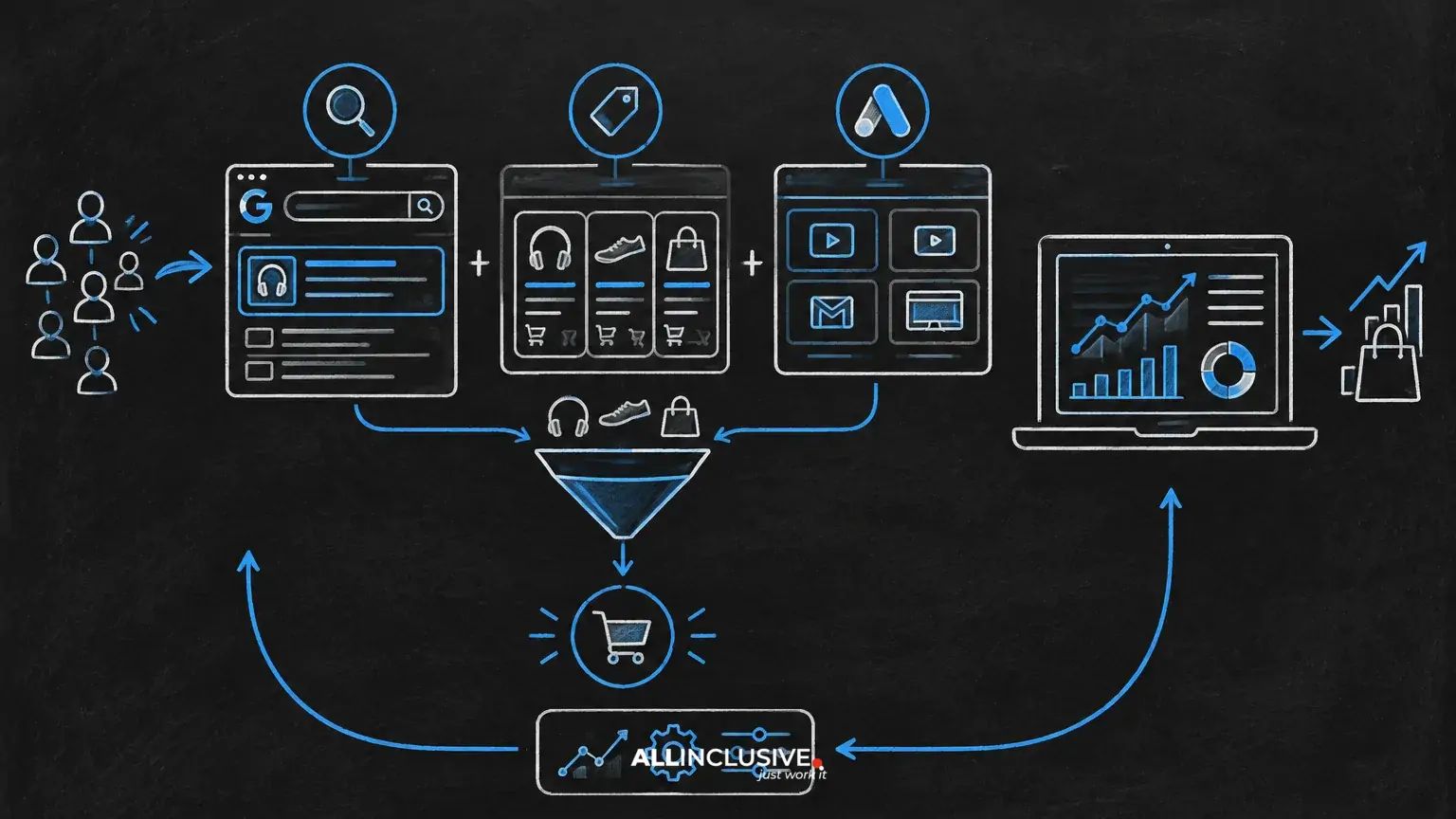
Google Ads for ecommerce works best when each campaign type has a clear commercial role. Search can capture explicit demand, Shopping can connect product queries with product data, and Performance Max can extend reach across Google’s inventory. The right mix depends on your catalog, margins, conversion data, brand strength and ability to measure profitable orders.
The objective is not to launch every available campaign type. It is to build a system that helps shoppers discover products, compare options, return to the brand and complete purchases—while giving budget and optimization decisions a reliable commercial foundation.
Start with roles, not campaign types
Before creating campaigns, define the job each part of the account must perform. A useful ecommerce framework separates four responsibilities:
- Capture existing intent: Reach shoppers already searching for a product, category or brand.
- Present the catalog: Show products with relevant attributes such as price, image and availability.
- Create or expand demand: Reach prospective buyers beyond the narrowest query set.
- Measure profitable growth: Connect advertising activity to revenue, margin, new-customer goals and repeat purchases where possible.
Campaign labels alone do not define these roles. A Search campaign can support brand defense or non-brand acquisition. A product-led campaign can capture high-intent demand or help introduce a less familiar product. Performance Max may contribute across several stages, but its value still needs to be evaluated against business outcomes rather than reach alone.
Where Search fits in an ecommerce program
Search is most useful when the wording of a query provides meaningful evidence of intent. Product, category, brand and problem-oriented searches can all be valuable, but they should not automatically be treated as equivalent.
Brand Search
Brand campaigns can help manage demand from shoppers already looking for your company or product line. Their role may include protecting branded queries, directing users to the most relevant landing page and supporting promotions. Evaluation should account for existing demand and organic visibility; branded conversions are not necessarily incremental simply because an ad received the click.
For a deeper discussion of the trade-offs, see brand campaigns in Google Ads.
Non-brand Search
Non-brand Search is generally the clearest route to testing category and product demand through query intent. It can be especially useful for:
- High-value categories with distinct commercial language
- Products that require explanation before purchase
- New products where feed-led visibility is not enough
- Queries that need carefully matched landing pages
Non-brand campaigns also require stronger discipline around query quality, exclusions, match behavior, landing-page relevance and economics. Separating important themes can make it easier to compare intent and tailor ad copy, but excessive fragmentation can dilute useful signals and complicate management.
Use the non-brand Search framework when the priority is acquiring demand beyond existing brand awareness.
Where Shopping fits
Shopping is product-led: the product feed and associated data play a central role in what can be shown and how products are matched to searches. This makes feed quality a commercial priority, not merely a technical housekeeping task.
Useful feed and catalog inputs can include accurate titles, descriptions, product identifiers, images, price, availability, variants and product categorization. The exact requirements and available controls can change, so teams should validate implementation against current platform documentation and their market’s requirements.
Why Shopping is valuable
- Product context appears early: Shoppers may see an image, product name and price before visiting the site.
- Catalog scale is possible: A well-maintained feed can support a large product range without writing a separate keyword plan for every item.
- Commercial comparison is visible: Product-level performance can reveal which items attract clicks and orders.
Common Shopping weaknesses
A feed cannot compensate for poor economics, unavailable products, weak product pages or inaccurate data. A large catalog can also create false confidence: many products may receive limited demand, while a small group drives most revenue or margin.
Segment products by meaningful business dimensions such as margin tier, inventory status, category, price range, seasonality or strategic importance. The appropriate segmentation depends on volume and data quality. The goal is to make budget and bid decisions more aligned with business value, not to create a complex structure for its own sake.
Where Performance Max fits
Performance Max can support ecommerce advertisers seeking coverage across multiple Google inventory surfaces from a unified campaign type. Its potential role is broader than product-query capture, which can make it useful for combining catalog assets, audience signals and conversion goals.
That breadth also changes how it should be managed. Performance Max is not simply “Shopping with a different name,” and it should not be judged only by the volume of reported conversions. Assess:
- Whether the campaign is reaching the intended products and markets
- Whether reported conversions represent the desired order and customer quality
- Whether spend is concentrated in profitable products or low-value transactions
- How performance changes when budgets, targets, promotions or inventory change
- Whether incremental demand is plausible given brand strength and existing traffic
Use asset groups, product organization and audience inputs to provide clear business context, but avoid assuming that more inputs automatically produce better outcomes. The campaign still needs a well-defined conversion goal, reliable value data and sufficient time for informed evaluation.
Choosing the right mix
A practical decision framework starts with five questions.
- What does the customer search for? If shoppers use precise product or category language, Search and product-led campaigns may both be appropriate. If demand is more problem-oriented, Search may offer greater control for testing message and landing-page fit.
- How important is product comparison? Products that compete on price, design, specifications or availability often benefit from strong catalog presentation.
- How much conversion data is available? Limited data calls for realistic goals, careful observation and avoidance of premature structural changes. Mature accounts may support more value-based segmentation.
- What is the economic objective? Revenue, contribution margin, new-customer acquisition and lifetime value can lead to different campaign priorities and bidding inputs.
- What can the team actually manage? A theoretically precise structure is not useful if nobody can maintain feeds, review queries, investigate products or act on measurement findings.
A practical account structure
There is no universal architecture, but many ecommerce programs benefit from separating campaigns or reporting views by commercial purpose. Possible dimensions include:
- Brand and non-brand intent
- Core categories and strategic product groups
- Country, language or market
- Margin or profitability tier
- New-customer acquisition versus broader sales objectives
- Promotional or seasonal inventory
Choose separations that affect decisions. If two groups have the same economics, budget, landing pages and optimization approach, splitting them may add administration without adding insight. If they require different targets or investment levels, separation may be justified.
Measurement: optimize for business value
Transaction tracking should record the value of completed orders as accurately as possible, including appropriate treatment of cancellations, refunds, taxes or shipping where relevant to the business model. The definition must be consistent enough for meaningful comparisons.
Revenue-based optimization is not the same as profit optimization. A high-value order can be less attractive than a smaller order if margins, fulfillment costs or return rates differ substantially. Where reliable margin data is available, incorporate it into decision-making rather than treating revenue as the final answer.
Also distinguish platform-reported performance from incremental business impact. Google Ads may receive credit for an order that would have occurred through another channel. Compare paid results with broader business trends, branded demand, organic activity, merchandising changes and promotional calendars.
Useful reporting cuts
- Campaign type and commercial role
- Brand versus non-brand demand
- Product, category and margin group
- New versus returning customer, where measurement is reliable
- Device, market and landing page
- Spend and value during promotional and non-promotional periods
Optimization priorities
Improve the inputs before changing bids
Check product availability, feed accuracy, price consistency, tracking, consent-related measurement requirements, landing-page speed and checkout reliability. Campaign changes cannot solve a product page that does not match the ad or an inventory system that reports unavailable items as purchasable.
Use search and product signals together
Search-query analysis can reveal language, objections and emerging demand. Product reporting can show which items attract engagement and orders. Use both to improve titles, category pages, ad copy, merchandising and exclusions.
Control budget through economics
Do not allocate budget solely by campaign type. A product-led campaign with attractive reported return may be drawing heavily from branded demand, while a non-brand campaign may be building more incremental reach at a lower immediate efficiency. Review the role, customer quality and marginal value of additional spend.
Test changes one at a time when possible
Changing budget, target, product set, landing pages and promotions simultaneously makes diagnosis difficult. Prioritize the change most likely to resolve the current constraint, define the evaluation window in advance and document external factors that could affect results.
Common mistakes in Google Ads for ecommerce
- Launching without a feed-quality process: Product data is treated as a one-time setup rather than an operating system.
- Blending every objective together: Brand defense, acquisition and profitability are evaluated under one undifferentiated target.
- Over-segmenting: The account becomes difficult to manage and each segment lacks useful data.
- Judging channels by last-click ROAS alone: The analysis ignores incrementality, customer quality and assisted demand.
- Ignoring inventory and margin: Budget continues toward products that cannot be fulfilled profitably.
- Making frequent reactive changes: Normal volatility is mistaken for a structural problem.
A launch and review checklist
- Define revenue, margin and customer-acquisition objectives.
- Audit product data, availability, pricing and landing pages.
- Validate purchase and value tracking across the checkout journey.
- Map brand, category, product and problem-based demand.
- Assign a clear role to Search, Shopping and Performance Max.
- Choose segmentation only where it supports a real decision.
- Set reporting views for products, categories, markets and customer value.
- Document exclusions, budget rules and testing priorities.
- Review query quality, product performance, feed health and business outcomes on a regular cadence.
The strongest ecommerce programs treat Google Ads as part of a broader commercial system. Search captures explicit demand, Shopping makes the catalog legible, and Performance Max can extend discovery and conversion opportunities. Results improve when those roles are clear, measurement reflects business value and optimization connects advertising decisions to inventory, margin and customer experience.
For the wider operating context, explore our paid search strategy resources and the broader paid media guide.