Google Ads for B2B can generate valuable demand, but the account should not be judged by lead volume alone. B2B buying cycles are longer, multiple stakeholders may influence a deal, and the first conversion often represents an inquiry rather than a sales opportunity.
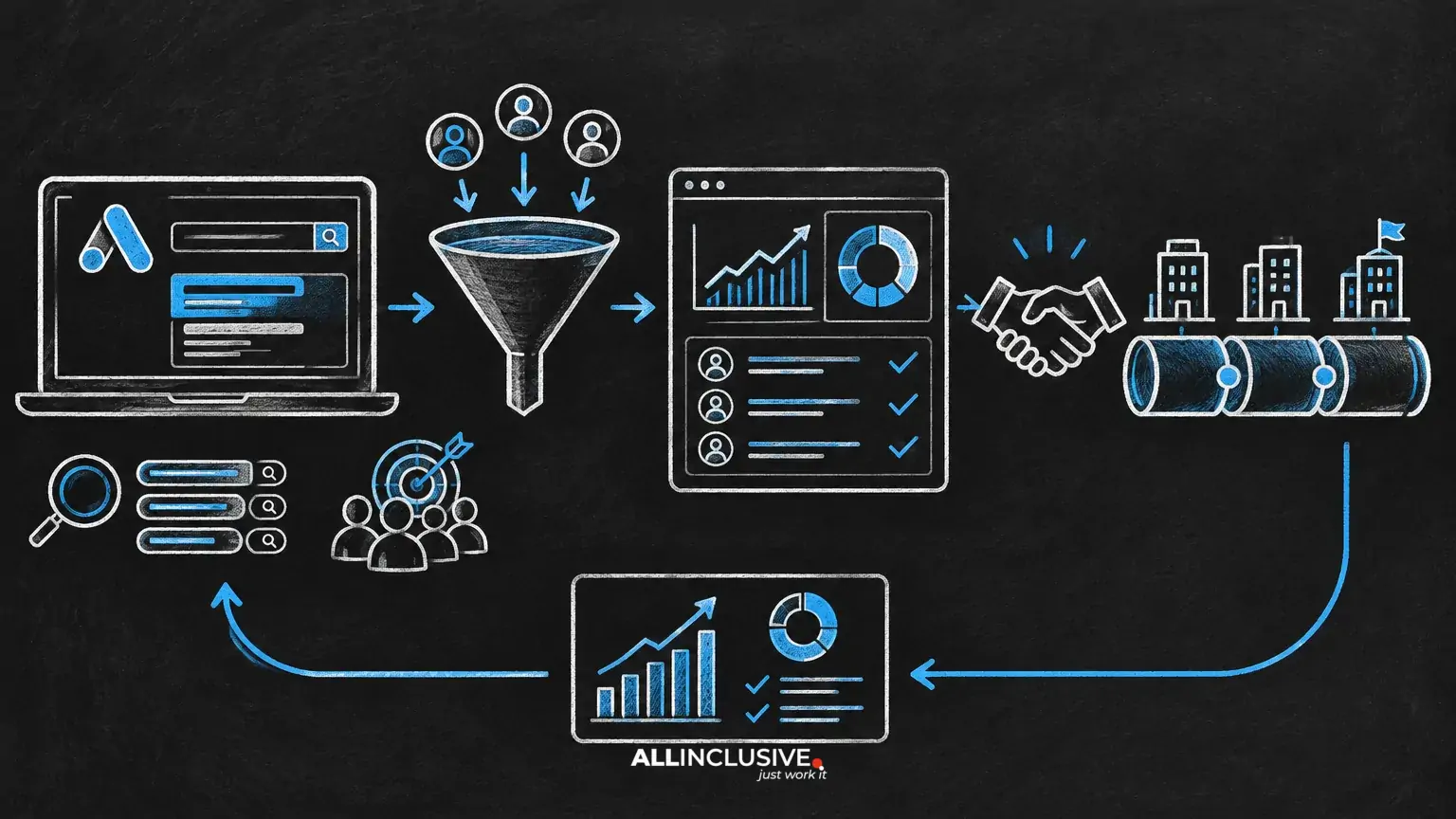
The strongest approach connects three decisions: which searches to buy, which prospects to qualify, and which downstream outcomes to send back into measurement. That creates a feedback loop between media, marketing operations and sales.
Start with the commercial question
Before building campaigns, define what Google Ads is expected to do in the buying process. The objective might be to capture existing demand for a known category, create consideration for a specialized solution, support account-based activity, or generate opportunities for a sales team.
These objectives require different expectations. A high-intent search campaign may be evaluated on qualified opportunities, while a broader campaign may be assessed on engaged accounts, assisted demand or progression to a later-stage conversion. Treating every campaign as a direct lead-generation channel makes optimization less precise.
A useful planning brief answers:
- Which products, services or use cases have enough commercial demand to justify paid search?
- Which companies or buyer roles are most valuable?
- What action indicates meaningful interest at each stage?
- How quickly can sales accept, reject or progress a lead?
- What revenue or pipeline data can be connected to the original click?
Build keyword coverage around buying intent
Keyword research for B2B should go beyond estimated volume. The central question is whether the language signals a problem, a solution category, a comparison or a near-term vendor decision.
1. Category and solution terms
These searches describe the type of product or service a buyer is seeking. They can be valuable, but often require clear landing-page relevance and qualification because the searcher may still be exploring options.
Examples include searches for enterprise workflow software, outsourced compliance services or industrial equipment maintenance. The right terms depend on the market and the language used by customers, not internal product terminology alone.
2. Problem and use-case terms
Problem-based searches can uncover demand before a buyer has selected a category. They may expand reach, but intent is less certain. Use the landing page and offer to help the visitor identify whether the solution fits.
These terms are often best tested in a controlled campaign or ad group with careful query review. A useful search may reveal a new demand theme; an irrelevant query may expose the need for a negative keyword or tighter targeting.
3. Comparison and evaluation terms
Searches containing language such as “alternatives,” “comparison,” “vendors” or “pricing” often indicate active evaluation. They are not automatically high quality, however. A prospect may be researching for a future project, gathering information for another stakeholder or looking for a low-cost option that does not match the offer.
4. Branded and competitor terms
Brand searches can protect demand and help capture users already familiar with the company. Competitor terms require a separate strategic decision involving relevance, economics, messaging and brand risk. They should not be blended into generic acquisition reporting.
For broader context on campaign roles, see non-brand Google Ads campaigns and brand campaigns in Google Ads.
Use a campaign structure that reflects decisions
Campaign structure should make budget allocation, messaging and analysis easier. It does not need to mirror every product variation or keyword theme if that creates unnecessary fragmentation.
Separate campaigns when differences in intent, geography, budget, landing-page experience, business value or reporting requirements justify separation. For example, a high-intent service category may deserve its own budget from broader problem-based discovery. A strategic enterprise segment may also need distinct messaging and qualification.
Within each campaign, organize ad groups or themes around closely related search intent. The goal is not maximum granularity; it is a credible connection between query, ad and landing page.
Write ads for qualification, not just clicks
B2B ad copy should help the right prospect recognize relevance while discouraging a poor fit. Clear language about the solution, audience, use case and next step is often more useful than generic claims.
Consider including:
- The business problem or category served.
- The type of organization or use case supported.
- A specific next step, such as a consultation, assessment, demo or guide.
- Important fit signals, such as implementation scope, operating environment or customer segment.
- Language that sets expectations for the conversation.
Do not promise outcomes that cannot be substantiated. A qualification-oriented message may produce fewer submissions while improving the proportion that sales can use.
Match the landing page to the buying stage
A landing page should answer the question implied by the search. Someone looking for a category may need a concise explanation of the offering and its applications. Someone evaluating vendors may need proof of capability, implementation detail, security information, integration context or a clear commercial next step.
Strong B2B landing pages typically make five elements easy to find:
- What the company provides and for whom.
- Which business problem or use case it addresses.
- Why the approach is credible.
- What happens after the form, call or meeting request.
- What information the visitor should provide to establish fit.
Forms should balance qualification with completion friction. Asking for every possible detail can suppress good demand, while asking for too little can burden sales with unusable inquiries. Test fields according to the information sales genuinely needs at that stage.
Define lead quality before launch
A conversion is an event. A qualified lead is a business judgment. The two should be measured separately.
Establish a shared lifecycle definition with marketing and sales. The exact labels vary by organization, but a practical model may distinguish:
- Inquiry: a form submission, call or other initial response.
- Marketing-qualified lead: an inquiry meeting agreed fit or engagement criteria.
- Sales-accepted lead: a lead that sales has reviewed and accepted for follow-up.
- Opportunity: a sales-created record with a defined commercial potential.
- Pipeline or revenue: the downstream value assigned according to the company’s internal process.
Document the rules for each stage, including ownership, rejection reasons and expected response time. Without that agreement, paid search optimization tends to revert to the easiest metric to collect.
Measure Google Ads beyond form fills
A B2B measurement framework should connect media data with first-party business data where possible. At minimum, report performance by campaign, search theme, landing page and lead stage—not only by click and submission.
Useful diagnostic questions include:
- Which queries generate inquiries?
- Which queries generate accepted leads or opportunities?
- Does lead quality vary by device, geography, audience or landing page?
- How long does each source take to progress?
- Where are leads rejected, and for what reason?
- Which campaigns influence pipeline even when they do not produce the first conversion?
Platform-reported conversions can support operational optimization, but they should be reconciled with the CRM or marketing automation system. Tracking gaps, duplicate records, offline activity and inconsistent lifecycle definitions can otherwise create a misleading picture.
Use value-based thinking carefully
Assigning different values to conversion actions can help represent business priorities. A completed sales-qualified stage should generally carry more strategic weight than a low-friction content download, provided the stages are defined consistently.
However, values should not be invented simply to make reporting look sophisticated. Start with documented business assumptions, review them against actual progression and update them when the sales process changes. If opportunity values vary widely, use a defensible method based on historical or approved commercial inputs rather than an arbitrary multiplier.
Where offline outcomes can be imported or otherwise connected to advertising records, they can improve the relationship between bidding decisions and pipeline. Implementation details depend on the organization’s analytics, CRM and consent architecture, so validate the data flow before relying on it for automated decisions.
Manage search terms and exclusions continuously
Search-term review is one of the most important controls in B2B paid search. It reveals how users interpret the keywords, identifies irrelevant demand and surfaces language that may deserve its own campaign.
Review queries by intent and business fit. Common exclusion themes may include employment searches, training or education requests, support questions, free tools, consumer use cases, unrelated industries and research that cannot lead to a commercial conversation. The correct exclusions depend on the offer, so use actual query evidence rather than a generic list.
Do not remove a term solely because it has a high cost or low initial conversion rate. First check whether the search is strategically relevant, whether the landing page answers it and whether the sales cycle simply requires more time to mature.
Set a testing and optimization cadence
Effective B2B account management combines fast operational checks with slower commercial analysis.
- Weekly: review spend, delivery, search terms, disapprovals, tracking anomalies and obvious lead-quality issues.
- Monthly: compare campaigns, themes, landing pages and audience segments using available lifecycle data.
- Quarterly: reassess the keyword map, sales feedback, conversion definitions, budget allocation and pipeline contribution.
Test one meaningful change at a time where possible. Candidates include the offer, qualification language, landing-page structure, query theme, form design or follow-up process. Record the hypothesis and the decision rule before interpreting results.
Questions to ask before increasing budget
Additional spend is justified when the account can identify where incremental demand is likely to come from and how quality will be protected. Ask:
- Are the best-performing search themes constrained by budget or by available demand?
- Can the sales team respond quickly enough to additional inquiries?
- Are qualified stages tracked consistently?
- Is poor performance caused by traffic, conversion experience, qualification or follow-up?
- Would a new use case, geography or landing page expand demand without weakening fit?
If these questions cannot be answered, improve measurement and funnel mechanics before treating more spend as the solution.
Where Google Ads fits in a broader B2B program
Paid search is strongest when it captures identifiable demand and gives buyers a relevant next step. It is not a substitute for positioning, sales enablement, lifecycle nurture or customer evidence. Search can also work alongside other paid channels that build awareness or re-engage known audiences, but each channel should have a defined role.
For a wider view of how paid channels connect across the funnel, explore the paid media hub. Businesses with a software-led motion may also benefit from the considerations in Google Ads for SaaS.
Google Ads for B2B: What to Prioritize
The most reliable B2B Google Ads programs are built around commercial intent and verified business outcomes. Start with the searches that indicate a credible need, align ads and landing pages with the buyer’s stage, define lead quality with sales, and connect reporting to progression rather than stopping at the form submission.
That discipline makes budget decisions clearer. It also gives the account a practical path from keyword management to pipeline improvement.
For broader strategic context, see our paid search resource.