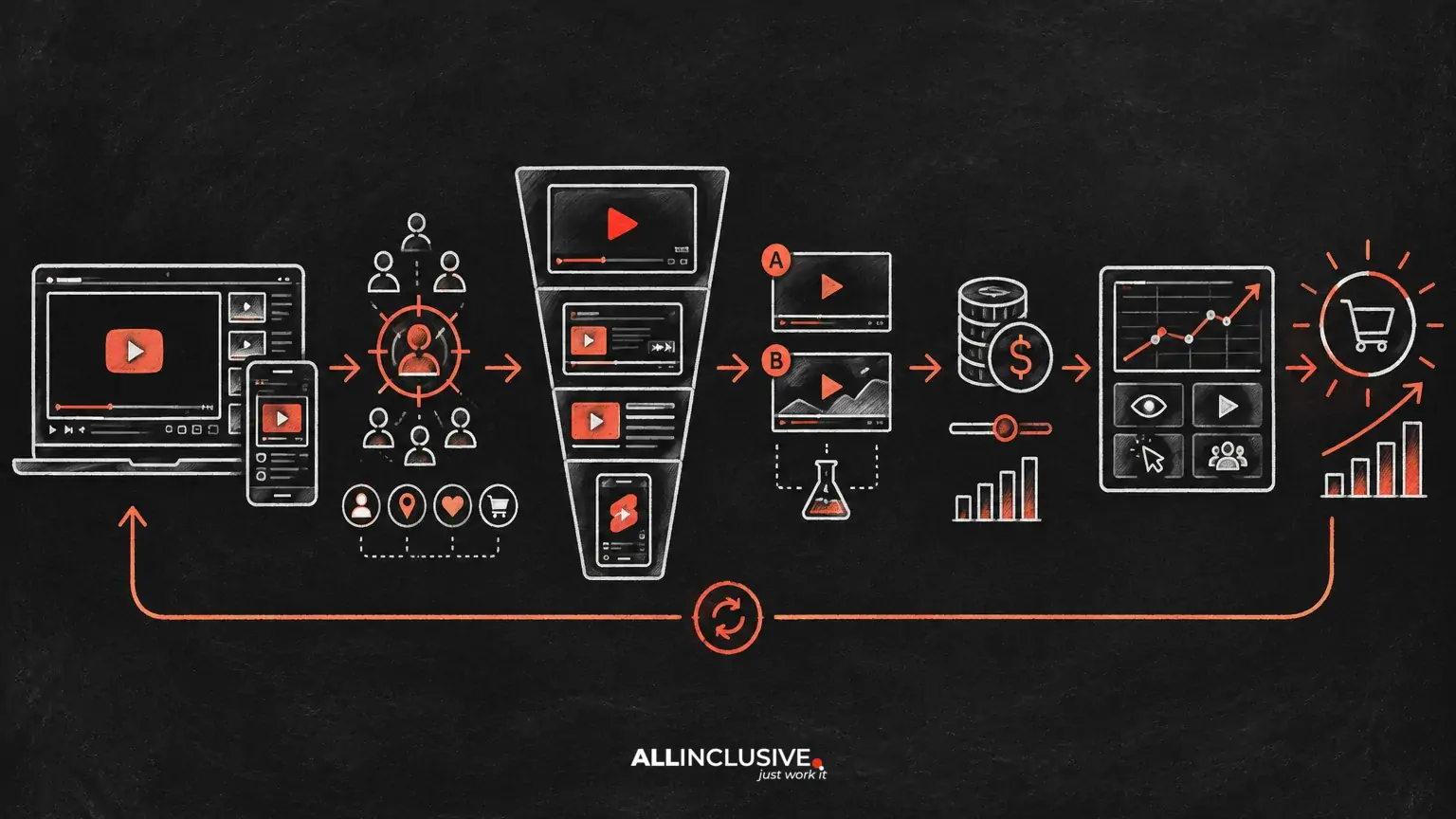
A strong YouTube advertising strategy does more than generate views. It connects audience selection, video creative, campaign objectives, landing pages and measurement to a specific commercial outcome. The right approach may support awareness, educate a considered buyer, create demand, or re-engage people who have already interacted with your business.
The strategic challenge is deciding which job YouTube should perform in the funnel—and then selecting formats, audiences and conversion signals that support that job. This guide explains how to build that system without treating every impression, view or click as equal.
Start with the commercial role of YouTube
Before choosing targeting or campaign settings, define the role YouTube will play in the customer journey. A campaign designed to introduce a category to new prospects should not be judged by the same criteria as a remarketing campaign intended to generate qualified leads.
Most YouTube programs support one or more of four strategic roles:
- Demand creation: Introduce a problem, category or point of view to people who may not yet be actively searching.
- Demand capture support: Reinforce consideration when prospects are comparing solutions or researching a known need.
- Education: Explain a complex product, use case, process or differentiation that is difficult to communicate in static ads.
- Re-engagement: Return qualified visitors, video viewers or existing prospects to the next step in the buying journey.
Assign a primary role to each campaign. This prevents a common failure mode: asking one campaign to maximize reach, drive immediate conversions and retarget high-intent users at the same time.
Build the audience architecture
Audience strategy should reflect both business value and buyer readiness. Broad reach can be appropriate when the objective is category education, while more constrained audiences may be useful when the offer is specific, the sales cycle is short, or conversion volume is limited.
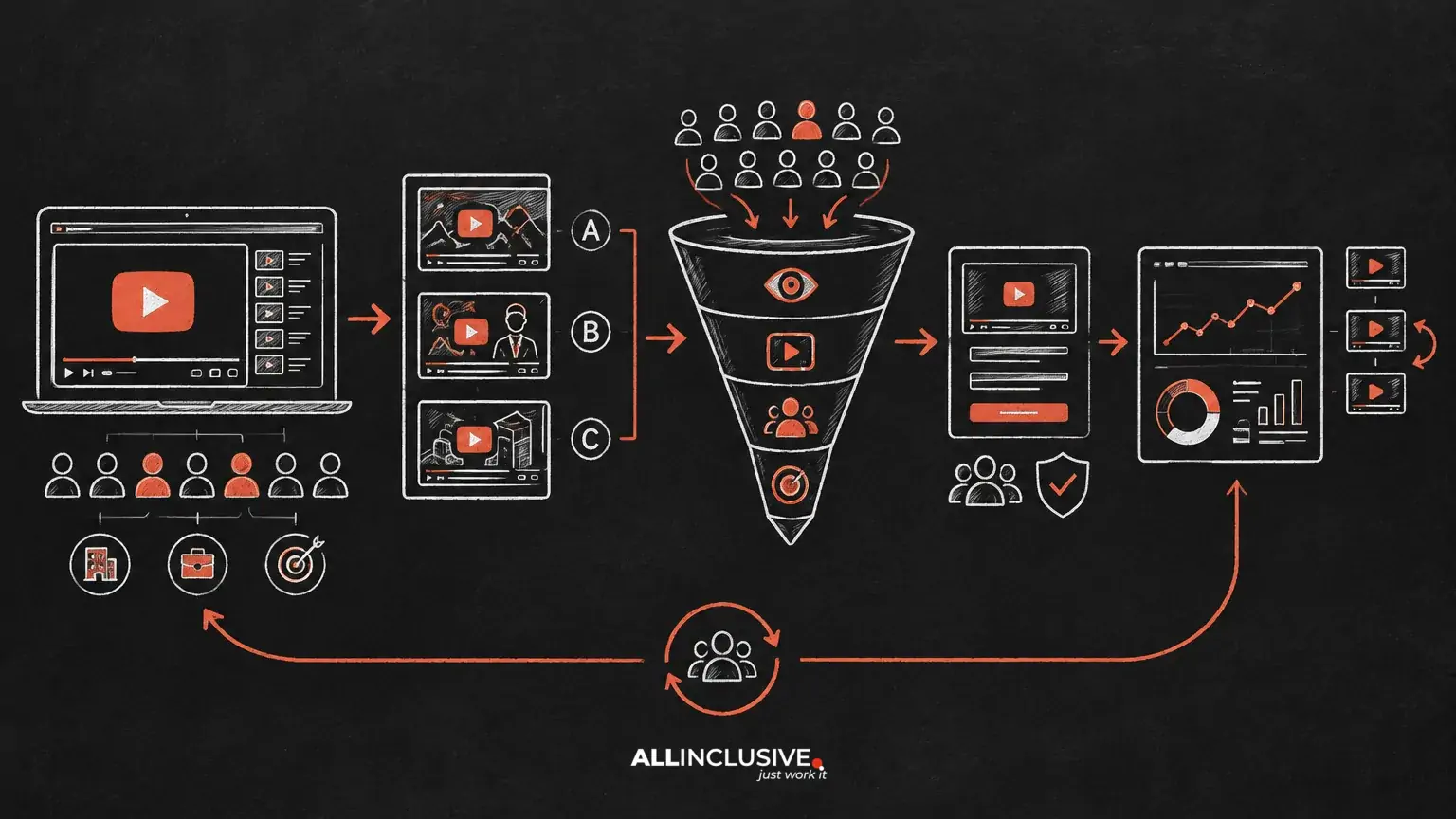
Use a tiered audience model
- Known high-intent audiences: People who have visited key pages, engaged with your videos, started a form, or otherwise demonstrated meaningful interest.
- Relevant in-market or interest-based audiences: Groups whose observed behavior or stated interests align with the problem your product solves.
- Custom intent-style audiences: Users associated with relevant search behavior, URLs, apps or other signals available within the platform’s current audience options.
- Contextual and content-aligned audiences: People encountering content related to the topic, use case or category.
- Broad prospecting audiences: Wider discovery intended to find qualified users beyond predefined segments.
Do not assume that the narrowest audience is automatically the most efficient. Tight targeting can reduce scale, limit learning and make delivery overly dependent on a small pool of users. Instead, test audience breadth against the campaign’s objective, conversion signal and available budget.
For a deeper breakdown of audience types and targeting inputs, see our guide to YouTube Ads Targeting.
Separate prospecting from remarketing
Prospecting and remarketing answer different questions. Prospecting asks whether YouTube can find new qualified demand. Remarketing asks whether the message can move an already-engaged person forward.
Keep these audiences distinct where possible. Separate reporting makes it easier to understand incremental reach, frequency, creative performance and conversion quality. It also prevents efficient remarketing conversions from masking weak prospecting performance.
Choose formats by job, not novelty
YouTube ad formats should be selected according to the message, audience mindset and desired action. Format names and available buying options can change, so treat platform mechanics as implementation details to verify during campaign setup. The strategic principles remain more durable.
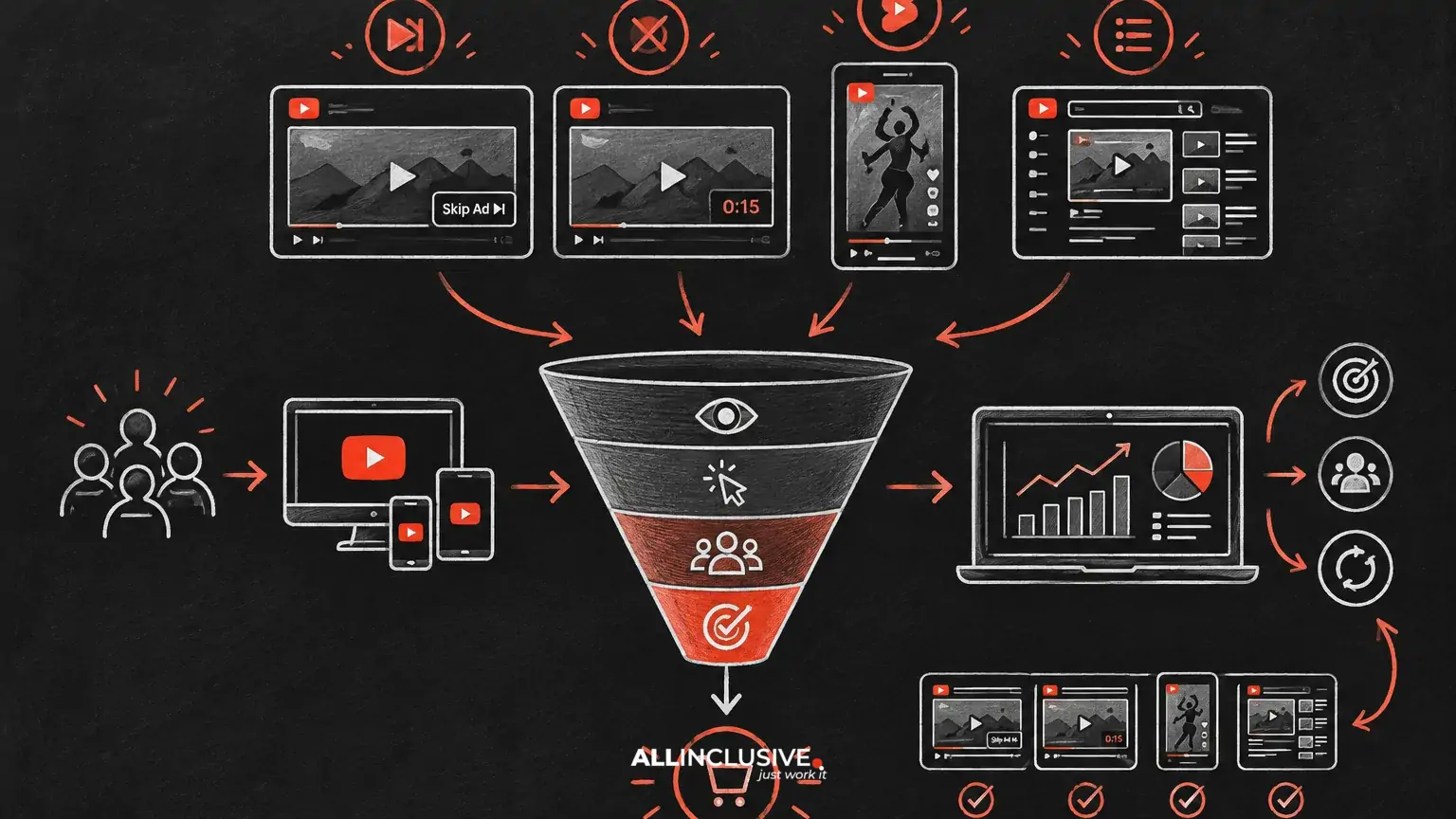
Skippable video
Skippable video is useful when the opening seconds can earn attention and the message benefits from explanation. It can support both broad reach and consideration, provided the creative communicates the core value before a viewer loses interest.
Use this format when you need to demonstrate a product, introduce a business problem, show a workflow or make a differentiated argument. Build the video so the premise remains understandable even if the viewer does not watch to the end.
Non-skippable video
Non-skippable placements can help deliver a concise message to a defined audience, but they demand discipline. The creative must be short, clear and relevant because the viewer cannot immediately leave the ad.
Use this approach for simple propositions, memorable brand cues or focused campaign themes. Avoid forcing a complex product explanation into a message that does not provide enough time to make it credible.
Short-form vertical video
Short-form placements require creative designed for mobile viewing, rapid comprehension and vertical composition. They are not simply shorter versions of a long-form commercial.
Test strong visual openings, captions, product demonstrations and creator-style executions where they fit the brand. The first frame, pacing and sound-off comprehension matter because the surrounding viewing behavior may be fast and interruption-sensitive.
In-feed video
In-feed placements can be effective when a user is actively discovering or researching content. The thumbnail, headline and opening scene work together to earn the click or view.
This format is often a useful fit for educational content, comparisons, product explainers and thought leadership. Make the destination page consistent with the promise made in the creative.
Our overview of YouTube Ads Formats can help with the format-level decision.
Match creative to the buying stage
Creative is the operating layer of a YouTube strategy. Targeting determines who may see the ad, but creative determines whether the message earns attention, creates understanding and prompts action.
Awareness creative
Awareness creative should make the problem, category or brand easy to recognize. Lead with a relevant tension rather than a long company introduction. A useful structure is:
- State the problem or opportunity quickly.
- Show why it matters to the intended audience.
- Introduce the distinctive idea or solution.
- Provide a memorable brand cue and an appropriate next step.
Consideration creative
Consideration-stage viewers need reasons to believe. Demonstrate the product, explain the process, answer objections or compare approaches without making unsupported claims. B2B audiences may need proof of implementation, integration, governance or business fit rather than a purely emotional message.
Conversion and remarketing creative
Remarketing creative should acknowledge prior engagement and remove the next barrier. The message might invite a demo, return to a product page, download a useful resource or complete an unfinished action. Avoid repeating the exact prospecting message when the audience already knows the category or brand.
Design the conversion path before launching
A video campaign cannot compensate for a weak post-click experience. Align the landing page with the ad’s audience, promise and call to action.
Check the following before launch:
- The landing page explains the same value proposition as the video.
- The next action is visible without requiring unnecessary navigation.
- Forms request only information needed for the next business step.
- Mobile layouts load and function properly.
- Lead or purchase events are recorded consistently across relevant tools.
- Sales teams can distinguish YouTube-originated leads from other sources.
For longer consideration cycles, do not make a form completion the only meaningful outcome. Track intermediate actions such as engaged visits, key page views, resource consumption or return visits, then connect those signals to later pipeline quality where possible.
Set objectives and measurement rules
Measurement should follow the campaign’s role. Views and view-through rates can describe delivery and engagement, but they do not independently establish commercial value. Clicks can indicate interest, yet they may not reflect qualified demand. Conversions require definition and validation.
Use a measurement hierarchy
- Delivery: Reach, impressions, frequency and placement or format distribution.
- Engagement: Video views, watch behavior, clicks and meaningful site interactions.
- Response: Leads, purchases, sign-ups or other primary conversion events.
- Quality: Qualified leads, opportunities, revenue, retention or downstream business value.
Choose a primary optimization event that is frequent enough to guide delivery and meaningful enough to support the business objective. If the final sale occurs weeks or months later, use a carefully selected proxy while maintaining a separate process for validating lead quality and pipeline outcomes.
Use a testable attribution approach
Platform-reported conversions are useful for optimization, but they should be interpreted alongside analytics, CRM and financial data. Differences between systems can arise from attribution windows, user consent, identity resolution, duplicate events and varying definitions of a conversion.
Document the following:
- Primary and secondary conversion events.
- Attribution windows and reporting time zones.
- How duplicate leads or repeat purchases are handled.
- Which events are imported for optimization.
- How offline outcomes are matched back to media exposure.
Where investment is material, consider controlled testing or geo-based experimentation when operationally feasible. A test should be designed before launch, with a clear hypothesis and success criterion—not added after results appear.
Plan budget around learning and role
Budget allocation should reflect the job each campaign performs. Prospecting generally needs enough scale to discover responsive audiences, while remarketing can operate with less reach but may encounter frequency pressure.
Start with a structure that is easy to interpret:
- One campaign for the primary prospecting objective.
- Separate remarketing activity for engaged audiences.
- Distinct creative groups for major messages or buying stages.
- Clear exclusions to limit unnecessary overlap.
Avoid fragmenting a modest budget across too many audiences, formats and creative variations. Excessive segmentation creates thin data and makes it difficult to determine what is working. Consolidate when the strategic question is the same; separate when the audience, objective or offer is genuinely different.
For planning assumptions and economic considerations, read YouTube Ads Cost.
Run a disciplined testing program
Testing should isolate meaningful decisions rather than produce a large collection of minor variations. Prioritize variables that can change the commercial outcome:
- Problem-led versus product-led opening.
- Demonstration versus testimonial or expert explanation.
- Short-form versus long-form creative.
- Direct response call to action versus educational next step.
- Broad prospecting versus higher-intent audience inputs.
- Dedicated landing page versus a general product page.
Change one major variable at a time when possible, maintain a consistent measurement window, and avoid judging creative solely on an early result before sufficient delivery has occurred. Review both efficiency and quality: a low-cost lead is not necessarily a valuable lead.
Common strategic mistakes
Optimizing for views alone
Views are a delivery outcome, not a complete business objective. Use them to understand attention, then connect them to site behavior, conversions and downstream quality.
Using one message for every audience
New prospects, active researchers and returning visitors have different information needs. Build message progression rather than repeating the same advertisement.
Over-targeting too early
Highly restrictive inputs can make a campaign look precise while reducing scale and limiting discovery. Begin with a reasoned audience hypothesis, then tighten or expand based on evidence.
Ignoring frequency and creative fatigue
Repeated exposure can become inefficient or harmful when the audience pool is small. Monitor frequency, engagement trends, negative feedback signals and conversion quality, then refresh or rotate creative as needed.
Failing to connect media with sales operations
For B2B and high-consideration offers, the real evaluation may happen after the form fill. Ensure lead routing, qualification definitions and CRM feedback are part of the measurement plan.
YouTube Advertising Strategy: Pre-Launch Checklist
- Define the campaign’s commercial role and primary audience.
- Choose a primary conversion event and supporting quality signals.
- Map the message to the buyer’s stage and likely objections.
- Select formats that fit the creative and viewing context.
- Prepare mobile-ready landing pages and validated tracking.
- Separate prospecting and remarketing reporting.
- Set exclusions, budget boundaries and learning expectations.
- Launch a focused set of creative tests.
- Review delivery, engagement, response and quality metrics together.
- Document decisions and iterate based on evidence.
A YouTube program is strongest when it is treated as part of a connected paid media strategy, not as an isolated video channel. Search, display, social, CRM and sales data can all help clarify whether YouTube is creating new demand, assisting conversion or efficiently re-engaging existing interest.
For organizations evaluating the channel more broadly, explore our YouTube advertising services and strategic capabilities.