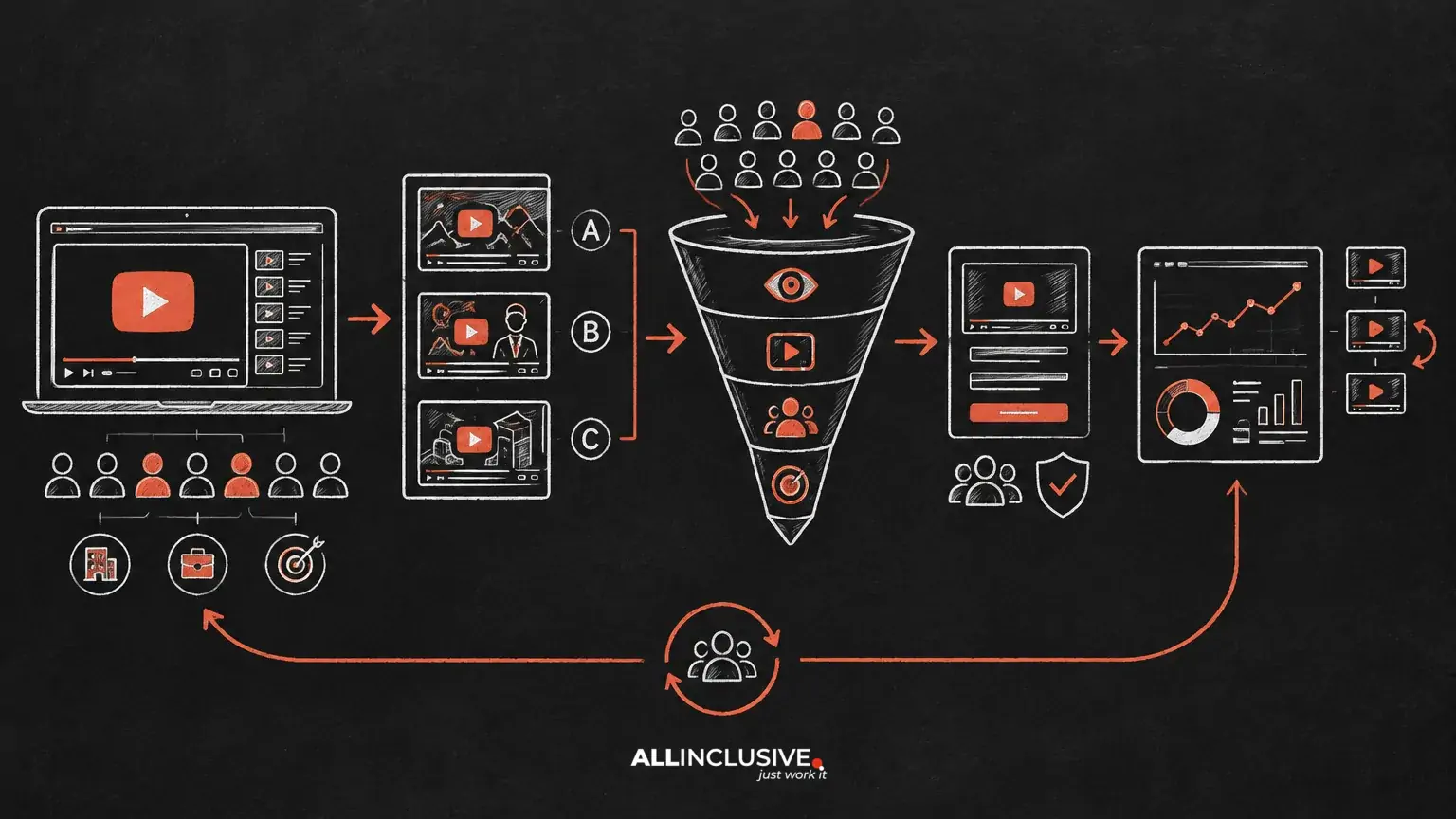
A YouTube Ads audit should answer three questions: are you reaching the right people, is the creative earning meaningful attention, and can you trust the conversion data? If the answer to any of them is unclear, increasing budget may scale uncertainty rather than performance.
This 20-point checklist is designed for marketers reviewing an existing account before reallocating spend, refreshing creative or changing campaign objectives. It separates strategic problems from platform mechanics and focuses on findings that can lead to a clear action.
How to run a YouTube Ads audit
Start with the business objective, not the campaign interface. Define the conversion or outcome the account is intended to influence, the audience it must reach, the markets and exclusions that apply, and the time period that provides enough data for a useful comparison.
Review campaigns at several levels: account, campaign, ad group, audience, creative, placement and conversion action. Do not judge performance from one metric in isolation. A low cost per view may indicate efficient attention—or simply broad delivery that produces little commercial value.
Account and campaign structure
1. Is every campaign tied to a specific business objective?
Label each campaign by its job: demand creation, consideration, lead generation, ecommerce conversion, remarketing or testing. If one campaign is expected to do all of these jobs, its reporting and optimization signals are likely to be ambiguous.
Document the primary outcome and the supporting indicators for each campaign. For example, a prospecting campaign may be evaluated through qualified site engagement and assisted demand, while a remarketing campaign may prioritize completed actions.
2. Are campaigns separated by meaningful variables?
Separate campaigns when budget control, geography, language, objective, audience temperature or creative strategy requires it. Avoid splitting campaigns merely to create a more detailed naming system. Excessive fragmentation can make delivery and analysis less reliable.
3. Is naming consistent enough to support analysis?
A useful naming convention should identify the market, objective, audience, format or creative theme, and test status. The exact structure matters less than consistency. Confirm that names match the actual settings and that archived or paused campaigns are clearly distinguishable.
4. Are budgets aligned with the test design?
Check whether each campaign has enough budget to generate a useful learning signal for its objective and conversion volume. If several small campaigns target overlapping audiences, consider whether consolidation would create a cleaner test. Conversely, do not combine campaigns when it would remove necessary control over market or objective.
Targeting and audience quality
5. Does the audience match the buying context?
Review whether targeting reflects the customer’s problem, category, stage and commercial context. An audience that appears relevant demographically may still be weak if it has no relationship to the product or buying situation.
For prospecting, test multiple audience hypotheses rather than assuming one segment explains demand. For remarketing, define the required level of intent and recency instead of treating every site visitor as equally valuable.
6. Are prospecting and remarketing separated?
Separate new-user acquisition from return-user activity when their messages, exclusions and success criteria differ. This prevents warm users from making prospecting look more efficient and helps ensure that budget is not quietly concentrated on people who already know the brand.
7. Are exclusions protecting budget?
Check customer exclusions, recent converters, existing users, employees, unsuitable markets and audiences that should not receive a particular message. Exclusions should reflect the campaign objective and privacy-safe measurement setup. Review them after major website, CRM or product changes.
8. Are placements and content controls appropriate?
Inspect where ads are appearing and whether those environments fit the brand and objective. Placement quality is not determined by a single list of domains or videos; evaluate context, audience relevance, engagement quality and downstream behavior together.
Where available, use appropriate content suitability controls and placement exclusions, but avoid treating every low-volume or unfamiliar placement as waste without reviewing its role and evidence.
9. Are overlapping audiences distorting the test?
Map audience membership across campaigns and ad groups. Overlap can make it difficult to determine which audience or message is responsible for an outcome, particularly when several campaigns compete for similar users.
Record the intended hierarchy: for example, customer suppression before high-intent remarketing, followed by broader prospecting groups. Then verify that implementation matches the plan.
Creative and message checks
10. Does the opening establish relevance quickly?
Review the first moments of every video for a clear reason to keep watching. The opening should identify a problem, outcome, audience or tension that is relevant to the intended viewer. Do not rely on branding alone to create attention.
11. Does each creative have one primary job?
A video can build category understanding, demonstrate a product, answer an objection or drive an action. It can support several outcomes, but one should be primary. If the viewer cannot tell what the message is asking them to understand or do, the creative is difficult to evaluate.
12. Is the value proposition specific?
Replace broad claims with concrete differences: the workflow improved, the problem reduced, the audience served or the decision made easier. Claims should be supportable and appropriate for the market. Strong creative makes the commercial relevance clear without depending on the landing page to explain everything.
13. Are there enough meaningful creative variations?
Audit variation by concept, hook, proof, length, presenter, visual treatment and call to action—not just by changing a headline. If all assets express the same idea in the same way, the account may be testing production details rather than messages.
14. Do creative and landing page make the same promise?
Compare the video’s claim, audience and call to action with the destination page. Remove friction caused by mismatched terminology, an unclear next step, missing proof or a different offer. A strong view metric cannot compensate for a broken post-click experience.
15. Are creative decisions based on more than view metrics?
View rate and engagement indicators can help diagnose attention, but they are not complete measures of commercial value. Compare them with qualified visits, assisted activity, leads, sales or other agreed outcomes. A creative that earns fewer views may still be valuable if it reaches a more relevant audience or improves downstream quality.
Measurement and attribution
16. Are conversion actions defined and prioritized?
List every conversion action being recorded and classify it as primary, secondary or diagnostic. Confirm that the actions used for optimization represent meaningful business progress. Low-friction events can be useful for analysis but may be poor optimization goals if they occur without commercial intent.
17. Is tracking tested end to end?
Complete a controlled test from ad exposure or click through to the intended conversion. Check tags, forms, redirects, consent behavior, imported events, duplicate counting and lead-status handoffs. A conversion appearing in a report is not proof that the full measurement chain is working correctly.
18. Are reporting windows and attribution assumptions documented?
Record the reporting window, attribution approach, time zone, conversion definitions and any known delays. Compare like with like when evaluating campaigns. Avoid declaring a winner immediately after a launch if conversions commonly occur later or if the data is still incomplete.
19. Can YouTube activity be evaluated beyond last-click?
Video can influence users who do not convert in the same session or through the same device. Review direct conversions alongside branded search, assisted conversions, qualified traffic, pipeline influence or other agreed indicators. This does not mean assigning value to every interaction; it means choosing an evaluation method that matches the campaign’s role.
Waste, efficiency and next actions
20. Is spend being redirected according to evidence?
Build a waste review that distinguishes four causes: irrelevant audience, unsuitable environment, weak creative and measurement or landing-page failure. Each cause requires a different response. Excluding placements will not fix a vague message, and new creative will not fix a duplicated conversion event.
Prioritize actions by expected impact, confidence and reversibility. High-confidence corrections—such as an incorrect market setting, broken form or missing exclusion—usually come before broad strategy changes. Then create a test plan for lower-confidence questions, such as which audience hypothesis or creative concept deserves more investment.
A practical audit output
Turn the review into a decision document rather than a list of observations. For every finding, record:
- Evidence: the campaign, audience, creative, placement or conversion path reviewed.
- Risk: the likely effect on reach, attention, conversion quality or budget control.
- Action: the exact change recommended.
- Owner: the person responsible for implementation or validation.
- Test window: when the change will be reviewed and what outcome would support the next decision.
Use a simple severity scale. Critical findings threaten data integrity or create clearly avoidable spend. Strategic findings indicate that targeting, creative or objectives may be misaligned. Optimization findings are worthwhile improvements that should not distract from foundational fixes.
What to do after the audit
Do not change every variable at once. Fix measurement and major setup errors first, then address audience structure and exclusions, and finally test creative and budget allocation. This sequence improves the chance that later results can be attributed to a meaningful change.
For a broader framework covering channel role, audience design, formats and measurement, see our YouTube advertising resource. You can also compare the audit with our guides to YouTube Ads targeting and YouTube advertising strategy. For the wider discipline of planning, measurement and optimization, explore paid media.
A good YouTube Ads audit does not simply identify a low-performing campaign. It explains why performance is weak or uncertain, separates correctable waste from legitimate testing, and produces a prioritized plan for improving the next decision.