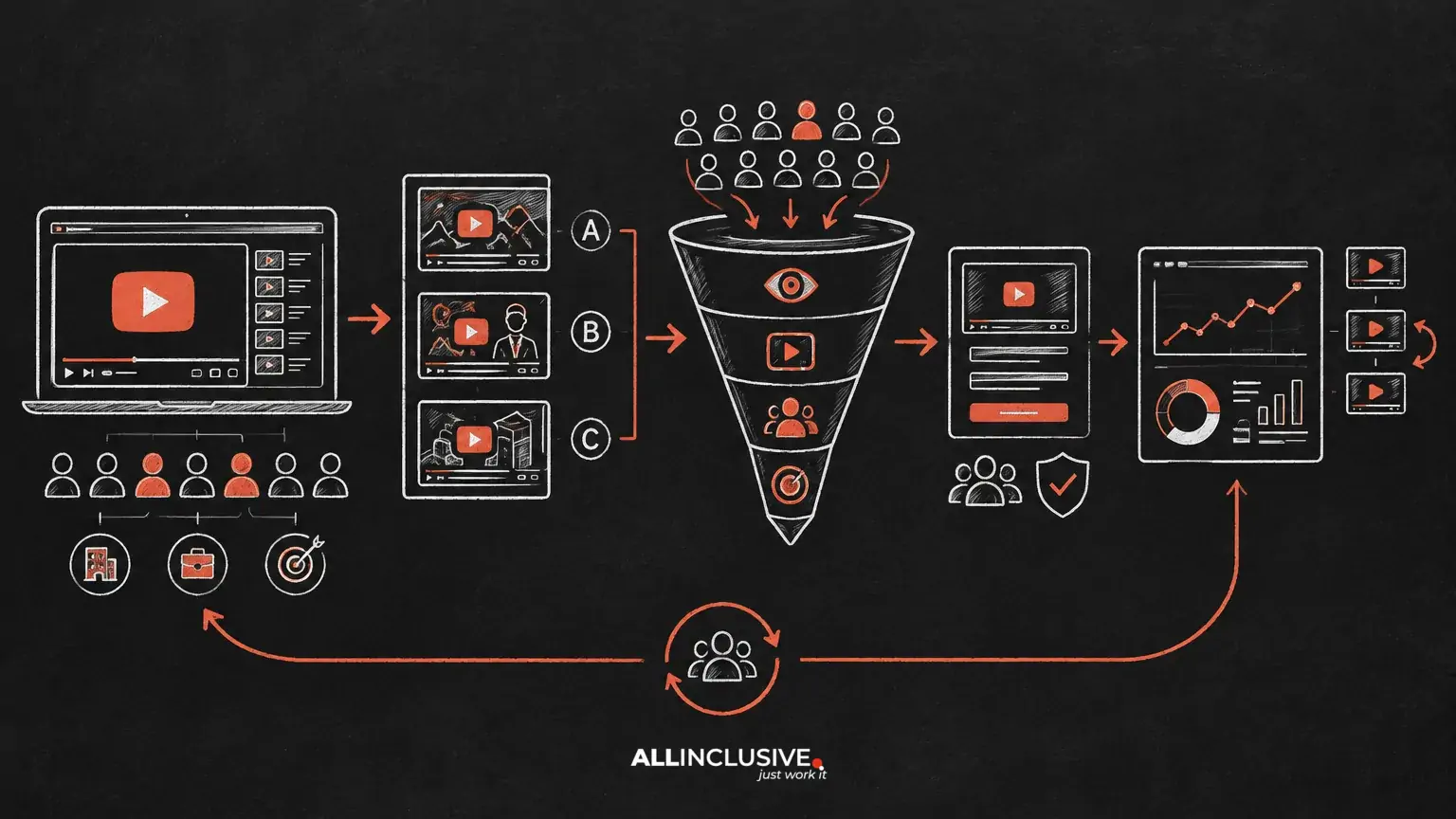
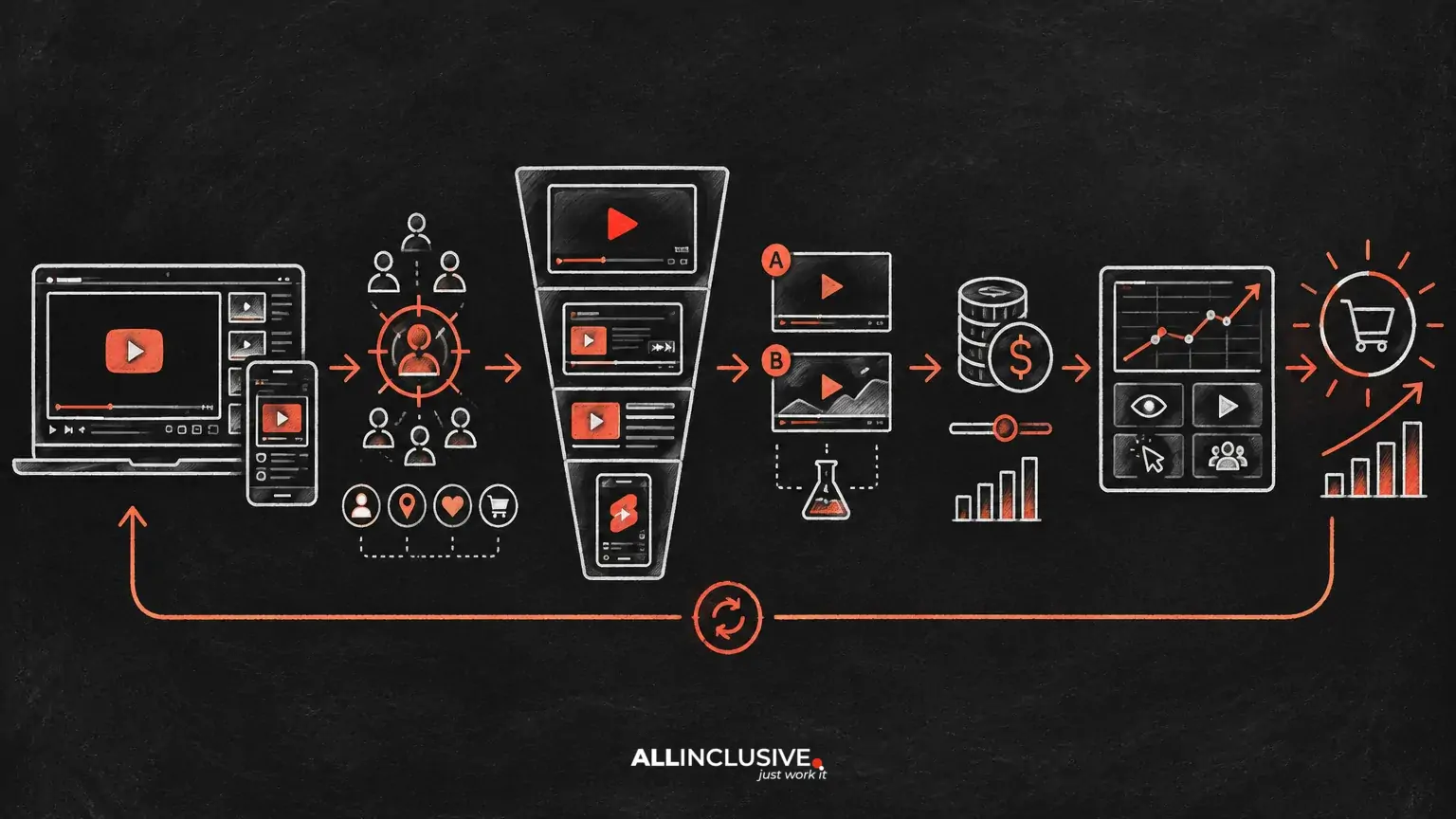
YouTube ads for ecommerce work best when they are treated as more than direct-response banners in video form. Ecommerce brands can use video to demonstrate a product, make a category easier to understand, create demand before a shopper searches, and re-engage people who have already shown intent.
The commercial challenge is deciding which job each campaign should perform. A product demonstration aimed at new prospects should not be judged by the same criteria as a reminder shown to a recent product-page visitor. Strong programs align creative, audience, landing experience, and measurement with the stage of demand being addressed.
This guide covers a practical approach to ecommerce YouTube advertising: where it fits in the funnel, how to develop creative, how to structure audiences, and how to evaluate performance without overstating what video alone caused.
What YouTube ads can do for an ecommerce brand
YouTube can support several distinct ecommerce objectives:
- Demand creation: Introduce a problem, product category, or differentiated use case to people who are not actively shopping.
- Product education: Show how a product works, what it includes, and why it may be preferable to alternatives.
- Consideration: Help shoppers compare options, understand proof points, or overcome purchase objections.
- Conversion support: Re-engage visitors, product viewers, cart users, or prior customers with relevant next steps.
- Customer growth: Promote replenishment, complementary products, upgrades, or seasonal collections to existing buyers.
These objectives can share a channel but should not automatically share the same creative, audience signals, bidding approach, or success metric. A campaign built to generate qualified product interest may produce fewer immediate purchases than a retargeting campaign while still contributing valuable demand.
Start with the customer decision, not the ad format
Before choosing a video length or campaign setup, define the decision the viewer needs to make. The answer usually falls into one of four categories:
- Recognize the problem: The viewer needs to see a relevant pain point or unmet need.
- Understand the solution: The viewer needs a clear explanation of what the product does.
- Trust the offer: The viewer needs evidence such as demonstrations, reviews, credentials, materials, or returns information.
- Take the next step: The viewer needs a direct path to browse, compare, subscribe, or purchase.
For a new product category, lead with the problem and use case. For a known category with intense competition, lead with the product difference. For a high-consideration item, provide proof and answer objections before asking for the sale.
This decision-first approach also helps prevent a common mistake: forcing every video to explain the company, the product, the offer, and the entire catalog at once. A focused message is easier to understand and easier to evaluate.
Creative strategy for YouTube ecommerce campaigns
Make the product visible early
Viewers should quickly understand what is being shown and why it matters. Product visibility does not require an immediate hard sell, but the opening should establish a recognizable situation, benefit, or visual demonstration. Avoid spending the first section of the video on a broad brand introduction if the viewer cannot yet tell what problem the brand solves.
Build around one primary benefit
Select one central promise for each creative concept. That promise could be convenience, performance, comfort, durability, taste, design, or another category-specific benefit. Supporting details can reinforce it, but too many competing claims reduce clarity.
Use demonstrations where they add proof
Demonstration is particularly valuable for products whose value is visual or experiential. Show setup, use, before-and-after context where appropriate, product scale, packaging, texture, fit, or a real workflow. The demonstration should prove the claim rather than simply decorate the video.
Design for sound-off and partial attention
Video ads may be encountered in different viewing contexts. Use clear visual sequencing, readable but restrained on-screen text, strong framing, and a logical story even when audio is unavailable or ignored. Captions and text should support the spoken message rather than duplicate every word in a crowded layout.
Give the viewer a clear next step
The call to action should match the level of intent. A prospect may need to explore a collection or learn how the product works. A returning product viewer may be ready for a product page, offer, or checkout path. Ensure the destination fulfills the promise made in the ad and loads effectively on mobile devices.
Creative concepts worth testing
Testing should compare meaningful hypotheses, not minor edits that have no strategic distinction. Useful ecommerce concepts include:
- Problem-solution: Start with a recognizable frustration and show the product resolving it.
- Product demonstration: Focus on how the product works, including an important feature or use case.
- Customer perspective: Use a first-person explanation of the buying problem and why the product was selected.
- Comparison: Clarify how the product differs from common alternatives without making unsupported claims.
- Objection handling: Address price, complexity, fit, shipping, maintenance, ingredients, returns, or another barrier.
- Collection or routine: Present complementary products as a solution or routine rather than as unrelated catalog items.
- Seasonal relevance: Connect the product to a timely need while keeping the message useful beyond a short promotion window.
Evaluate concepts at the level of the customer problem they address. If a product demonstration outperforms a lifestyle concept, the lesson may be that shoppers need more education—not simply that one opening frame was better.
Audience design for ecommerce video
Audience strategy should reflect both intent and customer value. A practical structure often separates:
- Prospecting audiences: New potential customers selected using relevant signals, interests, content contexts, or platform-supported audience options.
- Consideration audiences: People who have engaged with the brand, watched content, visited key pages, or shown other meaningful interest.
- Conversion audiences: Recent product viewers, cart users, checkout starters, or other high-intent groups.
- Customer audiences: Existing purchasers segmented by recency, product owned, order value, replenishment cycle, or cross-sell opportunity.
Do not assume that a larger audience is automatically better. A broad prospecting audience can be appropriate for a product with wide appeal and strong creative, while a niche product may require more deliberate contextual or interest-based signals. The right choice depends on category size, purchase frequency, margins, and available conversion volume.
Frequency also deserves attention. Repeated exposure can support recall, but excessive repetition can create waste or negative brand effects. Review reach, frequency, creative rotation, engagement quality, and downstream behavior together rather than relying on a single delivery metric.
For a broader discussion of audience inputs and campaign organization, see YouTube Ads Targeting. For sequential messaging to engaged viewers, YouTube Remarketing provides a useful complementary framework.
Connect the ad to the ecommerce experience
The landing experience should continue the ad’s argument. If the video emphasizes a specific product benefit, the destination should make that benefit easy to verify. If the video introduces a collection, the collection page should provide clear navigation and comparison. If the ad uses a promotion, confirm that the offer, eligibility, and expiration details are consistent.
Review the full path from click to purchase:
- Does the destination load quickly and work well on mobile?
- Can the visitor immediately identify the product or collection featured?
- Are price, availability, shipping, returns, and payment information easy to find?
- Does the page provide enough proof for the product’s price and level of consideration?
- Is the checkout path free from unnecessary friction?
Video cannot compensate indefinitely for weak merchandising, unclear product information, poor availability, or a difficult checkout. Diagnose the post-click experience before concluding that the media is the primary problem.
Measurement: separate response from contribution
Measurement should reflect the campaign’s role. Direct conversions are important, but they are not the only useful signal for prospecting video. Depending on the objective and measurement setup, review:
- Reach and frequency among the intended audience
- Video engagement and completed-view behavior
- Click-through and landing-page engagement
- Product-page views, add-to-cart activity, and checkout starts
- New-customer purchases and customer-quality indicators
- Revenue, contribution margin, or allowable acquisition cost
- Assisted behavior and branded search movement, interpreted cautiously
Attribution reports are directional, not a complete account of causality. Video can influence a purchase that later occurs through direct navigation, organic search, another paid channel, or a returning session. Conversely, a conversion assigned to a video interaction may have been likely to occur without the ad.
Use consistent conversion definitions, accurate analytics implementation, and a clear distinction between new and returning customers. Where the budget and volume justify it, consider incrementality testing or carefully controlled geographic, audience, or time-based comparisons. Avoid treating view-through or click-through reporting as proof that every reported conversion was caused by the ad.
How to judge YouTube ads for ecommerce economically
Economic evaluation should connect media cost to the value of the customer acquired, not just the initial order. A campaign can appear efficient on first-purchase revenue while attracting low-margin orders, discount-dependent buyers, or customers unlikely to return.
Useful decision inputs include:
- Gross margin after discounts, shipping, fees, and returns
- New-customer acquisition cost compared with an allowable target
- Average order value and expected repeat purchase behavior
- Product availability and inventory constraints
- Creative production and testing costs
- Time required for demand to convert
For cost terminology and broader media economics, see YouTube Ads Cost. The goal is not to force every campaign into the same return threshold. It is to establish different expectations for demand creation, consideration, conversion support, and retention.
A practical testing and optimization process
Begin with a small set of distinct creative hypotheses and a clear audience purpose for each campaign. Keep the product, offer, destination, and measurement definitions stable enough that results can be interpreted. Then use a regular review cycle:
- Validate delivery: Confirm that the intended audience is being reached and that the ads are eligible, visible, and technically measured.
- Review attention signals: Identify whether the opening and message are earning meaningful viewing behavior.
- Review traffic quality: Compare landing-page engagement and product interaction across creative and audience groups.
- Review commercial outcomes: Examine purchases, customer type, margin, and conversion lag.
- Form one next hypothesis: Change the largest likely constraint—creative clarity, audience relevance, offer, landing page, or measurement.
Do not optimize solely toward the cheapest view or highest click rate. Those metrics can be useful diagnostics, but ecommerce growth depends on qualified demand and profitable customer behavior.
When YouTube may be the right ecommerce investment
YouTube is often a strong candidate when the product benefits from demonstration, the category requires education, the brand has enough margin to support demand creation, or the company needs to reach shoppers before they begin a product search. It may be less suitable when the offer is difficult to explain visually, inventory is unstable, the site cannot convert existing intent, or measurement is not yet reliable enough to guide investment.
The best decision is usually not whether YouTube should replace search, shopping, social, or creator activity. It is how video can perform a distinct job within the broader paid media system, with creative and measurement adapted to that job.
For the wider channel framework, review YouTube advertising and YouTube Advertising Strategy. Ecommerce results improve when audience selection, creative development, landing-page experience, and commercial measurement are planned together rather than managed as separate tasks.