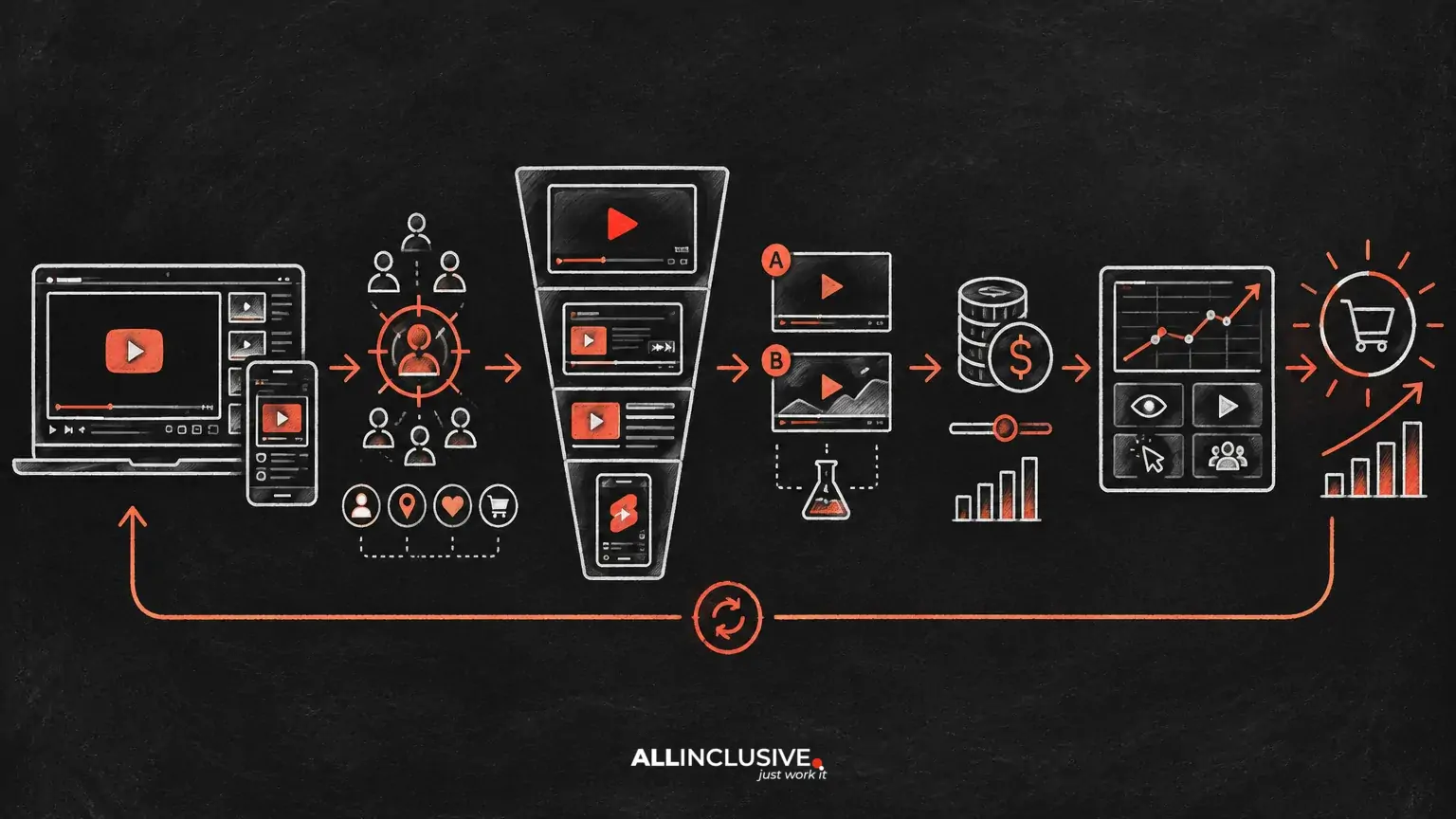
YouTube ads measurement is not a single dashboard or one conversion metric. It is a measurement system that connects exposure, attention, consideration and action while accounting for the fact that many viewers do not click an ad before converting.
The right approach depends on the campaign objective, buying model, conversion path and available first-party data. Brand campaigns may need reach, completed views and lift analysis. Demand-generation campaigns may prioritize qualified visits, engaged sessions and assisted conversions. Direct-response campaigns need reliable conversion definitions, attribution controls and an understanding of what happens after the click.
This guide explains how to evaluate YouTube advertising through three complementary lenses: view-through behavior, incremental lift and conversions.
Start with the business question
Before selecting metrics, define the decision the measurement program must support. Different questions require different evidence.
- Did the campaign deliver exposure? Review reach, impressions, frequency, viewability where available, and video engagement.
- Did people watch or engage? Examine completed views, quartile progression, interactions and site engagement.
- Did advertising change perception or intent? Use a lift methodology rather than relying only on platform-reported clicks.
- Did the campaign generate business outcomes? Measure qualified leads, purchases, pipeline or another agreed conversion event.
- Did the campaign create incremental outcomes? Compare exposed users or markets with an appropriate control group where feasible.
This prevents a common error: judging every YouTube campaign by last-click conversions, even when the campaign was designed to create awareness or influence future demand.
A measurement framework for YouTube campaigns
A useful measurement plan has four layers:
- Delivery: Did the campaign reach the intended audience at an acceptable frequency and cost?
- Attention: Did viewers watch, engage or continue through the creative?
- Response: Did users visit, search, submit, purchase or complete another defined action?
- Incrementality: Were outcomes caused by advertising, or would they likely have happened without exposure?
These layers should be reviewed together. High completion rates do not prove that a campaign generated pipeline. Strong click-through performance does not prove that every conversion was incremental. Conversely, a campaign with few clicks can still influence later branded searches or direct visits.
View-through measurement: what it can and cannot tell you
View-through measurement evaluates actions that occur after an ad impression or video view without a recorded click. It is especially relevant for video because exposure can affect later behavior even when the user does not interact immediately.
View-through conversions can be useful, but they require careful interpretation. They are generally an association between exposure and a later action, not automatic proof of causality. A viewer may already have been researching the brand, may have encountered other marketing channels, or may have converted for reasons unrelated to the ad.
Use view-through data as a diagnostic signal
Review view-through outcomes alongside:
- Click-through conversions and post-click conversion rate
- Conversion timing after exposure
- Audience, placement, device and frequency
- New-customer or qualified-lead status
- Branded search, direct traffic and other demand signals
- Results from controlled tests, when available
A high share of view-through conversions may indicate that video is influencing demand without generating immediate clicks. It may also reflect a broad attribution window, high existing intent, or measurement noise. The next step is investigation, not automatic budget expansion.
Set a sensible attribution window
The appropriate window depends on the buying cycle. A short-window consumer purchase and a complex B2B purchase should not be evaluated in the same way. Longer windows may capture legitimate delayed response but can also claim credit for outcomes increasingly distant from the exposure.
Document the window, apply it consistently, and compare results when the window changes. Avoid presenting view-through totals without stating the measurement rules behind them.
Lift measurement: testing whether advertising changed outcomes
Lift measurement is designed to answer a stronger question than “what happened after exposure?” It asks whether advertising changed an outcome relative to a suitable counterfactual.
Depending on the study design, lift may refer to changes in brand awareness, ad recall, consideration, purchase intent, search behavior or conversions. The exact method and availability depend on the platform setup, campaign scale, geography, audience and research partner or measurement tools involved. For conversion-focused campaigns, enhanced conversions can improve the quality of signals used in measurement.
Brand lift
Brand-lift studies typically compare responses from people exposed to advertising with responses from a control group. They are most useful when the campaign has a clear brand objective and enough eligible audience volume for a meaningful comparison.
Before launching a study, define:
- The primary question, such as ad recall or consideration
- The audience and geography being evaluated
- The creative or campaign variants included
- The minimum practical decision the result should inform
- How the result will be combined with delivery and business metrics
Do not treat a favorable survey result as a substitute for revenue measurement. Brand outcomes and sales outcomes operate on different timelines and should be interpreted as complementary evidence.
Conversion lift and geo-based testing
Conversion lift or geographic holdout testing can help estimate incremental actions by comparing exposed and control conditions. The design must protect the control group from contamination and account for differences between regions, audiences or time periods.
For B2B advertisers, a test may need to measure qualified opportunities or pipeline rather than form fills. That creates a longer feedback cycle, but it produces evidence closer to the commercial objective.
Where a formal lift study is not practical, advertisers can still improve rigor through structured experiments: hold out selected markets, vary budgets across comparable cells, predefine the evaluation period, and avoid changing multiple major campaign inputs at once.
Conversion measurement: build a reliable foundation
Conversion analysis is only as strong as the events being recorded. Start by separating business outcomes from convenient platform events.
Define the conversion hierarchy
A practical hierarchy might include:
- Primary conversions: completed purchases, qualified opportunities, booked meetings or revenue-producing actions
- Secondary conversions: completed forms, product-page engagement, account creation or high-intent content downloads
- Diagnostic events: video engagement, landing-page views, scroll depth or time on site
Primary conversions should guide optimization and budget decisions. Secondary and diagnostic events help explain performance but should not quietly become the definition of success.
Audit the conversion path
Check the complete journey from impression to outcome:
- Confirm that landing pages load correctly across major devices.
- Verify that tags or server-side events fire once and carry the intended event name.
- Check that consent, cookie restrictions and browser behavior are reflected in reporting limitations.
- Compare platform-reported actions with analytics, CRM and transaction systems.
- Match leads back to downstream quality, revenue or pipeline where possible.
Differences between systems are normal because they may use different counting rules, attribution windows, identity signals and processing times. The goal is not to force every system to match exactly; it is to understand the differences and designate a trusted source for each decision.
Choose metrics by campaign objective
Measurement should reflect the job assigned to the campaign.
Awareness and reach
Use reach, frequency, impressions, cost per reached user, completed views and lift indicators. Watch frequency closely: additional exposure may help reinforce a message, but excessive repetition can reduce efficiency or create fatigue.
Consideration
Combine video engagement with quality traffic, branded search trends, engaged sessions, content consumption and consideration or intent measures. Treat clicks as a pathway signal, not the entire value of the campaign.
Lead generation and demand capture
Prioritize qualified leads, meeting rates, opportunity creation, cost per qualified opportunity and pipeline contribution. A low-cost lead is not necessarily efficient if sales acceptance or downstream conversion is weak.
Commerce and direct response
Review purchases, revenue, contribution margin where available, new-customer rate and return on ad spend. Include view-through analysis as context, but validate the claimed contribution through incrementality testing or broader channel analysis when possible.
For a broader overview of campaign planning, see YouTube advertising strategy. For paid acquisition measurement across channels, explore paid media planning and optimization.
Segment the data before making decisions
Aggregate results can conceal important differences. Segment by:
- Audience type, including prospecting, remarketing and customer audiences
- Creative concept, hook, offer and call to action
- Format and inventory context
- Device, geography and language
- New versus returning users
- Conversion type and lead-quality stage
- Frequency and exposure recency
Use segments to generate hypotheses, not to search endlessly for the most favorable slice. Small samples can produce unstable rates, and multiple comparisons increase the chance of false conclusions.
Creative is often a major source of performance variation. Pair measurement with a structured creative review using the principles in YouTube ad creative. If the campaign includes short-form inventory, compare it with the guidance in YouTube Shorts ads.
Build a practical reporting cadence
Different metrics mature at different speeds. Use a reporting cadence that matches the decision.
- Early checks: delivery, spend, tracking health, reach, frequency and obvious landing-page issues
- Weekly review: creative engagement, audience delivery, traffic quality and conversion trends, allowing for reporting delays
- Monthly or milestone review: qualified outcomes, cohort behavior, assisted demand and budget allocation
- Quarterly or campaign-end analysis: lift studies, geo tests, incrementality evidence and strategic recommendations
Do not optimize aggressively on incomplete data. Establish a minimum observation period and meaningful volume threshold before comparing audiences or creative variants.
Common YouTube measurement mistakes
Using one attribution model for every objective
A last-click model may be useful for direct-response reporting but inadequate for awareness. Use multiple views of performance and label each clearly.
Counting all conversions as equally valuable
Separate low-intent actions from revenue, qualified pipeline or other commercial outcomes. Feed quality information back into optimization where the technical setup supports it.
Confusing correlation with incrementality
People exposed to ads may already be more likely to convert. Controlled comparisons provide stronger evidence than exposed-user totals alone.
Ignoring exposure frequency
Performance can vary by number of exposures. Analyze whether additional impressions improve outcomes or mainly add cost.
Changing too many variables at once
Frequent edits to budget, targeting, creative, bidding and landing pages make results difficult to interpret. Sequence tests and record changes.
A decision framework for budget and optimization
Use the following sequence when reviewing a campaign:
- Validate delivery: Is the campaign reaching the intended audience at an appropriate frequency?
- Validate attention: Are viewers progressing through the creative, and does performance vary by concept?
- Validate response: Are visits and conversions being recorded accurately?
- Validate quality: Do leads, customers or pipeline meet the business definition of value?
- Validate incrementality: Is there evidence that advertising caused additional outcomes?
- Act proportionally: Scale, revise or pause based on the strength of evidence rather than a single metric.
For conversion-led setups, the campaign structure and event design should support the measurement plan from the beginning. The related guide to YouTube Video Action Campaigns covers conversion-focused setup considerations. If the strategy depends on re-engaging known users, see YouTube remarketing.
YouTube Ads Measurement: What to Prioritize
Strong YouTube ads measurement combines three perspectives: what the campaign delivered, how audiences responded and whether outcomes were incremental. View-through data helps explain delayed behavior, lift analysis tests whether advertising changed perceptions or actions, and conversion measurement connects exposure to defined business results.
The most reliable programs make the objective explicit, document attribution rules, distinguish primary from diagnostic metrics, validate tracking and use controlled testing whenever practical. That produces a clearer basis for creative decisions, budget allocation and long-term channel planning.