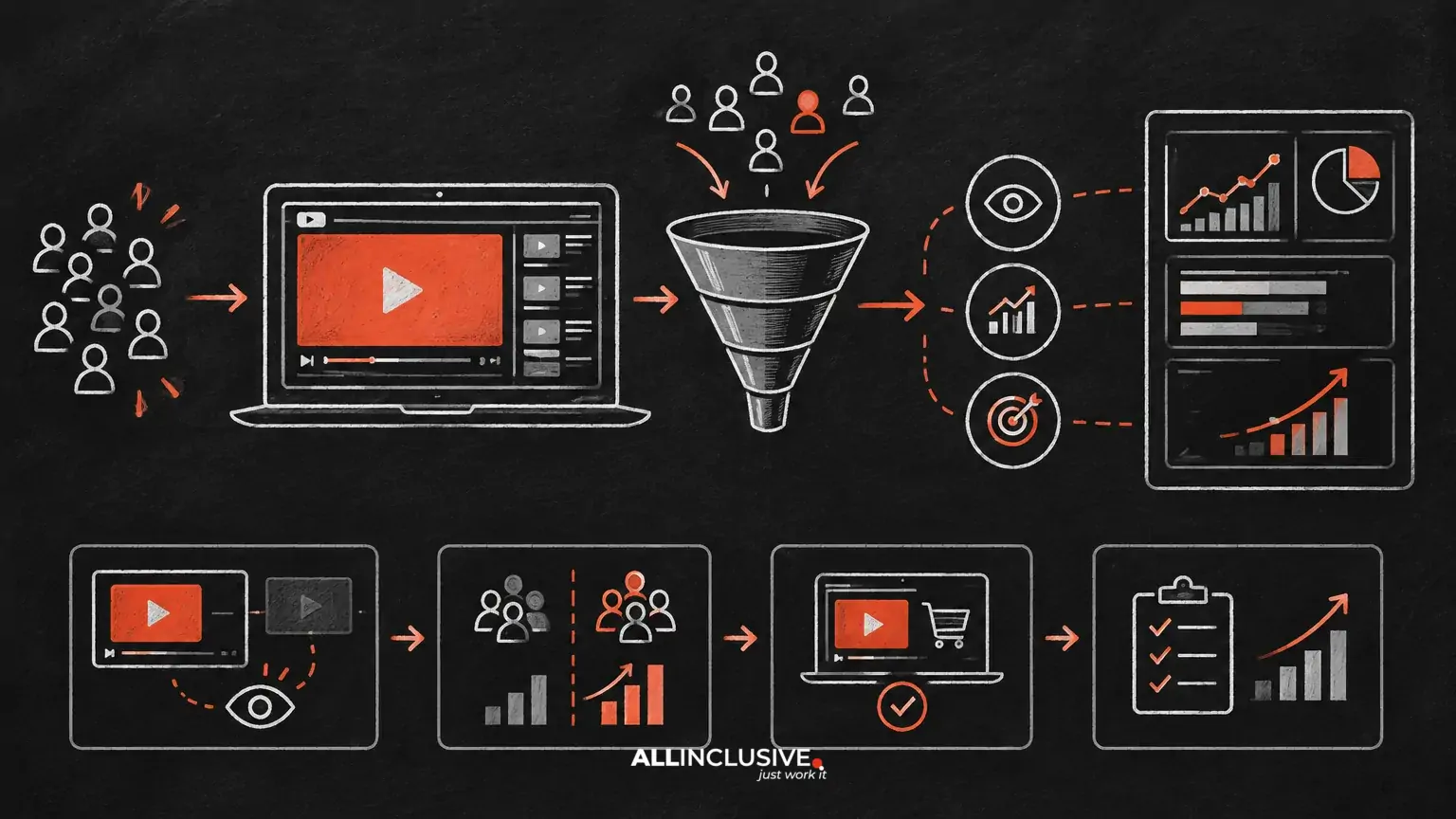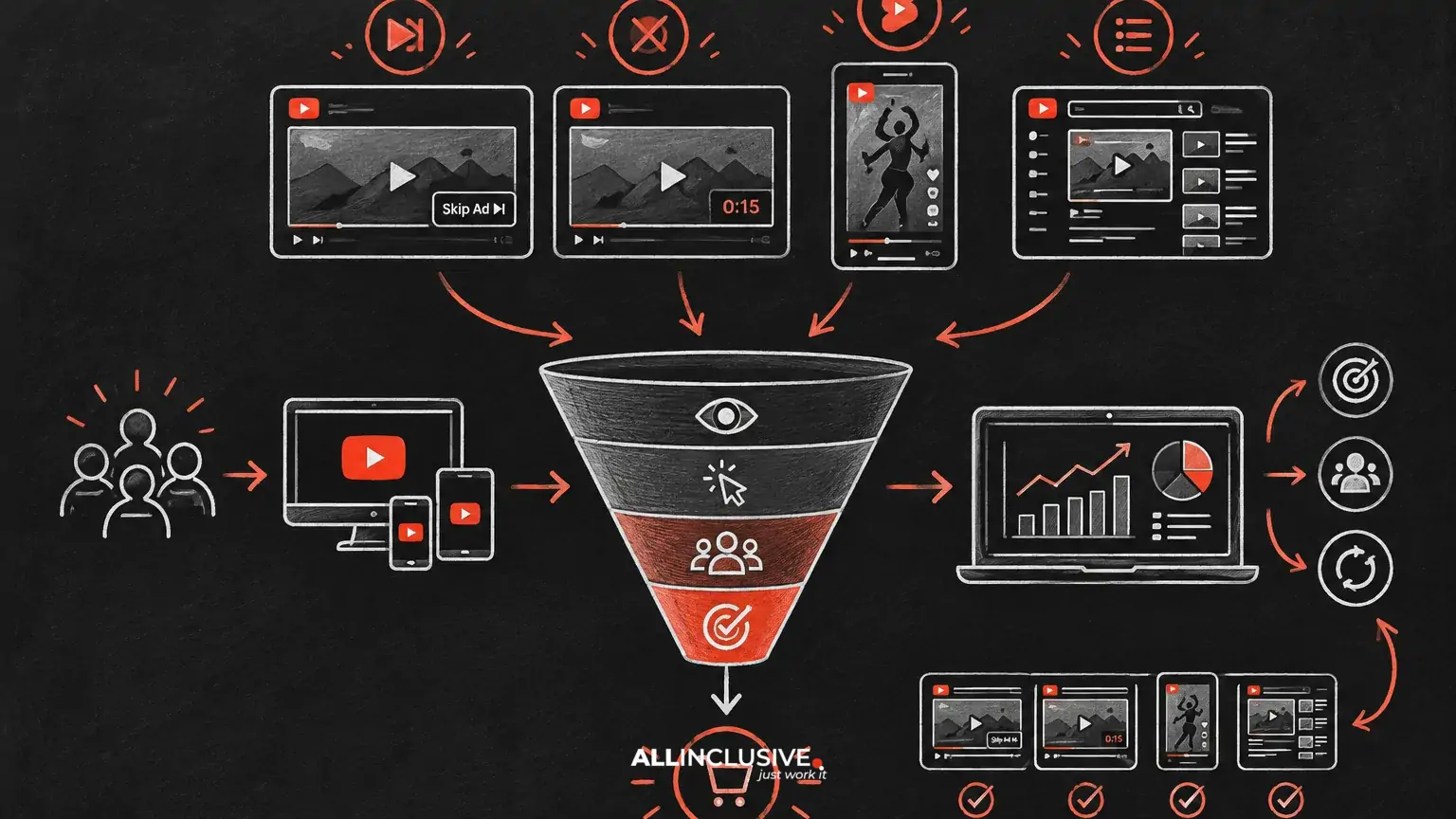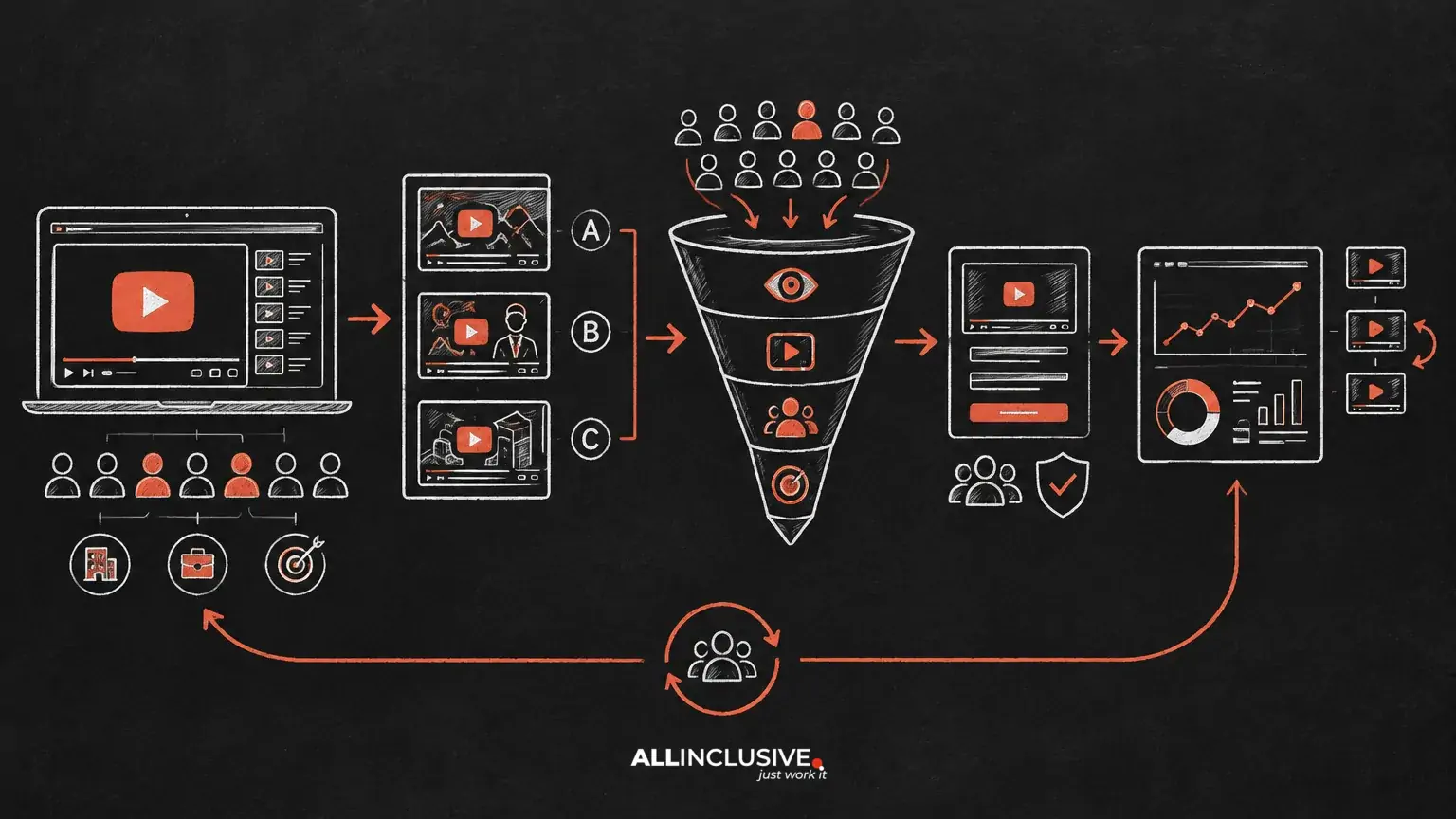
YouTube ads for B2B work best when they are treated as a staged buying-journey system rather than a last-click lead-generation tactic. Video can introduce a problem before a prospect searches for a solution, explain a complex category, establish credibility and give later campaigns a warmer audience to convert.
The commercial question is not simply whether YouTube can generate leads. It is whether video can improve the efficiency and quality of the broader demand system. That requires clear audience roles, useful creative, deliberate sequencing and measurement that connects exposure and engagement with downstream pipeline.
What YouTube ads should do in a B2B funnel
B2B purchases often involve multiple stakeholders, long consideration periods and a category that prospects may not yet understand. YouTube can support three distinct jobs:
- Demand creation: Make a relevant problem visible and give the audience a reason to investigate it.
- Demand capture support: Increase recognition and trust before prospects search, visit the site or respond to another channel.
- Remarketing: Re-engage people who watched, visited, downloaded, attended or otherwise demonstrated interest.
These jobs should not be evaluated with the same expectations. A prospect who has only seen a short introduction is not equivalent to someone who visited a pricing page or requested a technical guide. The campaign structure, creative and success criteria should reflect that difference.
A practical B2B YouTube strategy
1. Define the commercial problem before selecting audiences
Start with the business constraint. Is the company entering a new category, competing in a crowded market, increasing awareness among a narrow account universe, or trying to improve conversion from existing traffic? Each situation calls for a different role for video.
For a new category, the opening message may need to explain the operational problem and its business consequences. For an established category, the creative may focus on differentiation, proof or a specific use case. For a high-intent remarketing program, the priority may be objection handling and a clear next step.
Write the intended progression in one sentence: “After seeing this message, the right prospect should understand X and be more likely to do Y.” If that sentence is unclear, targeting and measurement will usually become unfocused.
2. Segment audiences by knowledge and intent
B2B audience definitions should combine business relevance with behavioral context. Depending on the account and data available, useful groups may include:
- Relevant industries, roles or company-size bands for prospecting.
- People researching a category, problem or adjacent solution.
- Visitors to high-value pages such as solution, comparison, integration or pricing pages.
- People who engaged with a previous video or content asset.
- Known leads, opportunities, customers or excluded accounts.
Audience labels should describe both who the person is and where they are in the buying process. “Operations leaders” is a profile. “Operations leaders who watched a problem-explanation video and visited the integration page” is a more actionable remarketing segment.
Platform availability and audience behavior can change, so validate current targeting options in the account before committing the plan. Strategy should remain stable even when specific mechanics evolve.
3. Build a sequence instead of repeating one advertisement
Repeated exposure to one generic video rarely provides a complete B2B argument. A sequence can make the journey more useful:
- Problem framing: Identify a costly, risky or inefficient situation.
- Category education: Explain how the relevant approach works and when it is appropriate.
- Proof and differentiation: Show methodology, customer evidence, product workflow or credible expertise.
- Conversion support: Present a specific next step such as a consultation, assessment, technical guide or product demonstration.
- Objection handling: Address implementation effort, security, integration, switching risk or internal approval.
Not every account needs all five stages. The sequence should match the length and complexity of the sales cycle. A straightforward product may move from education to conversion quickly; an enterprise purchase may require several proof points before a meeting request is reasonable.
Creative principles for B2B video
Lead with the business tension
Do not begin with a company biography. Open with a recognizable business problem, decision or consequence. For example, a workflow platform might start with the cost of fragmented handoffs, while a cybersecurity provider might focus on the difficulty of proving control across a distributed environment.
The opening should help the intended viewer self-identify. If the message could apply equally to every business, it is unlikely to create strong relevance for a specific buying group.
Make complex value easy to follow
B2B products often require explanation, but explanation does not require a long product tour. A clear structure is usually more effective:
- State the problem in the buyer’s language.
- Explain the relevant change in approach.
- Show the workflow or outcome visually.
- Support the claim with evidence that can be verified.
- Offer one appropriate next step.
Use on-screen support for viewers who watch without sound, but do not overload the frame. The creative should remain understandable when attention is divided.
Match the call to action to intent
A cold prospect may be more responsive to a useful guide, category explanation or diagnostic resource than to a request for a sales call. A returning visitor who reviewed solution details may be ready for a demo or consultation.
Use one primary call to action per asset. A long list of options makes it harder to understand what should happen next and complicates performance analysis.
Demand creation versus remarketing
Demand creation and remarketing need different creative, audience logic and measurement.
Demand creation
Prospecting creative should make the category or problem more salient. It can be aimed at relevant professional groups, industries, contextual interests or other qualified audience definitions. The key test is whether the message earns attention from people who could plausibly become buyers, not whether it produces immediate form fills at the same rate as high-intent search.
Useful prospecting concepts include:
- A short explanation of a problem that is expensive to ignore.
- A point of view on a common but ineffective process.
- A practical benchmark or diagnostic framework, provided the underlying evidence is sound.
- An introduction to a new operating model or category.
Prospecting should be assessed through a combination of delivery quality, engaged visits, branded or direct response, assisted conversions and later-stage pipeline signals where tracking supports them.
Remarketing
Remarketing should reflect what the audience already knows. Someone who watched an introductory video needs a different message from someone who visited a product page or downloaded a technical resource.
Useful remarketing groups may include video viewers at different engagement levels, recent site visitors, content downloaders, webinar registrants and prospects who reached a high-value page but did not complete the intended action. Apply exclusions so the audience is not shown an introductory message after progressing to a later stage.
Remarketing creative can focus on proof, implementation detail, comparison criteria, frequently asked questions or a direct sales conversation. Frequency should be monitored carefully, especially when the audience is small. Excessive repetition can create waste and damage perception without improving intent.
Measurement for B2B YouTube campaigns
Measurement should connect media exposure to meaningful business progress without claiming more causality than the data supports. Establish the tracking foundation before launch:
- Define primary and secondary conversions separately.
- Capture source, campaign, creative and audience details in lead records where possible.
- Distinguish marketing-qualified actions from sales-qualified outcomes.
- Agree on a reporting window that reflects the sales cycle.
- Check whether CRM stages can be reconciled with campaign data.
Primary conversion events might include a qualified consultation request, product demonstration or high-value content action. Secondary signals could include engaged sessions, return visits, video engagement or progression to a key page. These are useful diagnostics, but they should not automatically be treated as revenue outcomes.
Review performance at several levels:
- Delivery: Reach, completed views, view quality and frequency.
- Engagement: Site visits, content consumption and meaningful on-site actions.
- Conversion: Leads, qualified leads and conversion rate by audience and creative.
- Pipeline: Sales acceptance, opportunity creation and later revenue stages when volume and attribution quality permit.
For a broader framework covering audience selection, formats and measurement, see the YouTube advertising strategy guide. The goal is not to force every video impression into a last-click report; it is to understand where video contributes and where the program needs improvement.
Budget and optimization decisions
Set budget according to the role of each campaign and the size of the addressable audience. A narrow remarketing pool may saturate quickly, while a prospecting program needs enough room to test audience-message combinations. Avoid moving budget based on one short reporting window when the campaign’s objective is demand creation.
Optimize in a sequence:
- Confirm that the right audience is receiving the intended message.
- Check whether the opening and call to action earn useful engagement.
- Review landing-page relevance and conversion friction.
- Compare qualified outcomes, not only inexpensive actions.
- Shift budget toward combinations that show stronger commercial evidence.
Do not solve a creative problem with targeting alone. If the message is vague, increasing audience precision may reduce scale without fixing relevance. Likewise, do not judge a demand-creation asset solely by immediate lead volume if the intended role is to establish recognition and support later conversion.
For planning assumptions around cost, auction dynamics and conversion economics, consult the YouTube Ads Cost guide. Cost expectations should be modeled from the account’s audience, geography, creative quality and conversion path rather than copied from a generic benchmark.
Common mistakes in B2B YouTube advertising
- Using one audience for every stage: Prospecting and remarketing need different messages and exclusions.
- Making the video a company introduction: Lead with the buyer’s problem and context.
- Optimizing for cheap engagement: Validate whether engagement produces relevant site behavior and pipeline.
- Sending every viewer to a sales form: Match the offer to familiarity and intent.
- Ignoring sales feedback: Lead quality and account fit often require CRM or sales-team review.
- Overlooking fatigue: Monitor frequency and refresh creative before a small audience becomes saturated.
- Using unclear attribution: Document conversion definitions, windows and limitations before interpreting results.
YouTube Ads for B2B: Implementation Checklist
- Document the commercial objective and the audience’s current awareness.
- Map prospecting, engaged-viewer and site-visitor audiences to funnel stages.
- Create at least one message for problem framing and one for conversion support.
- Design landing pages that continue the promise made in the video.
- Set primary, secondary and offline sales-stage conversion definitions.
- Apply exclusions and audience sequencing rules before launch.
- Establish a review cadence for creative, audience quality and pipeline.
- Record learnings by message, audience, offer and sales outcome.
YouTube is most valuable in B2B when it is integrated with search, content, lifecycle and sales activity. If you are building a broader acquisition program, review the paid media strategy hub for planning across channels. For a deeper look at audience construction, see the guide to YouTube Ads Targeting.
The strongest program is rarely the one with the most video views. It is the one that gives the right prospects a useful reason to care, advances their understanding over time and makes the next commercial step easier to take.