Early advertising data suggests ChatGPT is developing its own media economics. Conversation depth, original creative and destination strategy are emerging as variables that advertisers may need to manage separately from paid search and social.
Key takeaways
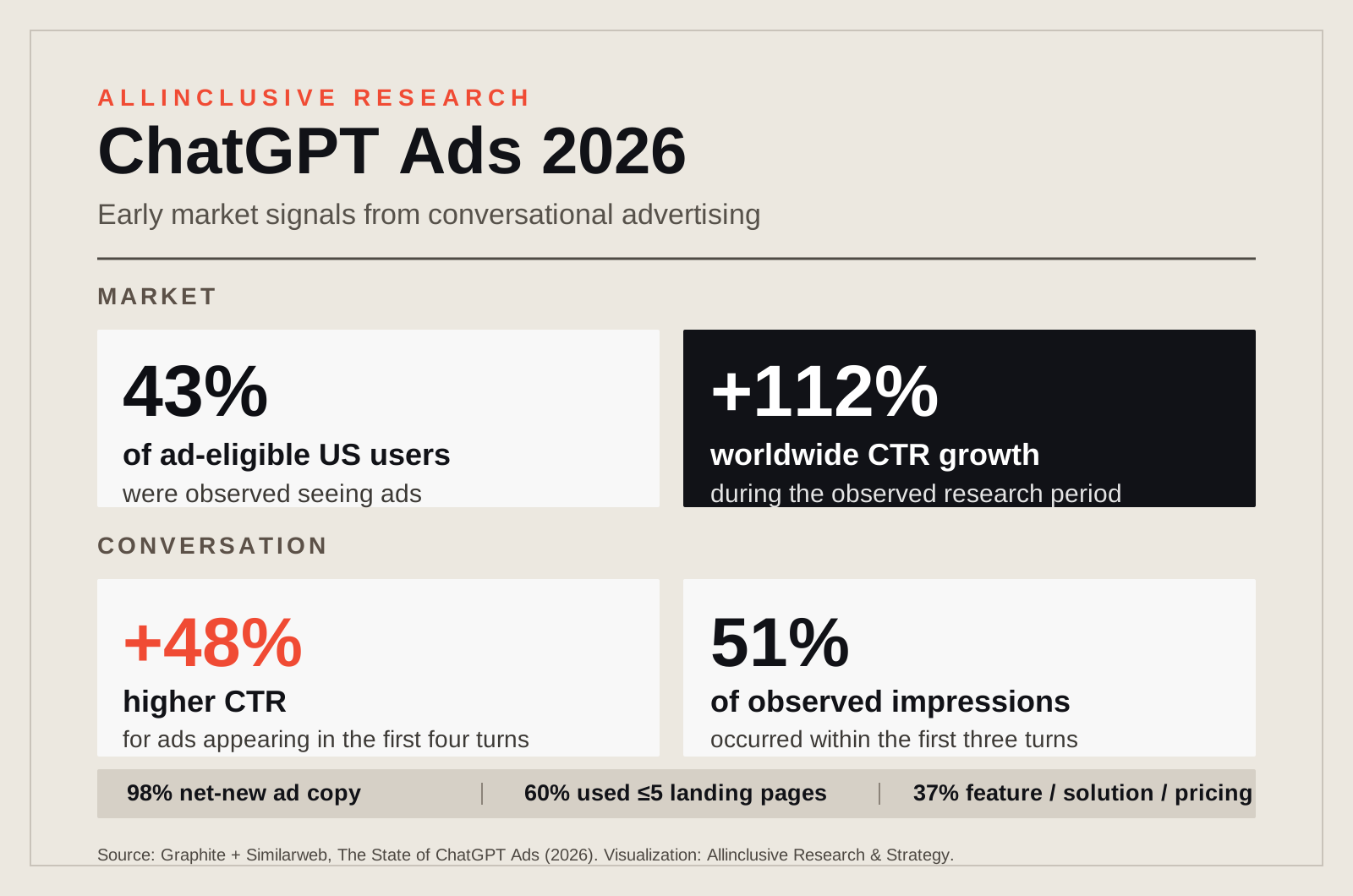
- 43% of ad-eligible users in the measured US market were observed seeing ads.
- Worldwide click-through rate increased 112% during the period analyzed.
- Ads appearing within the first four conversation turns generated 48% higher CTR.
- 51% of observed impressions appeared within the first three turns.
- 98% of observed ChatGPT ad copy was net-new rather than reused Google Search headlines.
- 60% of advertisers used five or fewer landing pages.
A new advertising market is beginning to take shape
ChatGPT advertising is moving from product experiment to measurable media behavior. The market remains young, and the available data should not be treated as a stable industry benchmark. But the first patterns are becoming difficult to dismiss.
Research presented by Graphite and Similarweb shows that advertisers are not simply replicating established paid-search practices inside a new interface. They are testing different creative, concentrating traffic into relatively small destination sets and competing for visibility at specific points inside conversations.
That matters because conversational advertising introduces something search advertisers have rarely had to plan around explicitly: the state of the decision before the advertisement appears.
Market snapshot
Source: Graphite + Similarweb, The State of ChatGPT Ads. Figures describe observations within the researchers' dataset, not guaranteed platform-wide performance.
Conversation depth may become a new form of intent segmentation
The most consequential signal in the dataset may not be overall CTR. It is the relationship between engagement and the point at which an advertisement enters the conversation.
Ads shown within the first four turns recorded 48% higher click-through rates, while 51% of observed impressions were concentrated within the first three turns.
In traditional search advertising, intent is inferred primarily from the query, keyword, audience, location and other auction signals. In a conversational environment, another variable becomes available: how far the user has progressed in defining the problem.
Allinclusive analysis
Conversation depth may emerge as a new intent layer. An advertiser is no longer entering only an auction around a query. It may be entering a decision process after the user has already explained objectives, constraints and possible alternatives.
The creative market is diverging from paid search
The research found that 98% of observed ChatGPT advertising copy was net-new rather than directly reused from Google Search headlines.
The number is notable because copying existing search creative would be the fastest way for advertisers to enter a new text-based ad environment. Instead, the observed behavior points in the opposite direction.
The likely explanation is contextual. A search advertisement often has to infer the user's need from a short query. A conversational interface may already contain the problem statement. Repeating the same keyword back to the user therefore provides less value than introducing a proposition that advances the decision.
| Search advertising | Conversational advertising |
|---|---|
| Responds primarily to a query | Can respond to accumulated context |
| Keyword relevance is central | Decision relevance may become more important |
| Headline often restates demand | Creative can add a next-step proposition |
| Landing page begins the explanation | Landing page may continue an explanation already underway |
Landing pages are becoming part of the media architecture
The destination data points to another structural difference. Sixty percent of advertisers in the dataset used five or fewer landing pages, while feature, solution and pricing pages accounted for 37% of observed destinations.
This suggests that early advertisers are not necessarily building large ChatGPT-specific landing-page libraries. Instead, they appear to be concentrating traffic into a limited number of commercially useful destinations.
That can be rational in a conversational setting. A user may arrive after already learning what the category does, comparing alternatives or discussing a particular business problem. Sending that user to a generic homepage risks discarding context that existed before the click.
Advertisers are still learning where the market is
The data does not yet describe a mature media channel. It describes an active learning market.
Graphite and Similarweb reported that advertiser behavior remains uneven, with a relatively small number of companies demonstrating consistent prominence. Jotform and Resume.io were the two advertisers identified as consistently appearing among the top 10 in the observed dataset.
That distinction matters. The presence of large or sophisticated digital advertisers should not be interpreted as proof that ChatGPT advertising already has predictable economics. It is evidence that companies consider the market important enough to test.
More ads do not necessarily mean more investment
One finding requires particular care. Half of the top 10 advertisers in the research were observed running more ads on ChatGPT than on Meta.
That comparison concerns ad count. It does not establish that those companies are spending more money on ChatGPT, generating superior returns or shifting budgets away from Meta.
The more defensible interpretation is that active advertisers are testing creative breadth aggressively while the channel's norms are still forming.
Branded conversations create a new competitive surface
The research also documented cases in which branded prompts could surface an advertisement from another company.
For marketers, that extends an old competitive problem into a new interface. Brands have long defended branded search terms against competitor advertising. Conversational systems may create a similar issue, but the competitive moment can occur inside a much richer research journey.
Strategic implication
Brand protection may eventually need to cover not only branded keywords but also AI-mediated evaluation journeys in which users ask questions about a company, its products, alternatives or category.
Five conclusions from the early data
Conversation position matters.
The first turns appear commercially different from later turns. Placement strategy may need to account for conversation stage, not merely audience.
Creative is becoming channel-specific.
The 98% net-new copy finding suggests advertisers are already treating the environment differently from conventional paid search.
The click carries more context.
A visitor can reach a landing page after a substantial pre-click conversation. Destination strategy therefore becomes part of media strategy.
Brand defense may expand into AI interfaces.
Competitive advertising around branded conversations introduces another surface that large brands may eventually need to monitor.
Learning velocity is the early advantage.
In an immature market, the advertiser that learns fastest about placement, creative and destination fit may have a larger advantage than the advertiser that simply buys the most inventory.
The Allinclusive ChatGPT Ads Readiness Index
For advertisers evaluating the channel, we use five operating dimensions. Each dimension is scored from zero to two, creating a maximum readiness score of 10.
What the data does not tell us yet
Early-market research is most useful when its limits are explicit. Several important questions remain unresolved.
- Whether current CTR levels will persist as ad supply and advertiser participation increase.
- How performance differs by industry, geography and purchase cycle.
- How much observed engagement is incremental rather than displaced from existing channels.
- How post-click conversion quality compares with search, social and other acquisition sources.
- Whether early-turn performance reflects placement itself or differences in the conversations that qualify for those placements.
- How advertiser auction dynamics and pricing will evolve as competition increases.
Those gaps are why the current numbers should be used as directional evidence, not as forecast assumptions.
What sophisticated advertisers should test first
An initial campaign does not need to answer every question about the channel. It needs to establish whether the channel produces enough qualified evidence to justify another round of investment.
- Conversation stage: Where in the dialogue does qualified engagement occur?
- Proposition: Which messages outperform generic brand language?
- Destination: Do feature, solution, comparison or pricing pages produce better downstream behavior?
- Quality: Are users completing meaningful business actions after the click?
- Incrementality: Is the channel creating new demand or redistributing demand from existing media?
The objective of the first campaign should therefore be learning efficiency, not impression volume.
Methodology & disclosure
About this analysis
This article is based on publicly presented research from Graphite and Similarweb in The State of ChatGPT Ads, published in September 2026.
The performance figures and advertiser observations cited above originate from that dataset. Allinclusive did not independently collect the underlying advertising impression data and does not present the figures as proprietary measurements.
The classification of the findings into conversation intent, creative systems, landing-page architecture, measurement and brand protection represents Allinclusive analysis and interpretation.
References to advertisers describe activity observed in the research and do not imply sponsorship, partnership, endorsement or a commercial relationship with Allinclusive.
Allinclusive Research & Strategy
The market is early. The operating questions are already visible.
ChatGPT advertising does not yet have the long performance history of search or social media. That makes certainty scarce, but it does not make the available signals irrelevant.
The early evidence points toward a media system in which conversation stage, native creative, destination relevance and downstream measurement matter from the start.
For advertisers, the opportunity in 2026 is less about being first to spend and more about being first to understand what deserves to scale.