UGC ads can be effective when the creator’s perspective helps an audience understand, trust, or imagine a product. They are not automatically high-performing because they look informal. For performance marketing, the strongest UGC usually combines a credible point of view with a clear customer problem, a specific proof point, and a direct next step.
The practical question is not whether UGC is “authentic.” It is whether a creator-led asset communicates a relevant promise more effectively than the alternatives available to your audience. That requires a deliberate brief, controlled testing, and measurement beyond cheap clicks.
What UGC ads are—and what they are not
User-generated content ads are paid placements built around a customer- or creator-style presentation. Common formats include testimonials, product demonstrations, unboxings, first-use reactions, tutorials, comparisons, and problem-solution videos. The creator may be an actual customer, a paid creator, an employee, or an actor following a customer-informed script.
That distinction matters. “UGC” describes a creative style and production approach more than a guarantee of organic origin. A polished testimonial can still feel credible, while an unscripted-looking video can feel artificial if its claims, delivery, or setting do not match the audience.
UGC also should not be treated as a replacement for every other format. Static ads, product demonstrations, founder-led videos, motion graphics, and editorial-style creative may communicate a benefit more clearly in particular categories or funnel stages. The right choice depends on the buying decision, audience awareness, offer, and amount of explanation required.
When authenticity can improve performance
Authenticity is valuable when it reduces uncertainty. A prospective buyer may want to know whether a product works in a situation that resembles their own, whether a learning curve is manageable, or whether the claimed benefit is meaningful in everyday use. A believable creator can make those questions easier to answer.
UGC is often a strong fit when:
- The product benefits from demonstration. Physical products, software workflows, services, and educational offers can become easier to understand when someone shows the experience.
- The category has skepticism. A specific account of the problem, process, and outcome can be more persuasive than a broad brand claim.
- The audience needs social context. Viewers may respond to seeing how a product fits into a routine, role, industry, or use case.
- The offer is unfamiliar. A creator can translate a new concept into plain language before the viewer is ready to evaluate features.
- The buying decision involves identity or lifestyle. The right person can help an audience picture themselves using the product.
UGC is less likely to solve a problem when the core issue is weak positioning, an unclear offer, poor landing-page alignment, or a product that cannot support the promise. Creative format cannot compensate for a proposition that is not compelling or credible.
Match the UGC concept to the funnel job
A UGC ad should have a defined job. “Make it feel natural” is a production direction, not a performance objective. Start by identifying what the audience must believe or do after exposure.
Awareness and problem recognition
At the top of the funnel, a creator can dramatize a recognizable problem or introduce a new way to think about it. The opening should quickly establish the situation rather than begin with a long personal introduction. For example, a creator might show the friction of managing a recurring workflow and then explain the category of solution.
The objective is usually not to communicate every feature. It is to earn attention from the right audience and create enough relevance for further consideration.
Consideration and education
In the middle of the funnel, UGC can explain how the product works, address objections, or compare the experience before and after adoption. Demonstration-led formats are useful here because they connect a claim to visible evidence.
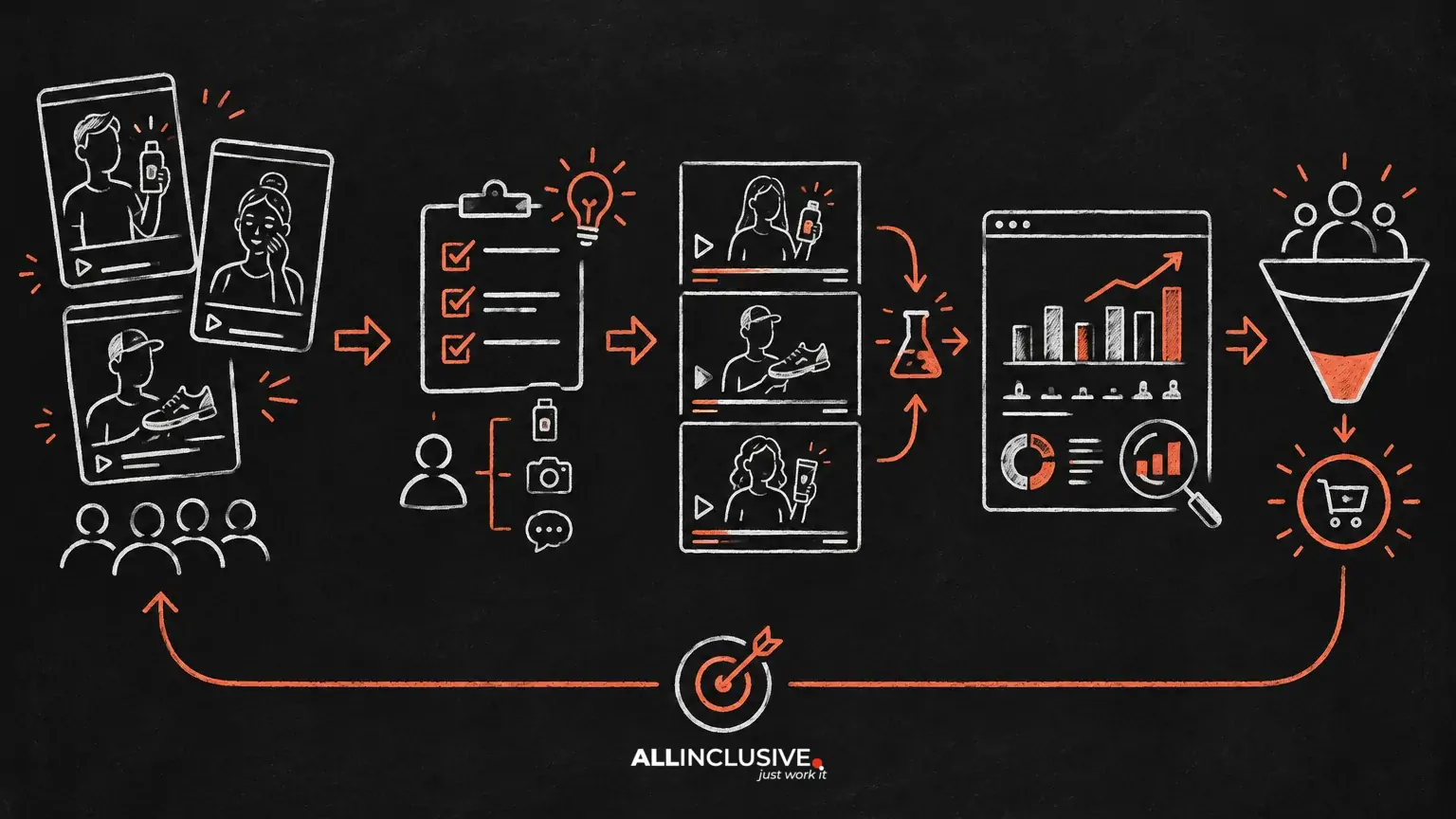
A strong consideration asset may follow this sequence:
- Identify the audience or situation.
- State the specific problem or frustration.
- Show the product, process, or intervention.
- Explain one meaningful benefit.
- Address a likely objection.
- Direct the viewer to the next evaluation step.
Conversion and decision support
For lower-funnel audiences, the creator should reinforce the decision rather than repeat broad awareness messaging. Useful angles include a concise testimonial, a walkthrough of the purchase or signup process, a response to a common objection, or a clear explanation of who the offer is and is not for.
Conversion-focused UGC still needs a credible call to action. Avoid forcing urgency or exaggerated claims into a format whose strength is trust. The message should make the next step understandable and proportionate to the audience’s readiness.
How to brief creators for performance
A performance brief should provide enough structure to protect the strategy without scripting every gesture or sentence. Over-direction can make an asset sound like an advertisement; under-direction can produce content that is engaging but commercially incomplete.
Include these elements in the brief:
- Audience: Define the role, situation, level of awareness, and relevant pain point—not just age or demographic labels.
- Single-minded objective: Specify whether the asset should generate problem recognition, explain the product, overcome an objection, or drive a qualified action.
- Core promise: State the benefit in language that can be demonstrated or supported.
- Proof requirements: Identify the experience, feature, process, or evidence that should make the promise believable.
- Guardrails: Document approved claims, prohibited implications, required disclosures, and category-specific compliance considerations.
- Creative boundaries: Clarify brand voice, visual restrictions, product handling, and any essential information.
- Deliverables: Define placements, aspect ratios, opening variations, cutdowns, captions, and required files.
Give creators a small set of approved talking points and questions rather than a rigid monologue whenever the format allows. Ask them to describe what they noticed, what changed, or what they would tell someone in the same situation. Specificity is generally more useful than generic enthusiasm.
Build the ad around a clear message architecture
Many UGC ads fail because the creator is relatable but the message is diffuse. A useful structure is a hook, context, proof, and action.
- Hook: Open with the problem, outcome, surprising observation, or relevant question.
- Context: Help the viewer understand why the creator’s experience applies to them.
- Proof: Show the product or explain the mechanism behind the benefit.
- Action: Tell the viewer what to do next and what they will find there.
These elements do not need to appear as formulaic labels. They can be expressed through a demonstration, a direct-to-camera explanation, a screen recording, or a sequence of practical moments. The important point is that the creative earns attention and then pays it off with information.
For B2B offers, avoid treating UGC as consumer-style performance by default. A customer interview, practitioner walkthrough, employee perspective, or role-specific demonstration may be more credible than a casual testimonial. The visual language can be accessible while the substance remains rigorous.
What to test in UGC ads
Testing should isolate meaningful variables. Producing many superficially different videos does not necessarily create learning. Start with strategic differences that could explain why an audience responds.
Useful test dimensions include:
- Audience problem: Compare different pain points or use cases.
- Creator perspective: Test a customer, practitioner, founder, employee, or category-specific voice where appropriate.
- Opening angle: Contrast a problem hook, outcome hook, demonstration, objection, or comparison.
- Proof type: Test a visual demonstration against an explanation, testimonial, or process walkthrough.
- Message depth: Compare a concise benefit-led version with a more educational version.
- Call to action: Match the action to the funnel stage and landing-page experience.
Change one primary variable at a time when the objective is to learn. In exploratory phases, broader concept tests are reasonable; afterward, refine the strongest angle through edits to the opening, pacing, proof, and offer framing.
For a broader testing system, see our creative testing framework. UGC should also be evaluated within the wider performance creative strategy, not as an isolated asset type.
Measure business contribution, not just engagement
UGC often attracts attention because it resembles content people already consume. That makes early engagement signals useful for diagnosis, but not sufficient for investment decisions.
Evaluate performance in layers:
- Attention: Does the opening stop the right audience and create meaningful viewing behavior?
- Message delivery: Do viewers reach the product explanation, proof, and call to action?
- Response: Does the ad generate the intended click, lead, signup, purchase, or other qualified action?
- Efficiency: Does the asset contribute to acceptable acquisition economics when measured against the campaign objective?
- Quality: Do downstream actions indicate fit, intent, and value rather than low-quality volume?
Use platform reporting for directional creative signals, but interpret it alongside analytics, conversion data, lead quality, and the full customer journey. A UGC ad can earn a strong click-through rate while attracting poorly qualified visitors. Conversely, a narrower asset may produce fewer clicks but better commercial outcomes.
Keep the landing-page promise aligned with the ad. If the creator emphasizes a use case, the destination should help the visitor confirm that use case quickly. Mismatches create friction that creative optimization cannot fully repair.
Production and approval considerations
Performance UGC needs a repeatable production process. Establish how creators will receive products or access, how claims will be reviewed, how revisions work, and what usage rights are required for paid distribution. The exact legal and platform requirements depend on the market, offer, and distribution context, so involve appropriate counsel or compliance reviewers where necessary.
Request multiple openings and, when practical, alternate proof sequences from the same shoot. This creates testing options without requiring a completely new production for every hypothesis. Capture clean audio, usable product footage, and versions with captions or text treatment as needed for the intended placements.
Do not confuse roughness with credibility. Natural delivery, relevant context, and clear evidence matter more than deliberately poor lighting, excessive jump cuts, or invented spontaneity.
When UGC is the wrong answer
Choose another format when the product requires detailed technical explanation, the offer depends on premium visual presentation, the audience expects formal authority, or the creator perspective would introduce unnecessary ambiguity. A product demonstration, static comparison, expert-led explainer, or structured case study may do the job better.
UGC can also be the wrong answer when the available creator does not match the audience or cannot speak credibly about the problem. Casting for surface resemblance is not enough. The person must have a believable relationship to the use case, and the script must respect what they can reasonably claim.
Use UGC when it improves communication—not because it is currently fashionable. The strategic goal is to make the value proposition easier to understand and trust.
UGC Ads for Performance Marketing: Pre-Launch Checklist
- Define the audience problem and funnel objective.
- Choose a creator perspective that is credible for the use case.
- Write a brief with one core promise and specific proof requirements.
- Prepare several strategically different hooks.
- Align claims, disclosures, usage rights, and approvals.
- Match the landing page to the ad’s promise and audience context.
- Launch a test that can distinguish concept performance from production effects.
- Review attention, message delivery, conversion quality, and efficiency together.
- Iterate on the winning angle before assuming the format itself is the winner.
UGC ads perform best when authenticity is treated as a communication advantage, not a substitute for strategy. Start with the customer problem, give the creator a credible role, show why the product matters, and measure whether the resulting action is commercially valuable. That approach makes UGC one useful component of a disciplined performance creative program and the broader paid media system.