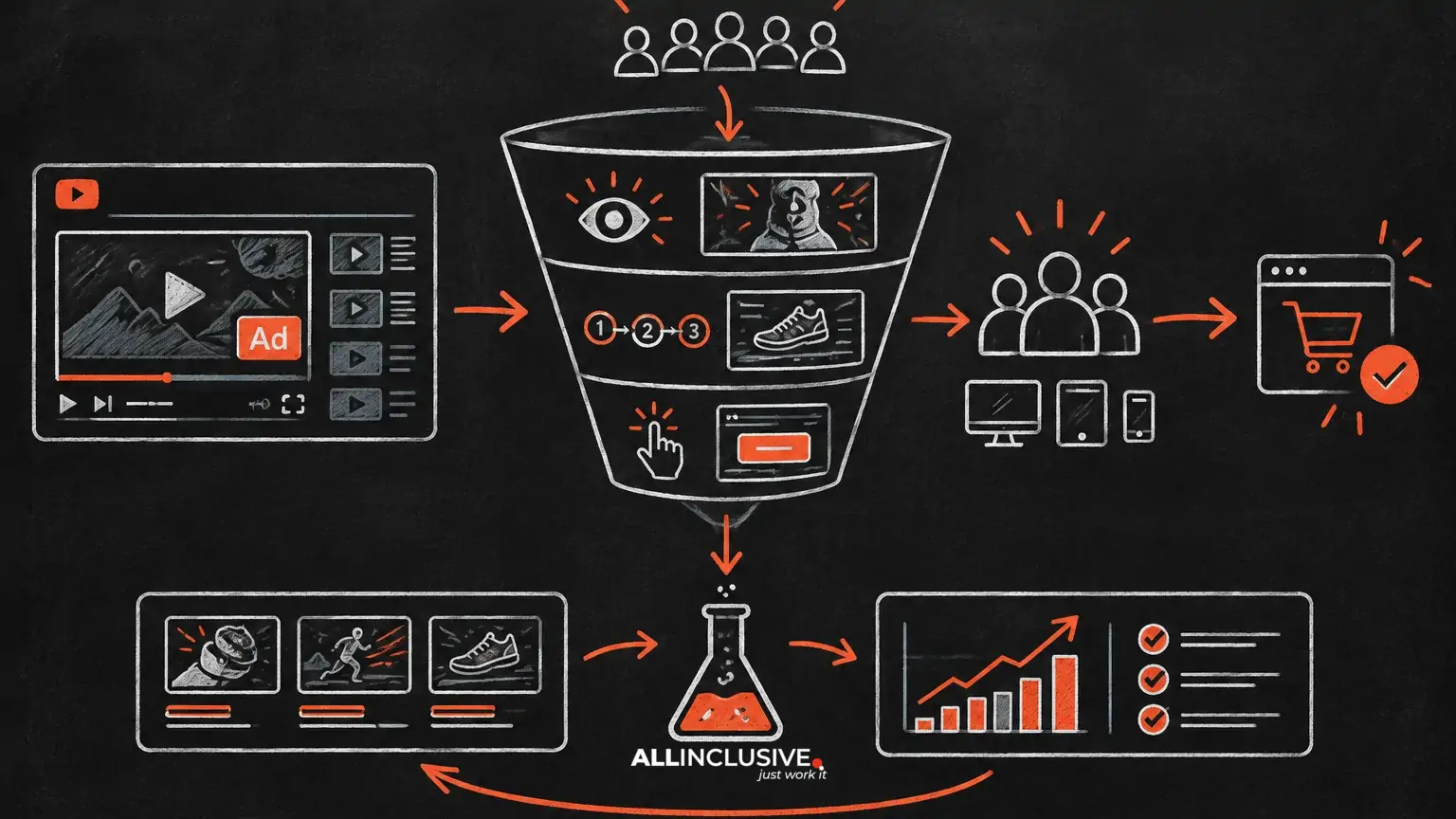
A creative testing framework gives paid-media teams a repeatable way to decide what to test, how to compare concepts, and what to do with the results. The goal is not to find a permanent “winning ad.” It is to reduce uncertainty quickly enough that creative production and media investment improve together.
Without a framework, teams often change the hook, offer, format, audience, landing page, and budget at the same time. When performance moves, nobody knows why. A disciplined process separates the variables that matter, defines the decision before launch, and treats every test as an opportunity to improve the next iteration.
What a creative testing framework should accomplish
A useful framework should answer five questions:
- What are we trying to learn? For example, whether a pain-led message is more relevant than an outcome-led message.
- Which variable is being isolated? This might be the opening hook, visual treatment, proof point, offer, or call to action.
- What evidence will support a decision? Define the primary signal and the guardrails before reviewing results.
- What action follows the test? Promote, iterate, pause, retest, or gather more evidence.
- How will the learning influence future creative? A result has value only when it changes the next brief, production choice, or media decision.
This makes testing a learning system rather than a series of disconnected ad launches. It also keeps the process distinct from platform mechanics. Delivery systems may determine how ads are distributed, but the strategic work is deciding what message and experience deserve to be tested.
Start with a testable creative hypothesis
Every test should begin with a hypothesis that connects a creative change to an expected audience response. A strong hypothesis is specific enough to prove or disprove.
Because [audience insight], we expect [creative change] to improve [business-relevant behavior] compared with [control], because [reason].
For example:
- Because prospects are uncertain about implementation effort, we expect a hook that demonstrates a simpler process to generate more qualified engagement than a generic efficiency claim.
- Because buyers need evidence before requesting a consultation, we expect a customer-proof opening to produce stronger downstream intent than a feature-led opening.
- Because the current ad asks for commitment too early, we expect a lower-friction educational call to action to improve the quality of initial responses.
A hypothesis should not merely say that one color, thumbnail, or headline will “perform better.” It should explain the audience problem and the behavior the change is intended to influence.
Choose the variable before choosing the asset
Creative tests become difficult to interpret when too many elements change at once. The answer is not to test only tiny cosmetic differences forever. It is to match the test design to the question being asked.
Test one primary variable when diagnosis matters
If the goal is to learn whether a new hook works, keep the main body, offer, format, audience, and destination as consistent as practical. This creates a clearer comparison and helps the team decide whether the hook deserves further development.
Common isolated variables include:
- Opening hook or first visual moment
- Audience problem or message angle
- Product demonstration versus outcome visualization
- Expert explanation versus customer proof
- Offer framing or call to action
- Static, video, carousel, or other format treatment
Use concept-level tests when the strategic question is broader
Sometimes the real question is not whether one headline beats another, but whether the audience responds better to a fundamentally different proposition. In that case, a concept-level test can change the hook, narrative, visual system, and proof structure together.
Concept tests can reveal larger opportunities, but they do not explain which individual element caused the outcome. Record them as directional evidence, then deconstruct the stronger concept into smaller, more diagnostic follow-up tests.
A practical sequence is:
- Test several materially different concepts to identify promising territory.
- Develop the strongest concept into controlled variations.
- Test hooks, proof, format, and calls to action within that territory.
- Refresh the winning structure with new examples rather than cloning one asset indefinitely.
Build a test matrix that reflects the buying decision
A test matrix prevents the team from overproducing minor variations while neglecting important strategic angles. Organize it around the components that shape how a prospect understands and evaluates the offer.
| Dimension | Example variations | Question to answer |
|---|---|---|
| Audience problem | Cost, complexity, risk, speed, missed opportunity | Which problem feels most urgent? |
| Promise | Save time, improve control, reduce uncertainty, increase output | Which outcome earns attention? |
| Proof | Demonstration, expert explanation, customer story, comparison | What makes the claim credible? |
| Format | Static, short video, screen recording, carousel | Which format communicates the idea clearly? |
| Friction | Immediate consultation, guide, assessment, product exploration | What is the appropriate next step? |
Do not attempt to test every cell at once. Rank opportunities by expected impact, confidence in the underlying insight, and production effort. The best next test is often the one that resolves the most important uncertainty, not the one that is easiest to produce.
For a more detailed planning structure, see the creative test matrix.
Define success before launch
A test needs a primary decision metric and supporting guardrails. The right metric depends on the funnel stage and the business objective.
- Attention signals: useful when evaluating whether the opening earns initial engagement.
- Engagement signals: useful when the creative asks the audience to consume or interact with more information.
- Conversion signals: useful when the test is intended to influence a measurable action.
- Quality signals: useful when inexpensive responses are not necessarily valuable business outcomes.
- Efficiency signals: useful for understanding the relationship between spend and qualified outcomes.
Do not treat an inexpensive click as proof of a strong business message. A creative asset can attract attention while producing weak-fit traffic. Conversely, a specialized message may generate fewer interactions but stronger downstream intent. The test objective should determine how the evidence is interpreted.
Set guardrails for issues such as poor landing-page alignment, low-quality leads, negative feedback, weak delivery volume, or unsustainable production requirements. These guardrails prevent a superficially attractive result from becoming a strategic mistake.
Control the test environment where possible
Perfect experimental conditions are uncommon in live paid media. Audiences overlap, delivery changes over time, and conversion volume may be limited. The goal is not laboratory purity; it is credible learning.
Improve interpretability by keeping the following consistent when they are not part of the test:
- Audience definition and exclusions
- Landing page or conversion destination
- Offer and conversion flow
- Budget logic and campaign structure
- Tracking conventions and naming
- Review window and attribution approach
Document anything that could affect the comparison, including budget changes, major website updates, seasonal events, inventory constraints, or shifts in sales follow-up. If several variables move simultaneously, label the result as directional rather than definitive.
Use a clear test naming and documentation system
Testing creates operational value only when people can find and understand the evidence later. Use names that identify the campaign, audience, concept, variable, version, and date. A simple structure might be:
Offer_Audience_Concept_Variable_Version_Date
Maintain a test log with:
- Hypothesis and strategic rationale
- Control and challenger descriptions
- Primary metric and guardrails
- Launch and review dates
- Relevant spend and delivery context
- Observed result and confidence level
- Decision and next action
Write the conclusion in plain language. “Variant B won” is not enough. Prefer: “The demonstration-led opening generated stronger qualified intent than the feature-led opening, suggesting that visible proof should be retained in the next concept round.”
Read results as evidence, not verdicts
Creative performance is affected by audience, delivery, offer, landing-page experience, conversion friction, and timing. A result should therefore be interpreted in context.
Separate signal strength from business importance
A large difference in an early-funnel metric may not translate into a meaningful business outcome. Ask whether the result:
- Appears across more than one relevant audience or placement context
- Persists beyond an initial delivery fluctuation
- Improves a metric connected to the business objective
- Produces acceptable downstream quality
- Can be repeated without excessive production complexity
Use directional language when evidence is limited
When volume is low or several factors changed, avoid declaring a universal winner. Use labels such as promising, inconclusive, not supported, or requires a follow-up test. This protects the team from overfitting to noisy results.
Look for patterns across tests
One test can be misleading. Repeated evidence is more useful. If several tests suggest that concrete demonstrations outperform abstract claims, that pattern deserves a place in the creative brief. If a result appears only once, treat it as a clue rather than a rule.
Turn every result into the next brief
The purpose of testing is not simply to pause weaker ads and scale stronger ones. The larger advantage comes from converting evidence into production guidance.
After each review, capture:
- Keep: elements supported by the evidence.
- Change: elements that limited clarity, relevance, or action.
- Explore: adjacent hypotheses suggested by the result.
- Retire: assumptions that the evidence did not support.
For example, if a problem-led hook attracts qualified attention but the product explanation loses momentum, the next brief might preserve the opening while simplifying the middle section. That is more valuable than producing another unrelated ad.
This is where the creative iteration process becomes important: performance data should influence the next concept without reducing creative development to mechanical duplication.
Common creative testing mistakes
Testing too many variables at once
This creates a result but not a useful explanation. If the test is intentionally broad, label it as a concept test and plan a diagnostic follow-up.
Declaring a winner too early
Early delivery can be unstable, and a small amount of data can exaggerate differences. Establish a review rule based on meaningful evidence rather than a fixed universal threshold.
Optimizing for the easiest metric
Teams often default to the metric that moves fastest. Make sure it reflects the intended business outcome and is paired with quality checks.
Confusing creative fatigue with a weak concept
An asset may decline because its audience has seen it too often, not because the underlying message is invalid. Learn to distinguish creative fatigue from audience saturation; the diagnostic approach is covered in ad fatigue vs. audience saturation.
Failing to create enough variation in the right dimension
Changing a headline by one word may not test a genuinely different angle. If the hypothesis concerns urgency, proof, or risk, the creative should make that strategic difference clear.
A practical operating cadence
A sustainable testing program can follow a recurring cycle:
- Diagnose: review performance, customer language, sales feedback, and funnel friction.
- Prioritize: choose the uncertainty with the highest potential business impact.
- Brief: document the hypothesis, control, challenger, metric, and guardrails.
- Launch: keep non-test variables consistent where practical.
- Monitor: check delivery and data quality without reacting to every short-term movement.
- Review: interpret results in relation to volume, quality, and context.
- Apply: update the next brief, media plan, and creative library.
Keep the cadence matched to the available budget, audience size, conversion volume, and production capacity. More tests are not automatically better. A smaller number of well-structured tests can produce more usable learning than a constant stream of poorly documented variations.
How this framework supports performance creative
Performance creative sits between market understanding, message strategy, production, and media execution. A testing framework connects those disciplines. It gives designers a clearer reason for each variation, gives media buyers a more defensible interpretation of results, and gives business leaders a view of how creative investment is reducing uncertainty.
For a broader view of how creative and media decisions work together, explore performance creative and the wider paid media discipline.
The strongest system is not the one that produces the most ads. It is the one that learns deliberately, preserves useful evidence, and compounds that learning into clearer concepts, better briefs, and more efficient decisions.