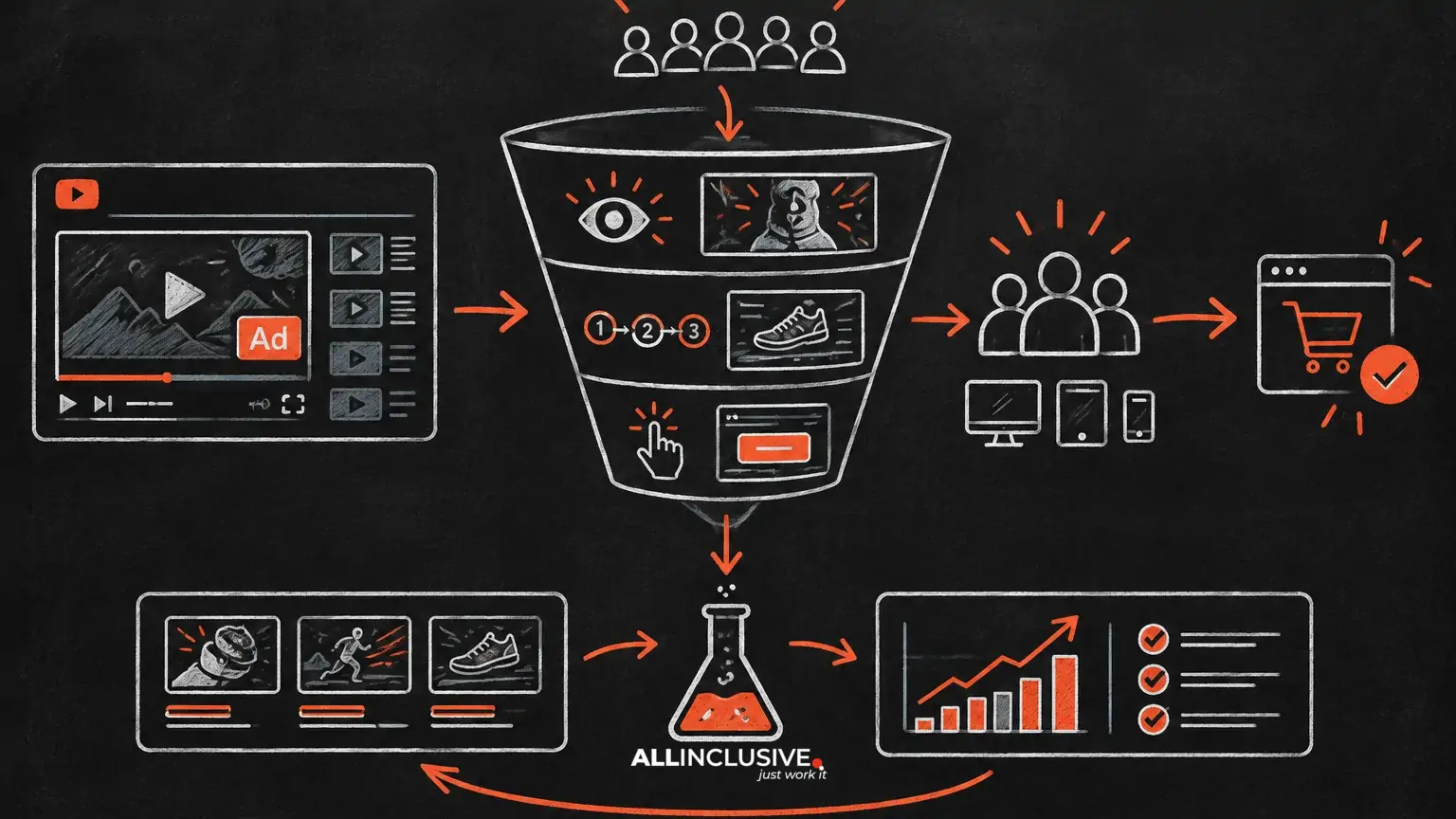
Performance creative is the discipline of developing advertising assets to support measurable business outcomes. It combines audience research, messaging, design, production, media context, and testing so creative does more than attract attention: it helps a campaign generate useful action and reliable learning.
Media buying can determine where, when, and to whom an ad is shown. Performance creative determines what the audience sees, what they understand, and why they should continue. The two functions are distinct, but they are closely connected. A well-structured campaign can still underperform when its creative does not make the value proposition clear, fit the buying context, or give the audience a credible reason to act.
This guide explains the role of performance creative, how it differs from brand creative and conventional ad production, and how marketing teams can build a practical system for developing and evaluating it.
What is performance creative?
Performance creative is advertising creative designed and managed with a measurable response in mind. That response might be a purchase, qualified lead, trial, app install, consultation request, or another defined conversion event.
The term does not mean every ad must be aggressive, short-term, or visually similar. It means the creative is developed within a feedback loop. Teams form a hypothesis about an audience, problem, promise, proof point, format, or call to action; expose that hypothesis to a relevant audience; evaluate the result in context; and use the learning to inform the next iteration.
A performance creative system typically connects:
- Audience insight: the needs, objections, motivations, and language of a defined audience.
- Message strategy: the problem, promise, mechanism, proof, and action the ad communicates.
- Creative execution: the visual treatment, copy, structure, pacing, presenter, product demonstration, and format.
- Media context: the placement, buying objective, audience temperature, device, and surrounding user experience.
- Measurement: the signals used to assess attention, engagement, conversion quality, and business value.
Why media buying depends on creative
Media buying can improve delivery and audience selection, but it cannot fully compensate for unclear or unconvincing communication. The ad is often the first meaningful interaction between a prospect and an offer. If the creative fails to establish relevance or trust, efficient delivery may simply produce more exposure to a weak message.
Creative affects several points in the paid-media journey:
- Attention: whether the ad earns enough notice to be processed.
- Comprehension: whether the viewer understands what is being offered and for whom.
- Persuasion: whether the message addresses a meaningful need and reduces uncertainty.
- Action: whether the next step is clear and proportionate to the audience’s level of intent.
- Learning: whether performance data helps the team identify which messages and audiences deserve further investment.
This is why a media buyer and creative team should not operate as separate production queues. Delivery data can reveal where an ad is losing momentum, while creative analysis can explain why a particular audience or placement may be responding differently.
Performance creative versus brand creative
Brand creative and performance creative are not opposing categories. Both can build recognition, trust, and preference. The difference is usually the operating context and the degree of accountability attached to the asset.
Brand creative often works across a broader time horizon. It may prioritize distinctive identity, emotional association, cultural relevance, or long-term memory. Performance creative usually has a more explicit job in the conversion path. It must communicate a relevant proposition, accommodate a specific buying environment, and provide evidence that can be evaluated against a defined objective.
The distinction is therefore about purpose, not visual quality. A performance ad can be polished and brand-consistent. A brand asset can also contribute to direct response. Problems arise when teams assume that a single creative approach must serve every stage, audience, and buying objective without adaptation.
The building blocks of effective performance creative
1. A clear audience and problem
Strong creative begins with a specific audience context. “Business owners” or “health-conscious consumers” may be too broad to guide a useful message. A better brief identifies the situation that creates urgency: a procurement team replacing a fragmented toolset, a marketer unable to explain lead quality, or a buyer comparing solutions under a tight deadline.
The audience definition should include awareness level. Someone who has never considered the category needs a different opening from someone comparing providers or returning to a product page.
2. A credible value proposition
The value proposition should answer why the audience should care and why the offer is relevant now. Avoid treating a list of features as a proposition. Translate features into an outcome, mechanism, or reduction in risk.
For example, a project-management platform might not lead with “custom fields and automated workflows.” It could lead with the operational problem those features address: giving distributed teams a clearer way to see ownership and prevent work from disappearing between handoffs.
3. A strong first frame or opening
The opening should establish relevance quickly, especially in environments where users can scroll or move on immediately. It can take the form of a recognizable problem, a pointed question, a product demonstration, a surprising contrast, or a direct statement of the audience’s desired outcome.
The opening should be truthful and connected to the rest of the ad. An attention-grabbing line that creates curiosity but does not deliver on its implication can damage trust and produce misleading engagement signals.
4. Proof and specificity
Claims become more credible when the creative shows how the product works, what changes, or why the company is qualified to help. Useful proof can include a demonstration, customer perspective, process explanation, comparison, sample output, or clearly framed evidence that the business can substantiate.
Proof should match the audience’s objections. A technical buyer may need operational detail, while an executive may first need confidence in implementation, risk, and commercial value.
5. A proportionate call to action
The next step should reflect the audience’s readiness. A cold prospect may be more responsive to an educational resource or a product explanation than to a high-commitment sales request. A warm visitor may need a direct route to pricing, a consultation, or checkout.
A practical performance creative workflow
- Start with the business objective. Define the conversion event and the quality standard behind it. More leads are not necessarily better if they cannot progress.
- Map the audience and buying context. Identify awareness level, objections, urgency, decision criteria, and likely placement environment.
- Build a message matrix. Organize possible angles around problems, desired outcomes, mechanisms, proof, objections, and calls to action.
- Choose formats deliberately. Match the creative form to the message. A product demonstration may benefit from video, while a concise comparison may work well as a static asset or carousel.
- Write a focused brief. Specify the audience, hypothesis, core message, mandatory proof, opening, action, format requirements, and exclusions.
- Produce meaningful variations. Change one or more strategic variables, such as angle, hook, proof type, presenter, visual treatment, or offer framing. Avoid generating many cosmetic versions that express the same idea.
- Launch with a learning plan. Establish what the team expects to learn and how the creative will be compared. The exact evaluation method depends on the campaign structure, delivery environment, conversion volume, and available data.
- Document decisions. Record the hypothesis, version, audience context, spend conditions, dates, results, and interpretation. This prevents teams from repeating inconclusive tests or mistaking correlation for a creative finding.
How to evaluate performance creative
Evaluation should move from attention to business outcome. A useful diagnostic sequence asks:
- Did the asset receive delivery under comparable conditions?
- Did the audience show signs of initial interest?
- Did the ad communicate the offer clearly?
- Did users take the intended next step?
- Did those actions produce acceptable conversion quality or revenue?
No single metric explains creative performance in every account. A low click-through rate may indicate a weak opening, poor audience fit, or an offer that is not compelling in the buying context. A strong click rate with weak downstream conversion may indicate a mismatch between the ad promise and landing-page experience, low-intent traffic, or inadequate qualification.
Use metrics as diagnostic signals rather than automatic verdicts. Compare assets under reasonably similar conditions, allow enough delivery for a meaningful observation, and account for changes in audience, placement, budget, offer, landing page, and conversion tracking.
Testing performance creative without wasting spend
Testing is most useful when it answers a specific question. “Which ad is best?” is too broad. Better questions include:
- Does a pain-led message outperform an outcome-led message for this audience?
- Does showing the product increase qualified actions compared with a conceptual visual?
- Does expert explanation build more downstream trust than a customer-style testimonial?
- Does a lower-commitment call to action improve the quality-adjusted conversion rate?
Separate strategic tests from production refinements. Testing a new audience problem is different from changing a background color. Both may matter, but they should not be interpreted as equivalent learning.
Teams can also use a structured creative testing framework to define variables, comparison rules, and documentation before launch. This helps reduce the common mistake of declaring a winner based on isolated results or uncontrolled changes.
Common performance creative mistakes
Confusing novelty with strategy
A new visual style is not automatically a new creative hypothesis. If the message, audience, and offer remain unchanged, the team may learn little beyond a superficial preference.
Optimizing for cheap engagement alone
High engagement can be useful, but it is not the same as commercial intent. Evaluate whether the attention contributes to the campaign’s actual objective and whether users progress beyond the first interaction.
Ignoring the landing-page experience
Creative and landing pages form a connected promise. If the ad emphasizes one benefit and the page leads with another, the transition can create confusion and reduce trust.
Producing too many minor variants
Volume does not replace variation in thinking. A smaller set of clearly differentiated concepts can produce more useful learning than dozens of near-duplicates.
Letting fatigue become a surprise
Creative performance can weaken as an audience sees the same asset repeatedly or as the market’s concerns change. Monitor delivery and response trends, and maintain a pipeline of new angles rather than waiting for a visible collapse. The guide to creative fatigue covers the diagnostic process in more detail.
How creative and media teams should work together
The most effective operating model gives both teams shared responsibility for learning. Media buyers can contribute information about audience behavior, placement context, delivery constraints, and conversion quality. Creative strategists can translate those signals into new hypotheses rather than simply requesting more assets.
A practical weekly or biweekly review can cover:
- Which concepts are earning meaningful attention?
- Where does the message appear to lose users?
- Which objections remain unresolved?
- Are results consistent across audiences and placements?
- What should be scaled, adapted, retired, or retested?
Keep platform mechanics separate from creative strategy. Delivery systems may influence which ads receive more exposure, but that does not prove the underlying message is universally superior. Treat the result as evidence within a defined campaign context.
Where performance creative fits in paid media
Performance creative is one part of a broader paid media system that also includes strategy, audience planning, buying, measurement, landing pages, and conversion operations. Creative cannot repair every weakness in that system, but it can make the offer more understandable and make media investment more informative.
For teams building a dedicated capability, the performance creative practice provides a useful strategic frame for connecting research, production, testing, and optimization without treating creative as an isolated deliverable.
Performance Creative: What to Prioritize
Performance creative is not simply advertising that contains a call to action. It is a disciplined way to connect audience understanding, message design, execution, media context, and measurement. Its value comes from creating ads that are relevant enough to earn attention, clear enough to be understood, credible enough to build confidence, and structured enough to generate useful learning.
Start with the audience problem and business objective. Develop distinct hypotheses, choose formats that serve the message, test under interpretable conditions, and use downstream quality—not surface engagement alone—to guide decisions. When creative and media buying operate as one learning system, paid campaigns become easier to diagnose and improve.