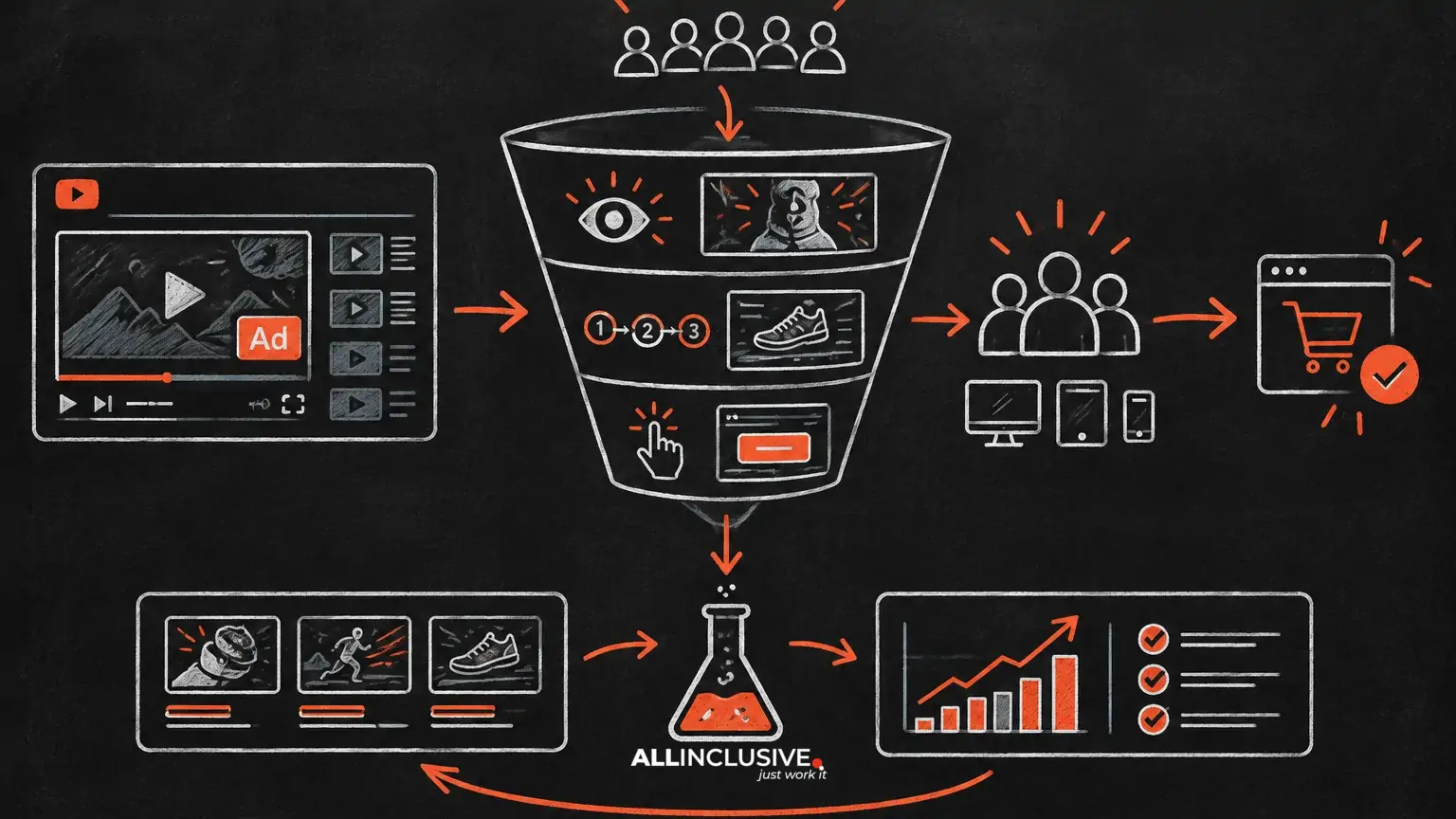
A performance creative brief gives designers the information they need to produce ads that can be tested, understood and improved—not just ads that look polished. It translates media-buying priorities into clear creative decisions: who the ad is for, what problem it addresses, what action it should drive, which variables matter most and how success will be evaluated.
The strongest briefs sit between strategy and execution. They do not prescribe every visual detail, but they do remove ambiguity around the audience, offer, message, funnel role, format requirements and testing plan. This allows designers and media buyers to work from the same hypothesis instead of treating creative production as a handoff.
What a performance creative brief should accomplish
A conventional creative brief may focus on brand positioning, campaign objectives and visual direction. A performance brief must go further. It should help the team answer four operational questions:
- Who is this ad intended to influence?
- What should the audience understand or feel quickly?
- What creative variable are we testing?
- What evidence will determine the next iteration?
That distinction matters because paid media creative is exposed to real delivery conditions. An ad may need to communicate without sound, compete in a crowded feed, work across placements or explain an unfamiliar offer in seconds. The brief should prepare the designer for those conditions without turning into a rigid production checklist.
The essential sections of a performance creative brief
1. Business and campaign objective
Start with the business outcome, not the requested asset. “Create three videos” is a production task; “generate qualified consideration for a high-intent audience” is a strategic objective.
State the campaign’s role in the customer journey and the action the creative should support. Examples include:
- Introduce a problem to a new audience.
- Show why a solution is different from familiar alternatives.
- Address an objection among returning visitors.
- Drive a product trial, lead submission or purchase.
Also clarify what the creative is not expected to do. An awareness asset should not be judged as though it were a direct-response product demonstration, and a retargeting ad may not need to explain the entire category from the beginning.
2. Audience and customer context
Demographic labels rarely provide enough direction for a designer. Include the audience’s situation, motivation, knowledge level and likely objections.
A useful audience section answers questions such as:
- What triggered the person to look for a solution?
- What have they already tried?
- What do they believe about the category?
- What could prevent them from taking the next step?
- How familiar are they with the brand and offer?
Use evidence where available: customer interviews, sales-call themes, search language, support tickets, site behavior or prior creative observations. If the audience is an assumption rather than a validated insight, label it as such. This prevents a speculative statement from becoming an invisible constraint in production.
3. Single-minded message
Designers need to know the one idea the audience should retain. A brief that lists every benefit, proof point and feature forces the asset to carry too much cognitive load.
Define the message in one sentence, preferably using a structure such as:
For [audience in a specific situation], [offer] helps them [desired outcome] by [credible mechanism or differentiator].
The statement is not necessarily final ad copy. It is a decision filter. If a visual, hook or feature does not support the central message, the team can question whether it belongs in the asset.
4. Problem, tension or hook
Performance creative often succeeds or fails in the opening moment. The brief should explain why someone should stop and pay attention without reducing the solution to exaggerated claims.
Potential entry points include:
- A recognizable problem or frustrating workflow.
- A costly mistake or missed opportunity.
- A surprising contrast between the current approach and the desired approach.
- A customer question that the offer can answer.
- A demonstration of the product solving a concrete task.
Specify whether the team is testing different hooks, different value propositions or different executions of the same message. Those are different learning objectives and should not be confused.
5. Offer, proof and required claims
List the offer clearly, including the action you want the audience to take. Then separate essential proof from optional support.
Useful inputs may include:
- Product capabilities relevant to the audience’s problem.
- Customer language or approved testimonials.
- Demonstrations, comparisons or before-and-after explanations.
- Terms, limitations and qualifying conditions.
- Legal, regulatory or brand requirements.
Do not ask designers to imply a claim that the business cannot substantiate. If wording is still under review, mark it as provisional. A performance brief should make claim ownership explicit so that creative development does not create avoidable approval delays.
6. Format and placement considerations
Format guidance should describe constraints that affect the idea, not simply repeat an asset specification. Include the intended channels or placements, aspect ratios, duration range, sound assumptions, safe areas, required branding and landing-page relationship.
When several placements are involved, explain which parts should remain consistent and which can be adapted. A single concept may need different openings, framing or text density depending on where it appears. The objective is not to make every version identical; it is to preserve the strategic message while respecting the viewing context.
Keep platform mechanics separate from strategy. Delivery systems and placement requirements can change, so the brief should identify current production constraints without treating them as universal creative principles. Confirm execution details during trafficking and quality assurance.
7. Creative hypothesis and test design
This is the section most often missing from traditional briefs. State what the team believes and what the asset is intended to teach.
For example:
We believe that showing the workflow before introducing the product will make the problem more recognizable to new prospects. We will compare this opening with a direct product demonstration while keeping the offer and audience strategy consistent.
A testable brief identifies:
- The variable being changed.
- The elements being held reasonably consistent.
- The audience or funnel context.
- The primary signal and supporting signals.
- The decision the team may make after reviewing the results.
More variants do not automatically create more learning. If every asset changes the hook, offer, visual style and call to action at once, the team may have difficulty explaining why one version behaved differently.
8. Measurement and interpretation
Media buyers should provide enough measurement context for designers to understand the feedback loop, without turning the brief into a dashboard.
Define the primary outcome in relation to the campaign objective. Then identify diagnostic signals that can help locate the problem. For example, an ad may receive attention but fail to generate action because the message and landing page are misaligned. Another may have a strong offer but lose viewers before the offer appears.
Measurement should be interpreted with delivery context. Results can be influenced by audience, auction conditions, placement mix, spend, frequency, conversion tracking and landing-page experience. Avoid labeling a creative “the winner” based on a single surface-level metric or a small amount of unqualified data.
For a broader framework on interpreting creative signals, see Ad Creative KPIs: Thumbstop, CTR, CVR and Revenue Signals.
What media buyers should give designers before production
A designer should not have to reconstruct the media strategy from a task title. Before production begins, provide the following inputs:
- Campaign context: objective, funnel stage, audience and destination.
- Audience evidence: customer language, objections, research findings or clearly labeled assumptions.
- Message priority: the central promise and supporting proof.
- Test plan: the variable being explored and the intended comparison.
- Asset requirements: placements, formats, duration, sound and adaptation needs.
- Measurement context: primary outcome, diagnostic signals and review timing.
- Approval boundaries: mandatory claims, prohibited claims, legal requirements and brand rules.
This information can be concise. A two-page brief with clear decisions is more useful than a long document filled with background that does not affect the work.
How designers can challenge an unclear brief
Creative collaboration improves when designers are expected to question strategic gaps. Useful questions include:
- Which audience problem should be visible in the first frame or opening?
- What is the one idea this asset must communicate?
- Is the requested proof credible and understandable to this audience?
- Which element is actually being tested?
- Does the call to action match the audience’s level of intent?
- Can the idea survive without relying on small text or sound?
- What information belongs on the landing page rather than in the ad?
These questions are not obstacles to speed. They prevent late-stage rewrites caused by unresolved strategy. If a brief cannot answer them yet, the correct next step may be a short discovery session rather than immediate production.
Common performance brief mistakes
Writing a list of deliverables instead of a hypothesis
Asset counts, dimensions and deadlines are necessary, but they do not explain what the creative should learn. Add a clear hypothesis and decision rule.
Asking for “thumb-stopping” creative without defining the tension
Attention is not a strategy. Explain what should make the audience pause and why that idea is relevant to them.
Overloading the asset with claims
More benefits can weaken comprehension. Prioritize one promise, then choose proof that makes it believable.
Confusing variation with testing
Changing colors, footage and copy may create visual variety, but it does not necessarily test a meaningful strategic question. Map each variation to a variable.
Giving feedback without connecting it to evidence
“Make it more engaging” is difficult to act on. Feedback should identify the observed issue and the proposed response—for example, clarify the problem earlier, show the product sooner or make the proof more concrete.
A practical performance creative brief template
Teams can use the following structure as a starting point:
- Project: campaign, audience and funnel stage.
- Objective: business outcome and desired action.
- Audience: situation, motivation, awareness level and objections.
- Core message: the one idea to communicate.
- Hook or tension: the reason to pay attention.
- Offer and proof: what is being presented and why it is credible.
- Execution direction: concept, tone, visual approach and relevant references.
- Requirements: formats, placements, duration, sound, branding and approvals.
- Test hypothesis: what is changing and what is expected to happen.
- Measurement: primary outcome, diagnostic signals and review conditions.
- Next decision: what the team will do if the evidence supports or challenges the hypothesis.
Turning the brief into an iteration system
A brief should not disappear once the files are delivered. After launch, record what the team observed, what remains uncertain and what should change next. This creates continuity between media buying and design instead of restarting from a blank page for every production cycle.
Use performance feedback to refine the next brief, but avoid treating every result as a direct verdict on the concept. Ask whether the issue relates to the opening, message clarity, proof, offer, audience fit, placement, landing page or delivery conditions. The goal is to convert results into a better question for the next round.
For a structured way to connect test results to new concepts, review Creative Iteration: Turning Ad Data Into the Next Winning Concept. You can also compare the brief’s testing logic with the Creative Test Matrix: Hooks, Angles, Formats and Offers.
Strong performance creative is a cross-functional system, not a last-minute request for more ads. When media buyers define the audience, hypothesis, constraints and measurement context—and designers translate those inputs into clear, compelling executions—the team can produce work that is both more useful to the audience and more informative for the next investment decision. Explore the broader performance creative discipline or connect it to the wider practice of paid media.