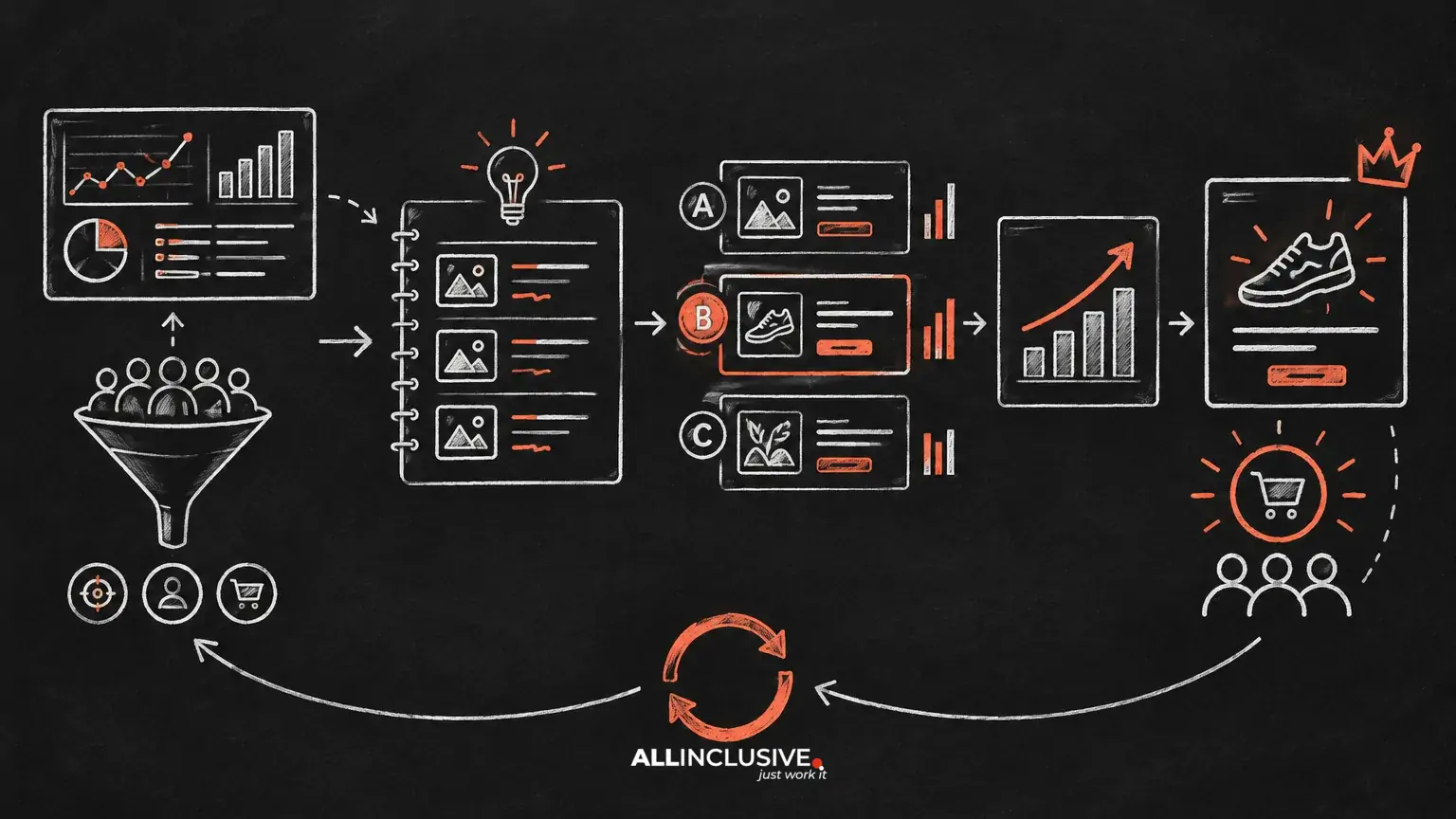
Creative iteration is the process of using evidence from live advertising to improve the next concept, not simply producing more variations of the same ad. The strongest iteration systems connect performance signals to specific creative decisions: which hook to preserve, which message to replace, which format to test, and which audience or funnel condition may be affecting the result.
That distinction matters because ad data rarely tells a team exactly what to make next. A low click-through rate may indicate a weak opening, an unclear offer, poor audience-message fit, or an execution problem. A strong click-through rate with weak conversion may show that the ad creates curiosity without qualifying the right prospects. The work is to turn those observations into testable hypotheses rather than treating every metric as a verdict on the entire concept.
This article presents a practical iteration loop for paid media teams: establish a baseline, diagnose the signal, form a hypothesis, create a focused variation, and feed the result back into the system.
What creative iteration actually means
Iteration is not the same as refreshing ads on a calendar or changing several elements at once. It is a controlled process of learning from performance while protecting what already appears to work.
An ad can be viewed as a set of connected variables:
- Hook: the opening visual, line, or problem that earns attention.
- Angle: the reason the audience should care, such as a pain point, desired outcome, risk, comparison, or insight.
- Proof: evidence that supports the claim, including demonstrations, customer language, product detail, or credible explanation.
- Offer and call to action: the next step and the value exchange attached to it.
- Format and execution: video, static, carousel, creator-led, product-led, animation, length, pacing, and visual hierarchy.
A useful iteration changes one meaningful variable or one tightly related group of variables. For example, a team might preserve the winning demonstration while testing three new openings. That creates a clearer learning question than replacing the hook, proof, offer, editing style, and landing page at the same time.
Start with a reliable performance question
Before reviewing ads, define the question the data needs to answer. “Which ad won?” is often too broad. Better questions include:
- Does the product demonstration create stronger engagement than a problem-led opening?
- Can the same offer generate more qualified clicks when the audience pain is stated more specifically?
- Is the concept losing attention before the proof appears?
- Does a lower-funnel message convert better after the audience has already interacted with the brand?
- Is the apparent creative decline actually caused by audience saturation, delivery conditions, or a weaker post-click experience?
These questions prevent teams from overreacting to isolated metrics. They also help media buyers and creative teams agree on what the next production cycle is intended to learn.
Read metrics as signals, not explanations
Performance data is useful when interpreted in sequence. No single metric can reliably explain every creative outcome, and platform reporting should be considered alongside tracking quality, landing-page behavior, audience context, and spend level.
Attention and engagement signals
Early indicators can show whether the opening earns attention and whether the concept is understandable enough to continue. Depending on the format and available reporting, teams may examine impressions, video engagement, outbound clicks, click-through rate, or other interaction signals. These metrics help identify whether the first promise and presentation are doing their job, but they do not prove that the traffic is valuable.
Post-click and conversion signals
Landing-page views, lead quality, purchases, qualified actions, conversion rate, and revenue-related measures reveal whether the ad attracts the right response. A concept with modest click volume may still be strategically valuable if it produces better-qualified demand. Conversely, an ad that drives inexpensive traffic may be a poor iteration source if the traffic does not progress.
Efficiency and delivery context
Cost per result, return measures, spend distribution, frequency, audience composition, and delivery stability provide context for the creative read. A weak result may reflect a mismatch between the ad and the audience, while a strong result may be concentrated in a narrow segment. Treat efficiency as an outcome to investigate, not a standalone creative diagnosis.
For a broader measurement framework, use the guide to ad creative KPIs to separate attention, response, conversion, and business signals.
Build a diagnosis before making the next ad
A practical diagnosis asks where the performance path breaks. Consider four stages:
- Attention: Does the opening interrupt or attract the intended audience?
- Understanding: Can the viewer quickly tell what is being offered and why it matters?
- Belief: Does the creative provide enough proof or specificity to make the claim credible?
- Action: Is the next step clear, relevant, and consistent with the promise made in the ad?
Patterns across these stages produce better hypotheses than a simple winner-loser label.
- Weak attention and weak response: Test a different hook, opening visual, or first-frame structure.
- Strong attention but weak clicks: Rework the angle, clarity, offer, or call to action.
- Strong clicks but weak conversion: Investigate qualification, message match, proof, landing-page continuity, and audience intent.
- Strong conversion but limited scale: Test adjacent hooks, formats, or proof structures while preserving the core promise.
- Declining performance after sustained delivery: Compare creative fatigue with audience saturation and delivery changes before replacing the concept.
This interpretation should remain cautious. The same pattern can have multiple causes, so the next test should be designed to distinguish among them.
Turn the diagnosis into a creative hypothesis
A useful hypothesis states what will change, why it may help, and what evidence would support the conclusion. A simple structure is:
Because [observed signal], we believe [creative explanation]. We will test [specific change] while holding [important variable] relatively constant. We will evaluate [primary outcome] alongside [quality or business check].
For example:
Because the current ad generates attention but few qualified clicks, we believe the opening creates interest without making the audience or outcome specific enough. We will preserve the product demonstration and test three problem-specific hooks. We will evaluate qualified click rate and downstream conversion, not just engagement.
The hypothesis prevents a common failure mode: producing a visually different ad without knowing what the variation is intended to teach.
Choose the right level of iteration
Not every result requires a new concept. Use a hierarchy of changes so the team can match production effort to the evidence.
Level one: execution refinement
Use this when the underlying message appears sound but the presentation may be limiting performance. Examples include tightening the opening, improving visual hierarchy, simplifying on-screen language, changing pacing, strengthening product visibility, or clarifying the call to action.
Level two: component iteration
Use this when one part of the ad appears to be the likely constraint. Keep the core concept and change the hook, proof device, objection response, format, or offer framing. Component tests are efficient when the team wants to isolate a specific learning question.
Level three: angle iteration
Use this when the concept may be relevant but the reason to care is weak or overused. Explore a different pain point, desired outcome, use case, comparison, risk, or customer segment while retaining a clear connection to the product.
Level four: concept replacement
Use this when repeated variations fail to resolve the problem, when the audience has clearly moved on, or when the original promise is not credible or strategically differentiated. A new concept should be informed by prior learning, not disconnected from it.
Design cleaner creative tests
A test is easier to interpret when the team defines the control, variable, audience, funnel context, and evaluation criteria in advance. A creative test matrix can organize these dimensions and prevent accidental duplication across production cycles.
When possible, preserve the elements that are not part of the question. If the test concerns hooks, keep the offer, proof, and destination consistent. If the test concerns proof, maintain the opening and call to action. Perfect isolation is not always possible in platform delivery, but deliberate structure still improves learning.
Use a primary decision metric and supporting checks. For a demand-generation campaign, the primary metric might be a qualified conversion, while click-through rate and landing-page engagement provide diagnostic context. For an awareness objective, an engagement signal may be more relevant, but the team should still define what action would justify advancing the concept.
Avoid declaring a winner too early. Review performance only after the ads have enough comparable delivery to support a reasonable directional read, and account for material differences in spend, audience, placement, attribution, and conversion delay. The exact threshold depends on the account and decision cost; there is no universal platform-independent cutoff.
Create an iteration record that survives handoffs
Creative learning compounds only when it is documented. Each test record should include:
- The original concept and intended audience.
- The hypothesis and the variable changed.
- The control or reference ad.
- The funnel stage and campaign objective.
- The relevant delivery and conversion context.
- The primary metric and supporting signals.
- The decision: scale, refine, retest, segment, pause, or retire.
- The next implication for briefs, messaging, and production.
Write conclusions in plain language. “The problem-led opening produced stronger qualified response than the generic benefit opening in this audience and context” is more useful than “Version B won.” The first statement can guide a brief; the second cannot.
Connect media findings to the next brief
Iteration breaks down when performance insights stay inside the media-buying team. Translate each important finding into creative direction. A brief might specify the proven audience tension, the language to preserve, the proof required, the elements still uncertain, and the variations needed for the next test.
The performance creative brief should also distinguish facts from interpretations. “This opening generated more qualified actions in the tested context” is an observation. “The audience prefers short-form education” is a broader interpretation that may require more evidence.
Production teams need enough specificity to act without being forced to reproduce one ad mechanically. Give them the learning constraint and the strategic territory, then allow multiple executions within that boundary.
Know when not to iterate the creative
Sometimes the right next action is not another ad. Check measurement integrity, landing-page speed and relevance, offer competitiveness, lead-routing quality, audience definition, budget distribution, and delivery changes. If the post-click experience is broken, more creative variation may only produce more expensive confusion.
Similarly, do not treat every short-term fluctuation as a creative insight. A meaningful iteration decision should be supported by a pattern, a clear business question, or a material change in the account context.
Make creative iteration a repeatable operating system
A mature process runs on a consistent loop:
- Collect performance and delivery signals.
- Identify where the response path appears to weaken.
- Form one or more explicit creative hypotheses.
- Prioritize tests by expected learning value and production effort.
- Launch focused variations with clear measurement criteria.
- Document the result and update the next brief.
Teams can then plan creative volume around learning priorities rather than arbitrary output targets. The goal is not to chase a permanent “winning ad.” It is to build a portfolio of concepts, hooks, proof structures, and offers that can be adapted as audiences, markets, and business priorities change.
For the wider role of creative strategy in acquisition, measurement, and growth, explore Allinclusive’s performance creative pillar and the broader paid media hub.