
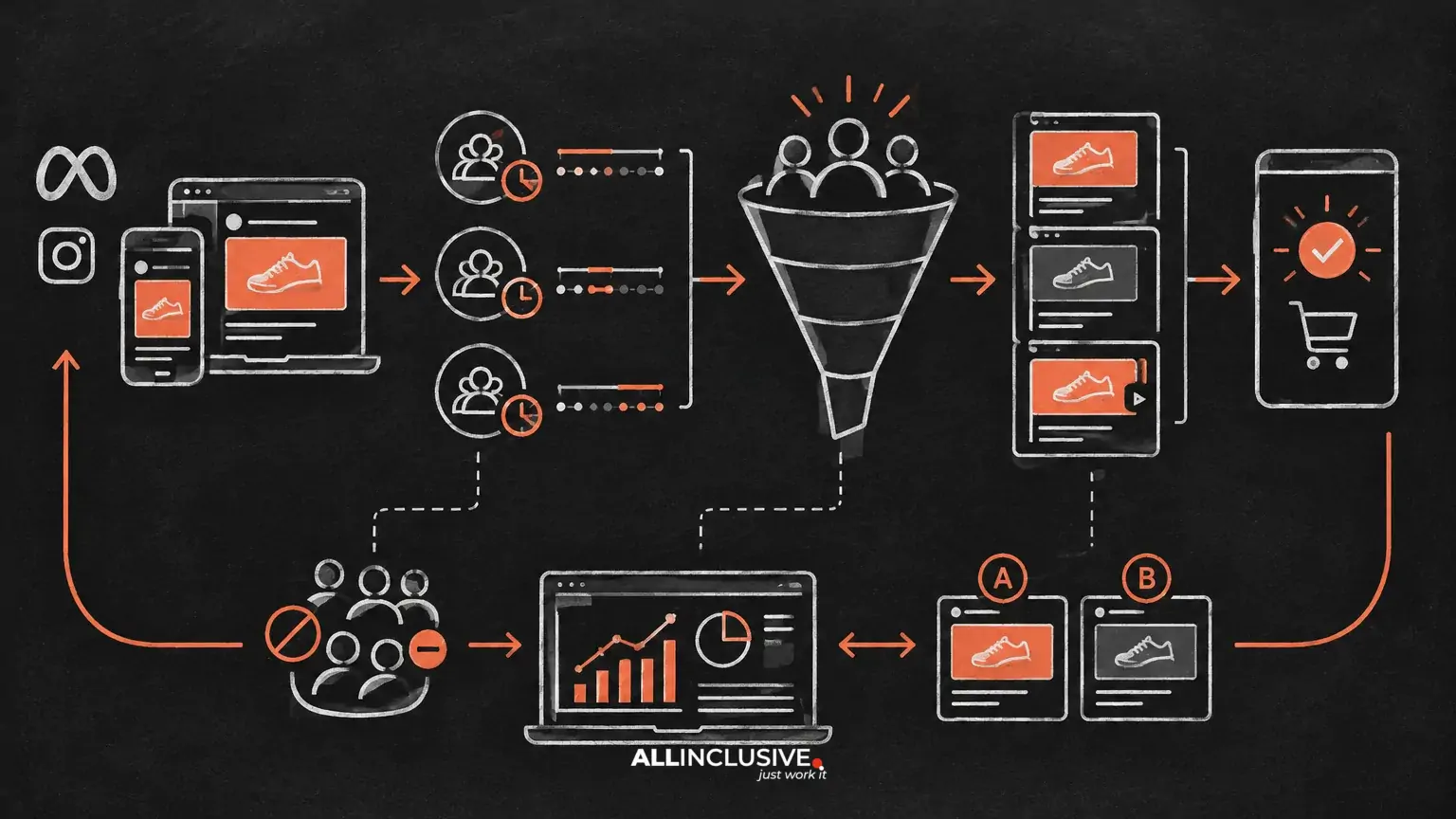
Meta Ads retargeting works best as a controlled follow-up system, not as a default campaign setting. The core decisions are which interactions qualify someone for retargeting, how long that qualification remains useful, what message the person should see next, and when they should be excluded.
A durable approach combines first-party signals, clear audience windows, sequential creative, conversion exclusions, and measurement that accounts for overlap and delayed decisions. The objective is not simply to reach people who visited your site. It is to deliver a relevant next step without wasting spend on users who have already converted, are not commercially qualified, or have seen the same message too many times.
What Meta Ads retargeting is designed to do
Retargeting targets people who have already interacted with your business or its content. Depending on the available data and account configuration, those signals may include website activity, product or landing-page visits, lead-form engagement, video or social engagement, customer lists, and completed actions.
These signals do not all represent the same level of intent. A person who viewed a pricing page has usually supplied a stronger buying signal than someone who watched a short video. Treating both groups as one audience can make reporting look simple while weakening message relevance and budget control.
Retargeting should therefore answer a specific question: What is the most useful next message for this type of prior interaction? For a considered B2B purchase, that message may be a proof point, comparison guide, technical explanation, or consultation invitation rather than a generic reminder.
Start with audience windows, not campaign settings
An audience window is the period during which a past interaction remains relevant enough to justify a follow-up impression. There is no universal best window. The right choice depends on buying-cycle length, product complexity, traffic volume, repeat-purchase behavior, and the recency of the signal.
Use shorter windows when intent decays quickly or the action has strong commercial meaning. Use longer windows when the purchase requires education, multiple stakeholders, budget approval, or procurement. Longer windows should not automatically receive the same message as recent visitors.
A practical window framework
- Recent high-intent activity: Consider a short window for pricing-page visitors, demo-page visitors, cart activity, or users who began a high-value form. The creative can address friction close to the decision.
- Consideration activity: Use a medium window for product-page visitors, repeat site visitors, substantial content engagement, or form starts without completion. The message can add evidence, clarity, and education.
- Early engagement: Use a longer window for video viewers, social engagers, or broad content visitors when the buying cycle supports continued nurturing. The message should earn the next visit rather than force an immediate conversion.
These categories are planning tools, not fixed platform requirements. Build windows around the business’s decision process, then validate them with audience size, conversion quality, frequency, and assisted behavior.
Separate recency from intent
Recency and intent are related but distinct. A recent low-intent interaction may deserve a lighter educational message than an older, high-intent action. Conversely, an old pricing-page visit may no longer justify an aggressive offer if the prospect has gone cold.
Where volume allows, separate audiences by both signal and recency. For example, a B2B advertiser could distinguish recent consultation-page visitors, older consultation-page visitors, recent solution-page visitors, and broad content engagers. Each group can then receive a different creative priority and budget treatment.
Map creative to the user’s next decision
Retargeting creative should not repeat the acquisition message without modification. The audience already has some familiarity with the brand, so the ad should resolve the next uncertainty.
Match the message to the signal
- Product or solution-page visitors: Clarify differentiation, implementation requirements, or the problem the offer solves.
- Pricing or conversion-page visitors: Address objections, explain the process, show what happens after submission, or provide a reason to return.
- Form starters: Reduce friction with concise qualification guidance, stronger value framing, or a clear explanation of the information requested.
- Content engagers: Offer a related asset, deeper explanation, or practical framework that advances evaluation.
- Existing customers: Exclude them from acquisition retargeting when the message is irrelevant, or create a separate cross-sell, renewal, or expansion journey.
A useful sequence often moves from recognition to proof to action. Early retargeting can reinforce the problem and solution. Later stages can introduce testimonials where permitted, implementation detail, comparison content, or a direct conversion path. The sequence should reflect actual sales friction rather than an arbitrary number of impressions.
Use exclusions to protect efficiency and relevance
Exclusions are one of the most important parts of retargeting architecture. Without them, users can remain eligible for acquisition messages after becoming customers, receiving multiple overlapping ads, or moving into a more appropriate audience stage.
Core exclusions to review
- Converted users: Exclude completed leads, purchases, booked consultations, or other primary conversions from the prospecting retargeting journey.
- Disqualified or unsuitable records: If reliable first-party data exists, avoid spending on users who do not fit the offer or cannot be served.
- Later-stage audiences: Exclude users who have progressed into a stronger intent segment from earlier-stage messaging when the platform and data structure allow it.
- Internal and test traffic: Remove employees, agencies, known test users, and irrelevant traffic from both activation and analysis where feasible.
- Overlapping campaign audiences: Decide which campaign should own a user when multiple ad sets could reach the same person.
Exclusions should be documented with an owner, source, refresh expectation, and business purpose. A conversion exclusion that is not updated reliably can be worse than a simple structure because it creates false confidence in the journey.
Control overlap before adding complexity
Audience overlap can cause multiple campaigns to compete for similar users and make performance difficult to interpret. It can also produce inconsistent messages: one campaign may promote an introductory guide while another asks for a sales conversation.
Start by defining audience ownership. For example, the highest-intent segment might own users who visited a conversion page recently; a consideration campaign might exclude that segment; and an early-engagement campaign might exclude both. The exact hierarchy depends on traffic volume and buying cycle, but the principle is consistent: each user should have a clear primary message whenever practical.
Do not create narrow segments merely to make the account look sophisticated. If a segment is too small to exit its learning period or produce useful decisions, consolidate it with a neighboring stage and differentiate through creative, landing page, or reporting rather than fragmentation.
Choose campaign structure based on decision quality
There is no single correct structure for every account. A simple retargeting campaign may be appropriate when traffic is limited and the audience shares a common next step. Separate campaigns or ad sets can make sense when audience intent, geography, product line, budget ownership, or conversion path materially differs.
Use a separate structure when you need to control one of these variables independently:
- Budget allocation between high-intent and lower-intent audiences.
- Distinct conversion events or landing pages.
- Different geographic, language, or regulatory requirements.
- Different sales ownership or lead-quality workflows.
- Meaningfully different creative and exclusion rules.
Keep the structure consolidated when splitting would create small audiences, duplicate delivery, or prevent reliable testing. For broader account design, see Meta Ads account structure.
Measure more than attributed conversions
Retargeting often receives credit for users who were already close to converting. That does not make the channel ineffective, but it means reported conversions should be interpreted alongside delivery and business-quality signals.
Review performance by audience signal and window, not only by campaign total. Useful questions include:
- Which prior action produces the strongest qualified conversion rate?
- Does shorter recency improve conversion quality or only raise reported efficiency?
- Are leads progressing through the sales process?
- How often are converted users still receiving prospecting messages?
- Is frequency rising without corresponding movement in intent or conversion?
- Are several campaigns claiming the same users?
Where possible, use holdouts, geo-based tests, platform experiments, or other incrementality methods appropriate to the account’s volume and governance. Attribution reporting can help optimize delivery, but it does not by itself prove that every credited conversion was caused by the ad.
For a related performance variable, review Meta Ads frequency alongside audience window and creative rotation. Repetition may indicate a small audience, an overly long eligibility period, weak exclusions, or a genuinely valuable high-intent segment. The remedy depends on which explanation is true.
Build a practical retargeting workflow
- List available signals. Document website events, content interactions, customer data, lead stages, and conversion events. Mark which sources are reliable enough for activation.
- Rank signals by commercial intent. Separate awareness, consideration, evaluation, and conversion behaviors. Do not assume every engagement is equally valuable.
- Set provisional windows. Use the sales cycle and signal strength to choose initial windows. Record the reasoning so future changes are testable.
- Assign audience ownership. Decide which campaign or ad set should serve each stage and which audiences must be excluded.
- Write the next-step message. For each segment, identify the likely objection or missing information and create a corresponding ad and landing-page experience.
- Validate data and exclusions. Check event quality, consent and data-governance requirements, audience refresh behavior, and conversion suppression.
- Launch with a manageable structure. Avoid splitting audiences or creative into more cells than the available volume can support.
- Review on a defined cadence. Look at delivery, frequency, conversion quality, overlap, and business outcomes before changing windows or budgets.
Common retargeting mistakes
Using one long window for every interaction
This keeps audiences easy to manage but hides intent differences. A long window can also expose people to messages that no longer fit their situation.
Retargeting every visitor with a sales message
Many visitors are researching, comparing, or arriving accidentally. Match the call to action to the evidence available rather than assuming immediate readiness.
Ignoring post-conversion journeys
Continuing to show acquisition ads after conversion wastes impressions and can undermine trust. Customer messaging should be managed separately where the business case supports it.
Changing windows and creative at the same time
If both variables change together, it becomes difficult to identify what improved or weakened performance. Make changes in a sequence that preserves learning.
Overreacting to short-term attribution
Retargeting audiences are often small and volatile. Evaluate trends by meaningful segment and qualified outcomes instead of making decisions from isolated daily results.
How retargeting fits into the broader paid-social system
Retargeting is one layer of a broader paid social program. It should connect acquisition, landing-page experience, lead handling, customer data, and measurement rather than operate as a separate reminder channel.
For adjacent work, compare retargeting with Meta Ads audience strategy and review Meta Ads creative testing when deciding how to develop messages across stages. Audience design determines who is eligible; creative testing determines which message earns the next action.
At the wider planning level, retargeting should also be evaluated within the company’s paid media mix. Search, email, direct traffic, sales outreach, and other channels may influence the same users. A strong retargeting program makes those interactions clearer, not merely more frequent.
Meta Ads Retargeting: Final Review Checklist
- Are audience windows based on signal strength and buying-cycle reality?
- Does each audience receive a message suited to its next decision?
- Are customers, converters, and later-stage users excluded where appropriate?
- Is there a clear owner for overlapping audiences?
- Can the available volume support the account structure and tests?
- Are conversion quality and incrementality considered alongside platform attribution?
- Are frequency and creative fatigue reviewed by audience window?
The most effective Meta Ads retargeting systems are disciplined rather than elaborate. They use trustworthy signals, purposeful windows, relevant creative, and explicit exclusions to make each follow-up impression more useful. Start with a simple audience hierarchy, document the assumptions, and expand only when the data supports a more detailed journey.


