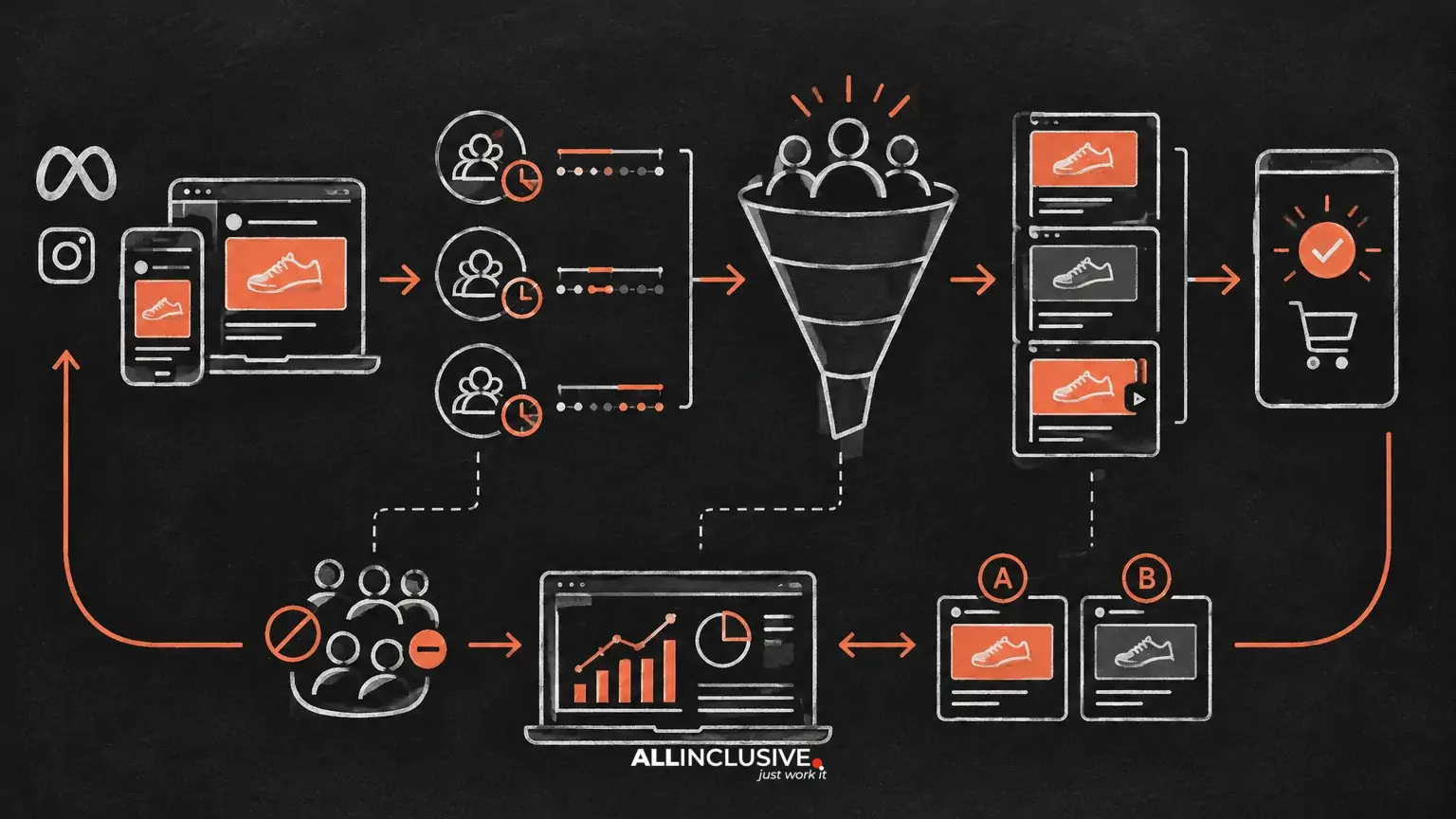
A strong meta ads strategy is more than choosing an audience and setting a budget. It connects business goals, offer design, campaign structure, creative production, measurement and disciplined optimization. The right approach also accounts for how much conversion data is available, how long the buying cycle is and where Meta fits within the broader customer journey.
For most advertisers, the goal is not to build the most complex account. It is to create a structure that gives the platform enough flexibility to find likely converters while giving the marketing team enough control to understand what is working. This article presents a practical framework for doing that.
Start with the business decision, not the campaign settings
Before opening Ads Manager, define the commercial decision the campaign must support. Common objectives include generating qualified leads, increasing purchases, driving registrations or creating demand that can later be converted through sales activity.
Translate that objective into a measurable conversion event and a realistic evaluation window. For example:
- E-commerce: optimize toward a meaningful purchase event when sufficient purchase signal exists; otherwise use a carefully selected lower-funnel event while improving the path to purchase.
- Lead generation: distinguish between form submissions, marketing-qualified leads and sales-qualified opportunities.
- B2B demand generation: connect campaign engagement to CRM stages rather than judging success only by low-cost leads.
- Content or event promotion: define whether the goal is reach, registrations, attendance or downstream pipeline.
The key question is: what action indicates real business value, and can it be measured consistently? If that answer is unclear, campaign optimization will tend to favor easy-to-generate activity rather than useful outcomes.
Build a simple campaign structure that matches the funnel
Campaign structure should reflect meaningful differences in objective, budget control, audience intent or creative strategy. It should not reproduce every internal marketing category as a separate campaign.
A practical structure often includes three layers:
- Prospecting: introduce the offer to people who are not yet active customers or known high-intent prospects.
- Retargeting: re-engage people who have interacted with the brand, website, content or product without completing the desired action.
- Customer or expansion activity: support repeat purchases, cross-sell, referrals or account-based follow-up where appropriate.
Not every account needs all three layers. A new advertiser with limited data may perform better with fewer campaigns and broader delivery than with multiple small ad sets. Conversely, a mature account may need separation when different audiences, offers or profitability targets require different decisions.
When to separate campaigns
Separate campaigns when at least one of these conditions is true:
- The campaigns have different business objectives or conversion events.
- They require materially different budget or bid-control decisions.
- The audiences must be managed differently to prevent wasted spend or conflicting messages.
- The offers have different economics, sales cycles or qualification standards.
- Reporting needs cannot be met through naming conventions and breakdowns alone.
When to consolidate
Consolidation is usually sensible when campaigns target similar people, use the same conversion event and are evaluated against the same commercial goal. Excessive fragmentation can restrict delivery, slow learning and make results harder to interpret.
Use a clear naming system that records the objective, market, funnel role, offer and major test variable. Naming will not fix poor strategy, but it makes analysis and governance faster.
Choose audiences according to evidence and scale
Audience strategy should balance relevance with delivery flexibility. Start with the strongest available first-party signals: customers, qualified leads, high-value purchasers, engaged users or other audiences with a clear relationship to the desired outcome.
Use exclusions thoughtfully. Existing customers may need to be excluded from an acquisition offer, while they may be valuable for retention or cross-sell activity. Similarly, people who have already completed a conversion should usually receive a different message from people who have only viewed a product or visited a landing page.
Broad targeting can be useful when the conversion signal is reliable, the creative clearly communicates the offer and the market is large enough to support exploration. It is less likely to solve problems caused by weak positioning, poor tracking, a low-converting landing page or insufficient demand.
For a deeper discussion of this decision, see Broad Targeting on Meta Ads: When It Works and When It Doesn’t.
Design creative around customer problems and buying stages
Creative is often the most visible part of a Meta campaign, but it should be treated as a system rather than a collection of isolated ads. Each concept should make a clear promise, identify a relevant problem and give the viewer a reason to take the next step.
Useful creative inputs include:
- Customer objections gathered from sales calls, support conversations and reviews.
- Proof points that clarify why the offer is credible or different.
- Demonstrations showing how the product or service works.
- Comparisons that help buyers understand alternatives.
- Specific use cases for different roles, industries or levels of awareness.
- Offers that reduce perceived risk, such as a consultation, trial, assessment or useful resource.
Build variation across the message, opening visual, format, proof, spokesperson and call to action. Changing only the background or headline creates less learning than testing genuinely different angles.
Match the message to awareness
Someone encountering a problem for the first time needs a different message from someone comparing vendors. Prospecting creative can lead with a problem, desired outcome or new perspective. Retargeting creative can address objections, explain process, reinforce proof or create a clear reason to return.
For B2B campaigns, avoid forcing a direct sales message onto every audience. A practical guide may be more appropriate for early-stage demand, while a case discussion, diagnostic or consultation may fit an in-market buyer.
Use a testing framework instead of constant ad changes
Testing should answer a defined question. Examples include:
- Does a problem-led message outperform a feature-led message?
- Does customer proof improve qualified conversion rate?
- Does a shorter form increase lead volume without damaging lead quality?
- Does a product demonstration outperform static explanation?
- Does a stronger offer improve downstream efficiency enough to justify its cost?
Change one major variable at a time when the account has limited volume. If traffic and conversions are substantial, structured multivariable testing may be possible, but the analysis still needs a clear hypothesis and a consistent decision rule.
Do not judge a creative test solely on click-through rate. A compelling but misleading ad can generate inexpensive traffic and weak commercial outcomes. Evaluate the complete path: delivery, click quality, landing-page engagement, conversion rate, qualification, revenue and retention where relevant.
Connect measurement across the customer journey
Reliable measurement is the foundation of optimization. Confirm that the intended conversion event fires once, is associated with the correct value where possible and can be reconciled with the website, commerce system or CRM.
At minimum, create a measurement map that documents:
- The primary conversion event and its business definition.
- Secondary events used for diagnostics.
- Required parameters, values and deduplication logic.
- UTM conventions and reporting ownership.
- CRM stages used to assess lead quality or pipeline.
- Attribution limitations and the time lag between conversion and revenue.
Platform reporting is useful for delivery and directional optimization, but it should not be treated as a complete view of incrementality or business performance. Compare platform data with analytics, CRM and financial reporting, while recognizing that different systems may use different definitions and attribution windows.
Optimize in a deliberate sequence
When performance weakens, diagnose the system in order rather than changing everything at once.
- Tracking: verify that events, values, URLs and CRM handoffs are functioning.
- Economics: confirm that the offer, pricing, margin and allowable acquisition cost are realistic.
- Funnel: inspect landing-page speed, message alignment, form friction and sales follow-up.
- Creative: assess fatigue, message clarity, format diversity and proof.
- Audience: review overlap, exclusions, scale and fit.
- Delivery controls: examine budget, bid strategy and placement constraints without assuming a setting change will solve a strategic issue.
Make changes according to the likely cause. If impressions are available but clicks are weak, creative or positioning may be the issue. If clicks are healthy but conversions are weak, investigate the landing page, offer and intent. If leads are plentiful but sales outcomes are poor, improve qualification and feedback rather than simply reducing cost per lead.
Manage budgets with business constraints in mind
Budget allocation should reflect marginal opportunity, not just historical averages. A campaign with a higher acquisition cost may still deserve more budget if it produces higher-value customers or stronger pipeline. Likewise, a low-cost campaign may be unattractive if its leads rarely progress.
Set a target range for acceptable acquisition cost, contribution margin or pipeline efficiency. Then establish how much volatility the business can tolerate during testing. Small budgets require patience and prioritization; attempting to test every audience, offer and format simultaneously produces inconclusive data.
Increase or reduce spend gradually enough to observe whether efficiency and lead quality remain acceptable. The exact pace depends on conversion volume, sales cycle, budget size and the consequences of being wrong.
Coordinate Meta with the broader paid-social plan
Meta can support awareness, consideration, conversion and retention, but it should not be evaluated in isolation from other channels. Creative insights may inform search, video or LinkedIn campaigns, while CRM outcomes can reveal which audiences and offers deserve more investment.
For a broader framework covering audience, creative and measurement decisions across networks, read Paid Social Strategy: Audience, Creative and Measurement Framework. If your account is specifically centered on Facebook placements and funnel roles, Facebook Ads Strategy: Prospecting, Retargeting and Measurement provides a narrower companion view.
A practical launch and review checklist
Before launch
- Define the commercial objective and primary conversion event.
- Confirm offer, landing-page and sales-process alignment.
- Document audience logic, exclusions and funnel role.
- Prepare multiple creative concepts with distinct messages.
- Validate event tracking, values, UTMs and CRM handoff.
- Set decision rules for pausing, iterating and scaling.
During the first review cycle
- Check delivery and tracking before interpreting performance.
- Compare creative by meaningful concept, not only by format.
- Look beyond cost per click to conversion and qualification quality.
- Separate short-term platform signals from delayed revenue outcomes.
- Record hypotheses and changes so results remain interpretable.
The strongest Meta programs are not built through a single perfect setup. They improve through clear objectives, controlled complexity, relevant creative, reliable measurement and consistent feedback from the business. For guidance on the wider paid social discipline, or to connect these decisions to the full paid media plan, use this framework as the starting point for an evidence-led operating process.