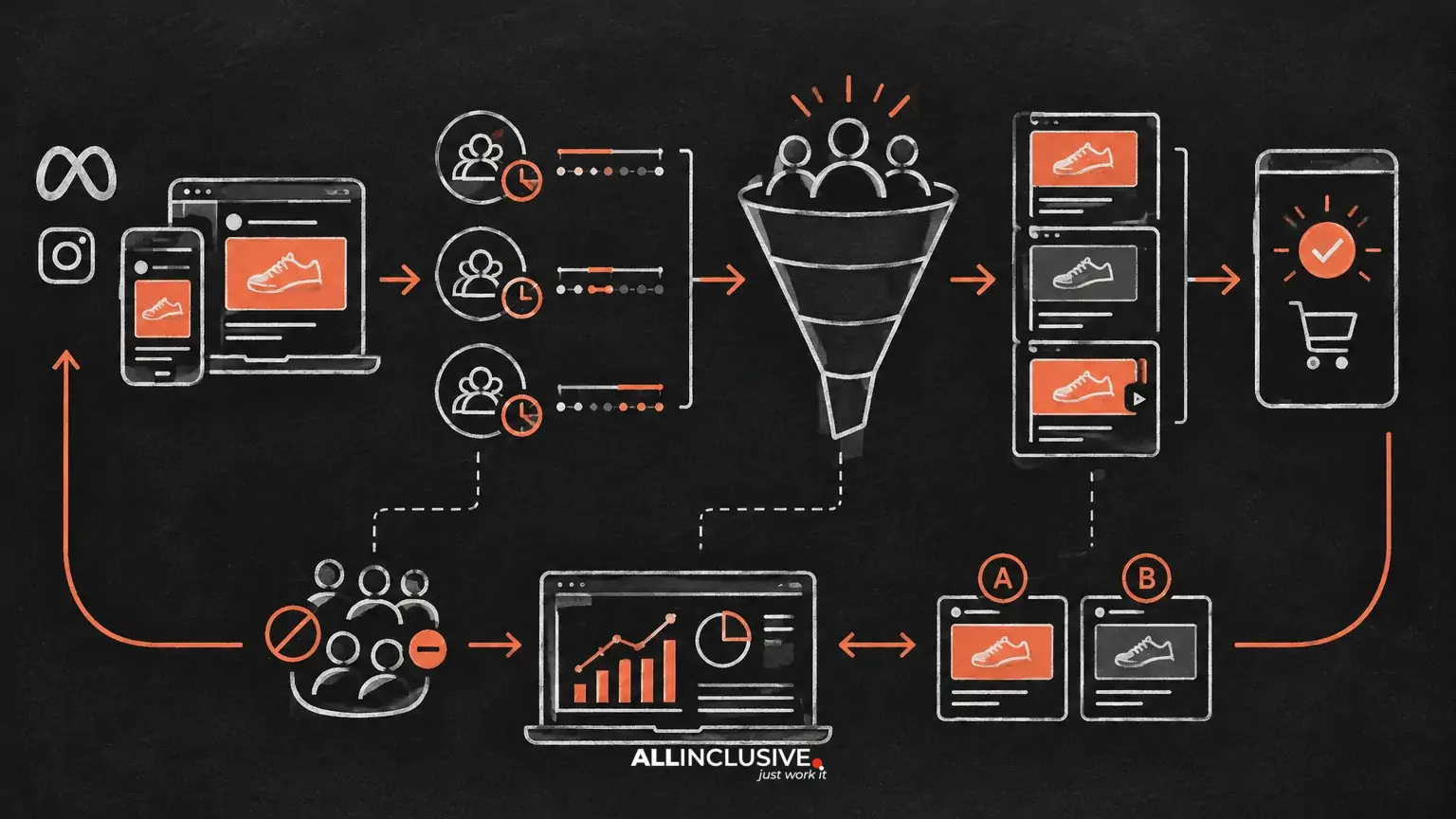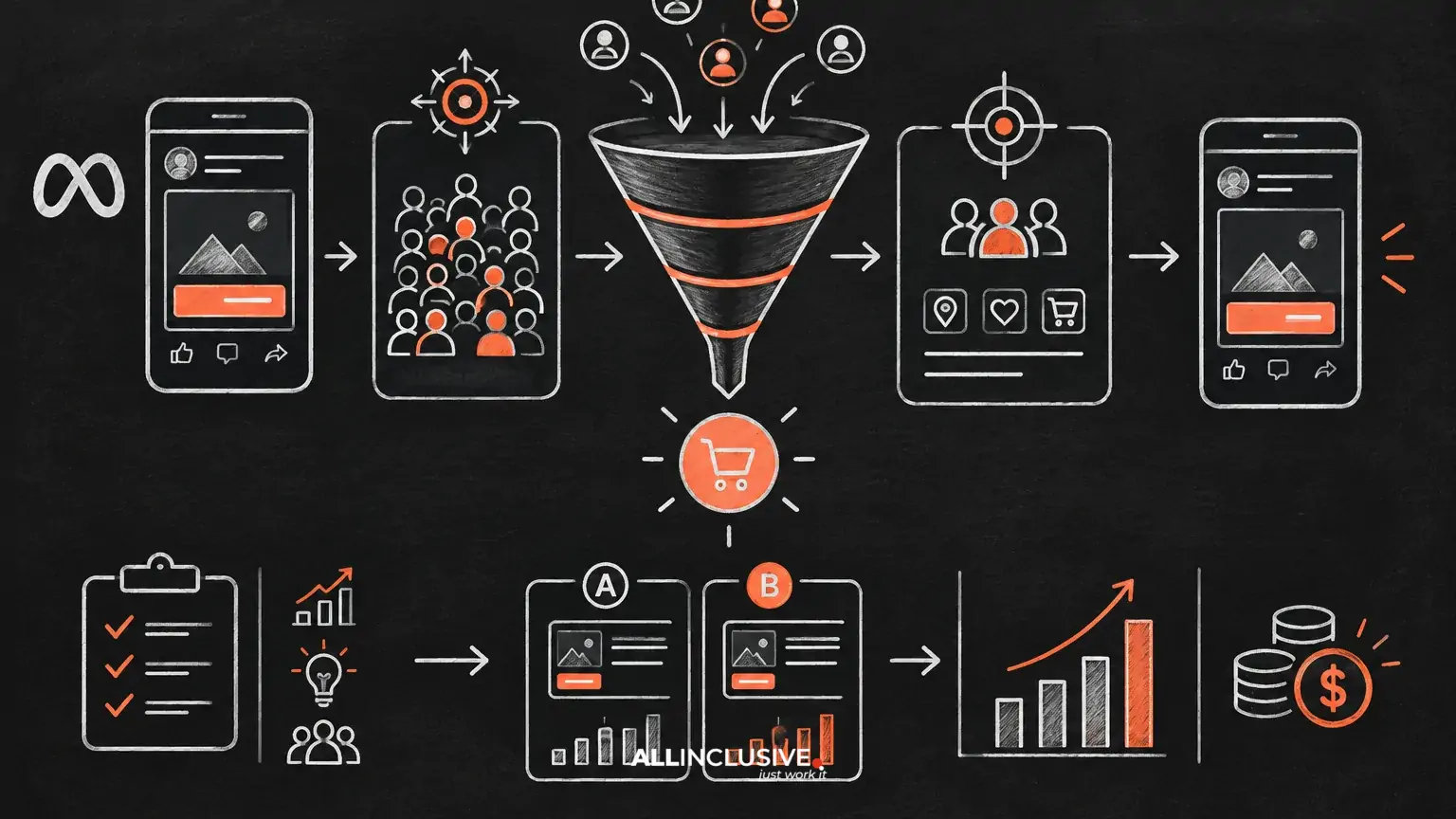
Meta Ads broad targeting means giving Meta relatively few audience restrictions and allowing delivery systems to find people likely to take the desired action. Instead of building a narrowly defined audience around detailed interests, job assumptions or extensive exclusions, advertisers provide a conversion goal, creative, offer and enough signal for the system to optimize.
Broad targeting can outperform narrow targeting when the account has a clear conversion event, sufficient quality data, strong creative and a market large enough for algorithmic exploration. It tends to disappoint when the offer is weak, tracking is unreliable, the conversion event is too scarce or the business needs a highly specific buying committee.
The right question is not whether broad targeting is universally better. It is whether your campaign has the conditions required for automated audience discovery—and whether you can evaluate it using qualified business outcomes rather than inexpensive delivery alone.
What broad targeting means on Meta
Broad targeting is an audience strategy, not a promise of untargeted reach. You may still define geography, age or other legitimate business constraints, depending on the campaign. The distinction is that you avoid adding layers of audience assumptions unless they serve a clear purpose.
In practice, broad campaigns usually rely on four inputs:
- Conversion objective: the action you want Meta to optimize toward.
- Creative: the message and visual or video cues that attract the right type of prospect.
- First-party signal: events, customer data and downstream feedback that indicate who is valuable.
- Commercial constraints: geography, eligibility, budget, offer availability and sales capacity.
Broad targeting does not remove the need for strategy. It shifts more of the audience-selection burden from manual segmentation to the combination of creative, conversion data and measurement.
When Meta Ads broad targeting is most likely to work
1. Your conversion signal is clear and reliable
Optimization depends on the event you select and the quality of the data associated with it. A campaign optimized for a low-friction action may find people who complete that action without being useful prospects. A campaign optimized for a meaningful business event has a better chance of aligning delivery with commercial value, provided enough signal is available.
Before testing broad targeting, confirm that the conversion event is firing consistently, is not duplicated, and represents a meaningful step in the buying journey. For B2B advertisers, that might be a completed qualification form, booked meeting or accepted lead—not simply any form submission.
2. The market is large enough to support exploration
Broad targeting needs room to test. If the addressable market is already small because of geography, regulation, language, industry or buying requirements, adding audience restrictions may not be the main problem—but removing them may not create meaningful additional opportunity either.
Broad audiences are more viable when there are enough eligible people and enough conversion volume for the system to learn from different pockets of demand. A niche product with limited eligible buyers may need a more deliberate account-based or contextual approach.
3. Creative communicates qualification cues
When audience filters are lighter, creative carries more responsibility. Strong ads explain the problem, identify the intended buyer and make the offer understandable. This can discourage low-fit clicks while attracting people who recognize the use case.
For example, a B2B software advertiser might reference a specific operational problem, company stage or workflow rather than use a generic claim such as “Improve your business.” The ad does not need to name every targeting criterion, but it should make relevance apparent.
4. The offer is strong enough to earn action
Broad targeting cannot compensate for an offer that creates little urgency or perceived value. A useful diagnostic is whether a qualified prospect would understand why to respond now, what they will receive and what happens next.
Depending on the funnel, the offer could be a practical guide, assessment, consultation, product demonstration or trial. The appropriate choice depends on buying complexity and intent. Broad delivery may generate more volume, but the offer determines whether that volume has commercial quality.
5. You can judge performance beyond the platform dashboard
Broad targeting can appear successful if you evaluate only reach, clicks or low-cost leads. B2B advertisers should connect campaign data to lead qualification, opportunity creation and revenue processes where possible.
Track quality by cohort and source, not just by average cost. A higher cost per lead can be acceptable if it produces more qualified opportunities. Conversely, a low cost per lead can hide poor fit, duplicate submissions or contacts that sales cannot reach.
When broad targeting is less likely to work
Highly restricted or account-specific demand
If the campaign must reach a defined list of companies, professional roles or organizational buying groups, broad targeting may be too imprecise. In these cases, the business constraint is not audience discovery; it is reaching known accounts or a narrow set of decision-makers.
That does not mean broad campaigns are impossible. It means they should not replace account-based, contextual or carefully qualified approaches when precision is the central requirement.
Insufficient conversion volume
If meaningful conversions are rare, the system has limited evidence from which to learn. Broad delivery may then generate unstable results or optimize toward easier but less valuable actions.
One response is to use a higher-volume event temporarily, but only if you understand the quality tradeoff and have a plan to move toward a more valuable event. Another is to consolidate fragmented campaigns so available signal is not divided across too many small ad sets.
Weak tracking or unclear attribution
Broad targeting is difficult to assess when events are missing, duplicated or disconnected from CRM outcomes. You may not know whether the audience is poor, the offer is weak or the measurement is incomplete.
Resolve the measurement problem before making major audience conclusions. Validate event definitions, landing-page behavior, lead routing and sales feedback together.
Creative that appeals to everyone
General creative often produces general response. If the message does not identify the problem or buyer, broad delivery can amplify curiosity without creating meaningful demand.
Build creative variations around different pain points, use cases and levels of awareness. Then evaluate not only which ad gets the lowest acquisition cost, but which message brings the strongest downstream audience.
Short testing windows and frequent resets
Automated delivery needs a stable test structure. Constantly changing budgets, audiences, conversion events and creative at the same time makes it difficult to identify cause and effect.
Set a decision window appropriate to the conversion cycle and spend level. Avoid treating every daily fluctuation as evidence that broad targeting has failed or succeeded.
Broad versus narrow targeting: a practical comparison
Narrow targeting can help when you have a defensible reason to constrain delivery. Examples include regulatory eligibility, a tightly defined customer profile, geographic service boundaries or a controlled test of a specific audience hypothesis.
Broad targeting can help when your assumptions may exclude viable prospects, when creative can qualify demand, or when the platform has more behavioral information than your manual audience definition. Neither approach should be judged by ideology.
Use these questions to choose a starting point:
- Is the product relevant to a genuinely broad market or only a specific segment?
- Can the ad clearly communicate who the offer is for?
- Is the primary conversion event both measurable and commercially meaningful?
- Do you have enough budget and time to evaluate learning rather than isolated results?
- Can sales or CRM data show whether delivery is reaching qualified buyers?
- Are there legal, geographic or operational constraints that must be enforced?
How to test broad targeting without losing control
1. Define the business hypothesis
Write down what you expect broad targeting to improve. The hypothesis might be that fewer audience restrictions will expand qualified reach, reduce dependence on fragile interest segments or find buyers outside your assumed profile.
Specify the primary success metric before launch. For a B2B campaign, this could be qualified lead rate, meeting rate, opportunity rate or cost per opportunity rather than click-through rate alone.
2. Keep the test interpretable
Do not change the audience, landing page, offer, creative concept and conversion event simultaneously if you want to learn what caused the result. A test does not need to be perfectly scientific, but it should have a clear contrast.
Compare a broad structure with a credible alternative under similar commercial conditions. Keep necessary constraints constant and document budget changes, exclusions and optimization events.
3. Give creative enough range
Broad targeting benefits from multiple creative routes. Test distinct hooks, formats and qualification cues rather than producing minor variations of one message.
Useful creative categories include:
- Problem-led ads that name an operational pain.
- Outcome-led ads that explain the business result without unsupported promises.
- Proof-led ads using substantiated evidence or a concrete process.
- Educational ads that offer a useful framework or diagnostic.
Review comments, lead responses and sales notes for signs that the message is attracting the intended audience.
4. Monitor quality in stages
Break performance into a funnel: delivery, engagement, conversion, qualification and sales progression. A problem at each stage suggests a different intervention.
- Low engagement: investigate the hook, format or relevance.
- Strong engagement but weak conversion: review the landing page, offer and message continuity.
- Strong conversion but weak qualification: improve the form, creative qualification cues or conversion event.
- Strong qualification but weak opportunity creation: examine sales follow-up, fit criteria and commercial positioning.
5. Set guardrails before launch
Define acceptable lead quality, spend limits, frequency concerns, geographic boundaries and escalation rules in advance. Guardrails prevent the team from declaring victory based on cheap volume or stopping a promising test after a small fluctuation.
Measurement considerations for B2B advertisers
Broad targeting is particularly sensitive to the gap between platform conversions and business outcomes. A submitted form is not automatically a qualified lead, and a qualified lead is not automatically an opportunity.
Use consistent definitions across marketing and sales. Capture the campaign and ad context in your CRM where possible, then review cohorts over a reasonable sales cycle. If the business has long consideration periods, early indicators can inform optimization, but they should not be presented as revenue proof.
Also separate audience performance from operational performance. Slow lead response, unclear qualification criteria or poor routing can make a sound acquisition strategy appear ineffective.
A decision framework for your next campaign
Start broad when the product has a sufficiently large market, the conversion event is dependable, creative can identify the intended buyer and you can measure quality beyond the initial conversion.
Start narrower when eligibility is inherently limited, the campaign is account-specific, the market is small, or the business lacks enough signal to evaluate automated discovery. In those cases, use the narrow approach as a deliberate constraint—not as a substitute for strong creative and measurement.
For a balanced test, retain only essential restrictions, create several distinct messages, use one clearly defined optimization event and evaluate qualified outcomes over an agreed period. If broad targeting produces more volume but lower quality, refine the offer and qualification system before concluding that the audience strategy is at fault.
Where broad targeting fits in a paid-social plan
Broad targeting is one lever within a larger system that includes positioning, creative development, landing-page experience, conversion design, measurement and follow-up. It should be evaluated alongside those components rather than isolated as a platform setting.
For wider channel context, see our guide to paid social. If your team is comparing networks, our overview of paid social for B2B explains how channel roles can differ across the buying journey. For a platform-specific creative and placement perspective, see Instagram Ads strategy.
Broad Targeting on Meta Ads: What to Prioritize
Meta Ads broad targeting works best when the system has room to explore and the advertiser provides strong inputs: a meaningful conversion event, reliable measurement, relevant creative, a credible offer and enough time to assess quality. It is less suitable when the audience is inherently restricted, signal is scarce or the business cannot distinguish valuable demand from inexpensive activity.
Test broad targeting as a commercial hypothesis. Keep the comparison interpretable, establish guardrails and judge the outcome by qualified business results. That approach turns audience selection from a preference into an evidence-based part of paid-media planning.
For broader strategic context, see the broader paid media hub.