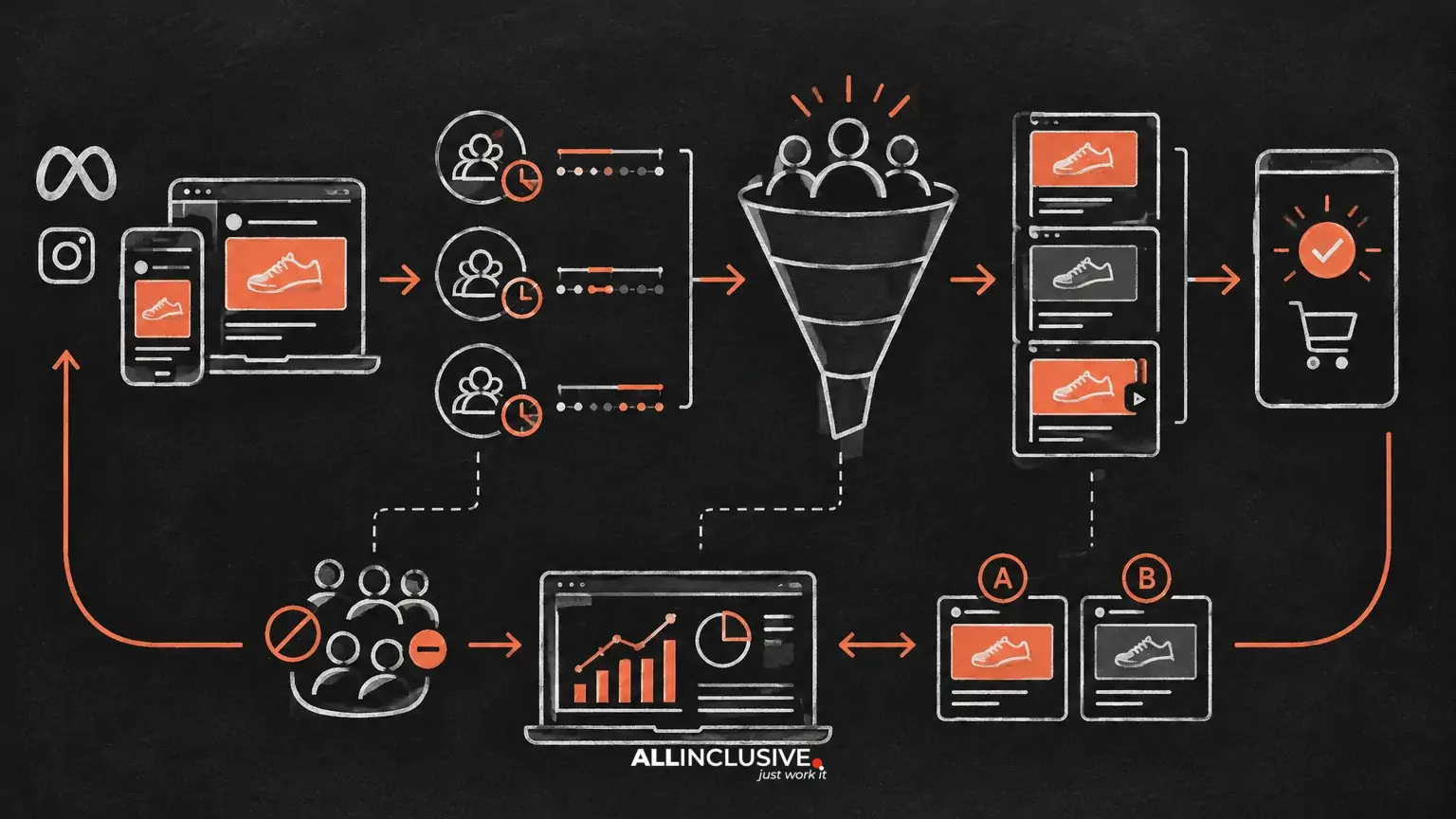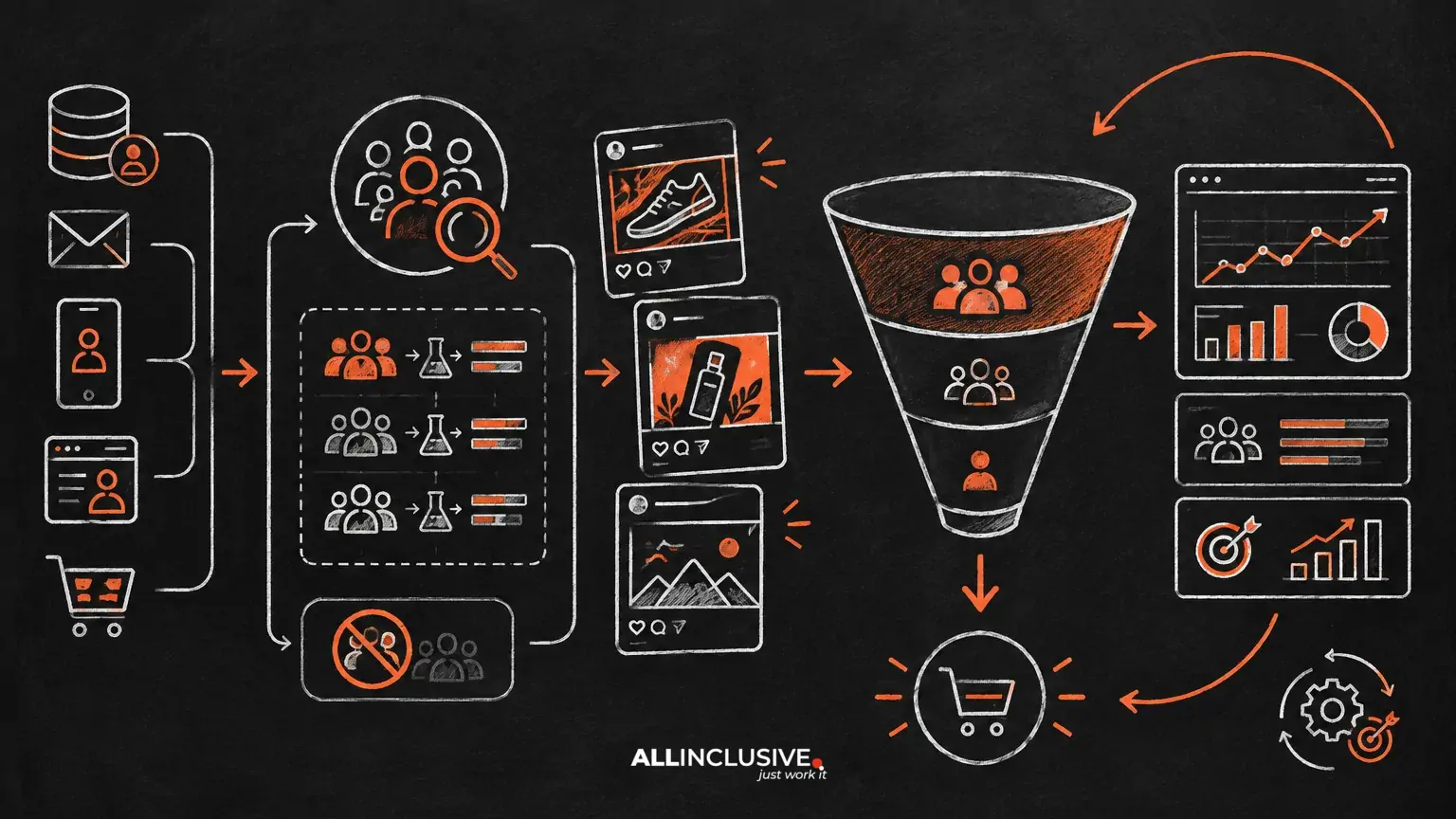
Meta Ads audience strategy is no longer mainly a matter of collecting every available interest, behavior and demographic filter. As detailed targeting options and delivery mechanics change, advertisers need a system that can withstand platform updates without losing commercial discipline.
The durable approach is to combine strong first-party data, clearly defined customer stages, sensible exclusions, controlled audience tests and creative that qualifies the right prospects. The objective is not to make audiences as narrow as possible. It is to give delivery enough room to find likely buyers while preserving a clear hypothesis about who the campaign should reach and why.
What has changed in audience strategy
Audience planning on Meta has always involved two separate questions:
- Who should be eligible to see the ad?
- What evidence should Meta use to find more people likely to act?
Detailed targeting can help express an initial hypothesis, but it is not a substitute for conversion data, message-market fit or sound measurement. Some targeting inputs may be unavailable, broadened, treated as suggestions or affected by delivery settings. The exact mechanics can change by objective, account, region and campaign configuration, so strategy should not depend on one filter behaving permanently in one way.
That makes audience resilience more important than targeting complexity. A resilient structure continues to work when a single interest disappears, an audience becomes too small or delivery expands beyond the original selection.
The four layers of a resilient Meta Ads audience strategy
1. Business-defined customer stages
Begin with the commercial journey, not the interface. Most accounts need separate thinking for at least four groups:
- New prospects: people with no meaningful prior interaction with the business.
- Engaged prospects: people who watched, clicked, visited or interacted but have not reached the desired conversion point.
- Active evaluators: people who viewed key pages, started a form, requested information or otherwise showed stronger intent.
- Existing customers or converted leads: people who should usually be excluded from acquisition or moved into expansion, retention or cross-sell programs.
These stages should influence budget, message, offer and exclusion logic. They should not be treated as interchangeable simply because they can be selected inside the same ad platform.
2. First-party signals
First-party signals are the foundation of audience quality. Depending on the business model and consent framework, useful inputs may include customer lists, qualified-lead records, website events, product usage, CRM stages and meaningful engagement events.
Quality matters more than volume alone. A seed list containing recent, correctly classified customers can be more useful than a larger list containing old leads, duplicates or contacts with unclear status. Define what each audience means, when it refreshes and whether it is appropriate for acquisition, suppression or retention.
For lead-generation accounts, do not stop at the initial form submission. Where possible, connect downstream qualification or sales outcomes to campaign analysis. This helps distinguish cheap responses from commercially useful demand.
3. Delivery flexibility
Broad or relatively open audiences can give the system more room to find efficient impressions and conversions, especially when the account has sufficient signal and the creative clearly communicates the offer. Broad does not mean careless. It means the advertiser is relying less on manual preselection and more on the combination of event quality, creative relevance, landing-page clarity and measured outcomes.
Use detailed targeting when it represents a meaningful testable hypothesis, not because a crowded audience appears more sophisticated. A narrow audience can create false confidence: it may look relevant in the setup while limiting scale, increasing repetition or obscuring whether the offer works beyond a small defined group.
4. Creative as qualification
When audience controls are less precise, the ad itself must do more filtering. State the problem, buyer context, value proposition and next step clearly. Creative can qualify through:
- Industry or role language that signals relevance.
- Use-case framing that helps the right prospect recognize the situation.
- Specific eligibility or fit criteria.
- Proof points that address the prospect’s stage of evaluation.
- Calls to action aligned with the actual conversion required.
This is not a reason to make every ad overly narrow. It is a reason to build a portfolio of messages, each with a clear audience hypothesis. For a B2B campaign, one ad might address a demand-generation problem for marketing leaders while another focuses on pipeline visibility for revenue teams. The audience setup can remain relatively open while the creative creates useful self-selection.
How to choose between broad, interest-led and first-party audiences
Use a decision framework rather than a universal rule.
Favor broad testing when:
- The campaign has a reliable optimization event and enough recent conversion activity to guide delivery.
- The offer has clear, wide relevance within the intended market.
- Creative variations communicate distinct problems or use cases.
- You can evaluate lead or purchase quality beyond the platform’s initial conversion.
Use interest or demographic hypotheses when:
- The market is genuinely specialized and the selected input maps to a real business context.
- The audience is being tested against a comparable broader control.
- The test has a defined success criterion and a reasonable observation period.
- The targeting input improves the business hypothesis rather than merely making the estimate smaller.
Prioritize first-party audiences when:
- You need to re-engage known prospects with a stage-specific message.
- You are building a seed for a modeled or lookalike test.
- You need to suppress customers, converted leads or recent form submitters from acquisition.
- You want to separate high-intent actions from low-value engagement.
These categories can coexist. An account might use a broad acquisition test, a first-party re-engagement campaign and a carefully controlled interest hypothesis. The important point is to avoid interpreting audience type as a guarantee of performance.
Build audience architecture around exclusions
Exclusions are often more valuable than adding another layer of targeting. They help prevent budget from being spent on people who have already moved to another stage or who should receive a different message.
Common exclusion groups include:
- Recent converters from prospecting campaigns.
- Open opportunities or active sales conversations when acquisition is not appropriate.
- Existing customers from new-customer campaigns.
- Recent website visitors from cold-audience campaigns when they have a dedicated retargeting path.
- Low-quality or disqualified records, where the business can identify them reliably and use is permitted.
Set the window according to the buying cycle and message, not an arbitrary convention. A short consideration cycle may require recent windows; an enterprise purchase may justify longer consideration audiences. Review overlap periodically because audiences, events and campaign objectives can change.
Audience exclusions should also reflect the limits of available data. If a CRM audience is incomplete or delayed, do not assume it removes every relevant person. Treat suppression as an operational process that requires data hygiene, refresh schedules and validation.
A practical testing structure
Keep the test question specific. “Which audience wins?” is usually too broad because results may reflect different creative, budget, placements, optimization events or lead quality. Better questions include:
- Can a broad prospecting audience produce qualified leads at an acceptable cost compared with an interest-led audience?
- Does a recent high-intent audience respond better to proof-oriented creative than to introductory messaging?
- Does a first-party seed improve downstream quality compared with a broader modeled audience?
- Does role-specific creative improve conversion quality without materially restricting delivery?
For a clean audience comparison, hold as many important variables constant as practical. Use comparable creative, conversion events, landing pages, geographic scope and measurement definitions. If you change audience and creative simultaneously, the result may still be useful for optimization, but it will not answer an audience-only question.
Document each test before launch:
- Hypothesis: why should this audience improve the business result?
- Primary metric: the outcome used to make the decision.
- Quality check: the downstream signal that prevents cheap but weak conversions from winning.
- Decision rule: what action follows if the test is positive, neutral or negative.
- Review date: when the team will inspect the result rather than reacting to every daily movement.
For related campaign design, see Meta Ads account structure. For seed quality and modeled audience testing, see how to build better Meta lookalike audiences.
Measure audience strategy beyond platform conversions
Audience decisions should connect to the business outcome. A useful measurement stack may include:
- Delivery indicators such as spend, reach, frequency and CPM.
- Response indicators such as click-through rate, landing-page behavior and conversion rate.
- Acquisition indicators such as cost per lead, cost per opportunity or cost per purchase.
- Quality indicators such as qualification rate, sales acceptance, revenue or retention.
Do not assume the lowest cost per conversion represents the best audience. A broader audience can produce more inexpensive actions but weaker downstream value; a smaller audience can produce fewer actions with stronger commercial relevance. The correct choice depends on the objective, sales process, margin and capacity to follow up.
Also separate audience performance from delivery conditions. CPM, auction competition, placement mix, creative fatigue, landing-page speed and tracking quality can all influence results. If a test changes several of these at once, avoid attributing the entire outcome to the audience.
Meta Ads Audience Strategy After Detailed Targeting Changes: Mistakes to Watch For
Confusing narrowness with relevance
A smaller estimated audience is not automatically more qualified. Relevance must be demonstrated through response and downstream quality.
Stacking too many interests
Long targeting lists can obscure the hypothesis and make it difficult to know what actually influenced delivery. Start with a clear group or a small number of interpretable variants.
Using engagement as a proxy for intent
Video views, page engagement and clicks can support retargeting, but they do not necessarily indicate buying readiness. Assign each event a role in the funnel and validate it against later outcomes.
Ignoring audience overlap
Multiple campaigns can compete for similar people, especially in smaller markets. Review campaign purpose, exclusions and delivery patterns before adding another audience layer.
Changing the setup too frequently
Constant edits make learning and diagnosis harder. Make necessary corrections, but give tests a defined evaluation process and record what changed.
A maintenance routine for audience quality
Audience strategy is an operating system, not a one-time build. Establish a recurring review that covers:
- Whether customer and lead lists are current, deduplicated and correctly classified.
- Whether conversion events still represent meaningful business actions.
- Whether prospecting exclusions are removing the intended groups.
- Whether audience sizes, delivery and overlap have changed materially.
- Whether creative still reflects the needs of each customer stage.
- Whether reported conversions align with CRM or revenue records.
Platform mechanics will continue to evolve. Your strategic advantage comes from knowing which signals are trustworthy, which assumptions are being tested and which outcomes matter commercially.
Meta Ads Audience Strategy After Detailed Targeting Changes: Decision Summary
The strongest Meta Ads audience strategy after detailed targeting changes is not the one with the most filters. It is the one that combines reliable first-party inputs, clear customer stages, deliberate exclusions, credible tests and creative that helps the right prospects identify themselves.
Use broad delivery where the data and offer support it. Use detailed targeting as a hypothesis, not a guarantee. Judge audiences on qualified business outcomes, and keep the architecture flexible enough to adapt when platform mechanics change. For the wider discipline behind this approach, explore our paid social strategy resources and the broader paid media hub. For stage-based re-engagement, see our guide to Meta Ads retargeting.