
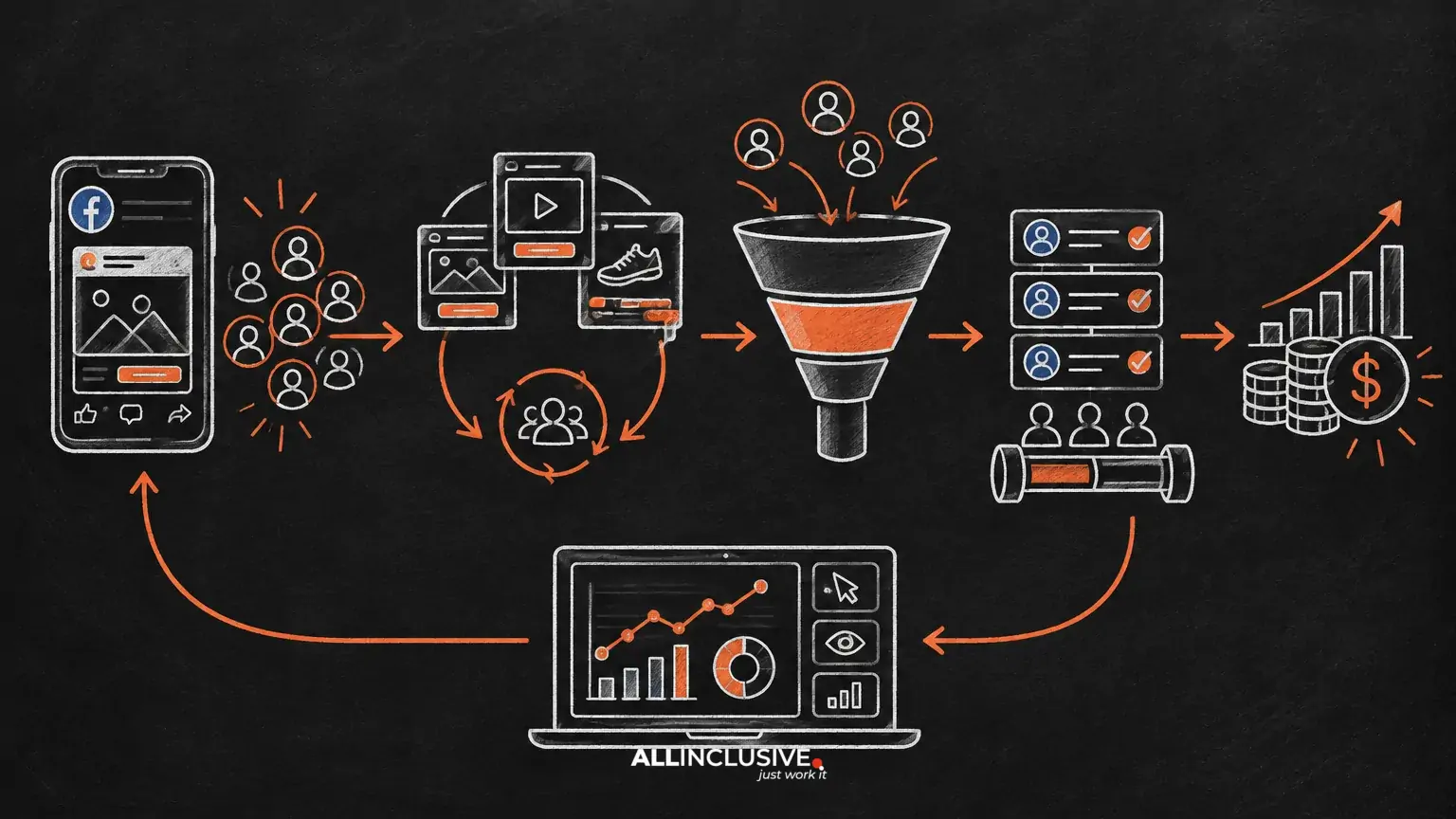
A strong Facebook Ads strategy is not a collection of audiences, ads and budgets managed in isolation. It is a decision system that connects business objectives to funnel stages, creative, landing pages, conversion signals and measurement.
For most advertisers, the practical question is not whether to use Facebook Ads. It is how to decide who should see an ad, what promise the ad should make, when to move users toward a conversion, and how to distinguish efficient demand generation from activity that only looks efficient inside the platform.
The most durable approach combines two motions: prospecting to create qualified new demand and retargeting to help existing prospects take the next step. Both should be governed by a measurement framework that reflects the sales cycle, margin and customer value.
Start with the commercial objective
Before selecting audiences or campaign settings, define the business outcome the account must support. The correct setup for ecommerce purchases is different from the setup for a B2B consultation, software trial or high-consideration service.
Clarify four inputs:
- Primary conversion: the action that represents meaningful progress, such as a purchase, qualified form submission, booked meeting or activated trial.
- Economic value: revenue, gross margin, pipeline value or a defensible proxy for customer value.
- Decision window: the likely time between first interaction and conversion.
- Operational capacity: how quickly sales or customer-success teams can respond to generated demand.
These inputs determine what the account should optimize toward and which reporting metrics deserve attention. A low-cost lead is not necessarily valuable if it cannot be qualified or followed up effectively.
Design the funnel around user readiness
Facebook Ads campaigns work best when the message matches the prospect’s level of awareness. A person who has never encountered the company needs a different reason to engage than someone who visited a pricing page yesterday.
Prospecting
Prospecting reaches people who are not yet known to the business or who have not demonstrated a recent high-intent action. The objective is to find potential buyers at an acceptable cost while giving the platform and the creative enough signal to identify quality patterns.
Prospecting creative should answer a clear question: Why should this audience care now? Useful angles may include a costly operational problem, a category misconception, a distinctive approach, a customer scenario or a practical way to evaluate alternatives.
Retargeting
Retargeting serves users who have already interacted with the company. The audience can include site visitors, content viewers, engaged social users, product viewers or previous leads, depending on the available signals and the business model.
Retargeting should not simply repeat the prospecting message. It should reduce uncertainty and provide the next logical action, such as reviewing proof, comparing options, completing a form, starting a trial or returning to checkout.
Customer and existing-user audiences
Existing customers may support retention, cross-sell, upsell or referral objectives. They should usually be considered separately from acquisition audiences so that budget and reporting do not obscure the difference between new and existing demand.
Build a prospecting approach that can learn
Audience strategy should create useful learning without fragmenting delivery into too many small segments. Begin with the business’s strongest evidence about who buys, why they buy and what problem precedes the purchase.
Potential inputs include:
- Customer and prospect data, used in accordance with applicable privacy obligations and platform requirements.
- High-value customer characteristics, not just broad demographic descriptions.
- Search, sales and customer-support language that reveals recurring needs.
- Content engagement patterns that indicate meaningful interest.
- Geographic, language or regulatory constraints that genuinely affect eligibility.
Use these inputs to form hypotheses, not assumptions. For example, a B2B consultancy might test whether its strongest response comes from operations leaders dealing with a specific bottleneck, rather than creating separate campaigns for every job title and industry combination.
Broad audience approaches can be useful when the conversion signal is reliable and the creative clearly communicates the value proposition. More constrained targeting may be appropriate when the offer has strict eligibility requirements, a limited service area or a narrowly defined buying committee. The decision should be based on signal quality, volume, economics and the ability to reach qualified buyers—not on a universal preference for broad or narrow targeting.
For a deeper comparison of this decision, see Broad Targeting on Meta Ads.
Use retargeting to resolve friction
Retargeting becomes more useful when audiences are organized by behavior and recency rather than treated as one undifferentiated pool. A recent product viewer may need a reminder or comparison point, while an older content visitor may need to understand the problem and category again.
Useful segmentation questions include:
- What did the person view or do?
- How recently did the action occur?
- What information is still missing?
- Has the person already converted or entered a sales process?
- Should the person be excluded because the message is no longer relevant?
Set exclusions deliberately. Without them, customers may continue seeing acquisition ads, recent converters may receive an inappropriate offer, and prospecting results may be overstated by users who were already close to converting.
Frequency should also be interpreted alongside audience size, creative variation and buying-cycle length. Repeated exposure may help in a considered purchase, but repetition without a new reason to act can create waste or fatigue.
Make creative the main testing system
Creative often carries more strategic responsibility than a minor variation in audience settings. Each ad should express a clear hypothesis about the problem, buyer, proof point or desired action.
Build a testing matrix across several dimensions:
- Problem: cost, risk, complexity, lost time or missed opportunity.
- Audience context: role, use case, lifecycle stage or customer situation.
- Promise: the outcome or change the buyer can reasonably expect.
- Proof: demonstration, process, comparison, customer evidence or expert explanation.
- Format: short video, static image, carousel, testimonial, product demonstration or founder-led explanation.
- Call to action: learn, compare, subscribe, request, buy or start.
Do not judge a creative test only by the cheapest click. A useful test connects the ad to downstream indicators such as qualified leads, completed checkouts, booked meetings, pipeline progression or revenue. If an ad produces attention but attracts poor-fit users, its apparent efficiency may be misleading.
Align the landing experience with the ad
Message continuity is a major part of paid social performance. The landing page should make it immediately clear that the visitor has arrived in the right place and should support the promise made in the ad.
Check the following:
- The headline reflects the ad’s central problem or benefit.
- The page is appropriate for the audience’s awareness level.
- The next action is visible and proportionate to the buyer’s readiness.
- Proof addresses the objections that matter at that stage.
- Forms request only information that is necessary for the next step.
- Tracking and lead-routing processes are tested before scaling spend.
A prospecting ad may lead to an educational page or category-level offer, while a high-intent retargeting ad may lead to a demo, checkout or consultation page. Sending every audience to the same destination makes it harder to match intent and diagnose performance.
Choose campaign structure for clarity, not complexity
Campaign structure should make budget allocation, testing and reporting understandable. Excessive fragmentation can limit learning and create inconclusive comparisons; excessive consolidation can make it difficult to separate objectives or identify weak segments.
Separate campaigns when there is a meaningful difference in:
- Business objective or conversion event.
- Funnel stage or audience eligibility.
- Geography, language or regulatory requirements.
- Budget ownership or performance target.
- Offer, landing experience or sales process.
Keep elements together when the only difference is a minor creative or copy variation that can be evaluated within a shared objective. Name campaigns and ads consistently so that reports reveal objective, audience context, offer, format and test status without manual interpretation.
The broader principles of structure and optimization are covered in Meta Ads Strategy: Campaign Structure, Creative and Optimization.
Measure beyond platform-reported efficiency
Measurement should operate at three levels.
Delivery and attention
These metrics help identify whether the ad is reaching people and earning attention. Examples include impressions, reach, frequency, video engagement, clicks and landing-page views. They are diagnostic, not final business outcomes.
Conversion and quality
These metrics show whether users are taking the intended action and whether that action is commercially useful. Examples include conversion rate, cost per lead, qualified-lead rate, booked-meeting rate, purchase value and cancellation or rejection rates.
Business impact
Where data supports it, evaluate pipeline created, sales progression, customer acquisition cost, contribution margin, payback period and retention. For longer sales cycles, connect lead and opportunity data back to campaign and creative dimensions with clear definitions and reasonable attribution limits.
Platform-reported conversions can be useful for optimization, but they should not automatically be treated as incremental revenue. Compare platform data with analytics, CRM outcomes, finance records and controlled tests where feasible. Differences may arise from attribution windows, identity limitations, conversion delays, duplicate records and cross-channel interactions.
Set a practical optimization cadence
Optimization should follow a repeatable operating rhythm rather than daily reactions to noisy results.
- Validate the foundation: confirm tracking, event definitions, landing pages, lead routing and exclusions.
- Review delivery: look for underdelivery, concentration, rising frequency, placement concerns and creative fatigue.
- Review quality: compare leads, purchases or meetings with downstream qualification and revenue data.
- Form one or two hypotheses: identify the most likely constraint, such as weak offer clarity, poor follow-up or insufficient creative variety.
- Make controlled changes: avoid changing audience, budget, creative and landing page simultaneously unless the account requires a reset.
- Document the decision: record what changed, why it changed and which metric should move.
Budget increases should be tied to capacity and economics, not just delivery volume. If the sales team cannot process additional leads or inventory cannot support demand, scaling spend may reduce overall efficiency even when platform metrics remain acceptable.
Common Facebook Ads strategy mistakes
- Optimizing for cheap traffic: low-cost clicks do not prove buyer intent.
- Using one message for every stage: unfamiliar prospects and high-intent visitors have different information needs.
- Over-segmenting audiences: small, fragmented groups can make learning and comparison difficult.
- Ignoring exclusions: customers and recent converters can distort acquisition reporting.
- Testing too many variables at once: results become difficult to interpret.
- Reporting only last-click or platform totals: channel contribution is more complex than one attribution view.
- Separating media from operations: lead quality, response time and sales follow-up directly affect paid performance.
When to use outside support
Internal teams can often manage execution when the offer, tracking and sales process are already clear. Specialist support becomes more valuable when the account has multiple markets, a long buying cycle, significant creative requirements, complex CRM feedback or material uncertainty about incrementality.
Evaluate an agency or consultant on the quality of its diagnosis and operating system, not only on promises of lower costs. The right partner should be able to explain how it will prioritize tests, define qualified outcomes, manage creative production, reconcile reporting and communicate trade-offs.
For the broader context around channel selection, audience design and measurement, explore the paid social strategy guide and the paid media resource hub.
Final framework
An effective Facebook Ads strategy can be summarized as a connected sequence:
- Define the commercial outcome and acceptable economics.
- Map prospecting, retargeting and customer communication to user readiness.
- Use audience inputs to form testable hypotheses without unnecessary fragmentation.
- Build creative around problems, promises, proof and next actions.
- Align landing pages, conversion events and follow-up operations.
- Measure quality and business impact alongside delivery metrics.
- Optimize through documented, controlled decisions.
The platform can help deliver and optimize ads, but strategy determines whether the resulting activity supports sustainable growth. The strongest programs treat targeting, creative, measurement and commercial operations as one system.


