
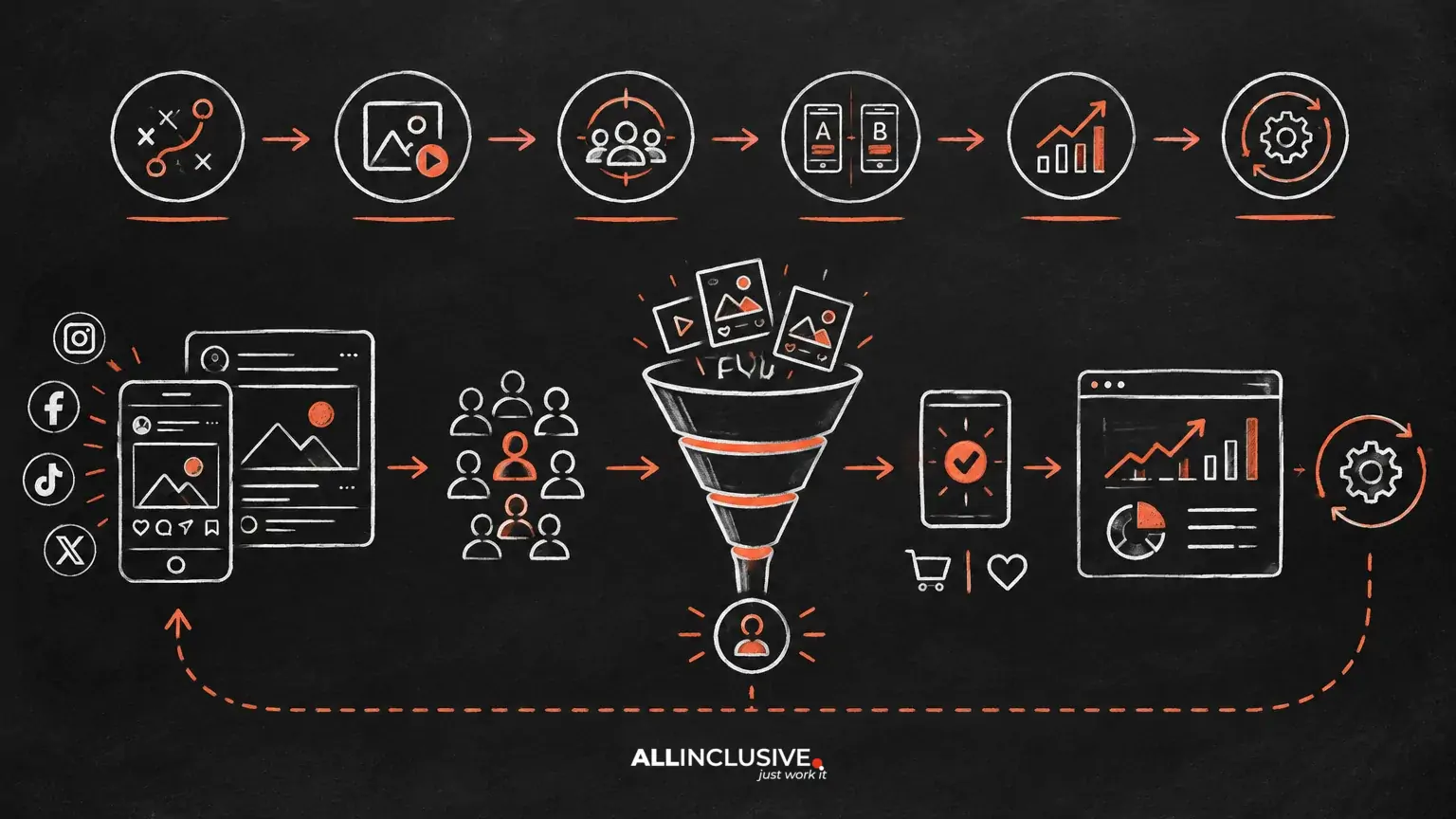
A paid social agency should do more than launch campaigns and adjust bids. The right partner connects business objectives to audience strategy, platform execution, creative production, conversion measurement and a repeatable optimization process.
For a B2B company, that means building a system that can generate qualified attention, capture demand and help sales understand which activity contributes to pipeline. The agency should also make clear what paid social can—and cannot—prove, especially when buying cycles are long and conversions happen across multiple channels.
This guide explains what to evaluate before appointing an agency and what a strong engagement should include.
What a paid social agency should be responsible for
Agency scopes vary, but a credible engagement usually covers six connected areas:
- Business and funnel strategy: defining objectives, audiences, offers and conversion paths.
- Channel and campaign planning: deciding where paid social fits and how campaigns should be structured.
- Creative strategy and production: developing concepts, formats, messages and testing priorities.
- Measurement: establishing conversion events, reporting definitions and a practical attribution approach.
- Media operations: trafficking, quality control, budget management and platform governance.
- Optimization and learning: turning performance data into documented decisions rather than isolated changes.
The important question is not whether an agency offers every possible service. It is whether these responsibilities are connected to a clear commercial objective.
1. Strategy should begin with the buying problem
A strategy should start with the business problem—not a list of platform features. Before recommending campaigns, an agency should clarify:
- Which market, segment or account type matters most?
- What action represents meaningful progress: a qualified inquiry, booked meeting, trial, demo or sales opportunity?
- How much demand already exists, and how much must be created?
- What objections or risks prevent prospects from moving forward?
- How long is the typical buying cycle?
- Which channels, assets and internal teams already influence conversion?
These answers shape the role of paid social. A campaign intended to capture existing demand requires a different offer and measurement plan from one designed to introduce a complex B2B category.
A useful agency strategy should document the customer journey, priority audiences, core message, offer, landing-page experience, conversion event and expected handoff to sales or marketing operations. It should also state what the campaign is not designed to do, preventing unrealistic expectations.
For a broader framework covering audience, creative and measurement decisions, see our paid social strategy guide.
2. Audience planning should balance relevance and scale
Audience strategy is more than selecting job titles, interests or uploaded lists. An agency should explain how targeting reflects the market and the funnel stage.
Define audiences by commercial relevance
For B2B campaigns, useful audience definitions may include company characteristics, role or seniority, existing engagement, customer status and buying-stage signals. The exact inputs depend on available data and the platform, but the logic should remain clear: why is this audience likely to matter now?
Separate prospecting from re-engagement
Prospecting, content engagement, website re-engagement and customer expansion should not automatically share the same objective or message. Separating these groups helps the team understand whether performance comes from new reach, repeated exposure or existing demand.
Use exclusions deliberately
Audience exclusions can reduce waste, protect customer experience and keep reporting interpretable. They may include existing customers, employees, converted leads, active opportunities or audiences assigned to another campaign. The agency should document exclusions and explain when they are reviewed.
Avoid false precision
Narrow targeting can appear strategically sophisticated while limiting delivery or excluding relevant buyers. A strong partner should test audience assumptions, monitor delivery quality and adjust based on evidence rather than treating a highly specific definition as automatically superior.
3. Creative should be treated as a performance system
Paid social creative is not simply a collection of branded advertisements. It is the mechanism that earns attention, frames the problem and gives the audience a reason to act.
An agency should provide a creative strategy that connects:
- Audience insight: the business challenge or motivation being addressed.
- Message: the central claim, point of view or value proposition.
- Proof: evidence such as process detail, expertise, customer experience or product demonstration.
- Offer: the next step and why it is useful at that stage of the journey.
- Format: the visual and written treatment suited to the placement and device.
For B2B, effective creative often needs to make a complex proposition easier to understand without stripping away the detail buyers need. Possible concepts include an explanation of a costly problem, a comparison of approaches, a short expert perspective, a process walkthrough or a practical diagnostic.
Ask how creative testing will work
Testing should have a hypothesis. Examples include testing a problem-led message against an outcome-led message, a specialist audience against a broader audience, or a diagnostic offer against a gated asset. The agency should identify what changed and what the result means before recommending a next iteration.
Testing every variable simultaneously can make learning difficult. A disciplined program changes priorities over time and preserves useful control wherever possible.
4. Measurement must connect media activity to business outcomes
Measurement is often where agency engagements become either useful or misleading. A strong partner should define the reporting chain before launch:
- Which event is the primary conversion?
- Which events indicate progress but are not final outcomes?
- How are leads qualified after submission?
- How will marketing and sales status be reconciled?
- Which attribution view will guide optimization?
- What limitations could affect interpretation?
For a short buying cycle, a platform conversion may provide a reasonably useful optimization signal. For a longer B2B cycle, lead quality, opportunity creation and revenue progression may be more meaningful—but they can arrive later and require CRM integration or offline feedback.
An agency should distinguish among:
- Delivery metrics: reach, impressions, frequency and spend.
- Engagement metrics: clicks, video views or interactions.
- Response metrics: landing-page visits, form completions and booked meetings.
- Quality metrics: qualified leads, opportunities, pipeline and revenue where available.
No single metric proves incrementality or causation. Reporting should therefore combine platform data with site analytics, CRM information and commercial context. When data is incomplete, the agency should say so plainly instead of presenting directional signals as financial certainty.
For a practical review of tracking, campaign structure and reporting issues, use our paid social audit checklist.
5. Campaign operations should be governed, not improvised
Execution quality affects performance and trust. Before launch, the agency should establish a documented operating process covering:
- Account access, ownership and security.
- Campaign naming and taxonomy.
- Budget approval and change thresholds.
- Creative review and legal or brand approvals.
- Tracking quality assurance.
- Landing-page and form checks.
- Incident response and escalation.
- Reporting cadence and meeting responsibilities.
The client should retain appropriate ownership of its advertising assets and data. Access should not depend on an individual agency employee, and the handover process should be clear from the beginning.
Governance also includes decision rights. The agency may be authorized to make routine optimizations within agreed boundaries, while significant budget shifts, new markets or changes to the offer require client approval.
6. Optimization should follow a learning agenda
Optimization is not synonymous with frequent edits. A useful process prioritizes changes according to likely impact, confidence and business relevance.
A practical optimization cycle is:
- Review: examine delivery, conversion and quality signals by audience, creative, placement and funnel stage.
- Diagnose: identify whether the issue relates to reach, message, offer, landing-page friction, tracking or lead quality.
- Prioritize: select the few changes most likely to improve the objective.
- Test: define the hypothesis, comparison and evaluation window.
- Document: record the outcome and the next decision.
This approach avoids optimizing to cheap clicks when the commercial goal is qualified demand. It also helps internal teams understand why a campaign changed, not just what changed.
How to evaluate agency fit
When comparing providers, ask for evidence of thinking rather than a generic capabilities deck. Useful questions include:
- How would you translate our commercial objective into campaign goals?
- What information do you need before proposing an audience or channel plan?
- How do you develop and prioritize creative concepts?
- Which signals would you use to assess lead quality?
- How do you handle long sales cycles and delayed conversion data?
- What decisions can you make without approval?
- How are tests documented and shared?
- What will the first 30, 60 and 90 days include?
- Which work is performed by the proposed team, and which is outsourced?
- What happens to accounts, data and documentation if the engagement ends?
The best answers should be specific to the business model, audience and sales process. Be cautious of guarantees based on platform metrics alone, fixed promises about lead volume without qualification context, or strategies that begin with channel selection before defining the commercial problem.
When an agency is the right choice
An agency can be useful when a company needs specialist capability, faster testing, additional production capacity or a more disciplined operating model. It may be less useful when internal ownership is unclear, the offer is not ready, conversion tracking is unreliable or sales follow-up cannot support incoming demand.
In those situations, the agency should help identify the constraint rather than masking it with more spend. Paid social can amplify a strong proposition and expose weaknesses in the customer journey; it cannot replace product-market fit, credible proof or operational follow-through.
Build the engagement around accountability
A successful paid social partnership is defined by clarity: clear objectives, clear audience logic, useful creative, defensible measurement and documented decisions. Platform execution matters, but it is only one part of the system.
When selecting a partner, assess whether the agency can connect media activity to the way your business actually grows. The right scope should give your team a practical plan, reliable visibility into performance and a steady process for learning what deserves more investment.
For context on how paid social fits into a broader acquisition program, visit our paid social services overview and explore the wider paid media hub.


