
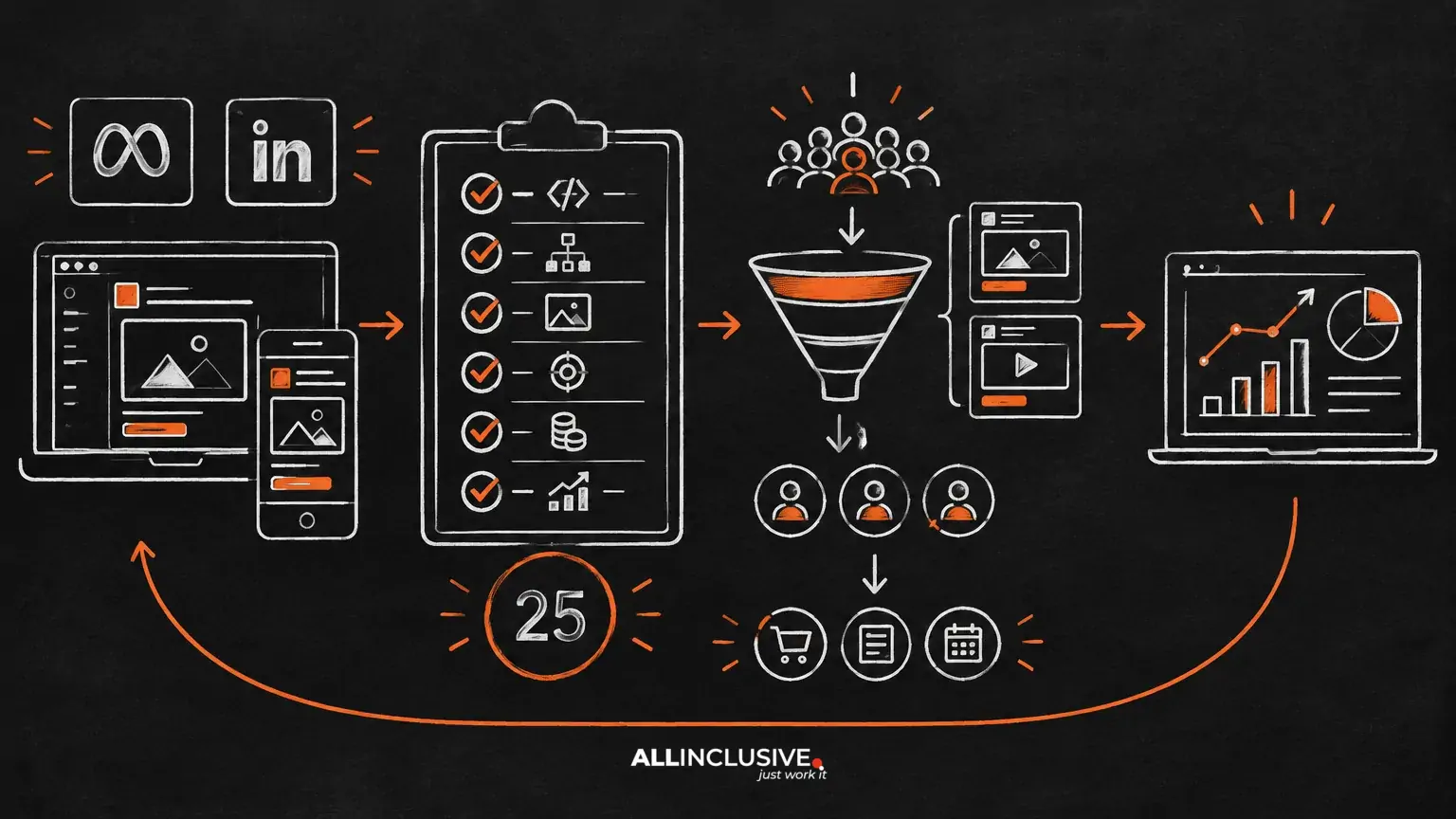
A paid social audit is a structured review of account setup, measurement, targeting, creative, budget allocation, and business outcomes. It should do more than identify broken settings. The goal is to determine whether the account can produce trustworthy evidence, reach the right audiences, support the buying journey, and turn media investment into qualified action.
This checklist covers 25 checks across Meta and LinkedIn. Some apply to both platforms; others depend on the platform’s available campaign controls and your broader measurement stack. Use it before taking over an account, launching a new program, increasing spend, or investigating performance that does not match sales reality.
For broader planning context, see our paid social resources and the paid media hub.
How to run a paid social audit
Start with the business objective and conversion path, not the ad interface. Gather access to the relevant ad accounts, analytics tools, CRM or marketing automation system, landing pages, creative library, and reporting documents. Define the audit period and separate recent changes from longer-term patterns.
Review findings in four categories:
- Critical: issues that make performance data unreliable, create compliance exposure, or prevent conversion delivery.
- High impact: changes likely to improve decision quality, audience quality, or budget efficiency.
- Testable: hypotheses that require controlled experimentation rather than immediate permanent changes.
- Informational: observations that provide context but do not justify action on their own.
A useful audit ends with a prioritized action plan, an owner, a decision rule, and a date for review. It should not become a long list of platform settings with no connection to business outcomes.
Measurement and tracking checks
1. Confirm the primary business objective
Document what the campaigns are expected to achieve: qualified leads, opportunities, purchases, registrations, or another meaningful action. Check whether the account’s optimization event and reporting columns reflect that objective. A campaign optimized for a low-value action can appear efficient while failing to support revenue.
2. Map the conversion path
Trace the journey from ad impression to landing page, form or conversion action, marketing qualification, sales acceptance, and revenue where possible. Record where each stage is measured and where handoffs can lose information. This map helps distinguish media problems from landing-page, routing, or sales-process problems.
3. Validate pixel, tag, and event implementation
Test the relevant tracking technologies in a controlled session. Confirm that events fire on the intended actions, use consistent names, and do not fire multiple times for one conversion. Review whether important parameters—such as campaign identifiers, value, currency, or lead type—are passed accurately.
4. Compare platform conversions with independent sources
Reconcile platform-reported results with analytics, form systems, CRM records, or transaction data. The numbers will not always match because attribution windows, time zones, deduplication, modeled reporting, and counting methods can differ. The audit should explain those differences rather than treating one source as automatically correct.
5. Check attribution and reporting windows
Document the attribution settings used in reporting and compare them with the buying cycle. Short-cycle ecommerce, complex B2B sales, and high-consideration purchases need different interpretations. Avoid comparing campaigns using different windows without clearly labeling the result.
6. Verify lead quality and offline feedback
For lead-generation campaigns, connect media reporting to downstream outcomes. Review lead acceptance, qualification, opportunity creation, and revenue by campaign or audience when data volume permits. If offline feedback is unavailable, mark cost per lead as an interim metric rather than a complete measure of performance.
Account and campaign structure checks
7. Check naming conventions and taxonomy
Names should identify platform, objective, market, audience, offer, funnel stage, and meaningful test variables without becoming unreadable. Consistent naming makes exports, dashboards, and CRM analysis more dependable across Meta and LinkedIn.
8. Review objective and conversion-event alignment
Confirm that campaign objectives, ad-set or campaign-level optimization choices, and selected conversion events support the intended outcome. Platform mechanics change over time, so assess the logic of the setup rather than relying on a copied structure or outdated account convention.
9. Look for unnecessary fragmentation
Identify campaigns or ad groups with overlapping audiences, thin budgets, or too little data to support decisions. Fragmentation can make learning and analysis harder. Consolidation is not always correct, however; preserve separation when markets, offers, legal requirements, or reporting needs genuinely differ.
10. Check geographic and language segmentation
Confirm that locations, languages, currencies, and landing pages match the actual service area and sales coverage. Review whether broad geographic targeting is masking meaningful differences in conversion quality, delivery cost, or follow-up capability.
11. Review exclusions and suppression logic
Check exclusions for existing customers, recent converters, employees, irrelevant regions, poor-fit accounts, and audiences that should be handled by a different campaign. For B2B programs, assess whether account lists and customer data are refreshed and governed appropriately.
Audience and targeting checks
12. Separate prospecting from remarketing
Identify which campaigns create new demand and which re-engage known users. Review audience definitions, exclusions, frequency, messaging, and conversion expectations for each role. Blending these groups can make results look stronger while hiding whether the program is actually expanding reach.
13. Assess audience relevance and scale
For Meta, review the logic of broad, interest, lookalike, first-party, and retargeting audiences where used. For LinkedIn, examine job functions, seniority, industry, company attributes, skills, groups, and account-based inputs as applicable. The key question is not whether targeting is detailed; it is whether the reachable audience contains enough of the people who can buy or influence the purchase.
14. Check audience overlap
Look for campaigns competing for the same users or accounts. Overlap can complicate delivery and inflate apparent competition within the account. Do not assume every overlap is harmful; different offers or funnel stages may justify it. Document the intended role of each audience.
15. Review first-party data quality
Check consent, recency, match quality, field completeness, and refresh processes for customer lists, website audiences, and account lists. A theoretically valuable audience may be unusable if records are stale, incomplete, or disconnected from the sales process.
16. Evaluate frequency and exposure by funnel stage
Review how often people or accounts see ads, especially in small remarketing pools. High frequency may indicate audience exhaustion, weak creative rotation, or an overly narrow segment. Low frequency may indicate insufficient budget or reach. Interpret frequency alongside engagement, conversion quality, and buying-cycle length.
Creative and landing-page checks
17. Audit creative coverage
List the active creative by audience, funnel stage, format, message, offer, and proof point. Check whether the account has enough meaningful variation to test different motivations—not just different colors or minor copy changes. On Meta, account for feed, Stories, Reels, and other eligible placements where relevant. On LinkedIn, assess whether creative fits the professional context and audience role.
18. Match the message to awareness and intent
Prospecting creative usually needs a clear problem, category explanation, or reason to care. Remarketing can address objections, proof, implementation concerns, or a more specific offer. Compare the ad promise with the user’s likely knowledge and next decision.
19. Check creative fatigue and delivery patterns
Review performance over time, not only aggregate totals. Look for declining engagement, rising costs, repeated exposure, or a concentration of delivery in one asset. Avoid declaring fatigue from a single weak day; investigate whether audience size, auction conditions, placement mix, or tracking changes offer another explanation.
20. Validate landing-page continuity
Confirm that the landing page repeats the relevant promise, audience, offer, and call to action from the ad. Check mobile experience, load behavior, form completion, privacy language, qualification fields, and thank-you or confirmation handling. A strong ad cannot compensate for a confusing or mismatched destination.
21. Review offer and conversion friction
Assess whether the requested action is appropriate to the audience’s intent. A high-friction demo request may be premature for a cold audience, while a low-commitment asset may not provide enough sales value for a high-intent segment. Test the offer, form, qualification approach, and follow-up together.
Budget, bidding, and performance checks
22. Compare spend with business value
Review spend by platform, campaign, audience, creative, market, and funnel stage. Compare costs at several levels: cost per conversion, cost per qualified lead, cost per opportunity, and revenue or pipeline contribution where available. Do not move budget solely toward the lowest top-of-funnel cost.
23. Check budget concentration and pacing
Identify whether too much budget is concentrated in a small audience, one creative, one market, or one platform. Review pacing against the planned period and sales capacity. A campaign can be efficient but strategically constrained if it cannot scale into sufficient qualified demand.
24. Review bid and delivery logic
Document the current budget type, bid approach, optimization event, schedule, placement controls, and delivery constraints. Assess whether restrictions are intentional and supported by evidence. Excessive manual controls can limit delivery; excessive automation can obscure where ads are appearing or which audiences receive spend. Use platform-reported mechanics as inputs, not substitutes for commercial judgment.
25. Test the reporting and optimization cadence
Check whether decisions are made on a suitable cadence for the conversion cycle and data volume. Separate monitoring metrics from decision metrics, define minimum evidence for a change, and record hypotheses and outcomes. A weekly review may be useful for pacing and anomalies, while creative, audience, or pipeline decisions may require a longer observation period.
How to turn audit findings into an action plan
Prioritize fixes in this order:
- Restore trust in the data. Fix broken events, duplicate conversions, missing parameters, and unclear attribution definitions.
- Protect commercial relevance. Correct objective, audience, geography, exclusions, landing-page, and lead-routing issues.
- Improve decision quality. Standardize taxonomy, reporting, creative documentation, and downstream outcome feedback.
- Scale what has evidence. Reallocate budget or expand audiences only after the measurement and conversion path are sufficiently reliable.
For each recommendation, record the issue, evidence, expected effect, owner, implementation date, and success criterion. Separate immediate fixes from tests. This prevents an audit from turning into uncontrolled simultaneous changes that make learning difficult.
Paid Social Audit: Strategic Perspective
A strong paid social audit does not reward the most complicated account. It identifies whether the system can reliably connect investment to audience quality, meaningful actions, and business outcomes. Meta and LinkedIn require different audience and delivery considerations, but the audit principle is shared: verify the measurement, understand the customer journey, challenge structural assumptions, and make changes in a sequence that preserves learning.
For additional planning guidance, compare this checklist with our paid social strategy framework, review the LinkedIn Ads strategy guide, and use the Meta Ads strategy guide when translating audit findings into campaign design.


