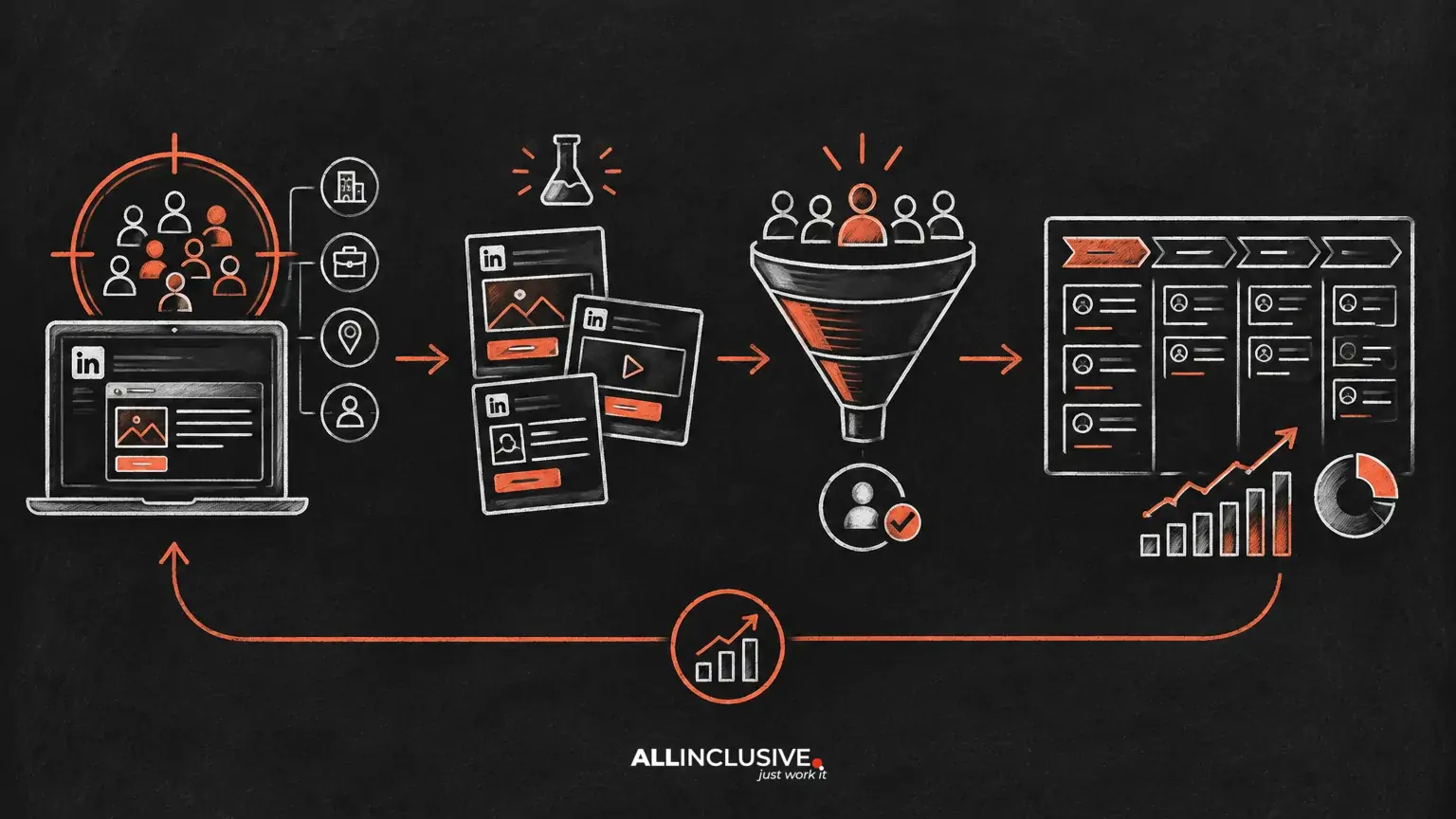
A strong LinkedIn ads strategy is not simply a matter of selecting job titles and launching sponsored content. For B2B advertisers, the real challenge is connecting audience fit, buying-stage relevance, offer design and sales follow-up to measurable pipeline outcomes.
LinkedIn can be useful when your market is defined by professional characteristics such as role, seniority, industry, company size or account list membership. It is less effective when targeting is treated as a substitute for positioning. The most reliable approach is to define the commercial problem first, then use LinkedIn to reach the right business audience with an offer appropriate to its level of intent.
This guide covers the core decisions: how to structure targeting, choose offers, design campaigns, test creative, manage lead quality and evaluate performance beyond surface-level platform metrics.
Start with the buying motion, not the campaign settings
Before building campaigns, document how a prospect becomes a qualified opportunity. A short buying-motion brief should answer:
- Which companies are most commercially valuable?
- Which people influence, approve or use the solution?
- What problem creates urgency?
- What evidence is required before a buyer speaks with sales?
- How long does the journey typically take?
These answers determine whether LinkedIn should support awareness, demand capture, account engagement, lead generation or sales acceleration. They also determine what counts as success. A high-volume form campaign may be useful for a lower-friction offer, but it should not be judged by the same standard as a campaign intended to create qualified enterprise opportunities.
For broader paid-media planning across channels, see the paid media hub. For LinkedIn-specific economics, the guide to LinkedIn Ads cost provides a useful companion framework.
Build targeting around account fit and buying roles
LinkedIn targeting is most valuable when it reflects how your market is actually organized. Avoid creating an audience from every possible professional attribute. Excessive layering can make delivery difficult, obscure learning and produce an audience that looks precise but is commercially incomplete.
Define the account universe
Start with the companies you want to influence. Depending on your business, this may be based on industry, geography, company size, technology environment, growth stage or a named-account list. Account-based campaigns should have a clear reason for inclusion. If the list contains companies with materially different needs, split the messaging or prioritize the segment with the strongest commercial case.
Map the buying committee
Most B2B purchases involve more than one person. Build separate hypotheses for economic buyers, functional owners, technical evaluators, users and potential internal champions. The same offer may not be equally persuasive to each group.
For example, a finance leader may respond to a business-case framework, while an operations leader may prefer a workflow assessment. A technical evaluator may need implementation details before accepting a sales conversation. Targeting should therefore support message relevance rather than merely expand reach.
Use exclusions deliberately
Exclusions can reduce wasted spend and protect the quality of reporting. Consider excluding employees, existing customers from acquisition campaigns, irrelevant functions, students or job seekers where appropriate, and audiences already in a different stage of the journey. Keep exclusions documented so the team understands whether a result comes from strategy or from a narrow delivery constraint.
Match the offer to buying intent
The offer is often the highest-leverage part of a LinkedIn campaign. A generic “learn more” message places too much work on the prospect. A useful offer gives the audience a clear reason to exchange attention, information or time.
Use lower-friction offers when the audience is still forming a problem or comparing approaches. Examples include:
- Original research or a well-supported industry report
- A practical checklist or planning template
- An educational webinar
- A diagnostic guide organized around a specific business problem
Use higher-intent offers when the audience has a clear need and your sales process can respond appropriately. Examples include:
- A consultation with a defined agenda
- An account-specific assessment
- A technical or operational review
- A product demonstration tied to a stated use case
Do not force every audience into a demo. A prospect who is researching a problem may download a useful guide but ignore a meeting request. Conversely, an account with active project signals may need a direct path to sales rather than another broad educational asset.
Design campaign stages around progression
A practical LinkedIn ads strategy usually includes distinct stages, even if the platform structure varies by account and objective.
1. Establish relevance
Introduce the business problem, point of view or category in language your audience recognizes. The goal is not to explain everything. It is to make the right people feel that the message is specifically relevant to their responsibilities.
2. Develop consideration
Use proof, education and practical guidance to help prospects evaluate options. This is where detailed content, examples, expert perspectives and objection-handling assets can perform a useful role.
3. Create a qualified next step
Offer a clear action for prospects who have enough context to engage. The landing page or form should set expectations about what happens next, who the conversation is for and what information is useful to provide.
4. Support sales progression
Paid media should not stop at form completion. Coordinate retargeting, nurture content and sales follow-up around the prospect’s stage. A campaign can generate leads while failing commercially if the handoff is slow, generic or disconnected from the ad promise.
Choose creative that communicates a point of view
LinkedIn creative should make the audience, problem and value of the next step clear quickly. B2B buyers do not necessarily need corporate language; they need credible relevance.
Strong creative concepts often include:
- A specific operational or commercial pain point
- A contrarian but defensible observation
- A concise framework for making a decision
- A customer scenario without unsupported claims
- A preview of what the asset or conversation will help the buyer accomplish
Test meaningful variables rather than changing every element at once. Useful test dimensions include the opening idea, audience segment, offer, proof type, call to action and landing-page experience. Keep a record of the hypothesis behind each test. Without that discipline, performance changes are difficult to interpret.
Creative should also reflect the intended buyer. A message aimed at a chief financial officer should not merely replace the headline with a senior-sounding title; it should address financial priorities, risk and decision criteria. A message aimed at a practitioner should demonstrate practical usefulness.
Keep the post-click experience consistent
Ad relevance can be lost on the landing page. The page should continue the promise made in the ad and answer the questions that determine whether the visitor will proceed.
Review the following elements:
- Message continuity: The headline and opening copy should clearly connect to the ad.
- Audience clarity: State who the resource, assessment or conversation is for.
- Value clarity: Explain what the prospect will receive, learn or accomplish.
- Proof: Use specific, supportable evidence rather than vague superlatives.
- Friction: Ask only for information that supports qualification, routing or follow-up.
- Next-step expectations: Make the process after submission understandable.
Native lead forms can reduce friction, but lower friction does not automatically mean higher lead quality. Website forms can provide more context and control. The right choice depends on the offer, sales process, privacy requirements, qualification needs and ability to follow up quickly.
Measure quality from lead to pipeline
Optimize reporting around the business outcome, not the most visible platform metric. Click-through rate, cost per click and form completion rate can help diagnose delivery and creative, but they do not establish commercial value by themselves.
A useful measurement framework separates four levels:
- Delivery: impressions, reach, clicks and engagement.
- Response: landing-page visits, form starts, completions and content downloads.
- Qualification: fit, intent, accepted leads, meetings or sales-qualified stages.
- Pipeline: opportunities, sourced or influenced revenue, sales-cycle progression and eventual value.
Agree definitions with sales before launch. “Qualified lead” should mean more than a completed form if the commercial objective is pipeline. Establish how records are routed, how duplicates are handled, how attribution is assigned and when offline outcomes are returned to the reporting system.
Be careful with small samples. A short-term change in cost per lead may reflect auction conditions, audience mix, creative fatigue, tracking differences or random variation. Make decisions using multiple signals and a time horizon appropriate to the sales cycle.
Control budget with decision rules
Budget allocation should follow evidence of business value, not simply the cheapest conversion. A low-cost offer may generate volume while producing little sales acceptance. A higher-cost campaign may be justified if it consistently reaches the right accounts and creates meaningful opportunities.
Define decision rules before results arrive. For example:
- Pause or revise creative when engagement and qualified response weaken together.
- Review targeting when delivery is limited or lead quality varies sharply by segment.
- Improve the offer or landing page when traffic is relevant but conversion is weak.
- Investigate sales follow-up when leads are accepted but meetings or opportunities do not progress.
- Increase investment only after the campaign demonstrates repeatable quality at the relevant stage.
Do not treat audience size as a strategy. A larger audience may improve delivery but dilute account fit. A smaller audience may be appropriate for a focused account-based motion, provided the measurement plan recognizes longer decision cycles and limited volume.
Common LinkedIn strategy mistakes
Targeting job titles without a business hypothesis
Job titles can be inconsistent across companies and markets. Use them as one input, then validate whether the audience matches the accounts, functions and buying roles that matter.
Using one offer for every stage
Awareness, evaluation and purchase intent require different levels of commitment. Align the offer with the prospect’s likely questions and readiness.
Optimizing only to platform conversions
Conversion volume is useful only when the conversion represents meaningful progress. Connect campaign reporting to qualification and pipeline data.
Ignoring creative fatigue
Even a well-targeted campaign can lose effectiveness when the same message is repeated too long. Maintain a testing backlog and refresh concepts, not only visual details.
Sending leads into an undefined follow-up process
Document ownership, response timing, qualification criteria and nurture paths. Paid acquisition and revenue operations must work as one system.
LinkedIn Ads Strategy for B2B: Pre-Launch Checklist
- Define the target accounts, buying roles and commercial objective.
- Choose an offer that matches the audience’s buying stage.
- Write a clear value proposition and one primary call to action.
- Build audience exclusions and document the targeting logic.
- Create multiple creative hypotheses tied to specific objections or needs.
- Align the landing page or lead form with the ad promise.
- Verify tracking, CRM routing, qualification fields and offline reporting.
- Agree the review window and decision rules with marketing and sales.
- Launch with enough variation to learn, but not so much that the budget is fragmented.
- Review performance by account fit, buying role, offer and pipeline stage.
LinkedIn is most valuable when it is treated as part of a coordinated B2B growth system rather than an isolated lead form channel. The strongest strategy combines disciplined audience selection with a relevant offer, credible creative, consistent post-click experience and measurement that reaches the pipeline.
For comparison with other paid-social approaches, review the guides to Facebook Ads strategy and Instagram Ads strategy. Their mechanics and audience contexts differ, but the same principle applies: align targeting, message, offer and measurement with the buyer’s journey.
For broader strategic context, see our paid social resource.