
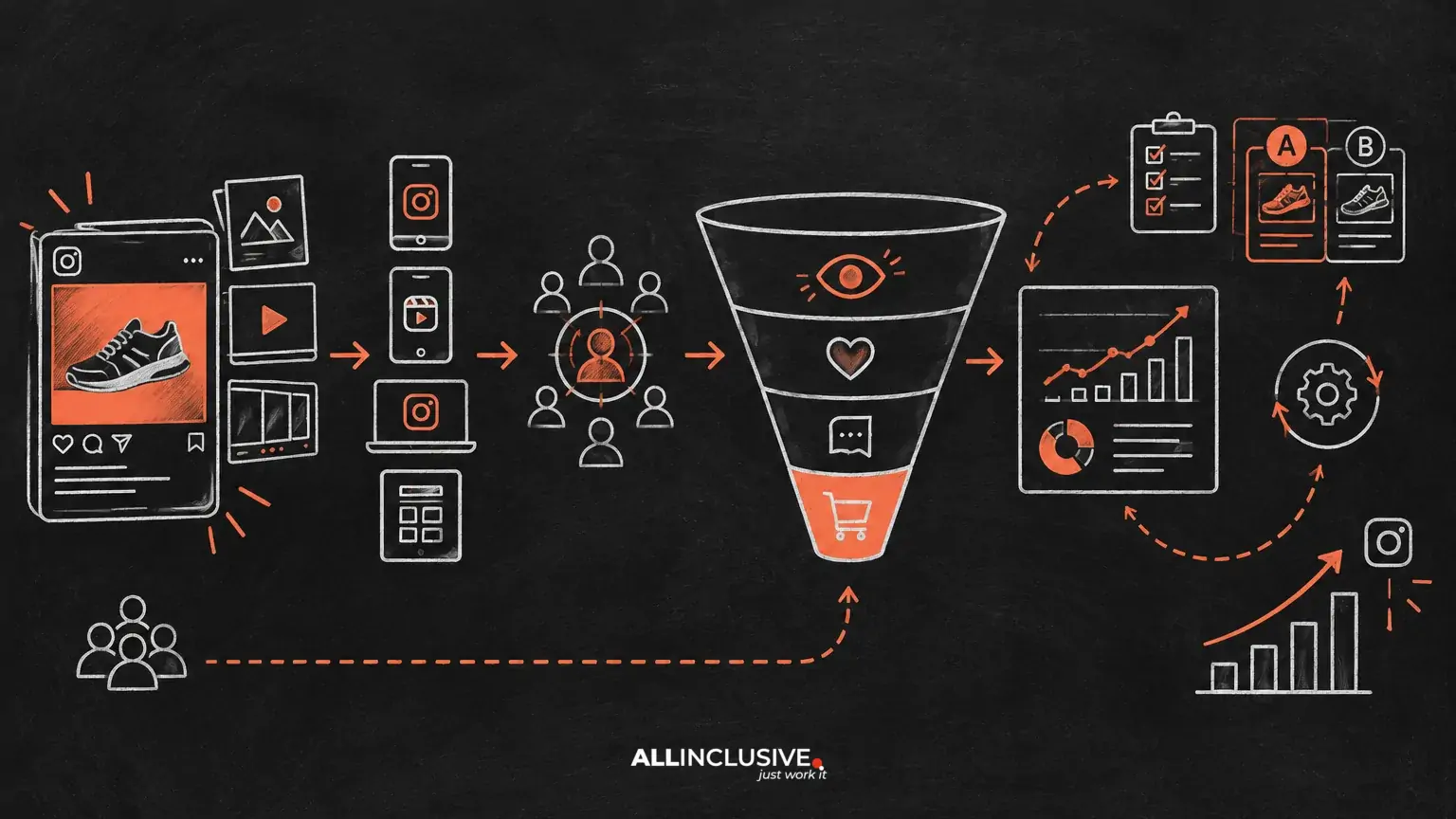
An effective instagram ads strategy is not simply a decision to advertise on Instagram. It is a system for matching audience intent, creative format, placement, offer, landing-page experience, and measurement to a defined business outcome.
For most advertisers, the strongest approach is to design the strategy around the funnel first, then use Instagram’s available inventory and creative formats to deliver the right message at each stage. Prospecting creative should earn attention and create qualified interest. Retargeting creative should resolve objections and make the next step clear. Measurement should connect platform activity to meaningful business events rather than relying on surface-level engagement alone.
Start with the business objective
Before building campaigns, define the commercial outcome the advertising must support. Common objectives include generating qualified leads, increasing purchases, driving booked consultations, promoting a product launch, or creating demand for a longer sales cycle.
The objective changes how you evaluate nearly every campaign decision:
- Lead generation: prioritize message clarity, qualification, form friction, and sales follow-up.
- Ecommerce: connect creative and landing pages to product consideration, purchase intent, and contribution margin.
- Professional services: emphasize proof, expertise, problem awareness, and a credible conversion path.
- Longer B2B cycles: measure progression from engagement to inquiry, meeting, opportunity, and revenue where data quality allows.
Do not optimize the strategy around a metric that is disconnected from the commercial goal. A campaign can produce inexpensive clicks while failing to generate qualified demand. Conversely, a campaign with a higher initial cost may be more valuable if it produces stronger downstream opportunities.
Design the Instagram funnel before the campaign structure
Instagram is used across multiple stages of the buying journey, so a single ad and audience are rarely sufficient. Map the funnel according to the amount of awareness and intent your audience already has.
1. Prospecting: create relevant demand
Prospecting campaigns introduce the problem, category, product, or point of view to people who may not know your brand. The creative should make the audience recognize a relevant situation quickly.
Useful prospecting angles include:
- A costly or inefficient process the audience already experiences
- A before-and-after workflow, without overstating the result
- A practical demonstration of the product or service
- An expert explanation of a common decision or mistake
- A customer scenario that helps the right audience self-identify
Prospecting does not require the message to be vague. It should be broad enough to find relevant people but specific enough to communicate who the offer is for and why it matters.
2. Consideration: build confidence
Consideration creative gives interested users reasons to continue. It can explain how the solution works, compare approaches, show a product in use, answer objections, or provide useful education.
For B2B advertisers, this stage often benefits from assets such as process explainers, expert commentary, case-study narratives, implementation details, and clear descriptions of fit. Avoid treating every engaged user as sales-ready. A person who watched or interacted with content may still need evidence and context before taking a high-friction action.
3. Conversion: make the next step easy
Conversion-stage creative should make the offer, qualification, and next action explicit. Depending on the business, the call to action may be a purchase, inquiry, demo request, consultation, application, or content download.
Reduce uncertainty by explaining what happens after the click. For example, a service advertiser might clarify the type of conversation, who it is for, and what information the prospect should prepare. An ecommerce advertiser might emphasize product benefits, availability, delivery information, or a specific promotion when appropriate.
4. Retention and expansion
Existing customers can require a different message from prospects. Consider creative for onboarding, repeat purchase, complementary products, renewals, referrals, or education. Exclude customers from prospecting messages when a different experience would be more relevant, but confirm that audience definitions and data signals are working as intended before making the structure unnecessarily complex.
Build a creative system, not a single ad
Creative is often the primary variable that determines whether Instagram advertising earns attention. A durable system combines multiple concepts, formats, hooks, proof points, and calls to action.
Separate the concept from the execution
A creative concept is the underlying reason someone should care. An execution is how that idea is presented. One concept might be adapted into a short demonstration, a founder-led explanation, a customer scenario, and a static visual. This makes testing more informative than producing many minor edits of the same asset.
Test meaningful differences such as:
- Hook: the problem, question, observation, or result introduced first
- Value proposition: speed, quality, risk reduction, convenience, expertise, or another relevant benefit
- Proof: demonstration, review, process detail, comparison, or customer evidence
- Offer: product, consultation, guide, trial, assessment, or another next step
- Presentation: creator-style, founder-led, product-led, editorial, or graphic execution
Make the first moments do useful work
Users decide quickly whether an ad is relevant. Lead with the audience’s situation rather than a long brand introduction. Show the product or outcome early when visual demonstration is persuasive. Use on-screen language where it helps comprehension, but ensure the creative remains understandable without depending on every placement displaying content identically.
Strong creative is not necessarily polished in a traditional advertising sense. It is clear, credible, native to the viewing environment, and relevant to the audience’s current problem. Production quality should support trust and comprehension rather than obscure the message.
Match the call to action to intent
A low-commitment message may work better for early-stage audiences, while a high-intent audience may respond to a direct conversion request. Avoid asking cold audiences to take an action that requires trust they have not yet developed. Likewise, do not bury the next step when the user has already shown meaningful intent.
Choose placements according to the creative and objective
Placement decisions should follow the message and the campaign goal, not assumptions about which surface is always best. Instagram inventory can include different environments and formats, each with different viewing contexts. Creative that works in one context may need adaptation elsewhere.
Use a placement framework based on four questions:
- Does the asset fit the environment? Check dimensions, pacing, text visibility, sound dependence, and the location of the call to action.
- Can the user understand it quickly? The message should survive distracted viewing and small-screen conditions.
- Is the placement supporting the objective? Evaluate downstream actions, not just delivery or engagement.
- Do you have enough evidence to isolate a placement? Avoid making strong conclusions from small or unstable samples.
When several placements are used, prepare creative variations rather than forcing one asset into every context. Broader delivery can help the system find opportunities, but it does not eliminate the need for clear creative, accurate tracking, and disciplined evaluation.
Plan audiences around intent and data quality
Audience strategy should reflect how people become customers. Common audience groups include prospecting audiences, engaged users, site visitors, lead or product viewers, existing customers, and account-based or first-party lists where appropriate.
Keep audience logic simple enough to manage and learn from. Excessive segmentation can fragment delivery and make it difficult to identify what is actually working. At the same time, an audience may need separate treatment when the message, offer, value, or eligibility is genuinely different.
Broad prospecting can be appropriate when the creative clearly communicates the target problem and the conversion signal is reliable. More defined audiences may be useful when the offer is highly specialized or when there is a legitimate business reason to control eligibility. The decision should be based on data quality, market size, creative clarity, and the cost of a poor-fit conversion.
For broader context on social campaign planning, see our paid social strategy resources. You can also compare the channel-specific framework in our Meta Ads Strategy guide and the principles of paid social strategy.
Connect the ad to the landing-page experience
Ad performance cannot be separated from what happens after the click. The landing page should continue the promise made in the creative and make the next action easy to understand.
Review the full path:
- Does the headline reflect the ad’s core message?
- Is the audience and use case clear immediately?
- Does the page provide enough proof for the level of commitment requested?
- Are form fields, checkout steps, or scheduling requirements proportionate to the offer?
- Does the page work well on mobile devices?
- Are important events recorded reliably across the journey?
Message continuity matters. If an ad promotes a specific solution or offer but the landing page leads with unrelated corporate language, users must do unnecessary work to determine whether they are in the right place.
Measure the funnel, not just the platform
A useful measurement plan has three layers. The first is delivery and engagement data, which helps identify whether the creative is being seen and understood. The second is conversion data, such as leads, purchases, booked calls, or other defined actions. The third is business-quality data, such as qualified leads, opportunities, revenue, repeat purchases, or margin.
Establish the primary success metric before launch, then define diagnostic metrics that explain movement. For example, a lead campaign may monitor click-through behavior, landing-page completion, lead volume, qualification rate, sales acceptance, and eventual pipeline contribution. A purchase campaign may connect ad exposure and conversion data to product economics rather than judging success from purchases alone.
Be cautious when comparing results across short time windows, small audiences, or campaigns with different offers. Attribution systems are useful but imperfect representations of the customer journey. Use multiple sources of evidence where possible, including analytics, CRM data, backend sales records, and controlled tests.
For a broader view of paid media planning, measurement, and channel coordination, visit our paid media hub.
Use a disciplined testing process
Testing is most valuable when it answers a decision question. Start with a hypothesis such as: “A demonstration-led hook will attract more qualified product viewers than a feature-led hook.” Define the audience, offer, primary metric, evaluation window, and decision rule before interpreting results.
Prioritize tests in this order:
- Offer and message-market fit
- Creative concept and hook
- Landing-page alignment and conversion friction
- Audience approach
- Placement and format adaptations
- Bid or budget refinements
This order prevents minor campaign settings from receiving attention while a weak offer or unclear message remains the larger constraint. Change one major variable at a time when the goal is learning. If the goal is efficient delivery, a more flexible setup may be reasonable, but document what changed so the result can still be interpreted.
Common Instagram strategy mistakes
Using one creative for every funnel stage
Awareness, consideration, and conversion audiences have different questions. A single asset may occasionally perform across stages, but the strategy should not depend on that outcome.
Optimizing for cheap activity
Low-cost impressions, clicks, or engagements are not proof of business value. Use them diagnostically and connect them to the outcome that matters.
Over-segmenting campaigns
Too many small ad sets can divide data and restrict delivery. Segment only when the audience, message, offer, or measurement requirement justifies it.
Ignoring operational follow-up
Lead quality depends partly on what happens after submission. Define ownership, response expectations, qualification criteria, and CRM handling before scaling spend.
Refreshing ads without learning
Replacing an asset can improve performance temporarily, but unless the underlying reason is understood, the team may repeat the same mistake. Record the concept, hook, offer, audience, and result for every meaningful test.
Instagram Ads Strategy: Pre-Launch Checklist
- Define the commercial objective and primary conversion event.
- Map audiences by awareness, intent, customer status, and eligibility.
- Prepare multiple creative concepts with distinct hooks and proof points.
- Adapt assets to the intended placements and viewing contexts.
- Align ad messaging, landing-page content, and call to action.
- Confirm tracking, CRM routing, ecommerce events, and exclusions.
- Set a testing hypothesis and decision criteria before launch.
- Review both conversion volume and downstream quality.
- Document learnings before making the next major change.
Instagram Ads Strategy: Strategic Perspective
The best Instagram ads strategy is a connected operating model, not a collection of isolated ads. Start with the business outcome, design the funnel around audience intent, develop creative concepts that communicate quickly, adapt them to the viewing context, and measure the journey through to business quality.
When performance is weak, diagnose the constraint in sequence: offer, message, creative, audience, landing page, tracking, and follow-up. That approach produces more durable learning than changing campaign settings without a clear hypothesis.


