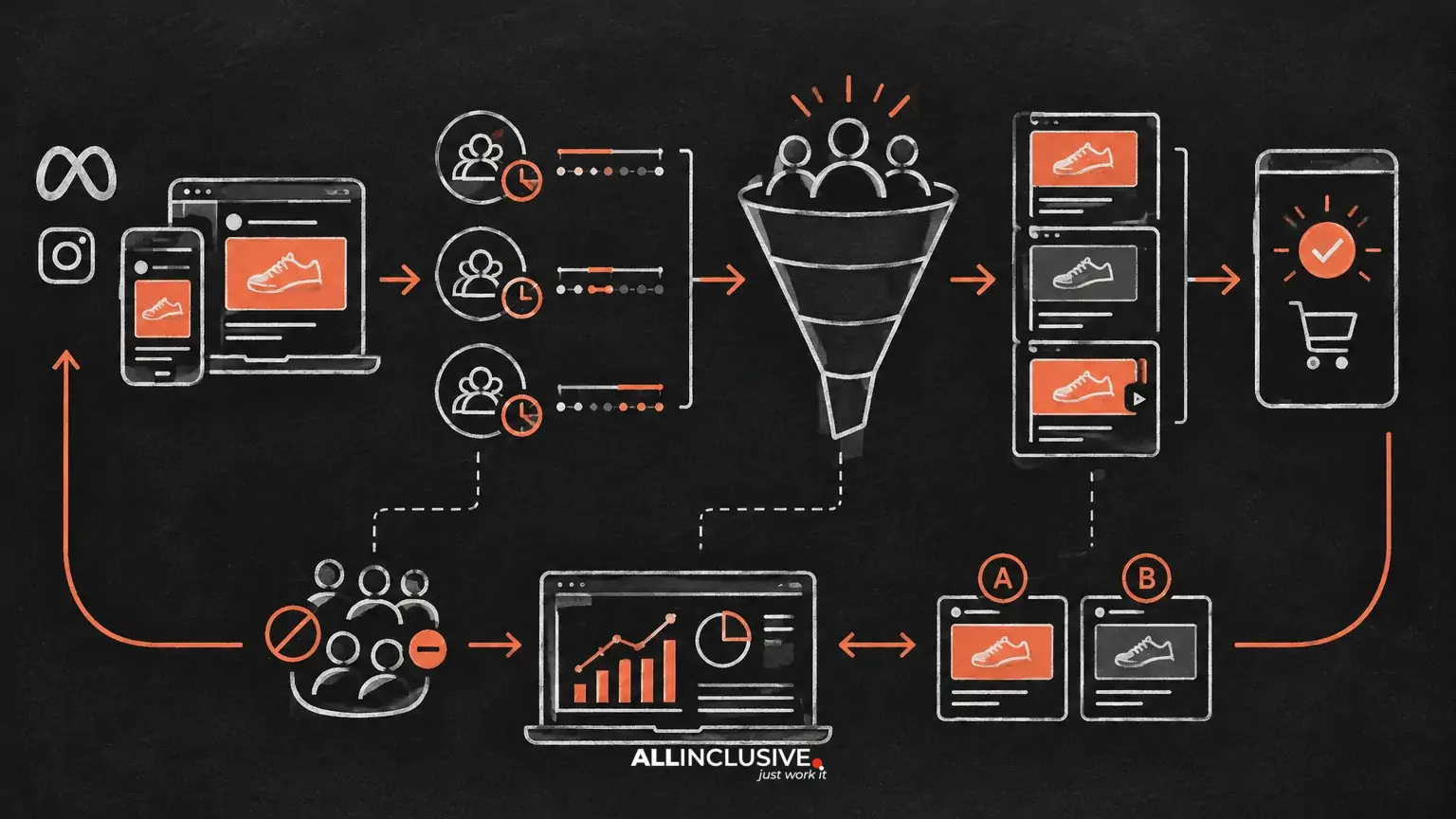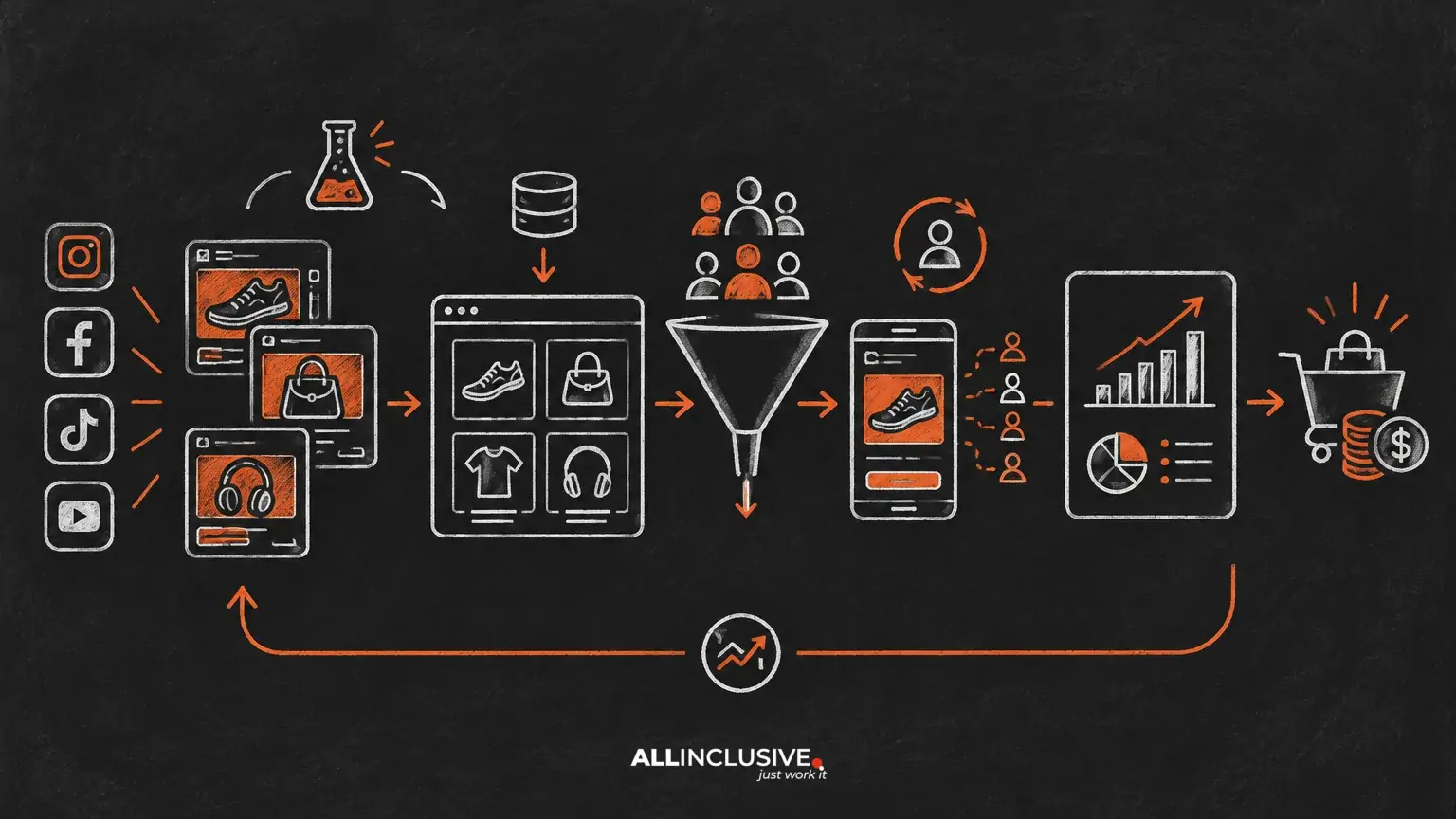
Paid social for ecommerce works best when it is treated as a connected commercial system—not a collection of ads. Creative earns attention, product feeds make inventory discoverable, audience strategy helps manage intent, and measurement determines whether reported conversions represent incremental revenue.
The most effective programs therefore begin with the buying journey and business economics. They identify which products deserve promotion, which creative ideas can communicate value quickly, which audiences need education or reassurance, and how performance will be evaluated beyond platform-reported purchases.
What paid social for ecommerce should accomplish
Ecommerce paid social typically has four jobs:
- Create demand: Introduce products to people who may not yet be actively shopping.
- Capture consideration: Help prospects understand the product, its use case, differentiation and value.
- Recover intent: Re-engage visitors, product viewers and cart abandoners where appropriate.
- Generate profitable growth: Produce contribution after considering media, product margins, discounts, shipping, returns and operational costs.
These jobs overlap, but they should not be judged by the same standard. A prospecting campaign may create valuable new demand without matching the conversion rate of a high-intent retargeting campaign. Conversely, a retargeting campaign can appear efficient while mostly harvesting demand that would have converted through another path.
That distinction is central to evaluating paid social for ecommerce: reported return on ad spend is useful, but it is not the same as incremental revenue.
Start with economics, not campaign settings
Before choosing channels, audiences or bidding approaches, define the financial boundaries of the program. At minimum, document:
- Average order value and expected repeat purchase behavior
- Gross margin or contribution margin by product group
- Typical discounting, shipping and return costs
- New-customer versus existing-customer value
- Acceptable acquisition cost for each priority product or customer type
- Stock availability, seasonality and promotional constraints
One blended target can conceal important differences. A premium product, a low-margin accessory and a replenishment item may require different acquisition thresholds. Segmenting targets by product economics gives media and merchandising teams a more realistic basis for decisions.
It also prevents a common mistake: scaling the campaigns with the strongest attributed return without checking whether those campaigns are simply receiving credit for existing demand.
Creative is the primary growth lever
In many ecommerce accounts, audience settings receive more attention than the message itself. That is usually backwards. Paid social placements compete for attention in environments where users are not necessarily shopping. Creative must make the product relevant quickly and give the viewer a reason to continue.
Build creative around customer problems
Product photography can communicate appearance, but it may not explain why the product matters. Strong creative often starts with a customer tension or use case:
- What problem does the product solve?
- What moment causes someone to search for a solution?
- What objection prevents purchase?
- What proof would make the product more credible?
- What changes after the product is adopted?
For example, a skincare brand might test messages about routine simplicity, ingredient confidence, visible use cases and subscription convenience—not merely different background colors behind the same product shot.
Test concepts, not cosmetic variations
Creative testing becomes more informative when each test isolates a meaningful hypothesis. Useful variables include:
- Angle: convenience, performance, value, identity or problem avoidance
- Format: demonstration, testimonial, comparison, product collection or creator-style explanation
- Opening: a customer question, visual result, product action or specific use case
- Proof: review language, demonstrations, specifications or expert explanation
- Offer: free shipping, bundle value, trial, guarantee or limited promotion where commercially appropriate
A testing plan should state what the team expects to learn. If every variation changes the hook, format, offer and landing page at once, a winning result may be difficult to interpret.
Match creative to the buying stage
Prospecting creative generally needs to establish relevance and explain the category or problem. Consideration creative can answer objections and demonstrate product value. Retargeting creative may focus on product details, reviews, availability, shipping information or a reminder of the shopper’s previous interest.
This does not mean every audience needs a completely separate production pipeline. Modular assets can be adapted across stages, provided the message remains appropriate to the audience’s level of awareness.
Use catalogs as a merchandising system
Product catalogs are more than a technical feed. They are a structured representation of the store that can support product discovery, dynamic creative and merchandising decisions.
A useful catalog process includes:
- Feed quality: Maintain accurate titles, descriptions, images, prices, availability and destination URLs.
- Product grouping: Organize items by margin, category, collection, season, inventory status or strategic priority.
- Creative alignment: Ensure product data and imagery support the claims made in ads.
- Landing-page consistency: Confirm that the advertised item, price and availability match the destination experience.
- Exclusion logic: Remove unavailable, low-margin or strategically inappropriate products when they should not receive spend.
Catalog promotion can be especially useful for retailers with broad assortments or frequent inventory changes. It can also create problems when the feed contains discontinued products, inconsistent naming or products that cannot support the campaign’s economic target.
Merchandising and paid media teams should agree on which products deserve distribution. The platform can automate delivery, but it should not be the only system deciding what the business wants to sell.
Structure campaigns around decisions
Account structure should make it easier to answer business questions. Excessive fragmentation can slow learning and spread budget too thinly, while excessive consolidation can obscure differences in product economics or audience purpose.
Before creating a separate campaign, ask whether the distinction changes one of the following:
- Budget or bidding control
- Creative requirements
- Product assortment
- Measurement standard
- Geographic, legal or operational constraints
If the answer is no, a separate campaign may add management complexity without creating useful control. If the answer is yes, separation may be justified.
For channel-specific considerations, see our guide to paid social budget allocation, which addresses how teams can think about prospecting and retargeting investment without treating the funnel as a fixed percentage split.
Prospecting and retargeting need different evaluation
Prospecting is responsible for reaching potential customers who have not shown strong recent intent. It should be evaluated using a combination of conversion efficiency, new-customer quality, creative learning and contribution to overall demand.
Retargeting addresses people who have already interacted with the brand. It may be efficient, but its apparent performance can be overstated when attribution windows overlap with organic, direct or branded demand.
Useful retargeting controls include:
- Clear audience definitions and recency windows
- Exclusion of recent purchasers when the product does not require immediate repurchase
- Frequency monitoring to limit repetitive exposure
- Creative variation based on the user’s previous action
- Separate reporting for existing customers and prospective customers
For broader channel planning, the paid social strategy hub provides a useful starting point. Ecommerce teams should also consider how paid social fits into the wider paid media mix, including search, shopping, affiliates and other demand-capture or demand-generation channels.
Measure incremental revenue, not only attributed revenue
Platform reporting can help optimize delivery, but it should not be treated as a complete causal measurement system. The more demand a brand already has, the more important it becomes to ask whether paid social changed the outcome.
Incrementality can be investigated through several approaches, selected according to budget, traffic volume, geographic footprint and operational capability:
- Holdout tests: Compare outcomes for an eligible group exposed to media with a comparable group that is intentionally withheld.
- Geographic tests: Vary investment across comparable regions and compare changes over time, while controlling for major external factors.
- Pre- and post-analysis: Monitor broader business outcomes around material changes, recognizing that this is weaker than a controlled test.
- Blended efficiency: Compare total revenue or contribution against total media spend rather than relying only on platform attribution.
- New-customer analysis: Separate first-time purchasers from existing customers and evaluate later value where reliable data is available.
No method is perfect in every situation. The important practice is to define the decision the test will inform, keep the comparison credible and avoid presenting directional evidence as precise proof.
Connect media reporting to the store experience
Ad performance can be limited by factors outside the campaign. Review the path from impression to purchase:
- Does the ad promise match the product page?
- Does the landing page load reliably across important devices?
- Are price, shipping, returns and availability clear?
- Can shoppers find product proof quickly?
- Are checkout errors or payment restrictions creating friction?
- Does the post-purchase experience support repeat demand?
When creative generates interest but conversion remains weak, changing targeting may not solve the underlying problem. The issue may be message-to-page mismatch, insufficient product information, an unclear offer or low confidence in the transaction.
A practical operating model
A sustainable ecommerce paid social program usually benefits from a recurring cycle:
- Diagnose: Review product economics, inventory, audience quality, creative fatigue and measurement limitations.
- Prioritize: Choose a small number of commercial questions that matter to the next planning period.
- Produce: Develop creative and catalog inputs tied to those questions.
- Launch: Give the system enough consistency to produce interpretable signals, subject to business constraints.
- Evaluate: Compare platform, analytics and business-level outcomes.
- Learn: Record what changed, what happened and what should be tested next.
Documenting decisions is valuable. A creative that underperforms may still reveal that a customer problem is weak, an offer is unconvincing or the product page needs improvement. A campaign that exceeds its attributed target may still warrant an incrementality test before receiving a major budget increase.
When to use specialist support
External support is most useful when the challenge is not simply campaign setup. Consider specialist help when the business needs a clearer testing system, stronger creative operations, catalog governance, cross-channel measurement or an impartial review of reported efficiency.
Before engaging an agency or consultant, ask for a clear explanation of:
- Which business outcomes will define success
- How creative hypotheses will be developed and evaluated
- How product feeds and merchandising priorities will be managed
- How prospecting and retargeting will be separated in reporting
- How incremental impact will be investigated
- Which decisions remain with the client’s commercial and merchandising teams
For a comparison of platform considerations outside retail, see paid social for B2B. The objectives differ, but the underlying discipline—aligning creative, audience, measurement and economics—remains relevant.
Paid Social for Ecommerce: What to Prioritize
Paid social for ecommerce becomes more dependable when creative, catalogs and measurement are managed together. Creative should express customer value and generate learnings. Catalogs should reflect commercial priorities rather than merely mirror inventory. Measurement should distinguish attributed purchases from incremental revenue wherever practical.
The result is not a universal campaign formula. It is a decision-making system that helps ecommerce teams invest with more clarity, learn faster and scale the products and messages that create durable business value.