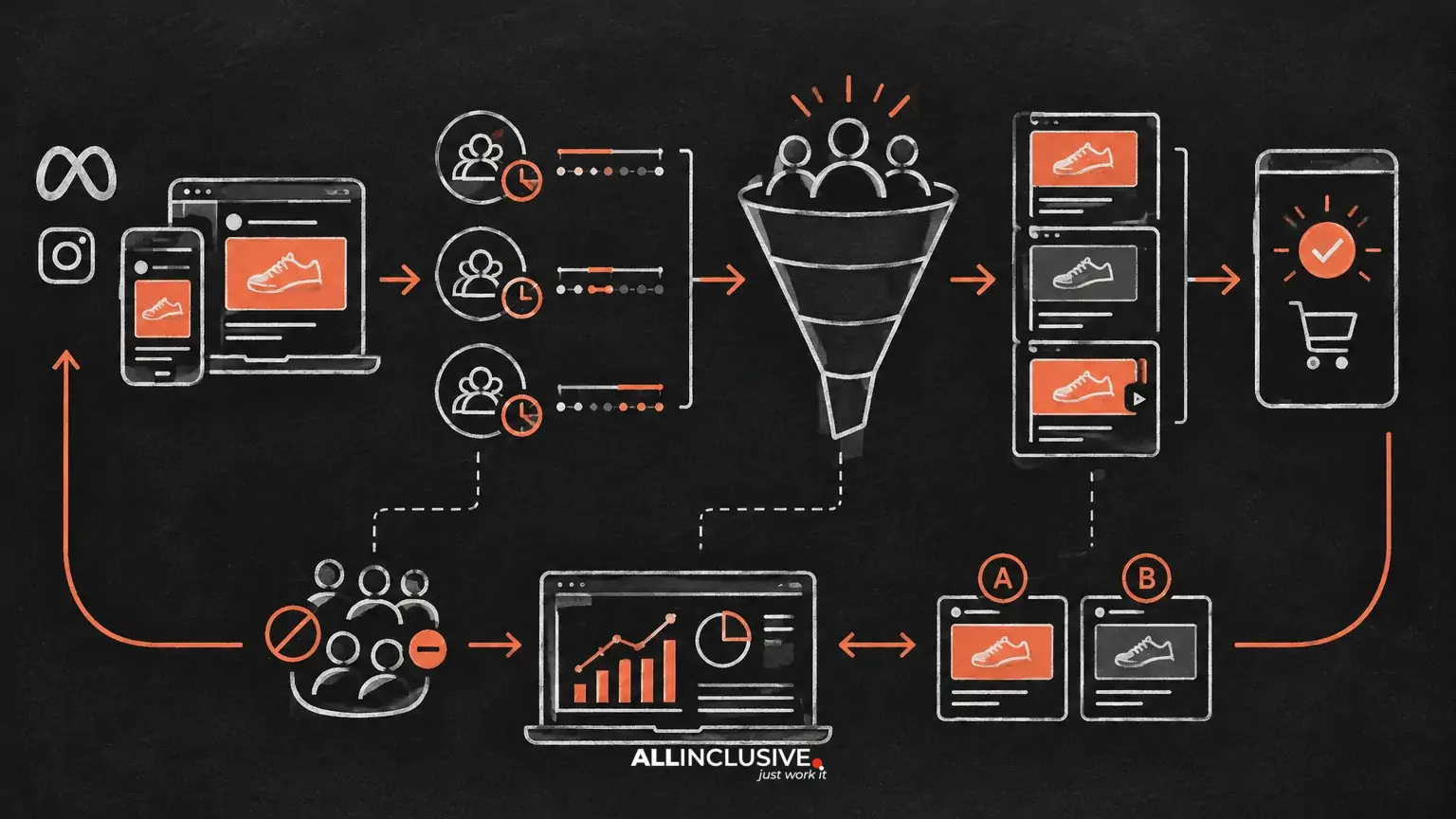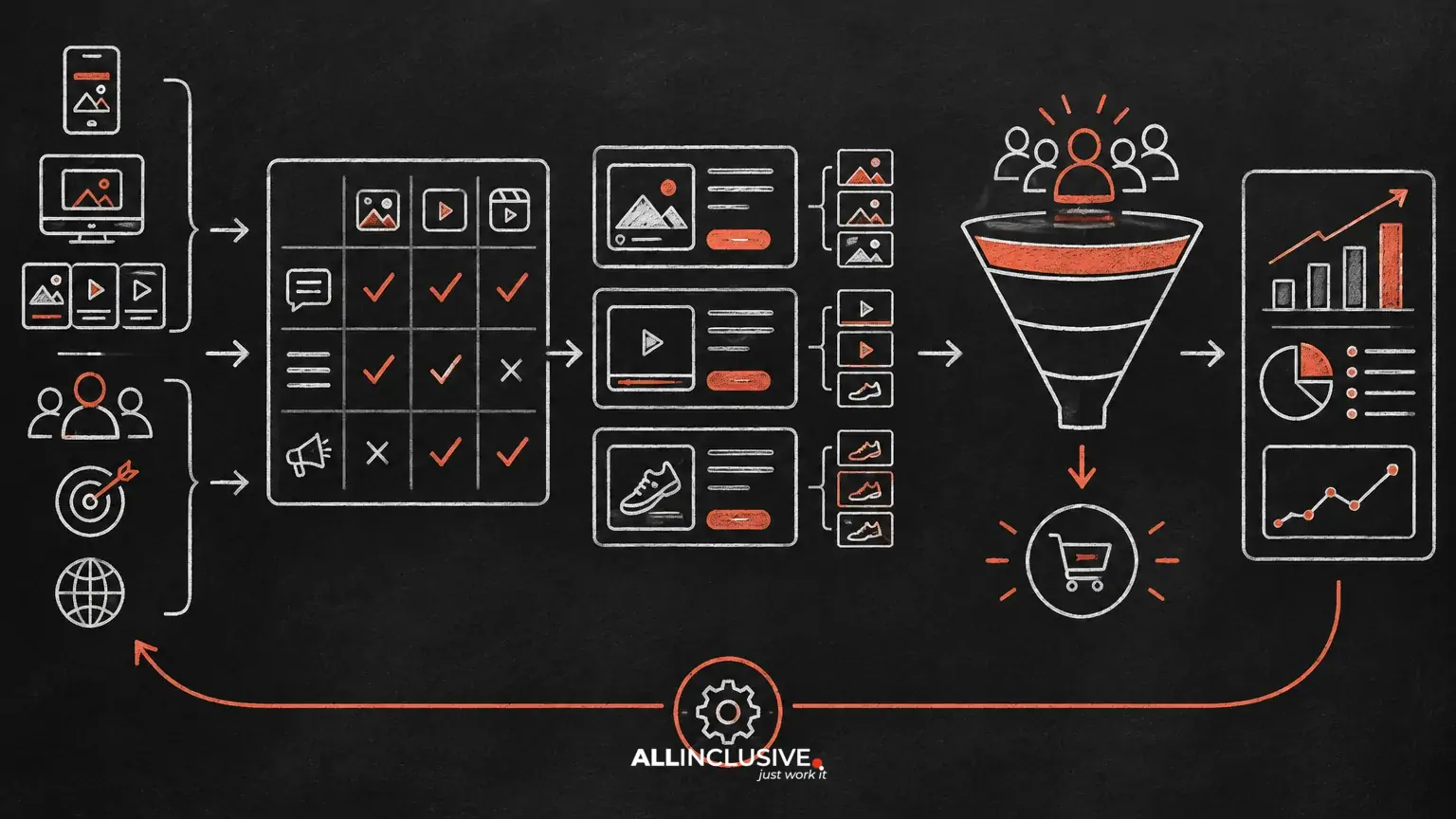
Meta Ads creative testing works best when it is treated as a structured learning program, not a sequence of disconnected ad launches. The goal is to identify which combination of message, concept, format, and proof creates the strongest business response for a defined audience and funnel stage.
A useful test matrix isolates one major variable at a time, keeps the decision rule explicit, and evaluates outcomes beyond the click. This approach helps teams distinguish a genuinely stronger creative idea from an ad that simply benefited from a different audience mix, delivery environment, offer, or measurement window.
What a Meta Ads creative test should answer
Before producing variants, write the question the test is designed to answer. A strong question is narrow enough to produce a decision.
- Message: Does a cost-saving message outperform a risk-reduction message for this audience?
- Concept: Does a problem-led idea generate more qualified demand than a product-demonstration idea?
- Format: Does short-form video create stronger downstream engagement than a static image?
- Hook: Does opening with the pain point outperform opening with the outcome?
- Proof: Does a customer example, demonstration, comparison, or quantified claim improve response?
- Call to action: Does a low-commitment next step outperform a direct sales request?
Do not combine all of these questions in one test. If one ad changes the hook, visual, offer, format, and landing page at once, the result may be useful as a replacement candidate, but it will not explain why performance changed.
Start with the testing hierarchy
Creative testing should follow the level of uncertainty that matters most to the account. A practical hierarchy is:
- Business proposition: Is the offer relevant and compelling?
- Audience problem: Is the message aligned with the audience’s situation and awareness level?
- Creative concept: What central idea earns attention and creates intent?
- Execution: Which hook, visual treatment, script, length, or layout communicates the concept best?
- Optimization: Which production details improve efficiency without changing the underlying idea?
Testing minor visual details before validating the proposition can create false precision. If the audience does not recognize the problem or value of the offer, changing button language or background color is unlikely to solve the main constraint.
A practical Meta Ads creative test matrix
Use the matrix below as a planning framework. The exact number of variants should reflect budget, conversion volume, production capacity, and the cost of making a wrong decision.
1. Concept tests
Concept tests compare materially different reasons to pay attention or act. They are usually the highest-value tests because they can reveal a new strategic direction.
- Problem-led: Focus on a costly, urgent, or recurring problem.
- Outcome-led: Lead with the desired business or personal result.
- Mechanism-led: Explain how the product or service solves the problem differently.
- Proof-led: Use evidence such as a demonstration, customer story, or before-and-after process.
- Objection-led: Address price, effort, switching risk, complexity, or internal approval.
Keep the audience, offer, destination, and primary conversion event as consistent as practical. The question is which concept deserves further production and distribution.
2. Message tests
Once a concept shows promise, test the specific value proposition. For B2B campaigns, useful message dimensions include:
- Efficiency versus quality
- Cost control versus revenue growth
- Speed to implementation versus long-term scalability
- Risk reduction versus competitive advantage
- Operational simplicity versus advanced capability
Message tests should use comparable creative executions. If one message is delivered in a polished video and another in a plain static image, the result combines message and format effects.
3. Hook tests
The opening seconds or first visual often determine whether a user continues. Test hooks that change the entry point while preserving the central proposition.
- Ask a diagnostic question.
- Name a recognizable operational problem.
- Challenge a common assumption.
- Show the product or process in use immediately.
- Lead with a specific consequence of inaction.
A hook test should not be judged only by an early attention metric. A hook that attracts broad curiosity but produces poor-quality clicks may be weaker than one with lower initial engagement and stronger conversion intent.
4. Format and execution tests
Compare formats when the concept is clear enough to survive translation. Potential comparisons include static image, carousel, short-form video, creator-style presentation, screen recording, product demonstration, and testimonial-led execution.
Format is not merely a production choice. It affects how much explanation is possible, how quickly the value proposition appears, and what level of trust the creative can establish. Evaluate whether the format supports the decision being asked of the user.
5. Proof and trust tests
Many B2B offers require confidence before conversion. Test different forms of proof, including:
- Customer narrative or use case
- Process demonstration
- Expert explanation
- Third-party validation where permitted and substantiated
- Transparent comparison
- Implementation detail or risk-reversal information
Proof should be specific enough to reduce uncertainty without making unsupported claims. Ensure that any customer, performance, or comparative statement is documented and approved for advertising use.
How to structure the test
Define the unit of comparison
Decide whether the test compares concepts, individual ads, ad sets, or campaign structures. For most creative questions, keeping the audience and conversion setup stable makes the result easier to interpret. However, platform delivery can distribute impressions unevenly, so the setup should be reviewed for meaningful exposure rather than assumed to be perfectly controlled.
Separate exploration from validation
Exploration asks, “Which ideas deserve attention?” Validation asks, “Does this idea remain useful under a more reliable or broader deployment?” These are different jobs.
During exploration, accept that some variants will receive limited delivery. During validation, compare the selected creative against the current control or incumbent, preserve the relevant audience and funnel conditions, and monitor whether the advantage persists across more than one reporting period.
Use a control when possible
A control is the current best-performing creative or the most defensible baseline. Without one, a team may identify a winner among weak alternatives while losing sight of the account’s existing performance. Label the control clearly and avoid changing it mid-test unless a business or policy issue requires intervention.
Record the test before launch
A simple test brief should include:
- Business question
- Audience and funnel stage
- Offer and landing page
- Primary conversion event
- Creative variable being changed
- Control and challenger definitions
- Decision rule
- Review date or minimum observation period
- Owner and next action
This record prevents post hoc explanations and makes learnings reusable across campaigns.
What to measure
Creative evaluation should follow the customer path. Common measures include delivery cost, thumb-stop or video-view behavior, outbound click-through rate, landing-page engagement, lead quality, conversion rate, cost per qualified lead, pipeline contribution, and revenue where measurement supports it.
Use the metric that matches the test question. If the test concerns the ability of a concept to generate qualified demand, an inexpensive click is not the final decision metric. If conversion volume is too low for a reliable downstream comparison, use intermediate indicators carefully and label the conclusion as directional.
It is also useful to inspect the relationship between metrics. For example, a creative may produce a strong click-through rate but weak landing-page engagement, suggesting a mismatch between the ad promise and destination. A creative with an average click rate but high-quality leads may deserve further investment rather than immediate replacement.
Decision criteria without false precision
There is no universal threshold that makes one creative a winner in every account. The appropriate decision depends on spend, conversion volume, sales-cycle length, margin, and the cost of scaling a mistaken conclusion.
Use a combination of:
- Direction: Is the challenger consistently better or worse?
- Magnitude: Is the difference large enough to matter commercially?
- Quality: Are the resulting users or leads valuable?
- Stability: Does the pattern persist across relevant placements, audiences, or periods?
- Confidence: Is there enough exposure and conversion information to make the decision responsibly?
When evidence is mixed, classify the result as inconclusive rather than forcing a winner. The next action may be to refine the concept, increase creative contrast, extend observation, or improve measurement.
Common testing mistakes
Changing too many variables
If every variant is a new idea, new format, new offer, and new destination, the team learns only that the ads were different. Use a staged matrix to create interpretable comparisons.
Declaring a winner too early
Early delivery can be volatile, especially when conversion volume is limited. Avoid treating a short-lived lead as a durable result. Review the data in the context of spend and business feedback.
Optimizing for the easiest metric
Engagement and low-cost traffic can be useful diagnostic signals, but they do not automatically represent commercial value. Connect creative reporting to qualified outcomes whenever possible.
Ignoring audience and frequency context
A creative may perform differently as the audience saturates or as repetition increases. Use the related guidance on Meta Ads frequency when interpreting declining response, and consider whether the issue is fatigue rather than the underlying concept.
Failing to refresh the learning
A winning ad is not a permanent conclusion. Preserve the winning principle, then create new executions around it. This protects the account from relying on one asset while retaining the insight that made it effective.
How creative testing connects to audience strategy
Creative results are conditional on audience context. A message that works for a prospecting audience may be inappropriate for someone who has already visited a product page. Segment tests by funnel stage when the user’s awareness, objections, or next action materially differ.
Creative should also be interpreted alongside broader Meta Ads audience strategy. If targeting, exclusions, or campaign structure change during the test, document those changes so the creative conclusion is not overstated.
A repeatable operating cycle
- Diagnose: Identify the business constraint and review performance by funnel stage.
- Hypothesize: Write a specific creative question and predicted mechanism.
- Prioritize: Choose the variable with the greatest potential commercial impact.
- Produce: Create a control and a small set of meaningfully different challengers.
- Launch: Keep relevant campaign, audience, offer, and measurement conditions stable.
- Review: Assess delivery, quality, and downstream outcomes without overstating limited data.
- Apply: Scale the learning, revise the concept, or retire the hypothesis.
- Document: Record what changed, what happened, and what should be tested next.
Teams that follow this cycle build a creative knowledge base rather than a collection of isolated winners. Over time, the value comes not only from finding better ads, but from learning which messages, proofs, formats, and objections matter for each audience and buying stage.
For the broader context around planning and measurement, see the paid media resource hub. For performance diagnosis at the click level, the guide to Meta Ads CTR can help connect creative response with audience and landing-page fit.
For broader strategic context, see our paid social resource.