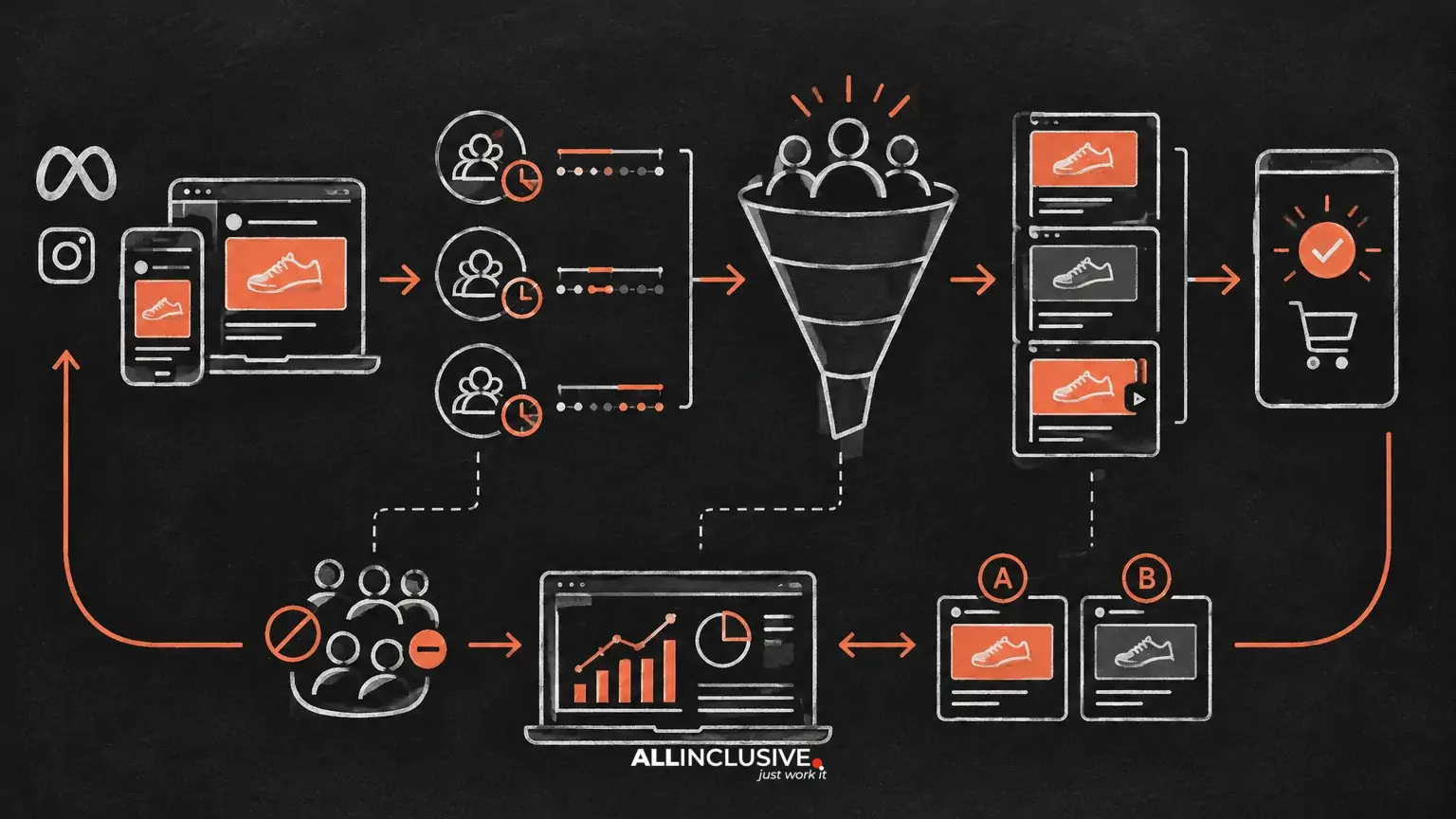
Meta Ads frequency measures the average number of times people in a selected audience have seen an ad during a reporting period. It is a useful diagnostic, but it is not a standalone definition of ad fatigue. A rising frequency can indicate productive repetition, especially in a short consideration cycle. It can also signal that an audience is too small, a campaign is over-concentrated, or the creative is no longer earning attention.
The practical question is not “What frequency is too high?” It is “What is happening to delivery and business outcomes as frequency rises?” Evaluate frequency alongside reach, impressions, click-through rate, conversion rate, cost, incremental audience opportunity, and the role of the campaign in the funnel.
What Meta Ads frequency actually tells you
Frequency is calculated as impressions divided by reach. If an audience receives 10,000 impressions and 5,000 people were reached, the average frequency is 2. Frequency is therefore an average, not a record of how many times every individual saw an ad. Some people may have seen it once while others saw it substantially more often.
That distinction matters when diagnosing fatigue. A campaign-level frequency can hide a highly exposed subsegment, particularly when the audience is broad but delivery is concentrated among people most likely to engage or convert. Breakdowns by audience, placement, geography, age range, device, or creative can reveal where repetition is actually occurring, subject to the reporting options available in the account.
Frequency is also time-dependent. A frequency of 3 over several weeks has a different meaning from a frequency of 3 in a short retargeting window. Always specify the reporting window before comparing campaigns or making a change.
When repetition is useful
Repetition is not automatically waste. Paid social often requires multiple exposures because a prospect may need to recognize a problem, understand an offer, evaluate credibility, and decide when to act. A campaign promoting a considered B2B purchase may reasonably need more exposure than a campaign supporting an immediate, low-friction action.
Frequency can be productive when:
- The audience is still receiving relevant creative variations.
- Click or conversion quality remains stable or improves.
- Reach is expanding at an acceptable cost.
- The campaign is supporting a longer decision process.
- Different messages serve different stages of awareness.
For example, a prospect may first see an educational asset, then a proof point, and later a clear offer. The audience has experienced repetition of the brand or problem, but not necessarily the same message in the same form. This is why creative diversity and sequencing often matter more than a single account-wide frequency figure.
When frequency starts to indicate fatigue
Fatigue is more credible when rising frequency coincides with deteriorating performance among the same audience and creative set. Common signals include declining outbound click-through rate, lower landing-page engagement, weakening conversion rate, rising cost per qualified action, negative feedback, or a growing share of impressions delivered to people who have already interacted repeatedly without progressing.
No single signal proves fatigue. A falling click-through rate may reflect a weaker offer, audience mismatch, tracking problems, placement mix, or a change in auction conditions. A higher cost may result from competition rather than repetition. Diagnose the pattern across several metrics and compare it with an earlier period, a different creative, or a less-exposed audience where possible.
A practical fatigue diagnosis
- Confirm the measurement window. Compare equivalent periods and avoid drawing conclusions from a very short interval or from data still subject to reporting delay.
- Check whether the audience is saturated. Look at reach, audience size, delivery concentration, and exposure by segment rather than relying only on campaign averages.
- Compare creative variants. If one ad is declining while another remains efficient, the issue may be creative-specific rather than audience-wide.
- Review quality signals. Examine clicks, conversions, qualified leads, post-click behavior, and any available feedback indicators.
- Rule out non-fatigue causes. Check tracking, landing-page changes, offer changes, budget shifts, attribution settings, and auction context.
Why there is no universal “too high” frequency
Frequency thresholds should not be copied from another account without context. The appropriate level depends on audience size, campaign objective, buying cycle, budget, creative volume, offer relevance, placement mix, and the time period being evaluated.
A small retargeting audience can reach a high frequency quickly. That may be acceptable if recent site visitors are highly valuable and the campaign produces incremental conversions. It may be unacceptable if the same people are shown a generic prospecting message after they have already taken the intended action.
Similarly, a broad awareness campaign can produce lower average frequency while still giving certain high-propensity segments repeated exposure. A campaign-level average should guide investigation, not replace it.
How to set practical review thresholds
Instead of setting a universal stop rule, define review conditions for each campaign. A review condition is a signal that triggers investigation, not an automatic pause.
Useful conditions include:
- Frequency is rising while reach growth slows materially.
- Performance declines across multiple creative variants serving the same audience.
- One segment receives disproportionate exposure compared with the rest of the target audience.
- Recent visitors, leads, or customers remain eligible after the desired action.
- Costs worsen without a corresponding improvement in lead or revenue quality.
- Comments, feedback, or engagement suggest the message is becoming repetitive or irrelevant.
Build these conditions into a recurring review by campaign role. Prospecting, retargeting, customer expansion, and retention campaigns should not share identical frequency expectations. Document the campaign’s purpose, audience window, primary success metric, acceptable efficiency range, and the action to take if exposure rises without performance support.
Creative rotation is the primary fatigue lever
When frequency rises, the first response should usually be to improve the creative system rather than to change targeting blindly. New creative can preserve the strategic message while varying the hook, visual treatment, proof, format, objection handled, or call to action.
Useful rotation approaches include:
- Change the angle: Move from problem education to proof, comparison, implementation, or risk reduction.
- Change the opening: Test a different first frame, headline idea, or customer tension.
- Change the evidence: Use a demonstration, process explanation, expert perspective, or customer scenario where appropriate.
- Change the format: Adapt the concept for video, static, carousel, or another eligible placement format.
- Refresh the offer presentation: Clarify the next step without changing the underlying commercial proposition unnecessarily.
Creative rotation does not mean replacing every ad at the first sign of a frequency increase. It means maintaining a credible pipeline of distinct assets and learning which variations sustain attention and qualified action. For a structured approach, see Meta Ads Creative Testing: A Practical Test Matrix.
Audience strategy: reduce unnecessary concentration
Frequency problems are often audience-design problems. Review whether the campaign includes people who should be excluded, whether the retargeting window is too narrow for the buying cycle, and whether multiple campaigns are competing for the same users.
Common actions include:
- Exclude converters or qualified leads when the campaign objective has been completed.
- Separate recent high-intent visitors from older, lower-intent visitors when their messages differ.
- Review overlap between prospecting, retargeting, customer, and account-based audiences.
- Test whether a broader but still relevant audience can maintain efficiency while expanding reach.
- Use distinct creative and offers for different stages instead of forcing one ad set to serve every stage.
Broadening an audience is not automatically an improvement. Additional reach is useful only when the audience remains commercially relevant and the campaign can generate acceptable outcomes. Conversely, narrowing an audience can increase concentration and accelerate fatigue, even when it appears to improve targeting precision.
For retargeting-specific decisions about windows, exclusions, and messaging, refer to Meta Ads Retargeting: Audience Windows, Creative and Exclusions.
Budget and pacing considerations
Budget changes can alter frequency, but they are not a reliable fatigue cure by themselves. Increasing spend against a small audience may accelerate repetition. Reducing spend may lower exposure while also limiting learning, reach, or conversion volume. The correct decision depends on whether the campaign is constrained by audience supply, creative quality, auction cost, or conversion capacity.
Before changing budget, ask:
- Is the campaign failing because it cannot reach enough relevant people?
- Is delivery concentrated because the audience is small or because of overlapping campaigns?
- Would additional creative give the system more viable options?
- Is the campaign’s objective optimized for the business outcome being evaluated?
- Would shifting budget to a different funnel stage improve total account efficiency?
Also distinguish average frequency from frequency distribution. A stable average can conceal a group receiving repeated impressions while another group remains unreached. Where reporting allows, inspect concentration and reach by audience segment rather than making decisions from the average alone.
Frequency and other performance metrics
Frequency should be read as part of a diagnostic chain:
- Reach and impressions: Is the campaign expanding coverage or repeatedly serving the same people?
- Engagement quality: Are people still clicking, watching, or interacting meaningfully?
- Post-click behavior: Do visitors remain relevant after landing?
- Conversion quality: Are leads, purchases, or other outcomes meeting the intended standard?
- Cost and value: Is the cost trend supported by business value, or is efficiency deteriorating?
Do not use click-through rate alone to declare fatigue. The relationship between frequency and conversion quality is more useful than either metric in isolation. If clicks decline but qualified conversions remain healthy, the campaign may still be effective. If clicks hold steady but lead quality falls, the issue may be audience or offer fit rather than visible ad fatigue.
For a broader diagnosis of engagement signals, see Meta Ads CTR: How to Diagnose Creative and Audience Fit. If cost pressure is part of the pattern, Meta Ads CPM: What Drives Cost and What You Can Control provides additional context.
A repeatable operating process
Make frequency review part of campaign management rather than a one-time reaction. A practical process is:
- Record frequency by campaign role and reporting window.
- Compare the trend with reach, cost, qualified outcomes, and creative-level performance.
- Identify whether concentration is audience-wide or limited to particular segments and ads.
- Check exclusions, overlap, audience windows, tracking, and landing-page changes.
- Introduce a targeted intervention: rotate creative, adjust the audience, revise exclusions, change the window, or rebalance budget.
- Define a measurement period before judging the intervention, while responding sooner to clear delivery or tracking errors.
Keep a simple change log. Note the frequency trend, diagnosis, intervention, and outcome. Over time, this gives the account its own evidence base instead of relying on generic thresholds that may not fit its audience or buying cycle.
Meta Ads Frequency: Decision Summary
Meta Ads frequency becomes a concern when repetition is associated with weaker reach expansion, declining creative response, poorer conversion quality, or unnecessary audience concentration. It is not a universal fatigue score and should not trigger an automatic pause at a fixed number.
Use frequency to ask better questions: Who is seeing the ads repeatedly? Which creative is responsible? Is the audience still commercially valuable? Are outcomes deteriorating, or is repetition supporting the decision process? A disciplined answer usually combines creative rotation, audience and exclusion hygiene, appropriate pacing, and measurement that connects exposure to qualified business results. For broader paid-social planning, explore paid social strategy and the wider paid media framework.