LinkedIn ads cost more than many paid-social alternatives on a surface-level CPC or CPM comparison. That does not automatically make LinkedIn inefficient. For B2B advertisers, the relevant question is whether the audience quality, buying context and downstream conversion rate justify the media cost.
There is no universal LinkedIn ads cost. Auction competition, audience size, objective, ad format, geography, bid strategy, creative relevance and conversion experience all affect what an advertiser pays. Treat platform estimates as planning inputs, not guarantees.
The most useful way to evaluate LinkedIn is to connect media costs to qualified leads, sales opportunities and revenue. This guide explains the main cost metrics, how to set a test budget, and how to decide whether campaign economics work for your business.
What determines LinkedIn ads cost?
LinkedIn advertising operates through an auction. Your effective cost is shaped by the value and availability of the audience you are trying to reach, the action you want users to take and the competitiveness of other advertisers pursuing similar impressions.
Audience competition
Senior job functions, narrow account lists, specialist industries and high-value geographic markets can be expensive because many advertisers want access to the same professionals. Adding layers of targeting can also reduce reach and make delivery less flexible.
Audience quality matters, but extreme narrowness is not automatically better. A small audience may produce fewer opportunities to learn, restrict delivery and concentrate spend in a limited group of users. Start with the buying committee and business problem you need to reach, then add only the targeting constraints that are necessary.
Campaign objective and conversion path
Campaigns optimized for impressions, clicks, video views or lead submissions can produce different cost patterns. A lower-cost click is not necessarily more valuable than a higher-cost lead submission. Compare each objective with the business action it is intended to support.
The conversion path also matters. A native lead form can reduce friction, while a landing page may provide more room to qualify, educate or route prospects. The best choice depends on offer complexity, sales requirements and the information needed before follow-up. See LinkedIn Lead Gen Forms: When They Beat Landing Pages for a closer comparison.
Creative relevance and auction response
Creative affects more than engagement. Ads that are clearly relevant to the audience can earn stronger interaction and make media more productive. Weak creative may generate low engagement, inefficient delivery or clicks that do not convert.
Test the message, offer, format and opening visual—not only different color treatments. For B2B campaigns, a specific operational problem, role-based insight or credible point of view is usually more useful than a generic claim about growth.
CPC, CPM and other LinkedIn cost metrics
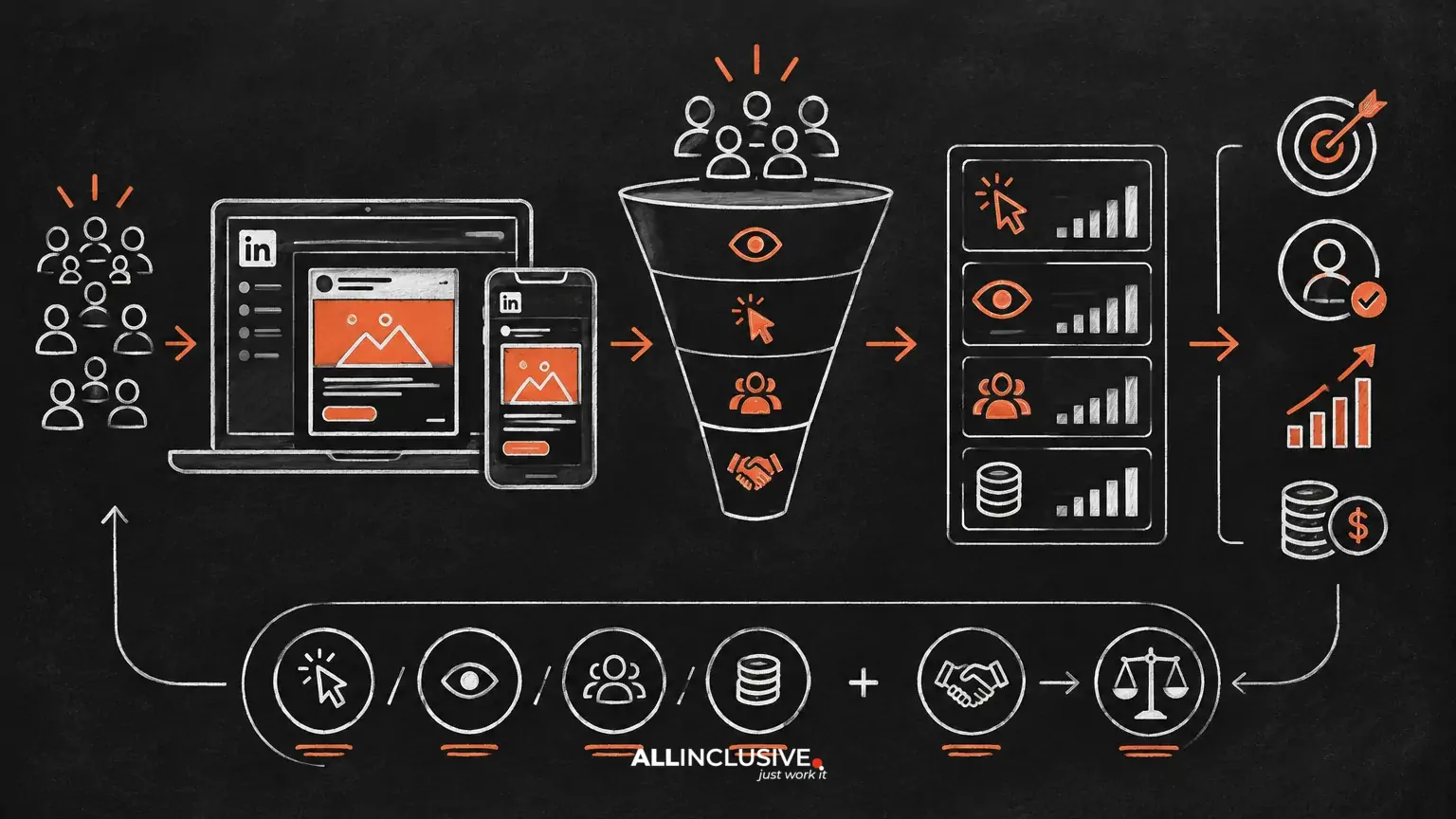
Use several metrics together. Any single cost metric can hide problems elsewhere in the funnel.
Cost per click
CPC is media spend divided by measured clicks. It is useful for understanding traffic efficiency, but it does not tell you whether visitors are relevant or whether they become leads.
Track at least two click measures when available: the cost of any recorded click and the cost of a click that reflects meaningful site intent. A low CPC with poor landing-page engagement can be less valuable than a higher CPC from a better-qualified audience.
Cost per thousand impressions
CPM is media spend divided by impressions, multiplied by 1,000. It helps compare the cost of buying attention across audiences and campaigns. CPM is particularly useful for awareness and account-based reach, but it cannot establish pipeline efficiency on its own.
Cost per lead
CPL is spend divided by leads. It becomes meaningful only when the lead definition is consistent. A form completion, content download, meeting request and sales-accepted lead are not interchangeable.
Report CPL by lead type and source. If possible, separate raw leads from qualified leads, accepted leads, opportunities and revenue. This prevents a campaign from appearing efficient simply because it generates a large number of low-intent submissions.
Cost per qualified opportunity
For many B2B advertisers, cost per qualified opportunity is more useful than cost per lead. It accounts for the conversion rate between lead capture and a sales outcome. The trade-off is that opportunity data arrives more slowly and requires reliable CRM connection and lifecycle definitions.
How to set a LinkedIn ads budget
Budgeting should begin with the business question, not an arbitrary platform amount. Define what you need to learn, how much qualified demand you want to create and how long the sales cycle is likely to be.
- Define the conversion event. Choose a meaningful action, such as a demo request, event registration or qualified content response. Document what makes the conversion valid.
- Estimate the required volume. Determine how many conversions or qualified accounts are needed to make a decision. A short test designed to produce one or two leads may be too weak to evaluate the campaign.
- Set an acceptable cost threshold. Use target CPL, cost per qualified lead or opportunity cost based on your margins, close rates and customer value.
- Allocate enough time for learning. B2B campaigns often need time for delivery, conversion and sales feedback. Avoid changing every variable after a few early results.
- Reserve budget for iteration. Do not spend the entire test allocation on one audience and one ad. Keep room to test a second message, format or conversion path.
A simple planning formula is:
Required media budget = target number of qualified outcomes × acceptable cost per qualified outcome
If you are planning from lead volume, use:
Expected qualified outcomes = media budget ÷ expected CPL × lead-to-qualified rate
These are planning models, not forecasts. Replace assumptions with observed data as soon as the campaign has enough volume to support a sensible comparison.
How to calculate whether LinkedIn ads can pay back
Lead economics should connect media cost to gross profit or contribution margin, not only to top-line contract value. A campaign can look attractive on revenue potential while remaining unprofitable after sales costs, delivery costs and low close rates.
Start with these inputs:
- Average first-year revenue or contribution margin per customer
- Lead-to-opportunity conversion rate
- Opportunity-to-customer close rate
- Expected cost per lead or qualified lead
- Sales and onboarding costs
- Acceptable payback period
For example, if a business generates 100 leads, 10 become opportunities and one becomes a customer, the campaign must be evaluated against the cost of generating those 100 leads and supporting the sales process—not just the number of form fills. The exact acceptable economics depend on the business model, margins and cash-flow constraints.
Use cohort reporting where possible. Compare leads generated in a given period with the later stages they reach. This avoids overreacting to early CPL before lead quality can be assessed.
Ways to reduce inefficient LinkedIn spend
Improve the offer before narrowing the audience
If the offer is vague, more targeting will not solve the conversion problem. Make the value exchange clear: what the prospect receives, who it is for and why it is useful now. A practical checklist, diagnostic, benchmark framework or event can be easier to evaluate than a broad “learn more” message.
Match the message to the buying role
A finance leader, technical evaluator and operational user may care about different outcomes. Build variations around the job problem and decision criteria of each important role, while keeping the campaign structure simple enough to produce learning.
Control targeting complexity
Use account, company, role and industry signals deliberately. Avoid stacking every available filter without a clear reason. Create a primary audience that is large enough to deliver and a focused test audience for a specific hypothesis.
Improve post-click continuity
The ad, landing page and follow-up should make the same promise. If an ad names a particular business problem, the destination should address that problem immediately. Remove unnecessary fields, clarify the next step and ensure the form works well on mobile devices.
Use frequency and creative rotation thoughtfully
Repeated exposure can support account-based campaigns, but the same message can lose effectiveness when the audience is small. Monitor delivery, engagement and conversion trends together. Refresh the angle when the audience has seen the message enough to stop responding, rather than changing creative on a fixed schedule without evidence.
When LinkedIn is worth the premium
LinkedIn can be commercially attractive when professional identity, company context or seniority is central to the targeting problem. It may be a strong fit when:
- The addressable audience is concentrated in identifiable companies or roles.
- A qualified customer is valuable enough to support higher acquisition costs.
- The sales team can follow up quickly and consistently.
- The offer requires business context that broad consumer platforms cannot provide as precisely.
- You need to influence multiple members of a buying committee.
It may be a weaker fit when the audience is broad, the offer is low-value, conversion feedback is unavailable or the campaign depends on immediate volume at the lowest possible click cost. In those cases, compare LinkedIn with other channels rather than judging it in isolation. Our Paid Social for B2B: Meta vs. LinkedIn vs. YouTube comparison can help frame that decision.
A practical measurement framework
Build reporting in three layers:
- Delivery: spend, impressions, reach, frequency, clicks and CPM.
- Conversion: landing-page sessions, form completions, conversion rate and CPL.
- Business impact: qualified leads, accepted leads, opportunities, pipeline and customers.
Use consistent naming, tracking parameters and CRM source fields. Reconcile platform-reported conversions with analytics and CRM records, recognizing that different systems may use different attribution windows and counting methods.
Evaluate creative and audience combinations, not only campaign averages. A blended CPL can hide one audience producing useful opportunities and another producing inexpensive but irrelevant leads.
LinkedIn Ads Cost: Decision Summary
LinkedIn ads cost should be judged against the value of the audience and the quality of the resulting pipeline. CPC and CPM are useful diagnostic metrics, but they are not the final decision criteria for most B2B campaigns.
Set a clear conversion definition, model the acceptable cost of a qualified outcome, test a focused but viable audience and connect advertising data to CRM stages. For a broader operating framework covering channel selection, measurement and optimization, explore our paid social marketing guide and paid media resources.