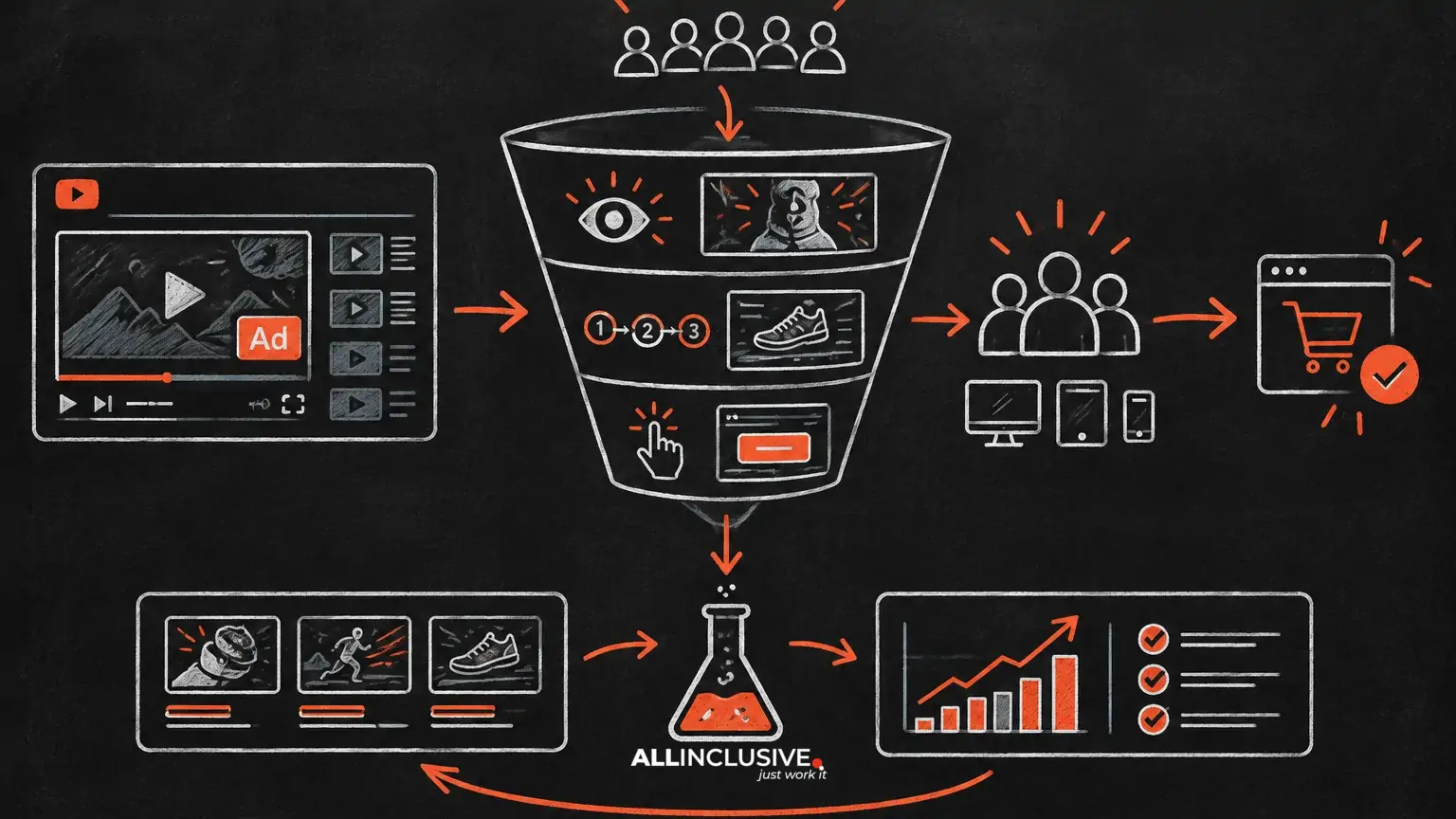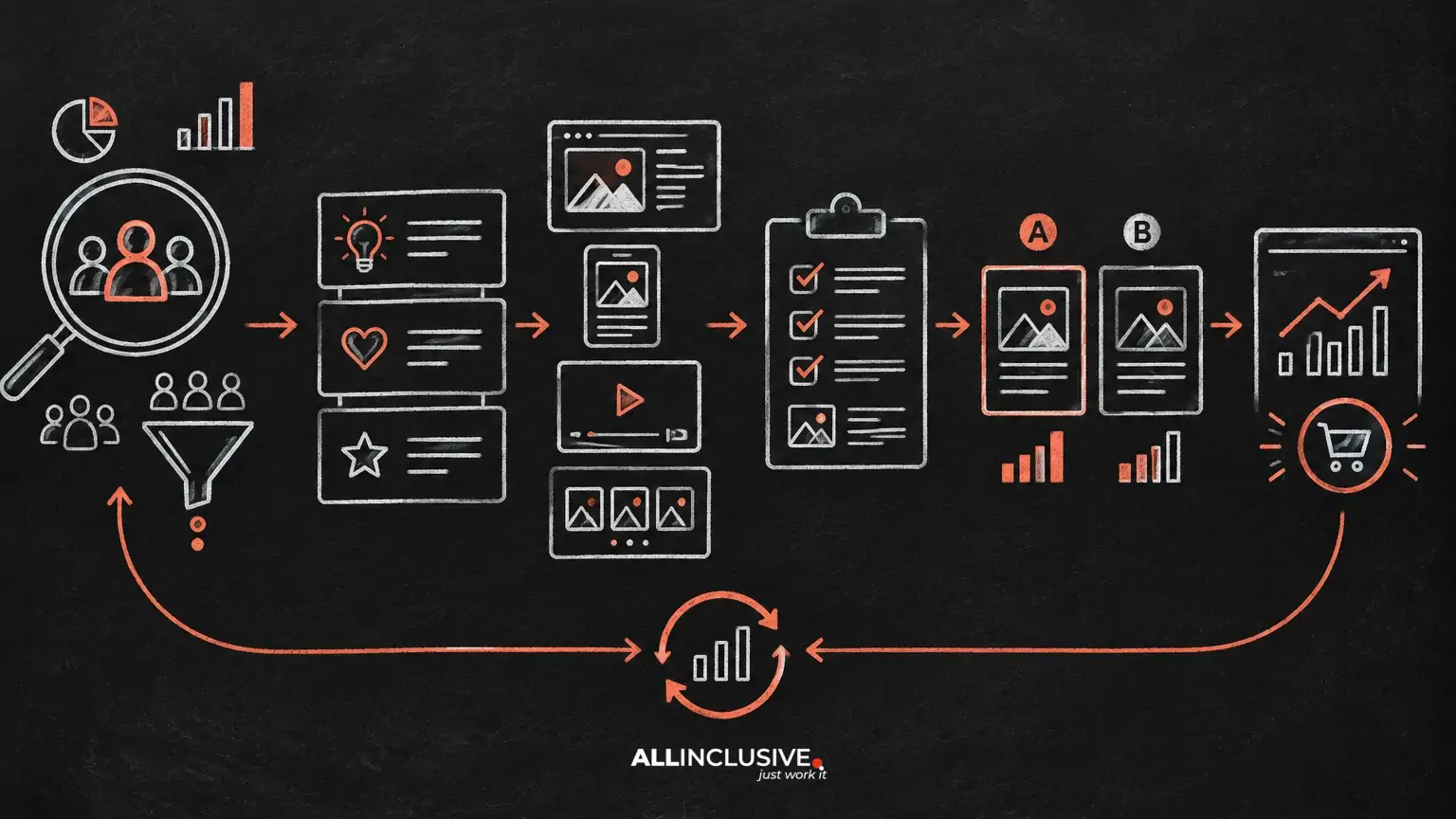
A performance creative strategy connects audience insight, messaging, production, media context, and testing into one operating system. It is not simply a collection of attractive ads, and it is not the same as choosing between static, video, or user-generated content.
The goal is to create a repeatable way to answer five questions: who are we trying to influence, what should they believe or do, which creative expression is most appropriate, how will we test it, and what will we learn from the result?
This framework is designed for marketing teams, agencies, and media buyers evaluating how to build a more disciplined creative process. It covers research, message angles, formats, briefing, testing, and the feedback loop between paid media and creative production.
What performance creative strategy means
Performance creative is creative developed with a measurable business action in mind. That action may be a purchase, qualified lead, booked consultation, app install, trial start, or another conversion defined by the funnel.
A performance creative strategy determines how creative decisions support that action without reducing every ad to a short-term click objective. Strong creative must earn attention, communicate relevance, make the offer understandable, and give the right prospect a reason to continue.
Strategy should come before production. Without it, teams often produce a high volume of variations that differ cosmetically but repeat the same underlying message. More assets do not necessarily create more learning.
Start with the business and audience problem
Before selecting a hook or format, define the problem the creative needs to solve. The answer may be weak awareness, poor qualification, low trust, unclear differentiation, offer friction, or a mismatch between the ad promise and the landing-page experience.
Document the following:
- Primary business outcome: What action matters, and what quality standard applies?
- Audience: Which segment, need state, or buying situation is being addressed?
- Barrier: Why might a suitable prospect hesitate, ignore the message, or abandon the journey?
- Proof: What evidence can make the claim credible?
- Next step: What should the viewer understand and do after seeing the ad?
Separating the audience from the barrier is important. “Small-business owners” is a demographic description; “small-business owners who cannot predict lead quality from paid acquisition” describes a more useful problem context.
Research inputs that improve creative decisions
Creative research does not require a large formal study. It requires proximity to the language, objections, and decisions of real customers. Combine multiple sources so the strategy is not shaped by one team’s assumptions.
Customer and sales conversations
Review call notes, support tickets, sales objections, onboarding questions, and lost-deal reasons. Look for repeated phrases, not just broad themes. The words prospects use to describe risk or desired outcomes can inform hooks, headlines, scripts, and proof points.
Existing campaign data
Use paid-media data as directional evidence rather than a complete explanation. Compare creative concepts, messages, formats, placements, audience contexts, and downstream quality where the data supports it. A click-through signal alone does not establish that an ad created valuable demand.
Market and competitor observation
Review how competitors frame the category, the alternatives they mention, and the proof they emphasize. The purpose is not to imitate executions. It is to identify common category language, overused claims, and opportunities to make the value proposition more specific.
First-party behavior
Landing-page search terms, product usage patterns, content engagement, and CRM outcomes can reveal where prospects are confused or highly motivated. Connect these observations to funnel stages instead of treating all visitors as one audience.
Build message angles before making assets
An angle is the strategic lens through which the offer is presented. It is broader than a headline and more meaningful than a visual variation. Several ads can express one angle, while one ad can contain multiple creative devices without changing its central angle.
Useful angle categories include:
- Problem recognition: Make a costly, frustrating, or overlooked problem easier to identify.
- Outcome: Show what improves when the problem is addressed.
- Mechanism: Explain how the product or service produces the result.
- Proof: Use demonstrations, expert explanation, customer evidence, or transparent process details.
- Objection handling: Address concerns about price, complexity, switching, implementation, risk, or fit.
- Alternative comparison: Clarify when the offer is preferable to an existing approach.
- Use case: Make relevance concrete for a particular role, workflow, or situation.
Prioritize angles based on audience relevance, business value, credibility, and production feasibility. An angle that sounds compelling but cannot be substantiated is not a durable creative strategy.
Match creative format to the communication job
Format should serve the message. The right choice depends on how much explanation is needed, how quickly the value must be understood, what proof is available, and where the audience is likely to encounter the ad.
Static creative
Static ads can communicate a focused claim, comparison, product view, checklist, or visual proof quickly. They are useful when the message can be understood without extensive narrative development. Keep the hierarchy clear: one primary idea, a recognizable offer, and a next step that does not compete with the main claim.
Short-form video
Video is useful when movement, demonstration, sequence, personality, or explanation adds meaning. It can show a workflow, reveal a product experience, dramatize a problem, or let a credible person explain the mechanism. The opening should establish relevance quickly, but the strongest opening is not always the loudest one; it is the one that makes the right viewer want to continue.
UGC-style and creator-led assets
Creator-led execution can make a message feel more conversational and situational. It is most valuable when the speaker has a credible relationship to the problem or can demonstrate a genuine use case. Authenticity is not a substitute for a clear offer, proof, or audience fit. For a deeper comparison of use cases and limitations, see UGC ads for performance marketing.
Longer-form explanation
Some offers require more education because the purchase is complex, high-consideration, or dependent on trust. Longer creative can explain the problem, mechanism, process, and objections in a logical order. The challenge is to maintain relevance throughout rather than extending a weak premise.
For a funnel-based comparison of formats, use the guidance in Static vs. Video Ads alongside the specific communication job your ad must perform.
Create a performance creative brief
A useful brief gives the creative team a decision framework rather than a list of production tasks. It should make the strategic choices visible before execution begins.
- Objective: Define the business action and the stage of the journey.
- Audience situation: Describe what the person is trying to solve, decide, or avoid.
- Core insight: State the tension or observation that makes the message relevant.
- Angle: Identify the central lens for the ad.
- Claim: State the main promise in language that can be supported.
- Proof: List demonstrations, evidence, credentials, process details, or customer examples available.
- Execution: Recommend format, speaker, visual system, tone, and approximate structure.
- Call to action: Make the next step consistent with the level of intent created.
- Constraints: Include legal, brand, accessibility, production, and placement considerations.
- Learning question: Specify what the test should help the team decide.
The learning question is frequently missing. “Make an ad about the product” is not testable. “Does a mechanism-led explanation reduce hesitation better than an outcome-led claim for high-intent prospects?” gives the team a meaningful decision to investigate.
Design tests around variables, not decoration
Testing should isolate a useful strategic variable whenever possible. Variables may include the angle, problem framing, proof type, speaker, offer presentation, opening structure, or level of product explanation.
Distinguish between:
- Concept tests: Compare fundamentally different messages or audience problems.
- Execution tests: Compare ways of expressing the same strategic idea.
- Production tests: Compare creative treatments such as pacing, framing, editing, or visual style.
Start with concept tests when the team lacks confidence in the core message. Once a promising concept is identified, refine the execution. Testing minor visual changes before validating the underlying angle can create false precision.
Keep the evaluation plan aligned with the objective. Early indicators can help diagnose attention or message delivery, while downstream measures are more relevant for lead quality, revenue, retention, or other business outcomes. Interpret results in context, including audience, placement, spend distribution, conversion lag, and the quality of the destination experience.
Use a structured learning loop
A performance creative program should turn campaign evidence into the next round of briefs. A simple loop is:
- Plan: Define the audience problem, angle, hypothesis, and success criteria.
- Produce: Create enough executional variation to express the strategic idea responsibly.
- Launch: Give the test a controlled purpose and document relevant media context.
- Read: Review performance alongside delivery, audience, funnel, and business-quality signals.
- Interpret: Decide whether the evidence supports the angle, the execution, both, or neither.
- Apply: Feed the conclusion into the next brief, landing-page update, or audience decision.
Do not label every weak result a creative failure. A message can underperform because the audience is poorly defined, the offer is weak, the landing page breaks the promise, or the test did not receive a fair opportunity to produce evidence. Likewise, a strong top-of-funnel signal should not automatically be treated as proof of commercial effectiveness.
Plan for fatigue without abandoning the strategy
Creative fatigue is not solved by changing colors at random. First determine whether the issue is repeated exposure, declining audience relevance, weak delivery conditions, or a message that has stopped differentiating the offer.
When a concept is strategically sound, extend it through new proof, use cases, speakers, demonstrations, openings, and formats. When the concept itself no longer addresses a meaningful audience problem, return to research rather than producing more cosmetic variations. The related guide on creative fatigue can help separate refresh decisions from broader strategic changes.
How to operationalize the strategy across teams
Assign clear ownership. Strategy or marketing leadership should define the business problem and audience priority. Creative teams should translate the angle into a compelling execution. Media buyers should provide delivery context, test design, and performance interpretation. Analytics or revenue teams should help connect platform signals to business outcomes.
Maintain a creative taxonomy that records the audience, angle, proof type, format, offer, funnel stage, and production version for each asset. This makes reporting more useful than organizing files by date or designer alone.
Finally, establish a regular review cadence. The review should answer:
- Which audience problems generated qualified attention?
- Which angles produced meaningful progression in the funnel?
- Which proof points reduced uncertainty?
- Which formats made the message easier to understand?
- What should the next production cycle test or stop?
Creative strategy works best when it is connected to the wider paid media system, including audience design, offer strategy, measurement, landing-page experience, and budget decisions. For a broader view of how to evaluate paid acquisition choices, visit the performance creative pillar.
Performance Creative Strategy: What to Prioritize
A durable performance creative strategy is a decision system, not an asset quota. Begin with the audience problem, develop distinct message angles, choose formats based on the communication job, brief for a clear hypothesis, and test variables that can change what the team does next.
The best creative process makes learning cumulative. Each campaign should improve the team’s understanding of who responds, which promise is credible, what proof matters, and how the message should evolve across the funnel.