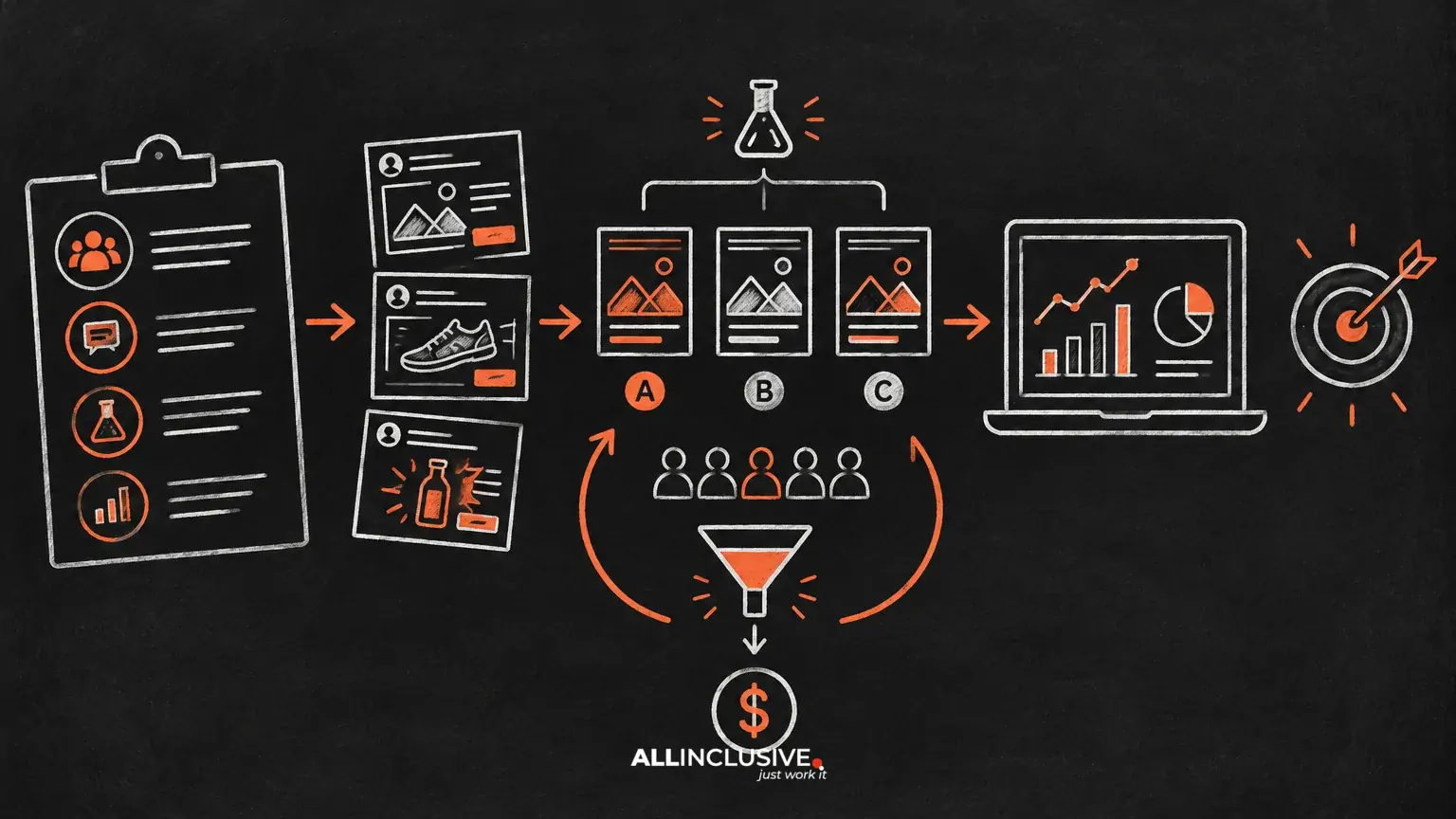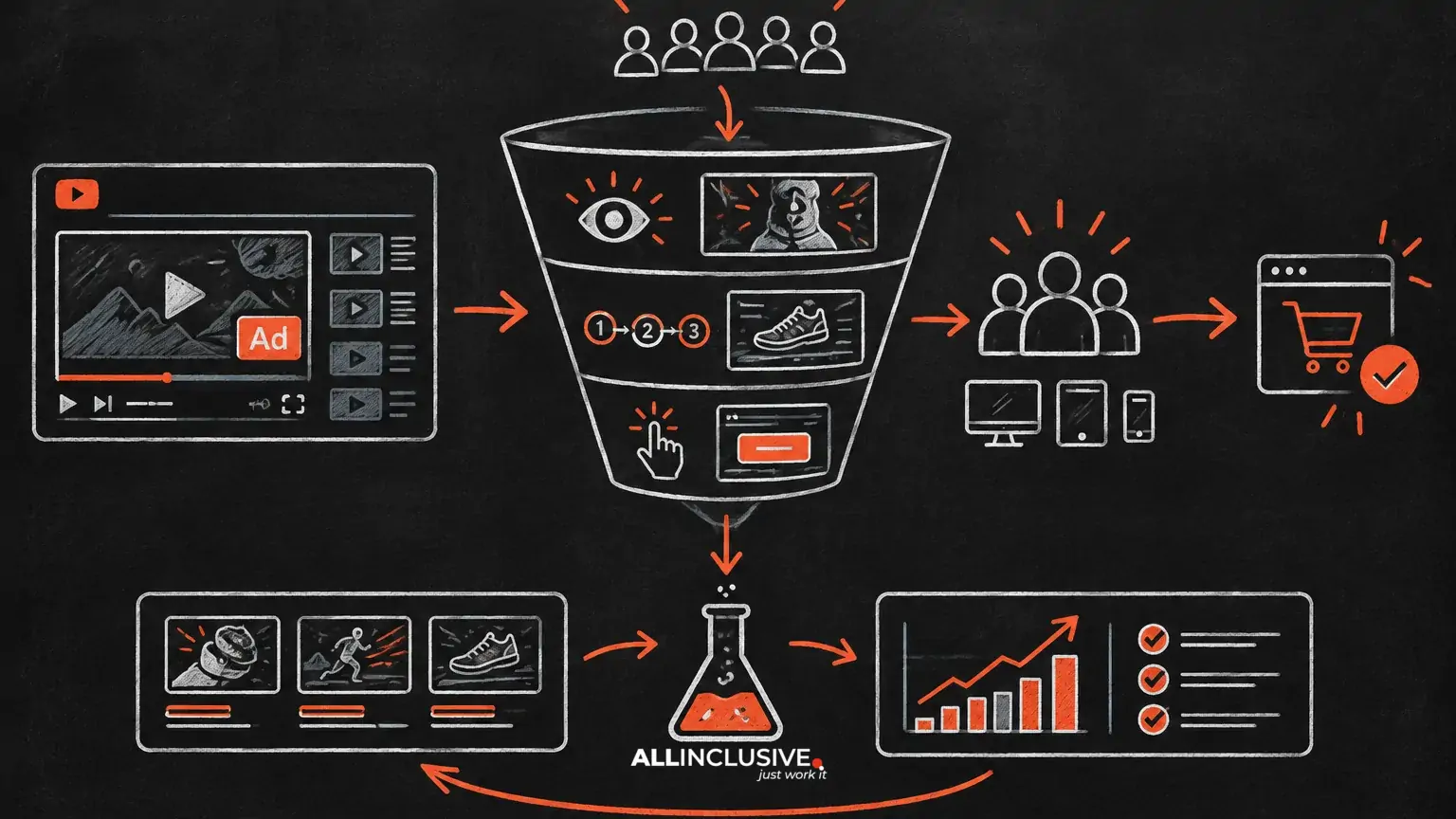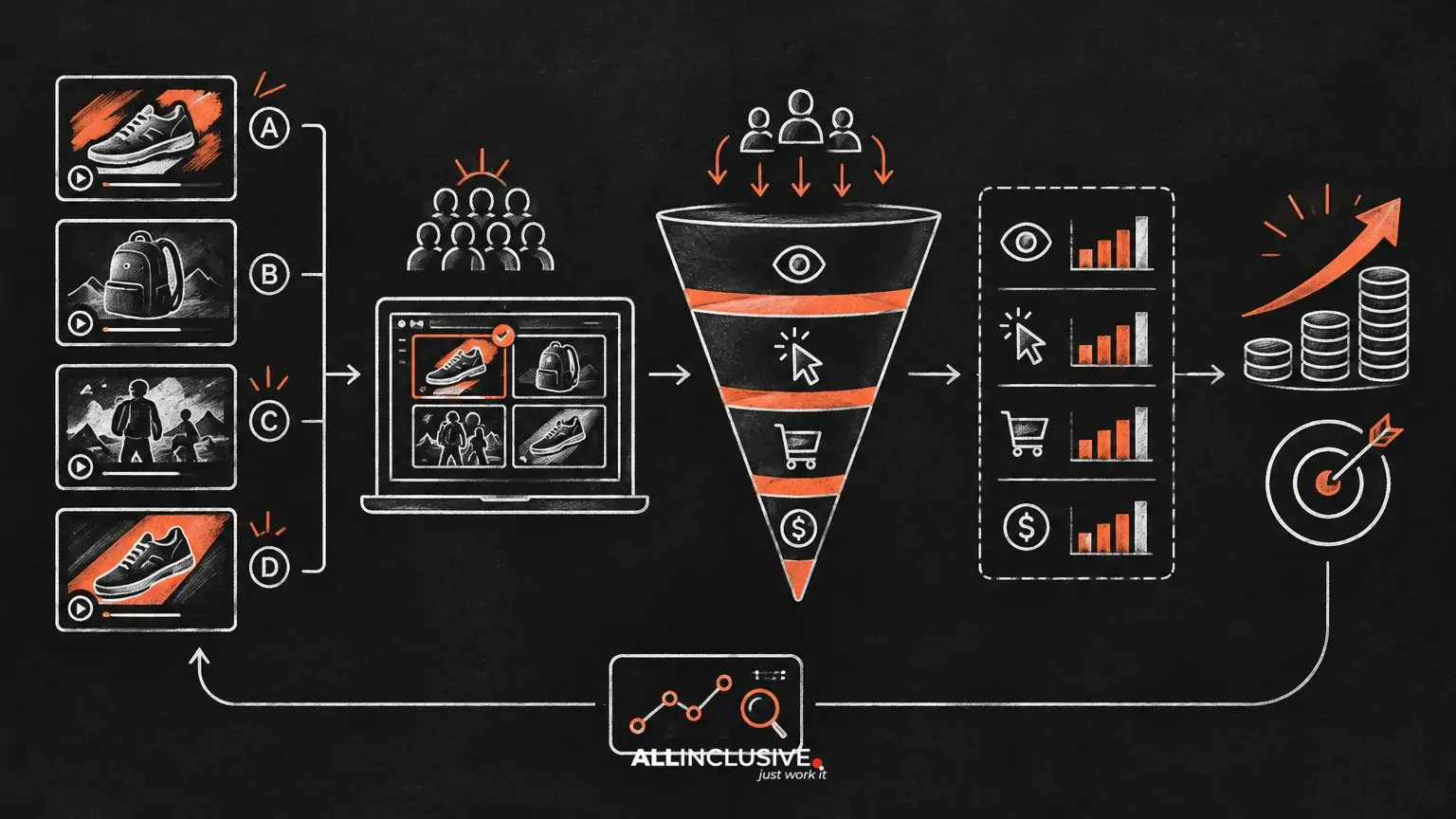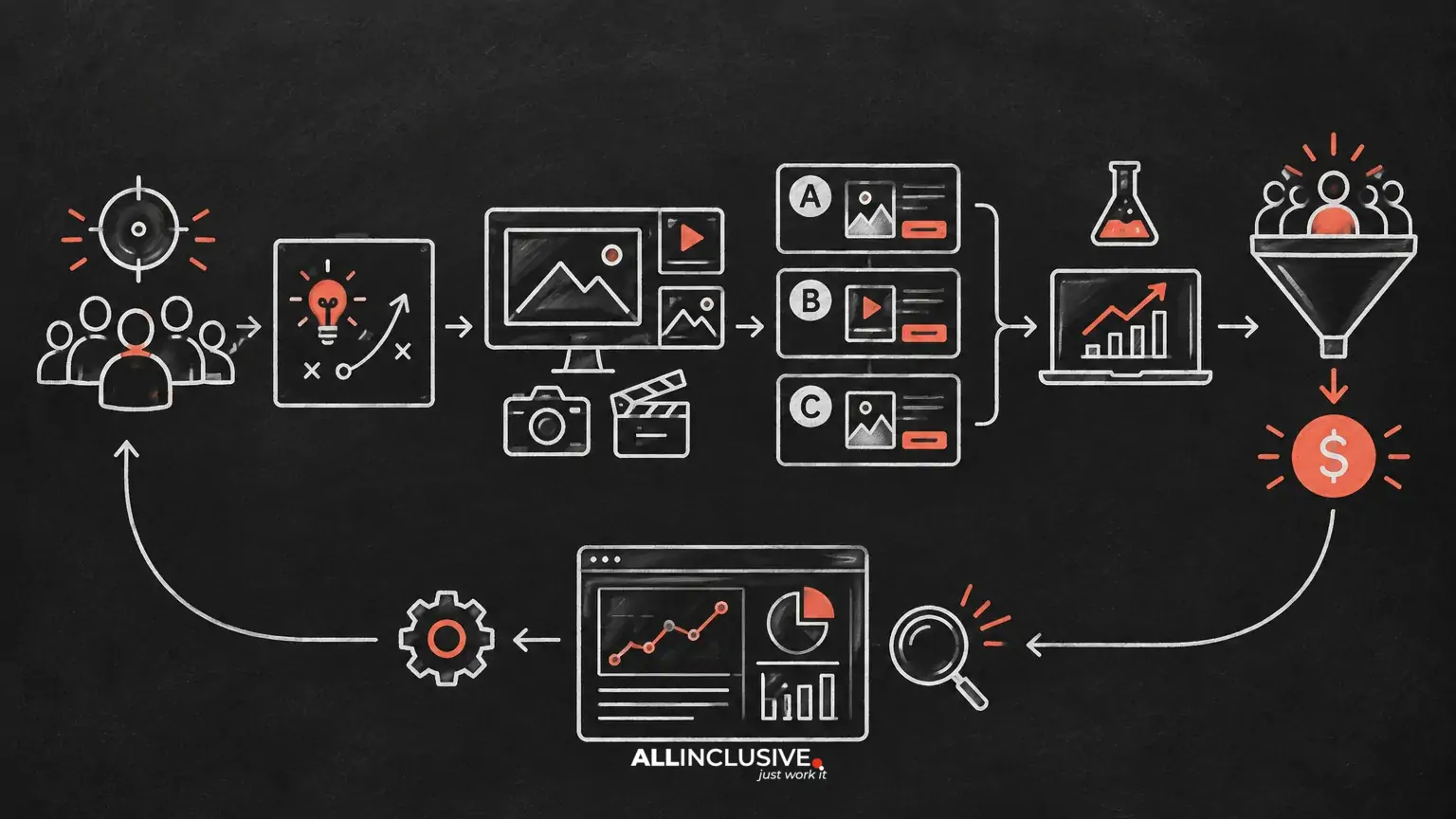
A performance creative agency connects creative decisions to measurable business outcomes. Instead of treating ads as isolated designs or videos, it builds a repeatable system for researching audiences, developing persuasive concepts, producing assets, testing them responsibly, and turning results into the next creative brief.
The distinction matters because strong-looking creative is not automatically effective creative. Performance depends on the relationship between the offer, audience, message, format, landing experience, media environment, and measurement quality. An agency can help manage that system, but it should not promise that creative alone will solve weak economics, poor positioning, or an unclear conversion path.
What does a performance creative agency do?
A performance creative agency develops and improves advertising assets with a commercial objective in mind. That objective may be qualified leads, purchases, booked consultations, app activity, or another defined conversion—not simply engagement or visual approval.
Typical responsibilities include:
- Audience and customer research: identifying motivations, objections, language, use cases, and moments of intent.
- Creative strategy: translating business priorities into angles, messages, formats, offers, and hypotheses.
- Concept development: creating distinct ideas rather than superficial variations of one ad.
- Production: making static, video, UGC-style, motion, display, or platform-specific assets.
- Testing: organizing experiments so the team can learn which variables influence performance.
- Analysis and iteration: interpreting results alongside media, audience, landing-page, and conversion data.
The agency’s role is therefore broader than ad design. It should help answer what to say, who should hear it, why the message may work, how it should be expressed, and what evidence would justify the next decision.
How the performance creative process works
1. Establish the business and measurement context
Before production begins, define the commercial goal and the constraints around it. Useful inputs include the primary conversion, acceptable acquisition economics, sales-cycle length, average order or contract value, margins, geographic scope, audience definitions, existing creative, and known tracking limitations.
This step prevents a common mistake: optimizing creative against a convenient but incomplete signal. A click can indicate curiosity, but it may not indicate lead quality or purchase intent. The appropriate evaluation window and success criteria depend on the business model and conversion path.
2. Research the audience and offer
Research should identify the reasons people act, hesitate, compare, or abandon the process. Sources may include customer interviews, sales-call notes, support conversations, reviews, search queries, CRM insights, existing campaign data, and direct observation of how the product is used.
The output should be actionable, not a generic persona document. For example, a team might learn that prospects understand the problem but distrust broad claims, or that existing customers value implementation support more than a feature list. Those findings can become creative hypotheses.
3. Build an angle and message system
A creative angle is the strategic route an ad takes to make the offer relevant. Depending on the market, angles may focus on a costly problem, a desired outcome, a change in circumstances, a proof point, a product mechanism, a comparison, or an objection.
Each angle should connect four elements:
- Audience situation: what the person is trying to solve or decide.
- Core promise: the useful outcome the offer can credibly support.
- Reason to believe: evidence, demonstration, process, expertise, or product detail.
- Next step: the action that matches the user’s level of intent.
Keep claims aligned with what the business can substantiate. A strong creative system makes the promise clearer; it does not compensate for an offer that cannot deliver it.
4. Choose formats and production treatments
Format should follow the job the creative needs to perform. A static ad may communicate a clear proposition quickly. Video may demonstrate a process, show a product in use, or create a stronger sense of context. UGC-style creative can make an experience feel more concrete when the speaker and claim are credible. Motion graphics may clarify an abstract workflow or comparison.
Production choices also depend on distribution, available assets, brand requirements, legal review, localization needs, and the intended placement. The goal is not to produce every possible format. It is to select formats that provide meaningful ways to express and test the strategy.
5. Launch with a learning plan
Testing should be designed before results arrive. Define the hypothesis, the variable being explored, the audience and media conditions, the primary evaluation signal, and the decision that could follow.
For example, a team might test whether a problem-led opening generates more qualified interest than a feature-led opening. That is more informative than producing several ads that differ in color, headline length, and footage without knowing what strategic question they address.
6. Feed learning into the next brief
Performance creative is iterative. Results should influence future concepts, but they should not be treated as universal truths without context. A winning opening may depend on audience temperature, offer, placement, spend level, seasonality, or landing-page alignment.
The useful output of a test is not only a winner. It may reveal which objection is important, which proof point is understood, where attention drops, or which audience needs a different message. These observations should become documented inputs for the next round.
What to look for when evaluating an agency
Strategic depth
Ask how the agency moves from business context to creative hypotheses. A credible process should include research, message prioritization, and a rationale for the proposed angles. If the process begins and ends with “make more variations,” it may generate volume without learning.
Production capability
Review whether the team can produce the formats your funnel requires at a sustainable pace. Evaluate concept quality, scripting, direction, editing, design systems, creator coordination, versioning, accessibility, and localization where relevant. A polished reel is useful, but it does not show whether the agency can maintain quality through repeated testing cycles.
Testing discipline
Ask what the agency considers a test, how it isolates variables, how it handles limited data, and how it avoids overreacting to short-term fluctuations. Testing plans should acknowledge that creative performance is affected by media delivery, audience composition, conversion tracking, and the quality of the post-click experience.
Reporting quality
Reporting should connect creative inputs to business outcomes. Useful reports identify the concepts, hooks, offers, formats, and audiences involved, then explain what the team believes the results mean and what will change next.
Be cautious of reporting that focuses only on impressions, click-through rate, or low-cost traffic when the business goal is revenue or qualified pipeline. Those metrics can be useful diagnostic signals, but their meaning depends on the conversion model.
Collaboration and ownership
Clarify who supplies research, product expertise, approvals, creators, footage, brand assets, legal review, and performance data. Confirm how source files, usage rights, revisions, and new iterations are handled. Operational clarity is especially important when creative volume increases.
How to build a practical testing roadmap
A roadmap should balance strategic exploration with controlled iteration. One useful structure is:
- Map the opportunity: list key audiences, problems, desired outcomes, objections, proof points, offers, and funnel stages.
- Prioritize hypotheses: choose ideas based on expected business importance, evidence, and feasibility—not novelty alone.
- Develop distinct concepts: make the concepts different in message or mechanism before creating minor executions.
- Adapt concepts to formats: write the first seconds, visual sequence, headline, call to action, and landing-page connection for each format.
- Define learning criteria: document the primary signal, supporting signals, relevant conversion window, and possible next actions.
- Review in context: compare creative with audience, placement, spend, funnel stage, and downstream quality.
- Iterate deliberately: scale credible patterns, refine promising concepts, and retire assets when evidence indicates they no longer contribute.
This process is compatible with a broader performance creative strategy, but the agency should tailor the roadmap to the account’s data quality, sales cycle, and production capacity.
Common mistakes in performance creative programs
- Starting with formats instead of customer problems: selecting video or static before deciding what the ad needs to communicate.
- Confusing variation with experimentation: changing minor design details without testing a meaningful hypothesis.
- Optimizing for the easiest metric: celebrating inexpensive traffic when the commercial goal depends on qualified conversions.
- Ignoring post-click alignment: making a promise in the ad that the landing page does not immediately support.
- Producing without a reuse system: creating one-off assets that cannot be adapted efficiently across audiences or placements.
- Declaring winners too quickly: treating early movement as definitive without considering data quality and context.
- Letting brand and performance operate separately: sacrificing clarity for visual novelty or sacrificing trust for short-term attention.
These issues often look like creative problems but may originate in positioning, offer design, audience selection, landing-page experience, or measurement. A capable partner should help identify those dependencies rather than attribute every result to the ad itself.
When should you work with an agency?
An agency may be useful when internal teams lack the production capacity, testing structure, specialist experience, or outside perspective needed to maintain a consistent creative program. It can also help when a business has media spend and conversion data but lacks a reliable way to turn those inputs into new concepts.
Before engaging one, define the gap you want to solve. Is the issue insufficient creative volume, weak strategic differentiation, slow production, unclear testing, inconsistent reporting, or limited access to creators and editors? The more specific the problem, the easier it is to assess whether an agency’s process matches it.
For broader context on how creative fits into acquisition planning, see the paid media resources. For a focused comparison of production choices, review static versus video ads, and for a deeper testing structure, see the creative testing framework.
Final decision criteria
The right performance creative agency should make the connection between strategy, production, testing, and commercial outcomes visible. Look for a partner that asks precise questions, separates hypotheses from conclusions, documents learning, and can explain both what the creative is intended to do and how the team will evaluate it.
Creative performance is not a one-time production project. It is an operating system for turning customer insight and market feedback into better decisions. Choose the agency whose process can keep learning after the first launch—not merely the one with the most attractive portfolio.
For broader strategic context, see our performance creative resource.