
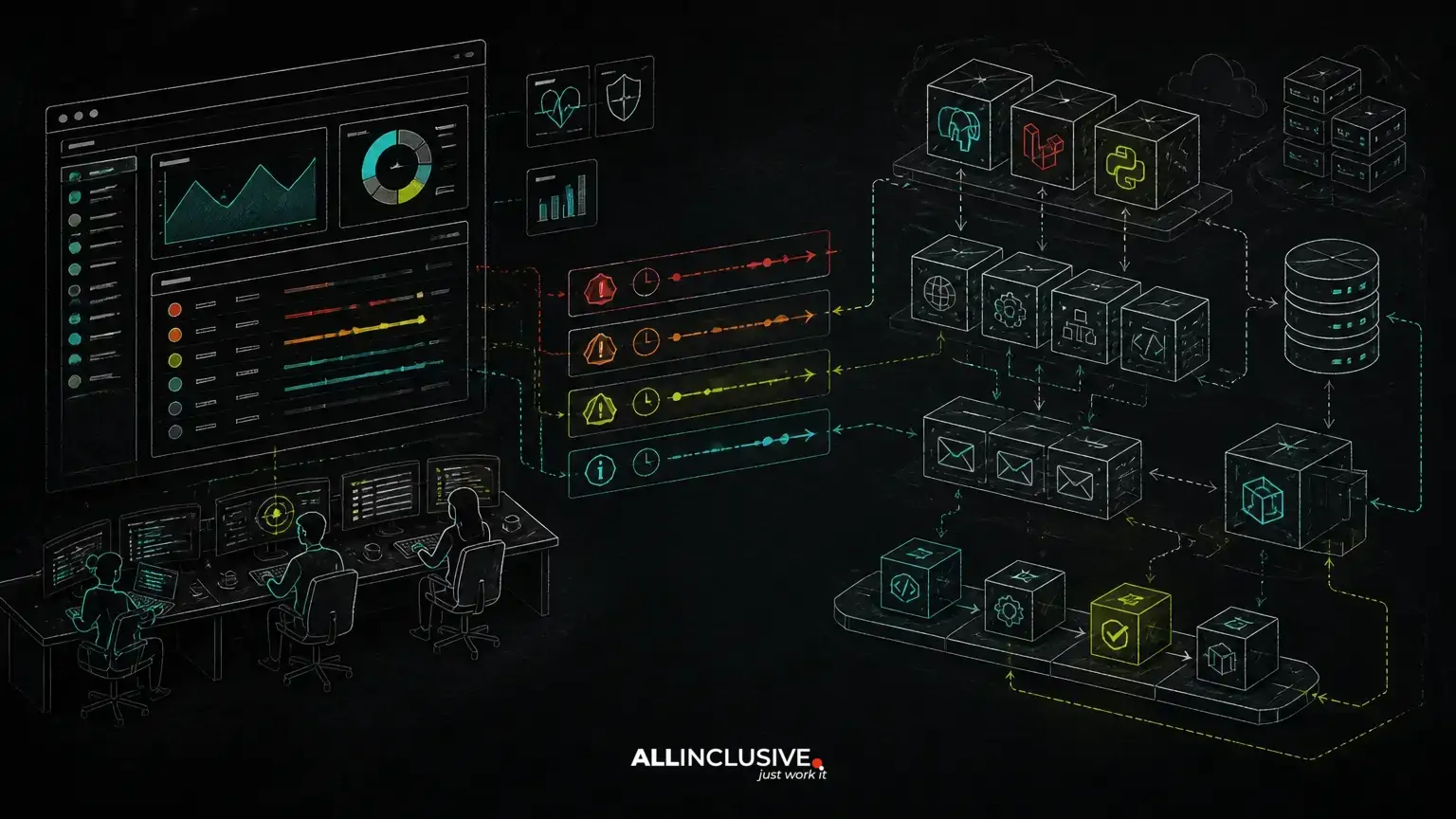
A software maintenance SLA defines what happens when a production application needs attention. It usually sets severity levels, response times, communication expectations, escalation paths and, sometimes, resolution or workaround targets. The purpose is not to promise that every defect can be fixed immediately. It is to create a shared operating model for incidents, maintenance and ongoing improvement.
For a mature custom Laravel, PHP or Python application, an effective SLA should reflect business impact, not just technical labels. A checkout failure, an intermittent reporting defect and an outdated development dependency may all require engineering work, but they should not receive the same priority. The SLA connects those decisions to monitoring, incident response, security work, release management and roadmap continuity.
This article explains the main parts of a software maintenance SLA and the questions technical and product leaders should ask before accepting one.
What a software maintenance SLA should define
An SLA is useful when it removes ambiguity during stressful or time-sensitive work. At minimum, it should clarify:
- Covered systems: applications, APIs, background workers, databases, deployment pipelines, integrations and environments included in the agreement.
- Service hours: whether support is available during business hours, on an extended schedule or continuously for defined critical incidents.
- Severity levels: the criteria used to classify incidents and requests.
- Response targets: how quickly the support team acknowledges and begins assessing an issue.
- Update cadence: how often stakeholders receive status updates while an incident remains open.
- Resolution approach: whether the target is a permanent fix, a workaround, service restoration or a documented plan.
- Escalation: who becomes involved when an issue exceeds its target or requires architectural, security or product decisions.
- Exclusions and dependencies: conditions that affect support, such as third-party outages, unavailable access or unsupported environments.
These details matter particularly when one team inherits a codebase from another supplier. Without a defined scope and operating process, maintenance quickly becomes a sequence of urgent requests with unclear ownership.
Severity levels should describe business impact
Severity is not the same as developer effort. A small configuration change can have critical business impact, while a complex defect may affect only an internal workflow. A practical severity model describes what users and the business cannot do.
Severity 1: Critical service interruption
A critical incident prevents a core production workflow from operating, creates a serious data-integrity concern or affects a broad user population. Examples may include a failed authentication service, unavailable checkout path or production deployment that causes widespread errors.
The SLA should define immediate ownership, frequent communications and an escalation path. The first objective is usually to contain the impact or restore a safe service state. A permanent correction may follow after logs, data and deployment conditions have been reviewed.
Severity 2: Major degradation or high-impact defect
A major incident significantly disrupts an important workflow but does not necessarily make the entire application unavailable. Examples include a material performance decline, a broken administrative process or an integration failure with a viable manual workaround.
Response targets should be shorter than for routine requests, but the service should still distinguish between restoring functionality and completing the underlying code change. That distinction prevents teams from rushing an unsafe patch simply to satisfy a resolution clock.
Severity 3: Limited functional issue
A limited issue affects a smaller group of users, a non-critical feature or a workflow with a reasonable workaround. It may still deserve prompt attention, especially if repeated occurrences indicate a deeper reliability problem.
Severity 3 work is often scheduled alongside planned maintenance, dependency updates or technical-debt reduction. The SLA should explain how these items enter the backlog and how product impact influences prioritization.
Severity 4: Request, question or improvement
Routine requests include documentation changes, access questions, minor interface adjustments and feature enhancements. These are generally governed by planning and delivery commitments rather than incident-response targets.
Mixing feature requests with incidents makes SLA reporting misleading. A request can be important without being an outage, and it should be evaluated through product and roadmap processes.
Response time is not resolution time
One of the most important distinctions in a software maintenance SLA is the difference between response and resolution.
- Response time is the time until the support team acknowledges the issue, confirms ownership and begins assessment.
- Mitigation time is the time until the impact is reduced through a rollback, configuration change, feature flag, workaround or other safe action.
- Resolution time is the time until the agreed corrective work is completed and verified.
- Restoration time is the time until the affected service is returned to an acceptable operating state.
These clocks can differ substantially. A database connection failure might be mitigated by restoring a previous deployment, while the permanent fix requires investigation into connection handling, capacity and deployment configuration. An SLA that promises a fixed resolution time for every severity may encourage superficial fixes or conceal unresolved risk.
Ask whether the agreement measures business-hours or calendar-hours, when the clock starts, what pauses it and how verification is handled. For example, waiting for customer reproduction steps, third-party access or an approved maintenance window may change the timeline, but those conditions should be explicit rather than assumed.
Monitoring determines whether the SLA can work
An SLA cannot compensate for weak observability. If the support team learns about a failure only after users report it, the response clock has already started late from the business perspective.
Monitoring for a custom application may include application errors, availability checks, queue depth, scheduled jobs, database health, storage, latency, deployment status and security-relevant events. The right signals depend on the architecture and the workflows that matter most. A Python worker may need job-failure monitoring; a Laravel application may require visibility into queues, scheduled tasks and application exceptions; a PHP service may need checks across web, database and integration boundaries.
Alerts should be actionable. Excessive low-value notifications create alert fatigue, while missing signals delay incident classification. A maintenance agreement should identify who receives alerts, who can access logs and dashboards, and how monitoring gaps are recorded as follow-up work.
For a practical starting point, see this application monitoring checklist.
Security patches and dependency updates need separate treatment
Security maintenance does not always fit neatly into incident severity. A vulnerability may not have caused an outage, but delaying remediation can increase operational and compliance risk. The SLA should define how security advisories are assessed, prioritized, tested and released.
Several factors affect timing:
- Whether the affected dependency is reachable in the production environment.
- Whether a supported update or compensating control is available.
- Whether the change affects application behavior, extensions or deployment images.
- Whether regression testing and a maintenance window are required.
- Whether the application is pinned to older PHP, Laravel or Python versions.
Dependency work should not be treated as an endless emergency. A managed update process tracks version constraints, test coverage, release notes, transitive dependencies and rollback options. The dependency update strategy for long-lived web applications should align with the SLA's security and maintenance commitments.
Inherited codebases require an onboarding phase
Support targets are difficult to make credible when the support team has not yet assessed the application. Inherited systems often lack current architecture diagrams, reliable deployment instructions, test coverage, environment parity or documented integration ownership.
A responsible maintenance agreement can include a transition or discovery phase before full SLA commitments begin. That phase may review:
- Production architecture, hosting and deployment access.
- Application logs, monitoring and alert routes.
- Critical user journeys and business dependencies.
- Database structure, backups and recovery procedures.
- Framework, language and third-party package versions.
- Known defects, technical debt and open security concerns.
- Test coverage, release gates and rollback procedures.
This does not mean support must wait until the codebase is perfect. It means the parties should distinguish known operational risks from unknown ones. The first month of ownership should produce a prioritized risk register and a plan for closing the most consequential gaps. See taking over an inherited codebase for a more detailed transition view.
Release management belongs in the maintenance conversation
Maintenance is not only ticket handling. It includes deciding how changes move safely from development to production. A useful SLA describes the release process for emergency fixes, routine patches and larger upgrades.
Important questions include whether changes receive peer review, which environments are used for validation, how database migrations are handled, who approves production releases and what rollback means for stateful changes. For Laravel, PHP and Python applications, the exact tooling may vary, but the operating principles remain: make changes traceable, test the workflows affected and retain a safe recovery path.
Emergency access should also be controlled. A critical incident may justify an expedited release, but it should still produce a record of what changed, why it changed and what follow-up validation is required. Post-incident review should identify systemic improvements rather than assign blame.
Questions to ask before signing an SLA
- Which applications, environments, integrations and infrastructure components are covered?
- Are support hours aligned with the users and revenue workflows that need protection?
- How are severity levels assigned, and who can change a classification?
- Does the response target mean acknowledgment, active investigation or a workaround?
- Are resolution targets realistic for inherited code, third-party dependencies and approval processes?
- What information must the customer provide for the SLA clock to start?
- How are security vulnerabilities prioritized outside ordinary incident queues?
- Who owns monitoring, backups, deployments, domains, certificates and vendor relationships?
- How are recurring incidents connected to roadmap work and technical-debt reduction?
- What reporting is provided, and does it show trends rather than only ticket counts?
Choosing an SLA that supports ownership, not just faster tickets
The strongest software maintenance SLA is a shared ownership model. It connects incident response with monitoring, security updates, dependency management, technical-debt decisions and planned product delivery. It also makes limitations visible: unsupported versions, incomplete access, fragile integrations and changes that require customer or third-party action.
Organizations with custom systems should evaluate maintenance providers on their ability to understand the application, preserve business context and improve the operating baseline over time. That may involve a focused support arrangement, a dedicated product engineering team or a broader partnership covering new development and modernization. Explore dedicated product teams when continuity between maintenance and roadmap delivery is important.
For broader guidance on selecting an engineering partner for custom applications, visit web development services. You can also review the wider support and maintenance practice and the development hub for related delivery considerations.


