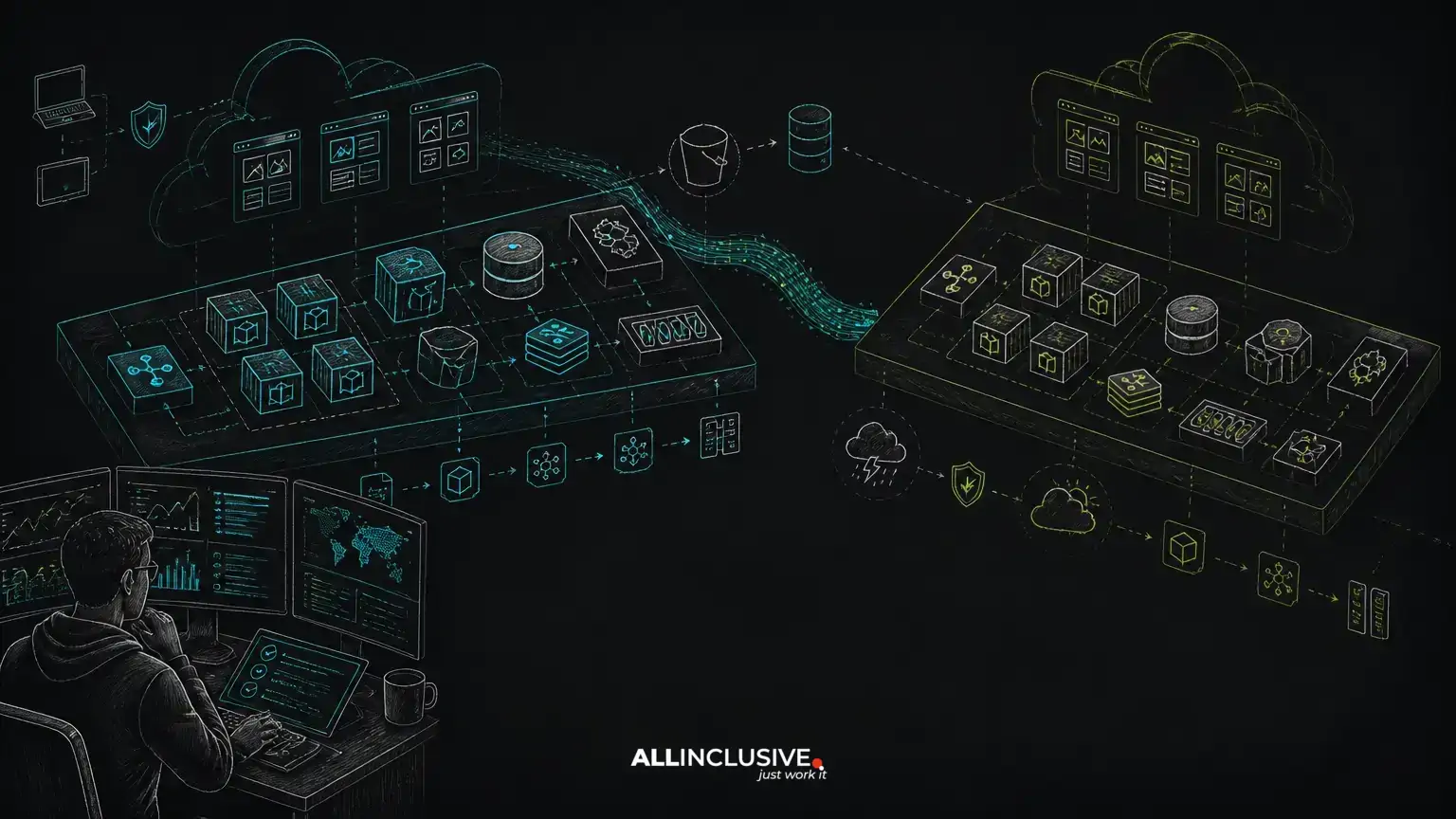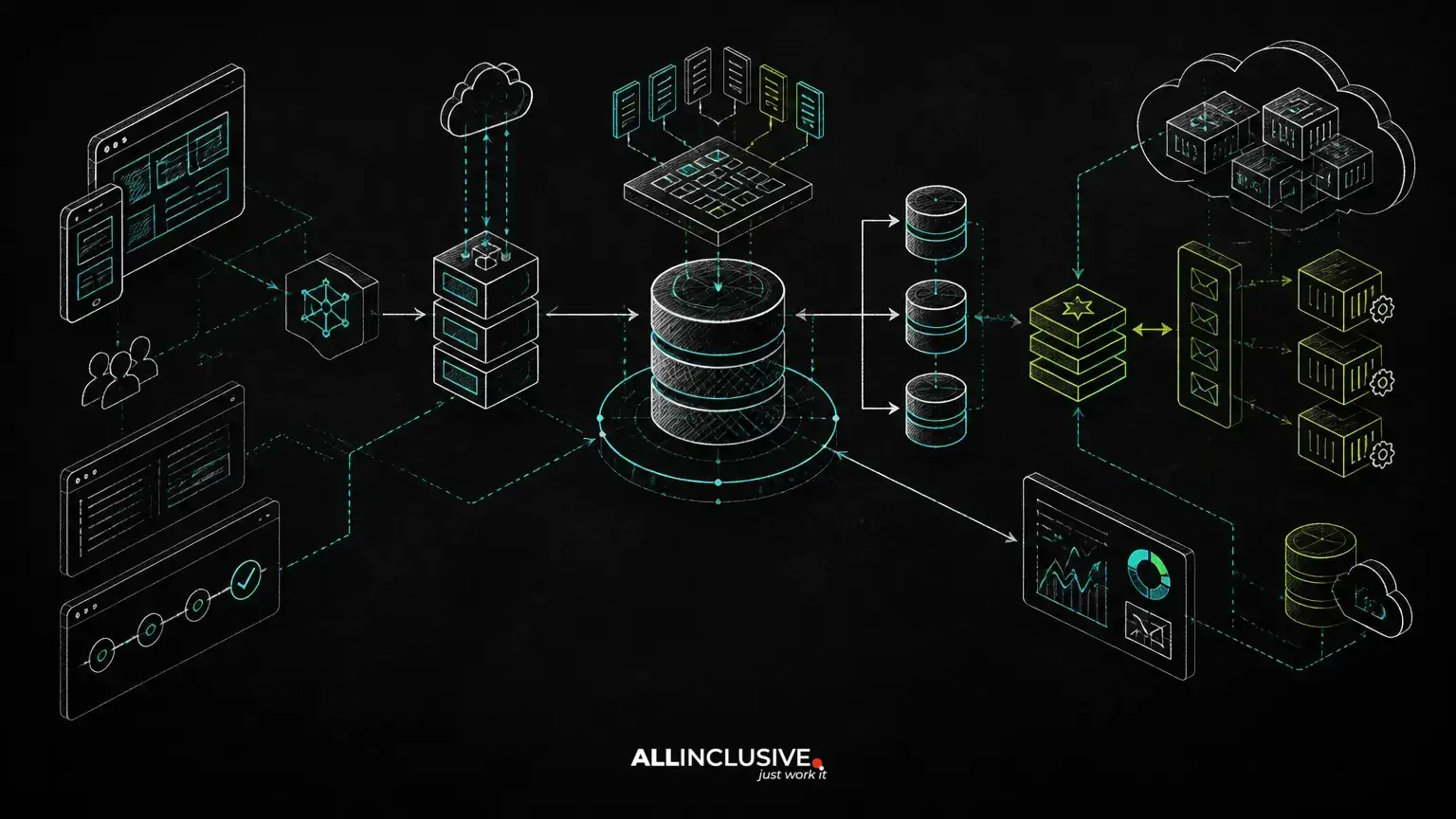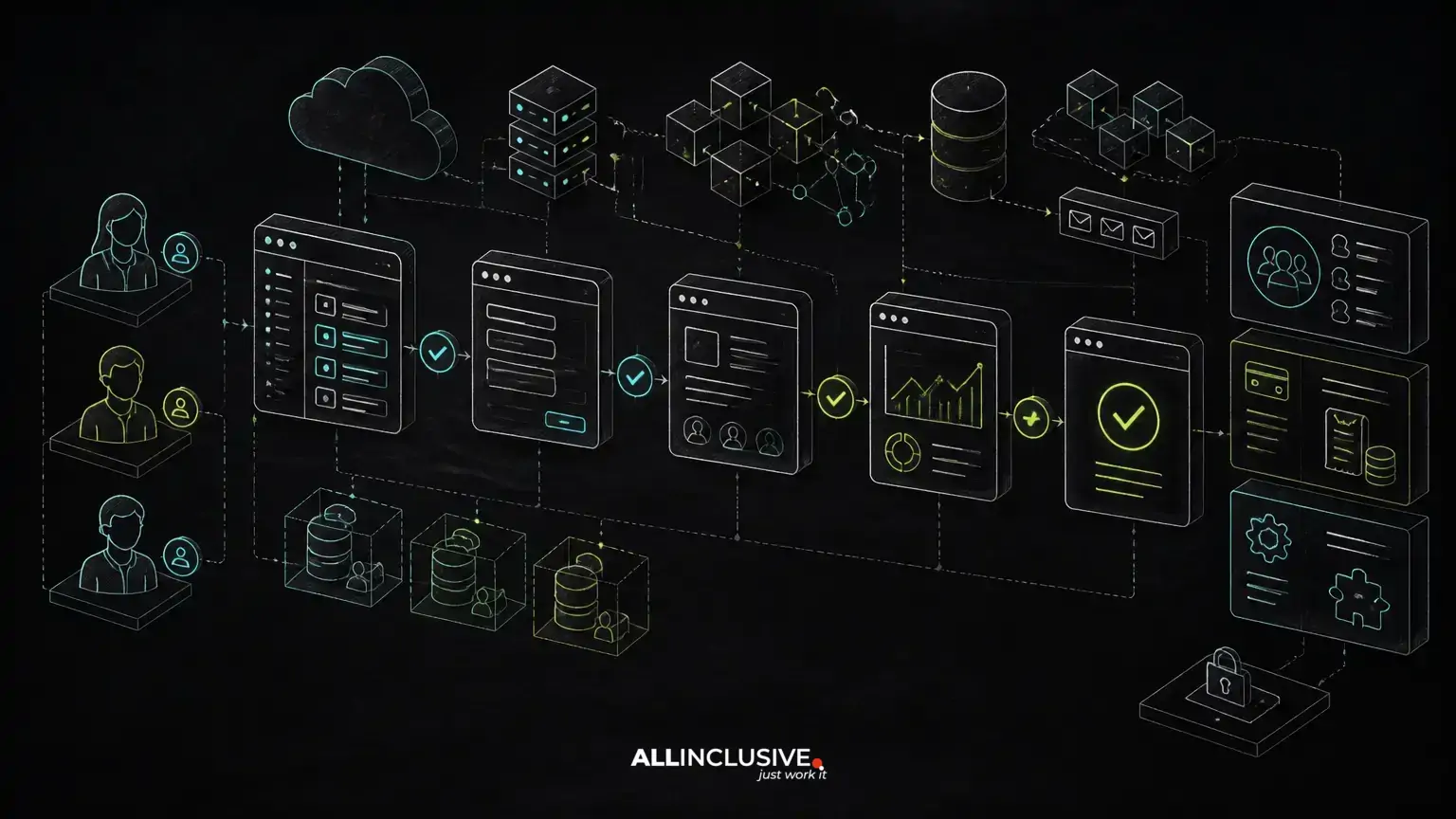
SaaS MVP development is not about producing the smallest possible application. It is about building the smallest reliable product that can test a specific business workflow with real users. The first release should make one important job meaningfully easier while creating enough technical foundation to learn from usage rather than from assumptions. For teams evaluating saas mvp development, this implementation detail is expanded in web development services.
That usually means prioritizing a narrow user journey, clear roles, dependable data handling and the operational capabilities needed to support the product. It usually means delaying broad integrations, advanced automation, complex customization and secondary interfaces until the core workflow has earned further investment.
Start with the workflow, not the feature list
A SaaS concept often begins as a collection of requested features: dashboards, notifications, reports, integrations, billing, mobile access and artificial intelligence. That list does not yet define an MVP. The useful starting point is the business process the product must improve.
Describe the workflow as a sequence:
- Who initiates the process?
- What information do they provide?
- What decision, approval or transaction follows?
- Which roles need to see or change the record?
- What outcome indicates that the workflow succeeded?
For example, a B2B operations product might focus on submitting a request, reviewing it, assigning responsibility, completing the work and reporting its status to a customer. That sequence is more useful for MVP scope than a general requirement such as “include a dashboard.” The dashboard may be necessary, but its purpose becomes clearer when tied to a specific operational decision.
This workflow-first approach also helps distinguish product requirements from implementation preferences. A stakeholder may request a mobile app, but a responsive web interface may support the initial workflow with less operational overhead. A team may request ten integrations, while one carefully selected import or export may be sufficient to validate demand.
What a SaaS MVP should usually include
A credible first release generally contains the capabilities required to complete the primary workflow safely and repeatedly. The exact scope depends on the product, but several areas commonly belong in the first version.
A complete primary user journey
The MVP should allow its target user to enter the product, perform the central task and reach a meaningful outcome. A collection of disconnected screens is not a usable MVP. If the product promises collaboration, the workflow should include the handoff between relevant users. If it promises a transaction, it should handle the transaction state, confirmation and appropriate failure paths.
Focused authentication and role-based access
Authentication identifies a user; authorization determines what that user may do. A SaaS product may need an owner, administrator, operator, approver or external customer, even in its first release. Define permissions around actions and data rather than only around page visibility.
For example, an account administrator may manage users, while an operator can update a work item but cannot change billing settings. Keeping this model explicit prevents insecure assumptions from spreading through controllers, screens and background jobs.
Data ownership and tenant boundaries
Multi-tenancy should be considered early when multiple organizations will use the same application. Each record should have a clear relationship to its tenant, and the application should enforce that relationship consistently in queries, authorization checks, background processing and administrative tools.
A simple shared-database model can be appropriate for an MVP, but it still requires disciplined tenant scoping, test coverage and operational controls. Separate databases or infrastructure may be appropriate for particular compliance, isolation or scale requirements, but they also introduce deployment and maintenance complexity. The decision should follow actual business and risk requirements.
Operational visibility
The team operating the product needs a way to investigate failed payments, stuck workflows, duplicate records, user access problems and other exceptions. An internal admin area, structured logs and basic error monitoring may be more valuable than another customer-facing feature.
Billing only when the business model requires it
If payment is part of the product hypothesis, billing belongs in the MVP—but only at the level needed to test that hypothesis. Define the product’s subscription states, entitlement rules, failed-payment behavior and cancellation flow before adding elaborate plan configuration. If early customers will be invoiced manually, automating every billing variation may be unnecessary for the first release.
What to delay without weakening the product
Delaying a feature does not mean ignoring it. It means recording the requirement, identifying its future architectural implications and avoiding premature implementation until evidence justifies the cost.
- Broad integration catalogs: Begin with the systems that are necessary for the primary workflow. Use a stable import, export or one carefully designed connector when that is enough to validate demand.
- Highly configurable workflows: Hard-code a well-understood process when appropriate, but keep boundaries clear so configuration can be introduced later without rewriting the entire domain model.
- Advanced analytics: Capture trustworthy event and business data first. Complex reporting built on unstable definitions creates confusion rather than insight.
- Multiple interface channels: A responsive web application may be a better first surface than separate desktop, mobile and embedded experiences.
- Complex marketplace mechanics: If the product connects two parties, first validate matching, communication and fulfillment before adding sophisticated ranking, bidding or commission rules.
- AI-assisted features: Start with a deterministic workflow and clear user review. AI can be added where it reduces meaningful effort, but prototype behavior should not be treated as production reliability.
The correct question is not “Can this feature wait?” It is “What evidence would make this feature worth building, and what foundation must exist so it can be added safely?”
Architecture decisions that matter before launch
An MVP deserves deliberate architecture even when its scope is small. “MVP” describes the product’s learning objective, not permission to create disposable code.
Choose the simplest architecture that preserves the workflow
A modular monolith is often a practical starting point for a SaaS product with a small team and a focused domain. It can keep related business rules together while maintaining boundaries between accounts, users, billing, workflow records and integrations. Separate services may become appropriate when independent scaling, isolation or deployment needs are real—not merely because microservices sound more advanced.
PHP and Laravel can be suitable for business applications that need authentication, authorization, queues, scheduled work, transactional data and administrative interfaces. Python may be a better fit for particular data-processing, automation or machine-learning workloads. The technology should follow the workflow, team capability and ownership requirements rather than a fashionable default.
Model business states explicitly
Many SaaS failures are state-management failures. A request may be draft, submitted, approved, assigned, completed, rejected or cancelled. Those states should be defined deliberately, with allowed transitions and responsible roles. Explicit state rules improve reporting, notifications, auditability and future integrations.
Protect ownership of the code and data
Custom-made product engineering should leave the business with control of its source code, data, deployment process and operational documentation. Confirm repository access, environment configuration, database migrations, backups, third-party accounts and handover procedures before development begins. Ownership is a commercial and continuity concern, not just a technical preference.
How to prioritize the first release
A useful prioritization method evaluates each proposed capability against four questions:
- Workflow necessity: Can the primary user complete the promised job without it?
- Learning value: Will it test an important product or commercial assumption?
- Operational risk: What could fail if it is omitted or implemented superficially?
- Rework risk: Will postponing it force a costly redesign of data, permissions or interfaces?
Features that are essential to the workflow and reduce material operational risk belong near the front of the plan. Features that mainly improve convenience, polish or breadth can often wait. A prioritization workshop should produce more than a ranked backlog: it should document assumptions, dependencies, acceptance criteria and the evidence required for the next decision.
For a product involving bookings, for example, availability rules, time zones, booking states, cancellation behavior and role permissions may matter more than calendar themes or public sharing. A product involving customer accounts may need secure document access and an audit trail before it needs extensive personalization. The domain determines the real MVP.
Common SaaS MVP mistakes
Building a miniature enterprise platform
Trying to support every customer type, pricing model and exception produces slow delivery and unclear learning. Select an initial segment and define the workflow for that segment.
Treating design polish as product validation
A professional interface matters, but visual refinement cannot compensate for incomplete business rules, unreliable data or a workflow that does not solve a meaningful problem.
Leaving security and permissions until the end
Retrofitting tenant isolation, authorization and audit requirements after features are built can be expensive and risky. Establish the access model early, then test it as the application evolves.
Automating before the process is understood
Automation can amplify an incorrect process. First establish which events should trigger work, who owns exceptions and how users recover from failure.
Ignoring the operational product
Customer-facing functionality is only part of a SaaS system. Support staff need tools to inspect accounts, correct permitted data issues, review events and resolve access or billing problems.
A release plan that supports learning
Plan the MVP in vertical slices rather than technical layers alone. A slice might include the interface, authorization, domain logic, persistence, notification and operational handling required to complete one part of the workflow. This makes the product testable earlier and exposes integration problems before the end of the project.
Before launch, verify the critical path with realistic roles and failure conditions:
- Can a new organization and its users be created safely?
- Can each role see and change only the records it should?
- What happens when a required integration is unavailable?
- Can users recover from validation errors or interrupted work?
- Can operators investigate a failed workflow?
- Are backups, deployment steps and environment secrets documented?
- Can the team measure the events that indicate successful use?
After launch, use support requests, workflow completion, repeated manual work and customer feedback to decide what comes next. The next release might justify a self-service integration, configurable rules, deeper reporting or an AI feature. It might instead reveal that the original workflow needs simplification.
When custom SaaS MVP development is the right choice
Custom development is most defensible when the product depends on a distinctive workflow, specialized permissions, regulated or sensitive data, complex integrations or a business model that generic software cannot represent cleanly. It also makes sense when the product itself is the company’s competitive asset and the team needs ownership of the underlying system.
A configurable off-the-shelf platform can be appropriate when the process is conventional, speed matters more than differentiation and its data, access and integration model fit the business. Build-versus-buy should be evaluated against workflow fit, total operating effort, vendor dependency, data portability and the cost of future change—not only the initial subscription or build estimate.
For a broader view of how discovery, architecture and delivery fit together, see the custom web application development process. Related decisions often arise in internal tools development, customer portal development and booking system development.
When you need a partner to shape and build a workflow-first product, explore custom software and web development. After launch, structured support and maintenance helps protect reliability as usage, integrations and business rules change.