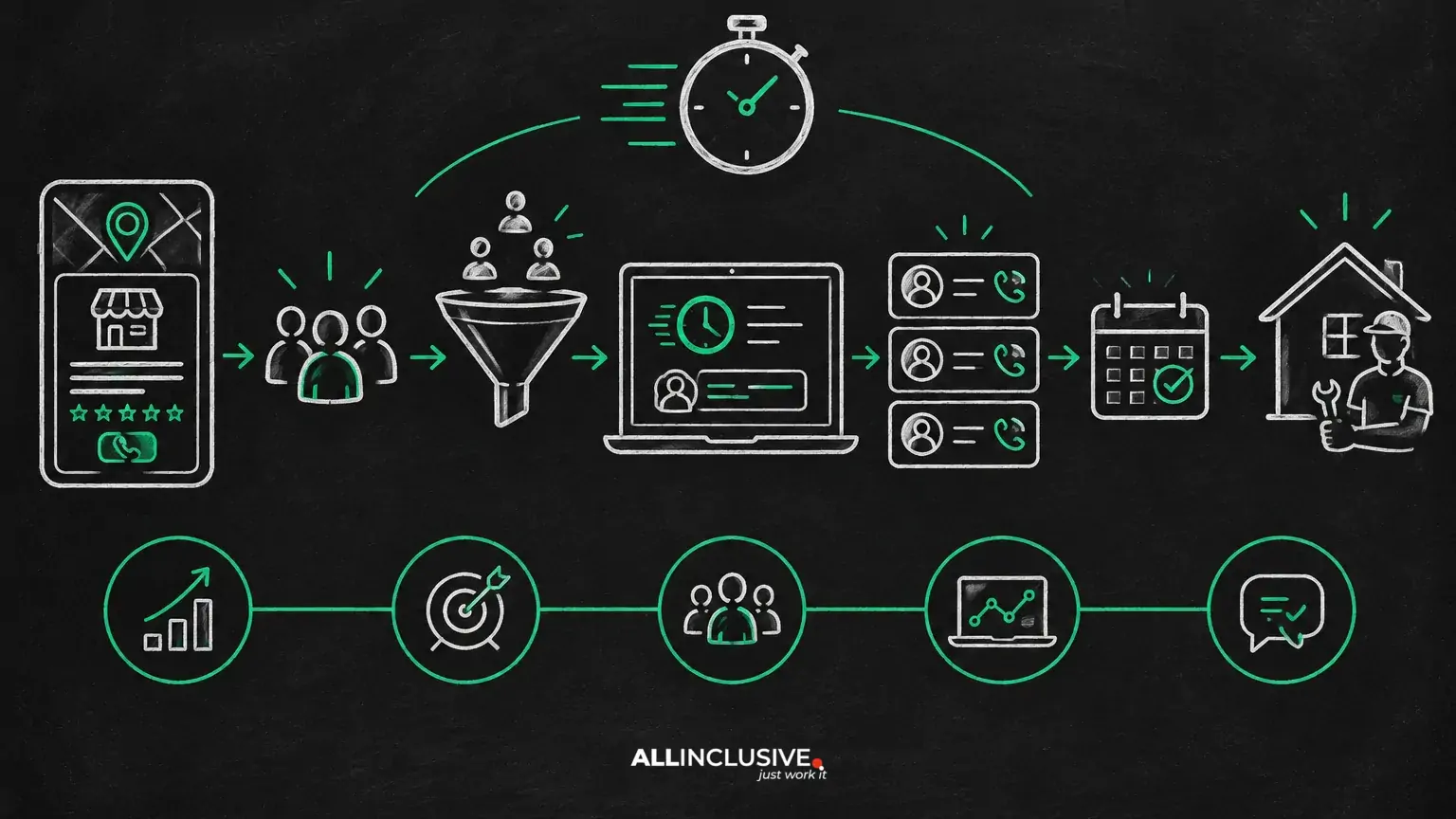
Local Services Ads response time matters because a lead is usually most useful when the customer is still actively looking for help. A delayed call or message can reduce the chance of a conversation, make the lead harder to qualify, and weaken the connection between advertising spend and booked work.
There is no universal response-time target that guarantees a booking. Results depend on urgency, service category, operating hours, location, staffing, lead quality, and how the business handles calls and messages. The practical goal is to make response time fast, consistent, measurable, and appropriate to the type of inquiry.
This guide explains how response time affects lead value, which metrics to track, how to design a workable follow-up process, and how to separate platform mechanics from operational strategy.
What local service ads response time actually measures
Response time is the elapsed time between a lead becoming available to the business and the business making a meaningful first attempt to engage. The definition should be agreed internally before performance is evaluated.
For example, a business may measure:
- The time from an incoming call to an answered conversation
- The time from a missed call to the first callback attempt
- The time from a message or form notification to the first reply
- The time from lead receipt to a complete follow-up sequence when the first attempt fails
These are not interchangeable. A reported “average response time” can look healthy while missed calls remain unanswered for hours. Break the metric down by lead type, day, hour, location, and outcome.
Also distinguish attempted response from connected response. A call placed immediately but never answered is operationally different from a conversation in which the business confirms the customer’s need and agrees on a next step.
Why speed can increase the value of a lead
Local Services Ads leads often represent active demand rather than passive exposure. The customer may be comparing providers, responding to a current problem, or trying to schedule work within a limited window. The longer the delay, the more likely the customer is to continue searching, contact another provider, or lose urgency.
Faster follow-up can help in four ways:
- It preserves intent. The customer remembers why they reached out and is more prepared to discuss the job.
- It improves contact probability. A customer who is still available may be easier to reach than one who has moved on.
- It supports better qualification. Timely conversations reveal service type, location, timing, and fit before resources are committed.
- It creates a clearer feedback loop. When lead handling is consistent, marketers can compare lead quality with booking and revenue outcomes more reliably.
Speed is not a substitute for professionalism. An immediate but careless response can damage trust. The best process combines prompt contact with accurate information, respectful communication, and a clear next action.
Urgency should determine the operating model
Response-time expectations should reflect the customer’s likely urgency. Emergency-oriented services may require live coverage or a dependable overflow process. Appointment-based services may have more flexibility, but a prompt reply can still protect demand. Higher-consideration services may need a structured qualification process rather than repeated generic calls.
Use a simple decision framework:
- Urgent inquiry: prioritize live answering, immediate escalation, and after-hours coverage.
- Near-term appointment: route leads to the team member who can confirm availability and schedule efficiently.
- Research or estimate request: use a concise first response, then collect the information needed for a useful consultation.
- Low-fit or unclear inquiry: respond promptly, but use qualification questions before assigning significant sales time.
This approach avoids treating every lead identically while preserving a consistent minimum standard.
How to measure response time without misleading yourself
Start with a lead-level dataset rather than a single account average. At minimum, record:
- Lead date and time
- Lead source and type
- Business location or service area
- Operating-hours status when the lead arrived
- First attempted response time
- First connected conversation time, if different
- Number of follow-up attempts
- Qualified, booked, completed, and revenue outcomes where available
Then review distributions, not only averages. A median can show the typical experience, while upper-percentile values can reveal a long delay affecting a meaningful portion of leads. Segmenting by business hours is especially important: an overnight lead and a midday lead should not be interpreted as the same operational event.
Useful diagnostic measures include:
- First-attempt response time: how quickly the business initiates contact
- Connection rate: how often an attempt results in a conversation
- Time to qualification: how quickly the business determines whether the lead fits
- Time to booking: how long it takes to secure an appointment or agreed next step
- Unworked lead rate: the share of leads with no documented follow-up
Pair these with booking and revenue measures. Faster handling is useful only if it contributes to better commercial outcomes without creating unacceptable staffing or service costs.
Build a response workflow that people can follow
A reliable workflow is more valuable than an ambitious target nobody can maintain. Define ownership at each stage:
- Receive: capture the lead in the approved phone, CRM, inbox, or scheduling system.
- Acknowledge: confirm that the inquiry has been received when an immediate conversation is not possible.
- Attempt: call or message using the channel and script appropriate to the lead.
- Qualify: confirm service need, location, timing, and any critical constraints.
- Book or route: schedule the work, transfer the inquiry, or assign it to the correct specialist.
- Document: record disposition, next action, and reason for non-booking.
Make the first response useful. A generic “How can we help?” may force the customer to repeat information already provided. A better response can identify the business, confirm the requested service, state availability or the next step, and ask only the questions needed to move forward.
Plan for missed calls and unavailable staff
Missed calls are a common failure point. Establish a callback queue, assign an owner, and define escalation rules for leads that remain untouched. If the business cannot provide live coverage throughout operating hours, consider an answering service, rotating on-call schedule, or automated acknowledgment that sets realistic expectations.
Do not promise a callback window the team cannot consistently meet. Trust is part of lead value, and inaccurate expectations can create more friction than a clear, slightly longer timeframe.
Use a defined follow-up sequence
One unanswered attempt does not necessarily indicate low intent. Create a reasonable sequence that varies timing and, where appropriate, channel. Stop when the customer responds, opts out, the lead is clearly unsuitable, or the defined sequence is complete.
Document the sequence in the CRM or lead-management process so performance does not depend on individual memory. The purpose is not to contact every person indefinitely; it is to prevent valuable inquiries from disappearing because ownership was unclear.
Connect response time to booking and lead quality
Response time should be analyzed alongside the broader funnel. A lead may be contacted quickly but fail to book because the service area is wrong, the price expectation is misaligned, the business lacks availability, or the inquiry is not genuine. Conversely, a slower response may still produce a booking in a low-urgency category.
Use cohort comparisons such as:
- Leads contacted promptly versus leads contacted after a longer delay
- Answered calls versus missed calls
- Business-hours leads versus after-hours leads
- Different service categories or locations
- First-attempt contact versus contact after multiple attempts
Review both conversion and quality. If faster response increases low-value bookings or consumes capacity that should serve higher-value work, the process may need better qualification rather than simply more speed.
For a broader view of the conversion path, see Local Services Ads booking rate. For ways to identify and reduce poor-fit inquiries, see Local Services Ads lead quality.
Platform mechanics versus business operations
Local Services Ads can generate calls and messages, but the advertising platform does not replace a business’s intake process. Reporting interfaces and lead notifications may provide useful timestamps or status information, but available fields, integrations, and workflows can change. Confirm current behavior in the relevant account and connected systems before using a platform field as a contractual service-level measure.
Keep three layers separate:
- Advertising layer: lead source, service category, location, and spend context
- Response layer: notification receipt, attempted contact, connection, and follow-up
- Commercial layer: qualification, booking, completed work, and revenue
When these layers are joined with consistent identifiers, the business can evaluate whether faster handling improves actual outcomes rather than merely improving an operational dashboard.
When response-time improvements should not come first
Speed is not always the highest-priority problem. Investigate other constraints when:
- Leads frequently fall outside the service area
- Staff cannot fulfill additional demand
- Customers report unclear pricing or poor communication
- Reviews or reputation create trust barriers
- Call tracking or CRM records are incomplete
- The account attracts inquiries for services the business does not provide
In these cases, improving targeting, profile accuracy, qualification, reputation, or capacity may create more value than pursuing a faster first attempt. See the guide to Local Services Ads reviews for the reputation side of the funnel.
A practical optimization plan
Use this sequence to improve response time without losing operational control:
- Define the event: agree on what starts and ends the response-time measurement.
- Audit recent leads: identify missed calls, unworked inquiries, delayed callbacks, and incomplete records.
- Set ownership: assign responsibility by shift, location, service type, and escalation condition.
- Create scripts and qualification questions: keep them short, accurate, and appropriate to customer intent.
- Test routing: verify notifications, forwarding, voicemail, CRM capture, and after-hours handling.
- Track outcomes: connect response data to qualified leads, bookings, completed jobs, and revenue where possible.
- Review capacity: ensure faster response does not create unmanageable appointment demand.
Review the process regularly, but avoid changing several variables at once. If routing, scripts, targeting, and staffing all change together, it becomes difficult to identify what improved performance.
Local Services Ads Response Time: What to Prioritize
Local Services Ads response time is an operational lever that can influence contact probability, qualification, booking, and ultimately lead value. The strongest approach is not to chase an arbitrary universal benchmark. It is to establish a clear definition, match urgency with coverage, follow every lead consistently, and evaluate speed against qualified and completed business outcomes.
For account structure and service-area context, start with the Local Services Ads guide. For the wider paid acquisition framework connecting media, operations, and measurement, explore paid media strategy.