
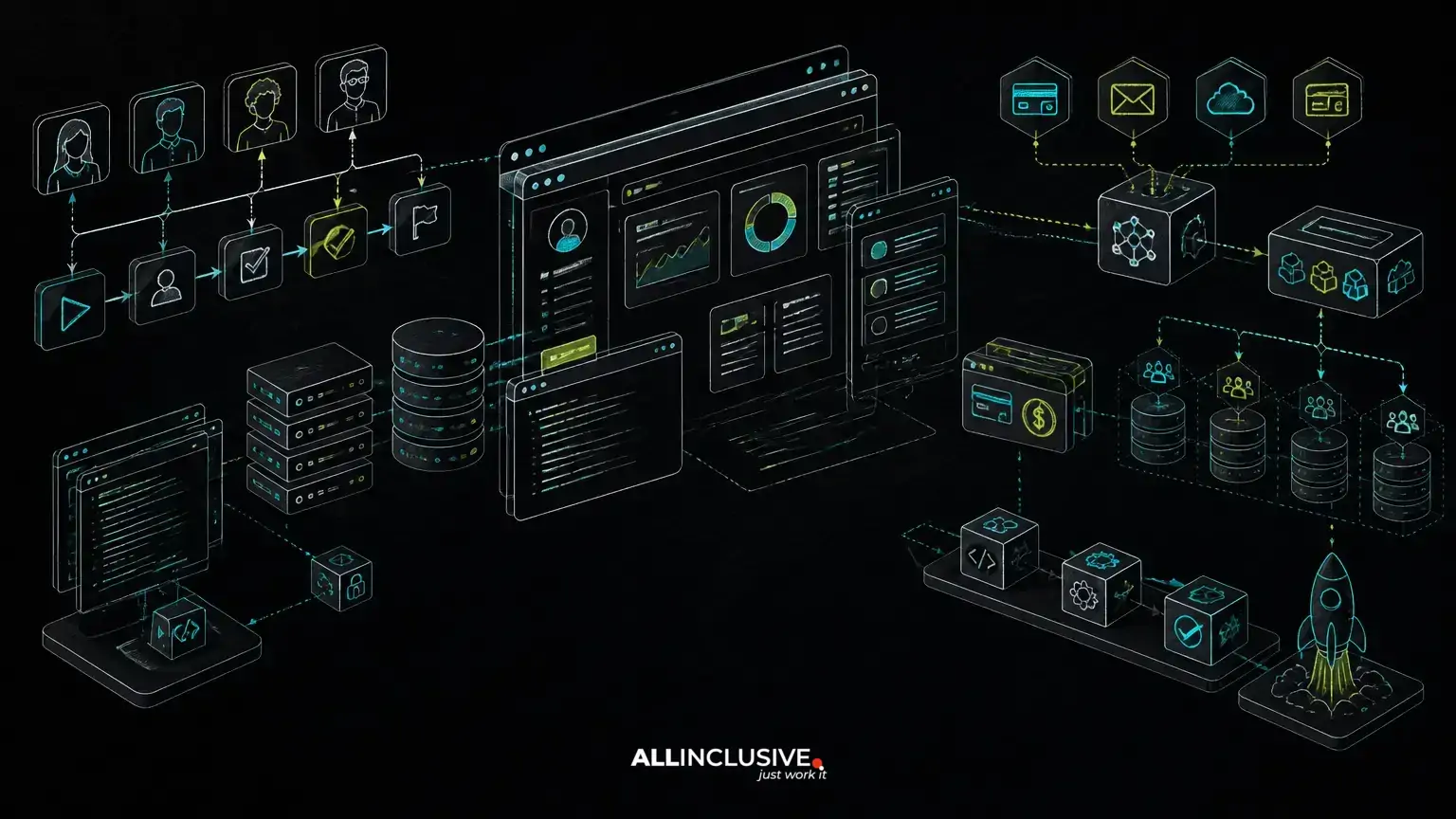
Full-service web development should cover the complete path from a business workflow to a reliable, maintainable product—not just interface design and code delivery. For a SaaS platform, client portal, marketplace, booking system or internal operations tool, the work should include discovery, architecture, implementation, testing, deployment, documentation and ongoing support.
The defining question is not whether one provider offers many services. It is whether the technical decisions form a coherent product that people can use, operate and extend. A workflow-first approach helps prevent a common failure mode: building attractive screens around processes that were never properly understood.
What full-service web development means in practice
A full-service engagement usually spans several connected responsibilities:
- Clarifying users, business rules, workflows and success criteria
- Designing the product structure, data model and application architecture
- Building the user interface and server-side application
- Implementing authentication, authorization and role-based access control
- Connecting payment, communication, reporting and third-party systems
- Testing critical workflows and handling deployment concerns
- Documenting the system and transferring source-code ownership
- Supporting maintenance, changes, monitoring and future product development
The exact technology stack should follow the product’s constraints. PHP and Laravel may be suitable for a business application with structured workflows, strong database requirements and a team that values a mature server-side ecosystem. Python may be appropriate for particular data, automation or AI-heavy components. The important issue is fit, not using a fashionable framework by default.
Start with the business workflow, not the feature list
A feature list can describe what a system does, but it rarely explains how work moves through the business. A workflow-first discovery process maps the actors, decisions, states, exceptions and handoffs that the software must support.
For example, a booking platform may need more than calendar availability. The real workflow could include provider approval, different service durations, deposits, cancellations, rescheduling, reminders, staff permissions and reconciliation. Each rule affects the data model, user experience, notifications and administrative tools.
The same principle applies to an internal system. “Add reporting” may actually mean importing data from several sources, defining ownership of records, preserving an audit trail and giving different teams different views. Treating that requirement as a simple dashboard can create expensive rework later.
Questions worth answering before implementation
- Who performs each step, and what permissions do they need?
- What conditions move a record from one state to another?
- Which actions require approval, review or an audit history?
- What happens when a payment fails, data is missing or an integration is unavailable?
- Which tasks are frequent enough to optimize?
- Which information must be visible to customers, staff, partners or administrators?
These answers provide a stronger foundation for architecture than a collection of screen mockups alone.
The core capabilities a custom web product may require
Product and application architecture
Architecture defines how the product stores data, enforces business rules, handles requests and separates responsibilities. It should be understandable to the people who will maintain it and flexible enough to support known product changes without introducing unnecessary complexity.
A well-designed application typically establishes clear boundaries between presentation, domain logic, persistence and external services. That does not require an elaborate distributed system. For many products, a well-structured modular monolith is easier to operate than several independently deployed services. As demand and organizational needs change, specific components can be separated when there is a clear reason to do so.
For a deeper discussion of proportionate design, see scalable web application architecture.
Authentication, authorization and RBAC
Authentication confirms who a user is. Authorization determines what that user can do. Role-based access control, or RBAC, organizes permissions around roles such as administrator, manager, customer, provider or support agent.
RBAC should reflect actual business responsibilities rather than being added as a superficial layer. Some products also need organization-level permissions, record ownership, location restrictions, approval limits or temporary access. These rules should be enforced on the server, not only hidden in the interface.
Multi-tenancy and data boundaries
SaaS products and partner portals often serve multiple organizations from one application. A multi-tenant design must define how tenant data is isolated, how users can belong to one or more organizations, and which configuration values vary by tenant.
Tenant boundaries affect database queries, background jobs, file storage, reporting, administration and support access. A tenant identifier added late in development may not be enough if the original model did not account for organization-specific rules. Multi-tenancy should therefore be an early architectural decision, even when the first release serves only a small number of organizations.
Billing and commercial rules
Billing is rarely limited to placing a payment form on a page. A product may need subscriptions, one-time charges, usage-based fees, invoices, taxes, refunds, credits, failed-payment handling and access changes when an account’s payment status changes.
The payment provider can process transactions, but the application still needs a reliable internal model of customers, plans, entitlements and billing events. Webhooks and reconciliation processes should be treated as part of the product workflow, with appropriate handling for retries and delayed notifications.
Integrations and operational resilience
Custom web applications commonly connect to email platforms, accounting tools, CRMs, shipping services, identity providers, calendars or specialized APIs. Each integration adds a dependency with its own authentication model, rate limits, data formats and failure conditions.
A robust integration design considers what happens when an external service is slow or unavailable. Queued work, retry policies, idempotent operations, error visibility and manual recovery paths can prevent a temporary vendor issue from becoming a lost business transaction.
Build versus buy is part of full-service product engineering
A full-service team should not assume that every capability must be custom-built. Buying or integrating a mature service can reduce delivery effort and operational responsibility for commodity functions such as payments, transactional email or identity management.
Custom development becomes more compelling when the workflow is a competitive differentiator, when off-the-shelf tools force harmful process changes, or when the business needs control over data, permissions and product behavior. The decision should consider:
- How closely the existing product matches the required workflow
- Whether its data can be exported and integrated reliably
- How pricing changes as usage, users or tenants grow
- What customization and automation are available
- How vendor outages or roadmap changes would affect operations
- Whether the business needs ownership of the underlying product logic
For a structured decision process, compare build vs buy software and custom web apps versus off-the-shelf software.
Delivery should include more than a production release
Implementation is only one phase of a product’s lifecycle. A responsible delivery process also defines how the application will be tested, deployed, observed and maintained.
Testing critical paths
Testing should prioritize business risk. A booking system needs coverage for availability, double-booking prevention, cancellation rules and notifications. A SaaS product needs coverage for tenant isolation, permissions, plan changes and account lifecycle events. Automated tests are especially valuable for rules that are easy to break during future changes.
Deployment and environments
Development, staging and production environments should be separated appropriately. Deployment procedures should be repeatable, and configuration secrets should not be embedded in application code. Database changes require particular care because a release may affect existing records and running processes.
Monitoring and recovery
Operational readiness includes useful logs, error reporting, backups and a defined approach to recovery. The right monitoring signals depend on the application, but teams should be able to identify failed jobs, broken integrations, unusual error rates and important workflow failures.
Documentation and ownership
Documentation should explain the architecture, local setup, deployment process, environment configuration, key integrations and important business rules. The buyer should also understand who owns the source code, repositories, domains, cloud accounts, design files and third-party subscriptions.
Ownership is not merely a contractual detail. Clear ownership reduces dependency risk and gives the business more control over future maintenance, supplier changes and product direction.
Support is a product responsibility, not an afterthought
After launch, users discover edge cases, business rules change and external services evolve. Support may include defect resolution, security updates, dependency maintenance, performance investigation, monitoring and planned enhancements. It should distinguish urgent operational incidents from ordinary product changes so that priorities remain clear.
Review the available support and maintenance options when defining how the system will be managed after release.
A practical evaluation checklist
When comparing providers, ask whether the proposed engagement includes the following:
- A documented understanding of the business workflow and edge cases
- An architecture suitable for the current product and likely next steps
- Clear treatment of roles, permissions, tenants and data ownership
- A plan for payments, integrations and external-service failures
- Testing focused on high-risk business operations
- Deployment, backups, monitoring and recovery considerations
- Source-code, infrastructure and account ownership terms
- Documentation that another qualified team can use
- A defined post-launch support and change process
The provider should be able to explain trade-offs rather than present one universal stack or process. For a broader view of available custom development services, consider how the team approaches discovery, implementation and long-term product ownership.
How to judge whether the engagement is truly full service
A full-service web development engagement is complete when the business can operate the product, understand its important decisions and continue improving it—not simply when code has been uploaded to production. The strongest approach connects workflow analysis, custom product engineering, proportionate architecture, reliable integrations and explicit ownership.
For buyers, the practical test is straightforward: can the provider explain how the system will support real work, handle failure cases, protect data, evolve without unnecessary rework and remain maintainable after launch? If the answer is clear, the engagement is addressing product engineering rather than only website delivery.


