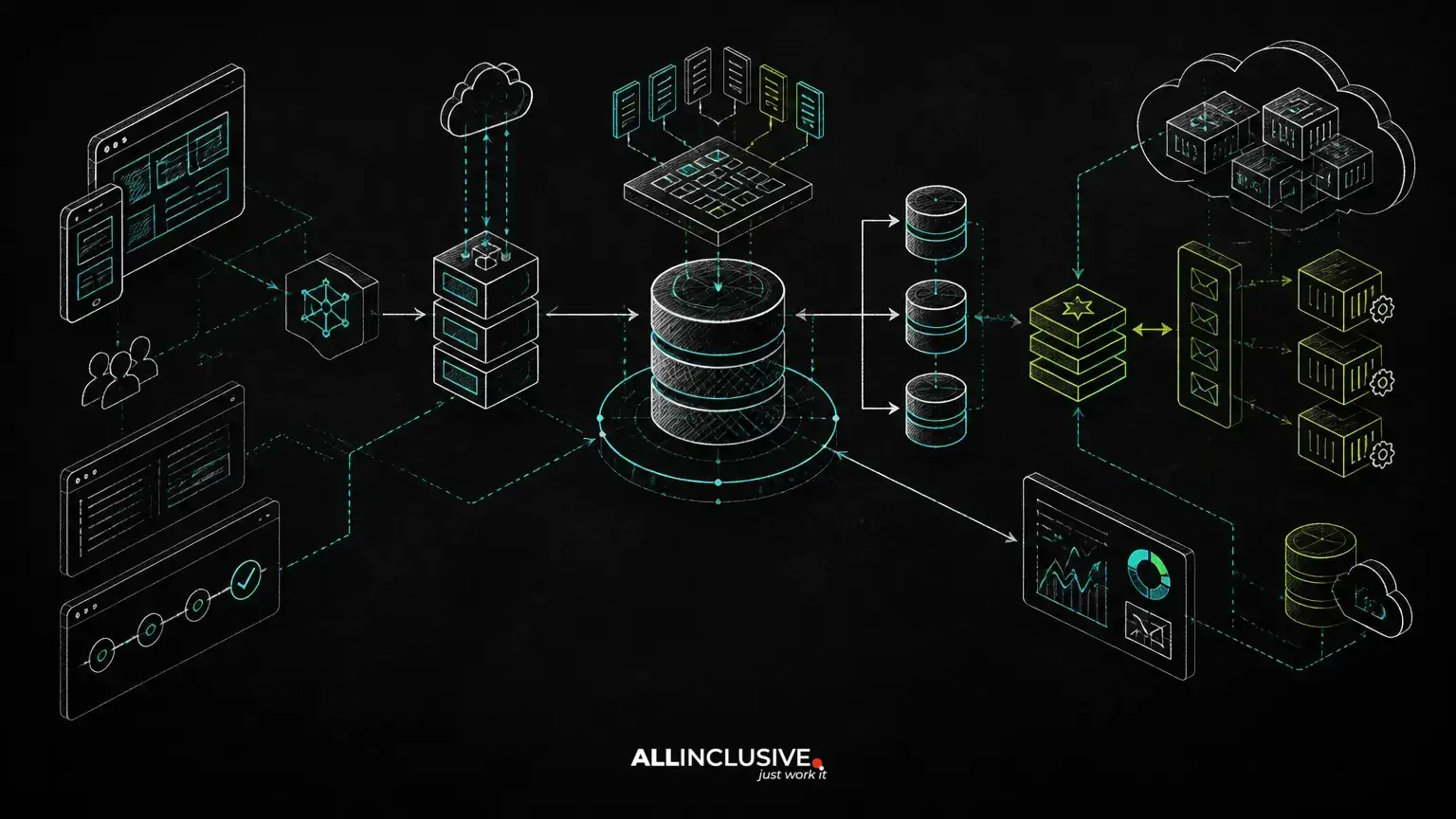
Laravel vs WordPress is not simply a choice between two ways to publish pages. WordPress is primarily a content management system with a large extension ecosystem. Laravel is a PHP application framework for building custom business software, APIs and product workflows. The right choice depends on whether your organization needs a content-led website or a system whose core value lives in domain logic, data, permissions and integrations.
For a marketing site, editorial publication or relatively standard company website, WordPress can often provide a faster path to launch. When the website has become a multi-role portal, customer application, SaaS product or operational system, Laravel usually offers a more deliberate foundation for custom software. That flexibility also creates more engineering responsibility: architecture, testing, deployment, security and long-term maintenance cannot be delegated to a theme and a collection of plugins.
The fundamental difference: CMS versus application framework
WordPress organizes content around a mature publishing model. Editors can manage pages, posts, media, taxonomies and user roles through an established administrative interface. Themes control presentation, while plugins extend functionality. This is a strong fit when the primary workflow is creating, approving and publishing content.
Laravel provides the building blocks for an application rather than a finished publishing system. Engineering teams define the domain model, business rules, interfaces and user journeys. A Laravel application might manage subscriptions, inventory, approvals, claims, customer accounts or complex internal operations. Content can be included, but it is not the framework's central assumption.
That distinction affects ownership. With WordPress, teams often assemble capabilities from existing components. With Laravel, teams design the capabilities they actually need. The first approach can reduce initial implementation effort; the second can reduce the compromises created by forcing unusual business processes into a content platform.
When WordPress is the practical choice
WordPress is often appropriate when most of the following statements are true:
- The primary goal is publishing and presenting content.
- Editors need a familiar administrative workflow.
- Requirements align with established themes, plugins and integrations.
- The site has limited custom business logic.
- Users do not need deeply personalized application workflows.
- The team wants a broad ecosystem for forms, search, commerce or content operations.
A company site, resource library, campaign site, publication or straightforward catalog may not benefit from the additional application architecture Laravel requires. Choosing Laravel for a problem WordPress already solves can increase delivery effort, hosting complexity and the amount of code the business must maintain.
WordPress still requires engineering discipline. Plugin quality varies, extensions can conflict, updates need testing, and customizations should be managed carefully. A template-first implementation can become difficult to change when business-critical behavior is distributed across plugins, theme code and undocumented configuration.
When Laravel becomes the stronger fit
Laravel is generally worth considering when the website is a software product with rules that are specific to the business. Signals include:
- Multiple user types have different permissions and workflows.
- Accounts, subscriptions, billing or entitlements must be modeled explicitly.
- The product integrates with several external systems or exposes an API.
- Background processing is needed for imports, notifications, reports or other long-running work.
- Data relationships and validation are more important than page composition.
- The interface changes frequently as the product is tested with users.
- The business needs control over application behavior rather than dependence on plugin conventions.
Laravel supports a structured approach to these requirements. Eloquent can represent domain data and relationships; authentication and authorization can be designed around the application's roles and policies; queues can move slow work out of the request cycle; caching can reduce repeated computation; and automated tests can protect critical behavior as the product changes.
These capabilities do not make Laravel automatically better. They make it more suitable when custom behavior is the product. A Laravel build should be evaluated as production application engineering, not as a more elaborate way to create brochure pages.
Architecture and maintainability
WordPress: composition and extension
WordPress can deliver substantial functionality, but the architecture often depends on how themes, plugins, custom post types, hooks and external services are combined. This can be efficient when the requirements fit the platform. It becomes harder to reason about when several extensions modify the same workflow or when business rules are scattered across configuration and custom code.
Maintainability depends on disciplined selection of extensions, documented customizations, controlled updates and a clear boundary between content and application behavior. A custom plugin is usually preferable to modifying a third-party plugin directly, but it still requires testing and ownership.
Laravel: explicit domain design
Laravel allows a team to organize code around the domain: customers, orders, plans, approvals, documents or other concepts that matter to the business. Controllers, services, policies, jobs, events and data models can be separated according to responsibility. The exact architecture should match the product's size; unnecessary abstraction can be as harmful as tangled code.
Explicit design makes future changes easier to assess. When a billing rule changes, the team can identify the relevant model, service, policy and tests instead of searching through unrelated template or plugin behavior. This does not eliminate technical debt, but it gives the team more control over where that debt lives.
Data, APIs and integrations
WordPress has a useful content data model and can support integrations through its APIs and plugins. It is a reasonable foundation when the external system mainly consumes pages, posts or media. Additional custom behavior may require bespoke endpoints, synchronization logic or a separate service.
Laravel is often a better fit when the product's data model is not naturally content-shaped. A custom application can define relationships, validation, state transitions and permissions around operational data. API contracts can be designed for web clients, mobile applications, partner systems or internal tools rather than added as an afterthought.
For teams evaluating backend choices, Laravel API development deserves separate consideration because API reliability involves versioning, authentication, validation, error handling, observability and deployment—not only returning JSON.
Security and operational responsibility
Neither platform is secure by default in the sense of removing engineering responsibility. WordPress sites need a controlled plugin inventory, timely updates, least-privilege accounts, secure hosting, backups and monitoring. Custom code must be reviewed alongside third-party extensions.
Laravel applications require secure authentication, authorization checks, input validation, secret management, dependency updates, database protection, logging and deployment controls. Policies and gates can help express access rules, but developers must ensure those checks are applied consistently. Queued jobs and integrations also need failure handling so that retries do not create duplicate actions or corrupt state.
Laravel's flexibility means the team owns more of the security model. That is an advantage when the product has complex permissions, but it makes experienced engineering and ongoing review important. A useful support and maintenance process should cover updates, incident response, backups, monitoring and controlled changes after launch.
Performance and scalability: avoid simplistic assumptions
Platform choice alone does not determine performance. A well-configured WordPress site can perform effectively for its intended audience, while a poorly designed Laravel application can be slow. Caching, database indexes, query design, asset delivery, hosting, observability and workload patterns all matter.
The difference is usually in how performance requirements are modeled. Laravel gives engineers direct control over query behavior, queues, cache boundaries and application workflows. That is useful when users generate personalized results, run reports or trigger integrations. WordPress can remain suitable when pages are cacheable and the workload is primarily content delivery.
Teams should define actual performance risks before choosing a platform. Ask which operations are read-heavy, which are asynchronous, what data must be consistent immediately, and how traffic or workload will be monitored. Avoid treating a framework name as a capacity guarantee.
Cost and delivery trade-offs
WordPress can lower initial delivery effort when requirements map closely to existing capabilities. Costs may later arise from premium extensions, customization, compatibility testing, security work, content migration and troubleshooting across multiple vendors or plugins.
Laravel commonly requires more upfront product discovery and engineering. The team must design the domain, build administrative workflows, create interfaces and establish deployment practices. The investment can be justified when it prevents recurring workarounds or supports a product that will evolve substantially. It can be wasteful when the business only needs pages, forms and editorial controls.
Compare total ownership rather than launch effort alone. Include discovery, custom development, integrations, testing, hosting, monitoring, upgrades, security review, content operations and the cost of changing the system later.
A decision framework for Laravel vs WordPress
- Identify the primary workflow. Is the system mainly publishing content, or do users complete business transactions and multi-step processes?
- Map the domain. List the entities, relationships, states, permissions and rules that must remain consistent.
- Separate content from application behavior. A product may use WordPress for marketing content and Laravel for authenticated workflows, or it may benefit from one integrated system.
- Assess integration depth. Count external systems, synchronization requirements, webhooks, APIs and failure scenarios.
- Estimate change frequency. Frequent product experiments favor an architecture where business rules are explicit and tested.
- Assign operational ownership. Decide who will manage updates, deployments, security, monitoring, backups and incident response.
- Prototype the riskiest workflow. Test the most complex permission, data or integration requirement before committing to a platform.
Hybrid architectures can be valid
The choice does not always need to be exclusive. A WordPress installation may handle editorial content while a Laravel application manages accounts, billing or operational workflows. The systems can be connected through carefully defined APIs, shared identity decisions and clear ownership boundaries.
A hybrid model also introduces costs: two deployments, duplicated monitoring, integration failure modes and potentially different data models. It should be chosen because the separation reflects real product boundaries, not because it avoids making an architectural decision.
What to review before replacing WordPress
If an existing WordPress site is becoming difficult to extend, do not assume a full rebuild is the only answer. First classify the problem:
- Stabilize: remove risky extensions, document dependencies, improve backups and establish update procedures.
- Refactor: isolate custom behavior, improve code quality and reduce coupling while retaining the platform.
- Migrate: move selected data or workflows to Laravel while keeping suitable WordPress capabilities.
- Rebuild: replace the system when its data model and extension structure no longer support the product's direction.
A migration should account for content, media, users, permissions, URLs, search visibility, integrations and operational procedures. Recreating the visible pages is not enough if the underlying workflows are business-critical.
Laravel and WordPress solve different problems
WordPress is usually the better choice for content-led websites whose requirements fit a mature CMS ecosystem. Laravel is usually the stronger foundation when the site is becoming a custom application with domain logic, structured data, APIs, permissions, billing, queues and evolving user workflows.
The practical question is not which platform is universally superior. It is whether the business is buying a publishing system or building software. For teams planning a custom application, the broader Laravel development discipline should include domain modeling, testing, secure deployment, upgrade planning and maintainable code—not only interface implementation. For a wider view of delivery options and engineering capabilities, see Allinclusive development services.
Related comparisons can help refine the decision: Laravel vs Node.js explores backend trade-offs for SaaS and business platforms, while Laravel vs Django compares two frameworks for custom product development.