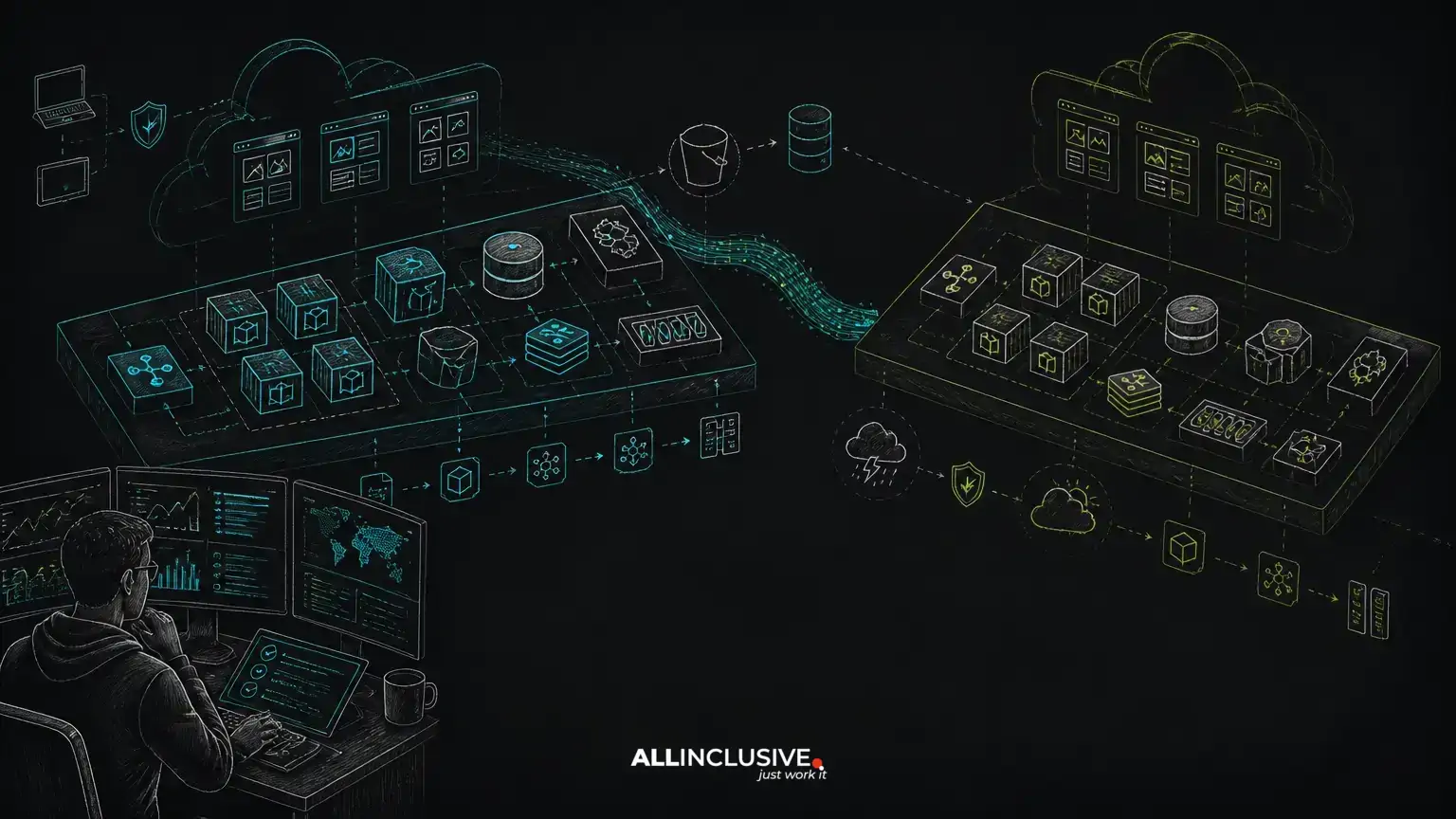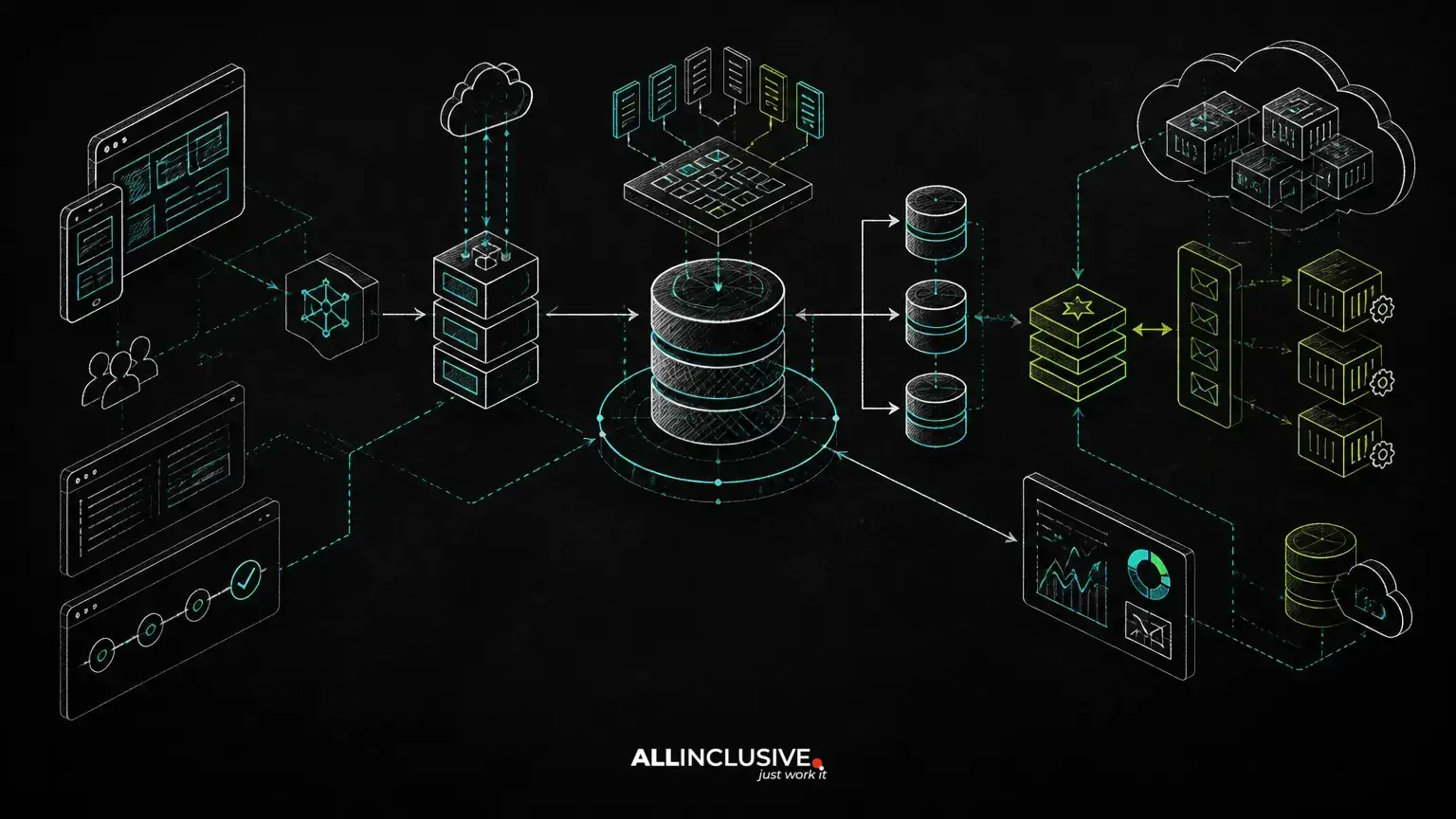
Python data pipeline development is not just the process of writing a script that reads data, transforms it and writes a file. A production pipeline must also define ownership, handle retries, validate inputs, expose useful operational signals and recover safely when dependencies fail.
The right architecture depends on data volume, freshness requirements, source reliability, transformation complexity and the consequences of incorrect output. A small scheduled job may be appropriate for a low-risk internal report. A customer-facing workflow, financial process or machine-learning data pipeline usually needs stronger controls: explicit stages, durable state, idempotent operations, monitoring and deployment practices that support safe change. For teams working on python data pipeline development, the related implementation guides django vs laravel and python backend development cover adjacent technical decisions.
This article explains how to design Python pipelines that can grow from scheduled automation into dependable data workflows without treating Python as merely a scripting language. For broader application architecture, see our Python development capabilities and the wider software development practice.
What a production Python data pipeline must do
A pipeline moves data through a sequence of operations, but its production responsibilities extend beyond transformation logic. A useful design makes the following questions answerable:
- Which source systems are read, and how are credentials managed?
- What input schema and data-quality assumptions apply?
- Which stages can be retried safely?
- How is partial progress recorded?
- What happens when a source is unavailable or returns malformed data?
- How does an operator know whether the pipeline is healthy?
- Can a previous run be reproduced or investigated?
- How are code and configuration changes tested before deployment?
These concerns connect technical design to business outcomes. Weak failure handling can produce incomplete reports, stale operational data or incorrect downstream decisions. Poor ownership can make a pipeline expensive to maintain even when the original script was quick to create.
Start with a clear pipeline contract
Before selecting a scheduler or queue, define the pipeline contract. This describes what the workflow consumes, what it produces and what guarantees it provides.
Specify inputs and outputs
Document source systems, expected fields, data types, time zones, pagination behavior and any rate limits. Outputs should include destination, format, partitioning or indexing expectations, and the meaning of a successful run.
For example, a pipeline that loads daily orders should clarify whether a day is based on UTC or a business time zone, whether late-arriving orders are included, and whether rerunning the day replaces or appends records.
Define freshness and completeness
“Runs every hour” is a schedule, not a service requirement. A more useful contract states how fresh the output should be, how much delay is acceptable and what constitutes completeness. This distinction helps teams choose between a simple cron-triggered process, a queued workflow or an event-driven design.
Separate business rules from orchestration
Transformation and validation rules should be testable independently from scheduling, retries and deployment. Keeping orchestration code thin makes it easier to run the same business logic locally, in automated tests and during controlled backfills.
Choosing the execution model
There is no single correct shape for every Python pipeline. The execution model should match operational needs rather than the novelty of the tooling.
Scheduled jobs for bounded, low-complexity workflows
A scheduled Python process can be suitable when the workflow has a predictable runtime, modest dependencies and limited coordination requirements. It may run through an operating-system scheduler, a platform scheduler or an application job system.
This model becomes risky when multiple stages need independent retries, when runs overlap, or when operators need a durable view of task state. A single process can also make it difficult to identify whether a failure occurred during extraction, transformation or loading.
Background workers and queues for asynchronous work
Queues are useful when work should be decoupled from a request, distributed across workers or retried independently. A web application might enqueue a data export rather than keeping a user request open. A pipeline may also queue partitions or source-specific tasks to isolate failures.
Queue-based systems require careful handling of duplicate delivery, visibility timeouts, dead-letter behavior and task idempotency. A queue does not automatically provide exactly-once processing; application logic still needs to make repeated execution safe.
Workflow orchestration for multi-stage pipelines
A workflow orchestrator becomes valuable when a pipeline has dependencies between tasks, scheduled backfills, branching logic, execution history or multiple teams operating the same workflows. The orchestrator should make state, retries and dependency relationships visible without hiding the actual data contract.
For smaller systems, a modular Python application with a durable run table may be easier to operate than introducing a large orchestration layer. The decision should consider team experience, deployment environment and the number of workflows expected over time.
Design stages for safe retries and reruns
Failures are normal in data systems. APIs time out, credentials expire, upstream schemas change and destinations become temporarily unavailable. A resilient pipeline assumes that a stage may run more than once.
Make operations idempotent
An idempotent operation produces the same intended result when repeated with the same input. Common techniques include:
- Using stable source identifiers and upserts rather than blind inserts.
- Recording a source cursor, batch identifier or partition key.
- Writing to a temporary location before promoting a completed result.
- Replacing a defined partition instead of appending duplicate records.
- Storing run metadata and input versions for later investigation.
Idempotency should be designed at the destination boundary, not assumed because the Python function itself is deterministic.
Distinguish transient and permanent failures
Temporary network errors may justify bounded retries with backoff. Invalid credentials, malformed records or incompatible schemas usually require an alert and human or code-level remediation rather than repeated attempts.
Retries should have limits. Unlimited retries can hide an outage, consume resources and delay later work. Failed records may need to be quarantined separately from a failed batch so that one malformed item does not silently invalidate an entire load.
Plan for backfills
A pipeline that cannot safely process historical ranges becomes difficult to repair. Backfill support should be an explicit feature, with parameters for date range, source version, destination behavior and concurrency. Backfills should also be isolated from normal runs when they could compete for rate limits or operational capacity.
Validate data before it reaches downstream systems
Validation should occur at multiple points. Input validation checks whether a source response has the expected structure. Transformation validation checks business rules and relationships. Output validation checks whether the published result is complete and usable.
Useful controls include required-field checks, type validation, accepted-value rules, uniqueness checks, referential checks and volume anomaly detection. The appropriate controls depend on the data domain. A modest internal dataset may need a few high-value assertions, while regulated or financially significant workflows may require stronger reconciliation and audit records.
Do not treat validation as a reason to discard unexpected data silently. A robust pipeline records what failed, where it failed and whether the data was rejected, quarantined or allowed through with a warning.
Build observability into the workflow
Observability lets operators understand pipeline behavior from its outputs, logs and execution history. It should answer both “Is it running?” and “Can we trust the result?”
Log structured events
Structured logs should include a run identifier, task name, source or partition, timestamps, record counts and error category where appropriate. Avoid logging credentials, tokens or sensitive payloads. Consistent fields make logs more useful in centralized monitoring systems.
Track operational metrics
Relevant metrics may include duration by stage, records read and written, rejected-record count, retry count, lag, freshness and failure rate. Metrics should be tied to an operational question. A large record count is not automatically healthy if the source duplicated data.
Alert on impact, not every exception
Alerts should reflect conditions that require action: missed freshness expectations, repeated failures, growing lag, validation failure or destination inconsistency. Excessive low-value alerts cause teams to ignore the signals that matter.
For AI and model-serving workflows, pipeline observability also supports feature freshness, training-data lineage and reproducibility. These concerns are discussed further in AI development, where data workflows often become part of a larger production system.
Testing Python data pipelines at multiple levels
Pipeline tests should cover more than individual transformation functions.
- Unit tests: Verify parsing, normalization and business rules using small controlled inputs.
- Contract tests: Check assumptions about external APIs, files or database schemas.
- Integration tests: Exercise real or representative storage, queue and service boundaries.
- Workflow tests: Confirm task dependencies, retries, failure handling and successful completion.
- Data-quality tests: Assert invariants such as uniqueness, accepted ranges and reconciliation totals.
Fixtures should include empty inputs, duplicate records, missing fields, late data, malformed values and partial failures. Tests should also cover rerunning the same batch, because duplicate processing is a common production failure mode.
Deploy pipelines as software, not as hidden server scripts
Production deployment should make code, configuration and dependencies identifiable. Package the application consistently, separate secrets from source code, and define environment-specific configuration explicitly.
Use version control for pipeline code and deployment configuration. Apply migrations or destination changes through controlled processes. A release should provide a way to inspect the deployed version and, where practical, roll back code without corrupting already-published data.
Containerization can improve consistency, but it does not solve data correctness or operational ownership by itself. The runtime environment still needs access controls, network configuration, resource limits, log collection and a clear process for handling failed runs.
When Python should work alongside Laravel or another application stack
Python does not need to replace an existing web application to provide strong data capabilities. A Laravel or PHP product may remain the right home for business workflows, authentication and customer-facing interfaces, while Python handles ingestion, analysis, machine-learning preparation or specialized integrations.
Boundaries should be explicit. Communication may occur through an API, queue, shared database contract or object-storage exchange, depending on latency and consistency requirements. Avoid coupling the systems through undocumented tables or fragile shell commands. Define ownership for schemas, retries, authentication and incident response.
This approach can preserve existing product investment while allowing data engineering work to use Python libraries and runtime patterns suited to the problem. For wider application decisions, our web development practice covers systems that combine business applications, APIs and operational services.
Common failure modes in Python pipeline projects
- One oversized script: Extraction, transformation, loading and notifications are tightly coupled, making partial recovery difficult.
- Schedule-only thinking: A cron expression exists, but no freshness objective, run history or ownership process does.
- Unsafe retries: Repeated execution creates duplicate records or sends duplicate downstream actions.
- Silent data loss: Parsing errors are logged but rejected records are not counted, stored or reviewed.
- Unversioned schemas: Upstream changes break the pipeline without a clear compatibility policy.
- Production-only testing: The workflow is tested against live systems after deployment rather than representative fixtures and integration environments.
- Over-engineering early: A complex orchestration platform is introduced before the workflow has stable contracts or clear operational requirements.
A delivery checklist for production-ready pipelines
- Define input, output, freshness and completeness requirements.
- Separate transformation logic from scheduling and runtime concerns.
- Choose scheduled execution, workers, queues or orchestration based on workflow complexity.
- Design every external write for safe retry or explicit duplicate handling.
- Add schema, business-rule and output validation.
- Record run state, identifiers, counts and failure reasons.
- Provide structured logs, useful metrics and actionable alerts.
- Test normal, empty, malformed, duplicate and partial-failure scenarios.
- Support controlled backfills and replay where the business requires recovery.
- Deploy through versioned, repeatable processes with clear ownership.
Strong Python data pipeline development is disciplined systems engineering. The goal is not to add infrastructure for its own sake, but to make data movement predictable, inspectable and recoverable. Start with a clear contract, keep business logic testable, choose the simplest execution model that meets the requirements, and add operational controls before the workflow becomes business-critical.