Laravel Reverb and WebSockets are useful when users need application state to change without repeatedly refreshing the page. Examples include live notifications, collaborative workflows, support conversations, operational dashboards and progress updates for long-running jobs. They are not automatically the right choice for every Laravel feature: polling, server-sent events, queued notifications or a conventional request-response API may be simpler and easier to operate. Another decision connected with laravel reverb websockets is covered in custom software development.
Reverb provides a Laravel-oriented path for WebSocket communication, but the important engineering decision is broader than selecting a package. A production implementation must define event ownership, authorization, delivery guarantees, client behavior, failure recovery, observability and deployment. This article explains where Laravel Reverb fits and how to decide whether a custom Laravel application genuinely needs live updates.
What Laravel Reverb changes in a Laravel application
Traditional web requests are initiated by the browser. The client asks the server for data, the server responds, and the connection ends. WebSockets reverse part of that pattern by allowing a persistent connection through which the server can send events to connected clients.
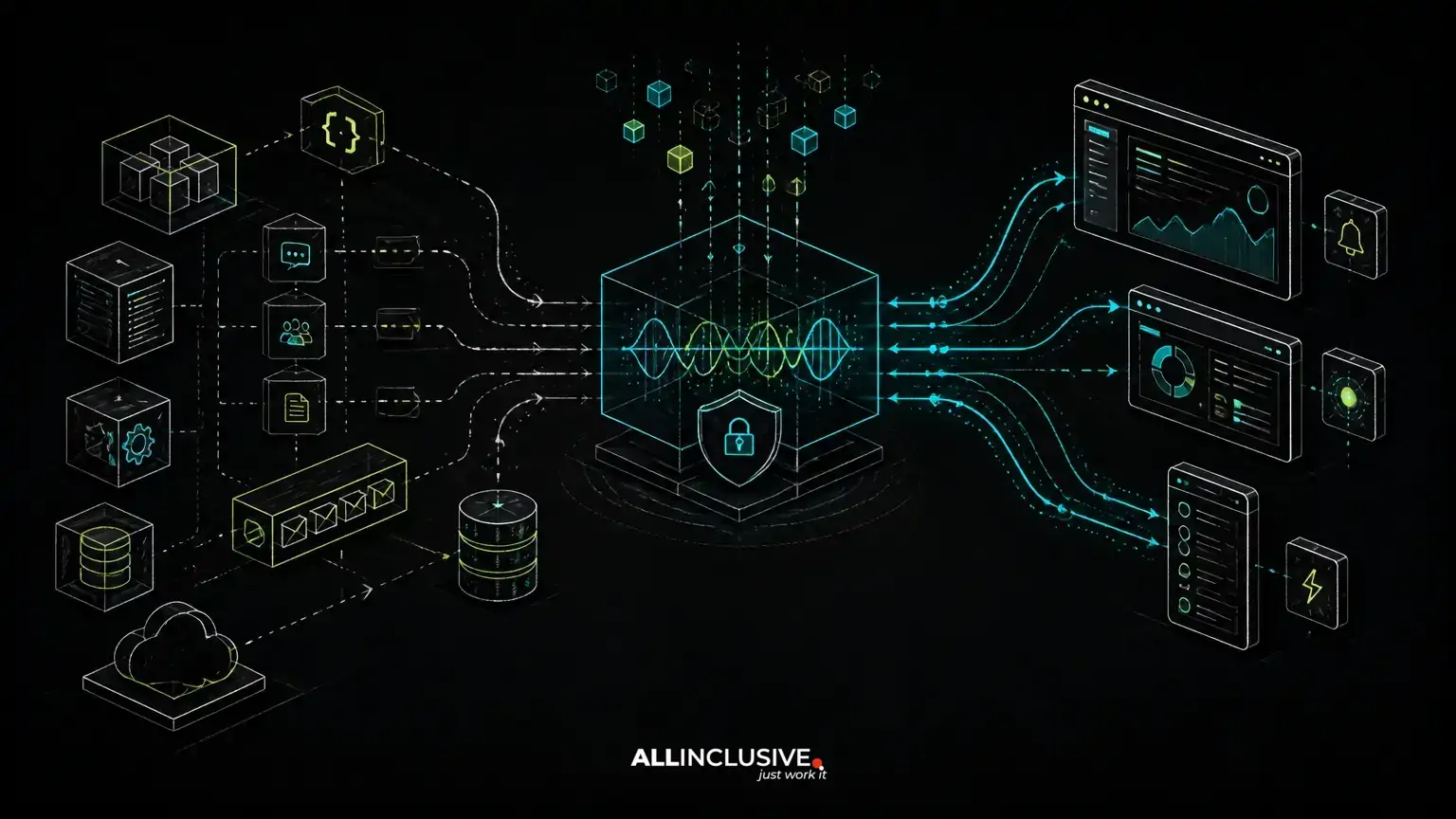
In a Laravel application, a business action can update the database and dispatch an event. A WebSocket layer can then publish that event to authorized browser clients. The interface receives the event and updates a portion of the page without requiring a full reload.
That flow usually involves several distinct responsibilities:
- Domain or application logic: decides what happened, such as an order status changing or a comment being added.
- Persistence: stores the authoritative state in the database.
- Event publication: describes which event should be broadcast and to which channel.
- Authorization: determines which users or tenants may subscribe or receive the event.
- Client state management: applies the event safely in the browser.
- Operational infrastructure: maintains connections, handles scaling and exposes logs and metrics.
Reverb can support the real-time transport, but it does not replace sound domain modeling, authorization or frontend state design. The database should generally remain the source of truth. A WebSocket message is a delivery mechanism, not a substitute for durable application state.
When Laravel Reverb is a good fit
Users benefit from immediate feedback
Real-time communication is justified when waiting for a refresh creates confusion, delays a workflow or causes users to repeat work. A support agent may need to see a new customer reply promptly. A team working on the same record may need to know that another user changed its status. An operations team may need a queue or job monitor to reflect changes as they occur.
The benefit should be described in workflow terms rather than as a technical novelty: fewer manual refreshes, clearer ownership, faster acknowledgment or better coordination.
The event model is clear and bounded
WebSockets work best when the application can express meaningful events with defined audiences. “Invoice approved,” “build completed” and “user joined workspace” are more useful event boundaries than broad, undifferentiated page refreshes.
Clear event boundaries improve testing and maintenance. They also make it easier to change the interface without rewriting the underlying business logic.
Clients need updates from server-side work
Queues and background jobs are common in production Laravel systems. Imports, report generation, document processing and integrations may take longer than a normal request. Broadcasting a job status event can provide a responsive user experience while the actual work runs asynchronously.
The browser should still be able to recover by querying the current job or resource state. If an event is missed because the user disconnects, the application should not leave the interface permanently incorrect.
When polling or ordinary APIs are simpler
Not every changing value needs a persistent connection. Polling can be a reasonable choice when updates are infrequent, a small delay is acceptable, or operational simplicity matters more than immediacy. A conventional API may be sufficient for a dashboard that users open occasionally and refresh manually.
Server-sent events can also be appropriate when communication is primarily one-way from the server to the browser. The right choice depends on the interaction model, hosting environment, connection requirements and team familiarity—not on the assumption that WebSockets are always the most advanced option.
Introducing real-time infrastructure for a low-value interaction adds responsibilities: connection management, authentication, reconnect behavior, deployment topology, monitoring and capacity planning. Those costs can be justified, but they should be visible in the product decision.
Architecture decisions for Laravel Reverb WebSockets
Keep business events separate from transport details
A controller or domain service should perform the business operation and persist its result. Broadcasting should be attached to a well-defined event or application boundary rather than scattered throughout presentation code.
This separation helps a team test whether an order can be approved independently of whether a browser was connected. It also supports other consumers later, such as email notifications, audit logs, integrations or analytics pipelines.
For broader guidance on designing Laravel endpoints and application boundaries, see these Laravel REST API best practices.
Choose public, private and presence channels deliberately
A public channel may be suitable for genuinely public information, but many business applications need private or presence-aware communication. Tenant dashboards, customer records, internal conversations and billing data require authorization based on the authenticated user, role, organization or resource relationship.
Channel authorization should be treated as an access-control decision, not a frontend convenience. A client must not be able to subscribe to a channel simply because it can guess a channel name. The server should verify the relationship between the user and the resource, and multi-tenant applications should explicitly enforce tenant boundaries.
For related modeling and isolation concerns, review Laravel multi-tenancy: database models, tenant isolation and operational trade-offs.
Define event payloads as stable contracts
A broadcast payload should contain enough information for the client to react, but not expose fields that the user does not need. Sending an entire database model can create accidental data disclosure, larger messages and tighter coupling between backend schema and frontend behavior.
Prefer intentional payloads with stable identifiers, event names and the specific fields required for the interface. Consider how an older browser client behaves when the backend adds a field or changes an internal model. Versioning may be appropriate when several clients or independently released applications consume the same events.
Design for reconnects and missed events
WebSocket connections can close because of network changes, browser suspension, proxy timeouts, deployments or service interruptions. Clients need reconnect behavior, and the application needs a way to restore accurate state after a gap.
A resilient pattern is to use a real-time event as a prompt to fetch authoritative resource data, especially for complex state transitions. For simpler interfaces, the client may apply an idempotent event locally and then reconcile periodically. The correct approach depends on the consequence of stale data.
Security and reliability issues to address before launch
Real-time features expand the application’s security surface. Review authentication for connection establishment, authorization for channel subscription and authorization for the underlying resource. Do not assume that hiding a channel name protects its contents.
Also consider:
- Whether sensitive information could appear in event payloads or browser logs.
- Whether a user can infer another tenant’s identifiers or activity.
- Whether event volume could be abused through repeated state changes.
- Whether rate limits and validation apply to actions that trigger broadcasts.
- Whether disconnected clients can safely catch up without duplicate side effects.
- Whether audit requirements demand a durable record separate from the broadcast.
Broadcasting should not be the only record of a critical action. Store important state changes and audit information durably, then treat the event as a notification that helps clients react quickly.
Scaling and deployment considerations
A local real-time feature can appear simple because one application process, one browser and one connection are involved. Production deployment is different. The team must understand how the WebSocket service runs alongside the Laravel application, how connections are routed, how multiple application instances share events and how deployments affect active clients.
Queues may be involved in event delivery or in the work that causes an event. Queue workers, the database, cache infrastructure and the WebSocket service each need appropriate health checks and operational ownership. Reverse proxies and load balancers must support the required connection behavior, and infrastructure limits should be understood before traffic grows.
Capacity planning should consider concurrent connections, message frequency, payload size, subscription patterns and reconnect storms. A feature that sends a small number of events to a modest audience has a different operational profile from a high-volume feed broadcasting frequent updates to many subscribers.
These concerns are part of production Laravel development, not an afterthought added after the interface is complete. A maintainable implementation documents the runtime topology, environment configuration, deployment sequence and rollback behavior.
Testing Laravel real-time features
Testing should cover more than whether a browser receives a message during a happy-path demonstration.
- Domain tests: verify that the business action changes state correctly without depending on a live connection.
- Authorization tests: confirm that permitted users can subscribe and unauthorized users cannot.
- Broadcasting tests: verify event names, channels and payload contents.
- Integration tests: exercise the workflow from an authenticated action through persistence and event dispatch.
- Client tests: check duplicate events, out-of-order messages, reconnects and stale state.
- Operational tests: validate configuration, health checks and deployment behavior in an environment resembling production.
Testing and continuous delivery practices become particularly important when queues, caches and real-time services are deployed together. The related guide on Laravel testing and CI/CD provides useful context for building a release process that catches integration problems earlier.
A decision checklist for adding Reverb
Before committing to Laravel Reverb WebSockets, answer these questions:
- Which user workflow is materially improved by live updates?
- How much delay is acceptable if a message is delayed or missed?
- What is the authoritative source of state after reconnecting?
- Which users, roles or tenants may receive each event?
- Can the event payload be minimized and treated as a stable contract?
- What happens when a client receives the same event twice?
- What happens when events arrive out of order?
- How will the service be monitored, scaled and deployed?
- Can the team test the behavior without relying only on manual browser sessions?
- Would polling or a standard API deliver the same business value with less operational risk?
If the answers are unclear, the next step is usually to define the event and state model before writing WebSocket code. That work often reveals that only a small part of the product needs real-time behavior.
Planning a maintainable real-time Laravel feature
Laravel Reverb can be a strong fit for custom SaaS and business applications that need timely, targeted updates. Its value depends on the surrounding engineering: explicit domain events, durable persistence, strict channel authorization, recoverable client state and an operational plan for connections and deployments.
The most maintainable design does not make every screen “live.” It applies real-time communication where it improves a measurable user workflow and keeps ordinary APIs, queues and database-backed state responsible for the parts they handle best. Teams evaluating an existing application can also separate stabilization, refactoring and infrastructure changes instead of treating real-time support as a reason to rebuild everything. For ongoing production ownership, see software support and maintenance.
That approach keeps Laravel Reverb in its proper role: a transport capability supporting well-defined product behavior, rather than an architectural shortcut around application design.