
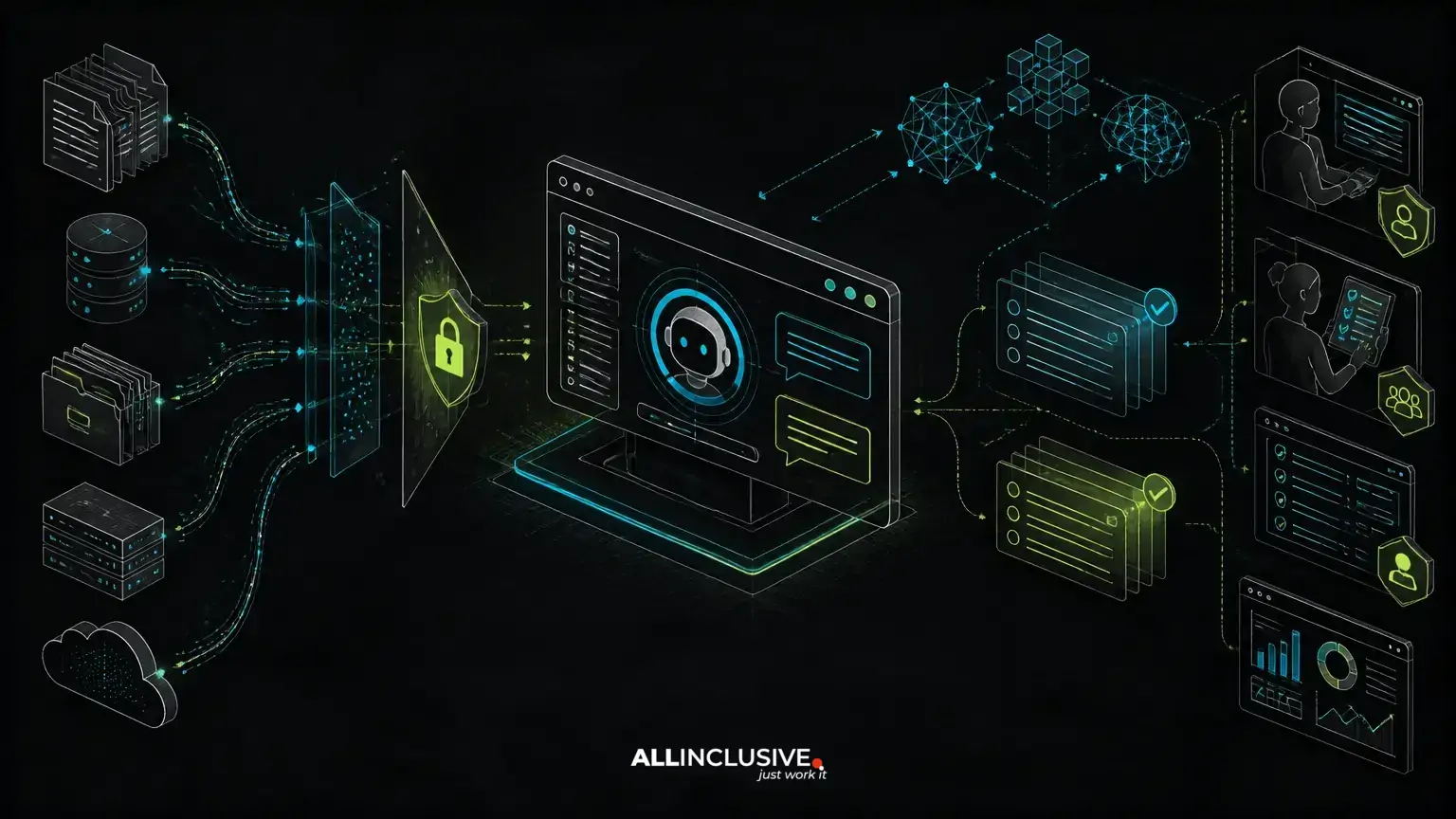
An enterprise knowledge assistant is more than a chatbot connected to a document folder. It is a software system that retrieves relevant private information, applies access rules, generates an answer, shows supporting evidence and provides a safe path when the system is uncertain.
The most reliable architecture usually combines retrieval-augmented generation (RAG), structured application workflows, permission-aware indexing, evaluation datasets and operational monitoring. A Python service can own ingestion and retrieval-intensive AI workloads while Laravel or another application layer manages users, business rules, audit records and product workflows. The right design depends on the organization’s data, security model and answer quality requirements.
This article explains the major components, failure modes and production decisions involved in building search and question-answering over private company data. For broader implementation context, see AI development and the software development hub.
What an enterprise knowledge assistant must do
A useful internal assistant should support a defined set of workflows rather than promise to answer every question. Common examples include finding policy requirements, summarizing approved product documentation, locating contract clauses, explaining operational procedures or helping support teams identify the next approved action.
Those workflows create requirements that consumer chat interfaces do not solve automatically:
- Grounded answers: Responses should be based on retrieved company sources instead of unsupported model memory.
- Permission enforcement: A user must not receive information merely because it exists in the index.
- Traceability: Answers should identify the documents, sections or records used to produce them.
- Freshness: Updates, deletions and access changes must reach the retrieval system predictably.
- Operational safety: The assistant needs fallbacks, rate controls, logging and human escalation.
These requirements make the assistant part of the company’s application architecture. The language model is one component, not the product boundary.
Reference architecture for private-data search and Q&A
A production design commonly separates five stages: source synchronization, content preparation, retrieval, answer generation and application delivery.
1. Source synchronization and ingestion
Connectors collect content from sources such as document repositories, ticketing systems, wikis, databases and approved file stores. Each item should carry metadata including its source identifier, owner, document type, version, timestamps and access-control attributes.
Ingestion should be incremental where possible. Reprocessing an entire corpus for every edit increases cost and makes freshness difficult to reason about. The pipeline should also handle deleted or revoked content, not only newly created files.
2. Chunking and enrichment
Documents are divided into retrieval units, often called chunks. Chunk size should reflect the structure of the source and the questions users ask. A policy may need section-aware chunks with headings preserved, while a table or support ticket may require a different representation.
Useful enrichment can include document titles, section paths, product identifiers, effective dates and source links. Poor chunking creates two opposing problems: fragments that lack enough context, or large passages that reduce retrieval precision and increase model input cost.
3. Embeddings and indexes
Embeddings represent content as vectors so semantically related queries and passages can be compared. A vector index is useful, but it should not be treated as a complete search strategy. Keyword search remains important for exact identifiers, error codes, policy names and product terminology.
Many assistants therefore use hybrid retrieval: lexical search, vector search or both, followed by filtering and reranking. For a deeper treatment of relevance behavior and failure modes, see semantic search with embeddings.
4. Retrieval and reranking
At query time, the system can classify the request, apply tenant and permission filters, retrieve candidate passages and rerank them for relevance. Reranking is especially valuable when the initial search returns several plausible passages but only a few should enter the model context.
Retrieval should preserve provenance. Each result should retain its source identity, location, version and authorization context so the answer layer can cite it and the application can audit the decision.
5. Generation and response delivery
The language model receives the user question, selected context and explicit instructions about how to respond. Those instructions should define what to do when evidence is missing: ask a clarifying question, state that the source set is insufficient or route the request to a person.
The application layer then formats the response, citations and possible next actions. A Laravel application, for example, may manage authentication, conversation history, feedback, permissions and workflow state while a Python service handles document processing, retrieval orchestration and model calls.
Permission-aware retrieval is a design requirement
Security cannot be added by hiding citations after generation. If unauthorized content reaches the model context, the system has already crossed an important boundary, even if the final answer appears harmless.
There are several ways to model access. The index can store document-level permissions, group identifiers, tenant boundaries or policy tags. The query service can then filter candidates before they are passed to the model. In more sensitive systems, retrieval may be performed through an authorization-aware data service rather than directly against a shared index.
Permission synchronization is a significant operational concern. If a user leaves a group or a document is revoked, the change must propagate to retrieval behavior. Teams should test revocation, inherited permissions, shared links, deleted files and conflicting source-of-truth systems.
It is also important to separate application authorization from model instructions. A prompt that says “do not reveal confidential information” is not a substitute for enforcing access in code and data services.
Why RAG does not eliminate hallucinations
RAG reduces the model’s need to rely on general training knowledge, but it does not guarantee correct answers. Failures can occur when the relevant document is not indexed, the query is ambiguous, the chunk loses context, ranking favors a similar but incorrect passage or the model misinterprets valid evidence.
Common controls include:
- Require citations for factual answers.
- Set minimum retrieval or evidence thresholds for high-risk workflows.
- Instruct the model to distinguish documented facts from inference.
- Ask clarifying questions when the request lacks a product, date or policy scope.
- Return source excerpts or links so users can verify important claims.
- Route sensitive decisions to human review instead of fully automated responses.
For regulated, financial, legal or operationally consequential use cases, the assistant should support review rather than pretend to replace accountable decision-makers.
Agents and tools should be added selectively
A basic knowledge assistant answers questions from retrieved content. An agentic assistant may also call tools such as ticket search, inventory lookup, CRM retrieval or workflow creation. Tool use can make the system more useful, but it expands the failure surface.
Each tool should have a narrow contract, explicit authorization and validation around inputs and outputs. Read operations are generally easier to control than write operations. Creating a ticket, changing an account or sending a message may require confirmation, structured parameters and a human approval step.
Do not introduce an agent simply because a model can choose among tools. First identify whether a deterministic workflow, ordinary search endpoint or backend service can perform the task more predictably. Agents are most appropriate when the sequence genuinely varies and the business value justifies the added testing and observability.
Model routing, latency and cost controls
Model selection should follow task requirements, not a single benchmark or brand preference. A system may route short classification tasks, query rewriting, summarization and complex synthesis to different models. Smaller models can handle bounded tasks, while more capable models may be reserved for ambiguous questions or multi-document reasoning.
Latency is affected by retrieval count, reranking, model queue time, prompt size, tool calls and response streaming. Cost is affected by the same factors, along with embedding volume, reindexing frequency and retention of conversation context.
Useful controls include limiting retrieved context, caching stable results, summarizing long conversation histories, avoiding unnecessary agent loops and recording token and infrastructure usage by workflow. These controls improve predictability without weakening the core permission model.
Evaluation must measure retrieval and answers separately
Production teams need an evaluation set built from representative questions, expected sources and acceptable answer behavior. It should include easy questions, ambiguous requests, conflicting documents, stale content, permission boundaries and questions with no supported answer.
Evaluate at least two layers:
- Retrieval quality: Did the system return the authoritative passage and exclude unauthorized or irrelevant material?
- Answer quality: Did the response accurately use the evidence, communicate uncertainty and provide appropriate citations?
Human review remains important because automated graders can miss subtle permission leaks, misleading wording or an answer that is technically plausible but operationally unsafe. Evaluation should run against changes to chunking, prompts, embedding models, reranking, connectors and model providers.
For the broader problem of introducing language models into an existing product, see LLM integration architecture. If the chosen implementation separates AI workloads from a PHP product layer, Python development can provide context for designing the service boundary.
Observability and human review belong in the first release
Logging only the final answer is not enough to troubleshoot a knowledge assistant. Useful telemetry can include query classification, retrieved document identifiers, filter decisions, model and prompt versions, tool calls, latency, token usage, user feedback and escalation outcomes. Sensitive content should be handled according to the organization’s data-retention and privacy policies.
Dashboards should help answer practical questions: Are users receiving empty results? Are certain sources consistently ranked poorly? Which workflows cause long delays? Are users correcting answers from a particular document set? Is a connector failing silently?
Human review can take several forms: approval before an external action, escalation for low-confidence answers, expert review of sampled conversations or a support queue for unresolved questions. Feedback should become structured evaluation data rather than disappearing into an untracked chat transcript.
A delivery sequence that reduces production risk
- Choose one bounded workflow. Start with a corpus and question type where authoritative sources are identifiable.
- Map data ownership and permissions. Document source systems, update behavior, retention requirements and access rules.
- Build ingestion and provenance first. Make freshness, deletion and citation behavior testable before tuning prompts.
- Establish a retrieval baseline. Compare keyword, vector and hybrid approaches using representative questions.
- Add grounded generation. Define unsupported-answer behavior and require evidence where appropriate.
- Instrument the service. Capture latency, errors, usage, retrieval traces and user feedback from the beginning.
- Expand carefully. Add tools, more data sources or additional workflows only after the initial path is measurable.
Custom software is often warranted when permissions, workflow integration, proprietary data or auditability are central to the use case. A packaged chat interface may demonstrate the concept, but production ownership requires control over connectors, authorization, evaluation and operational behavior.
Questions to resolve before building
- Which questions should the assistant answer, and which must go to a person?
- What is the authoritative source for each answer category?
- How quickly must edits and permission changes become effective?
- Can every answer expose verifiable supporting sources?
- What actions, if any, may the assistant perform?
- Which data may be sent to external model providers, and what retention controls apply?
- How will the team measure retrieval quality, answer quality and user trust?
An enterprise knowledge assistant succeeds when it is designed as a controlled information workflow rather than an open-ended prompt box. RAG, embeddings and language models provide important capabilities, but production value comes from the surrounding engineering: source quality, authorization, evaluation, observability, cost controls and accountable human review.


