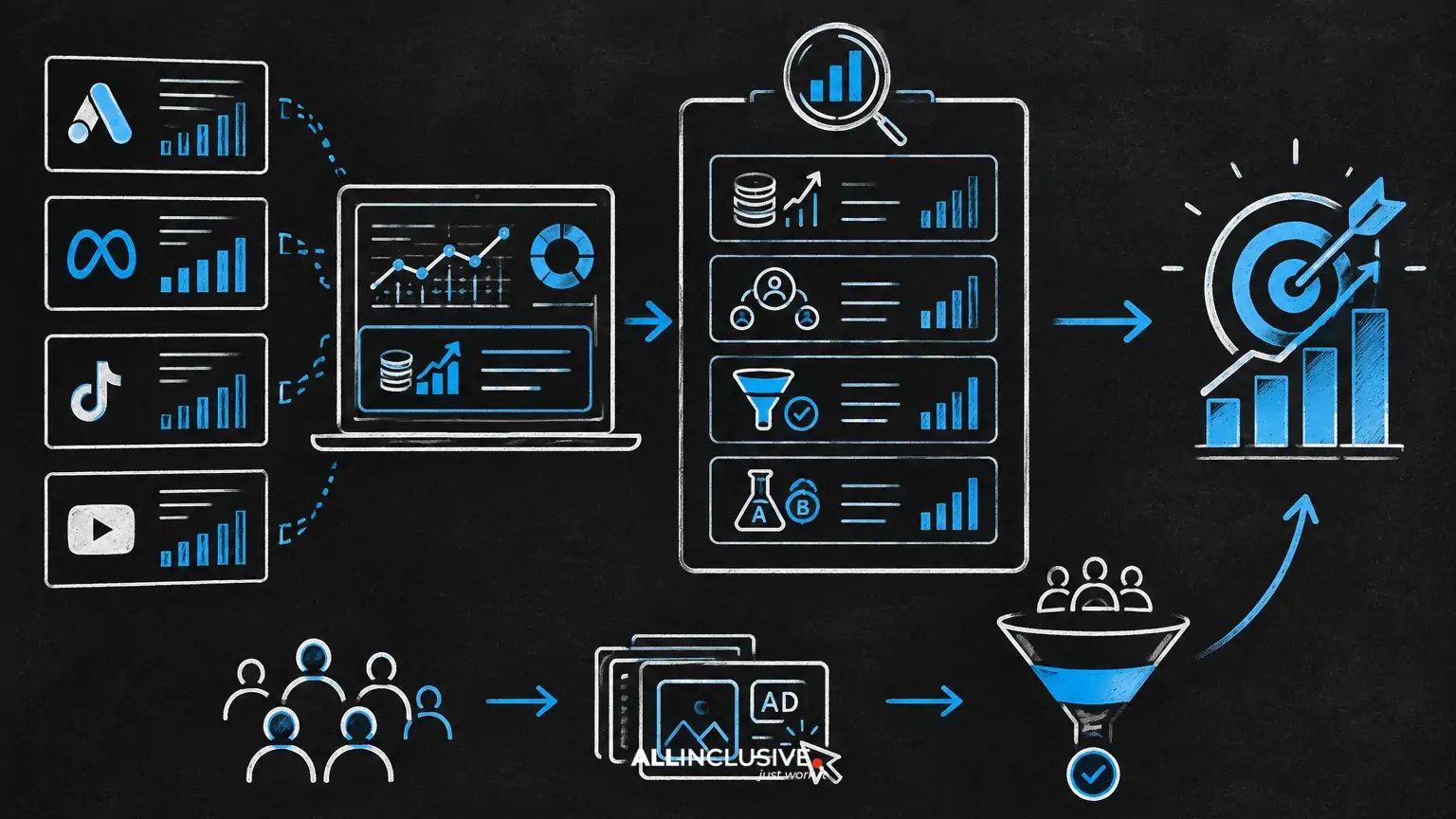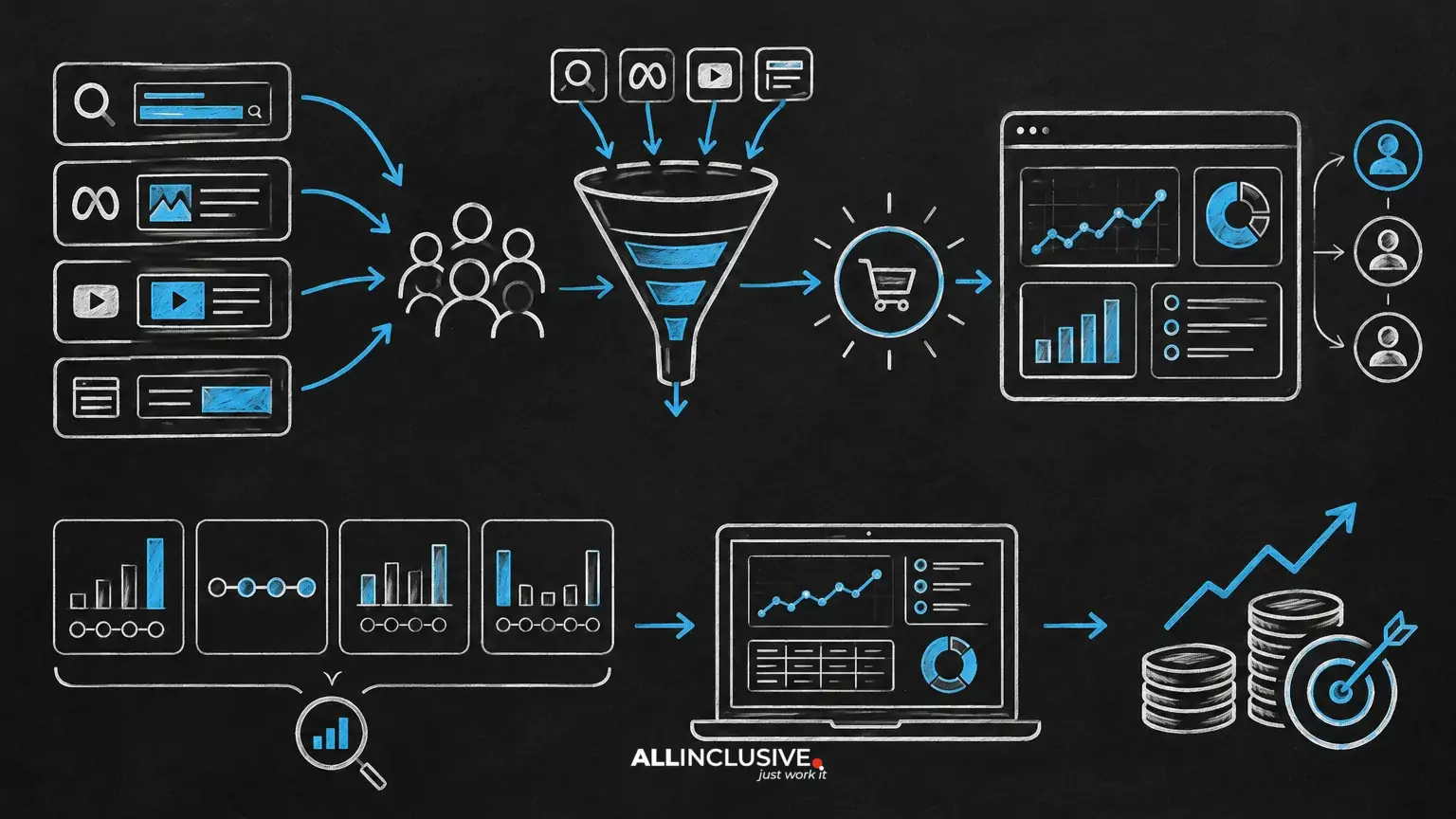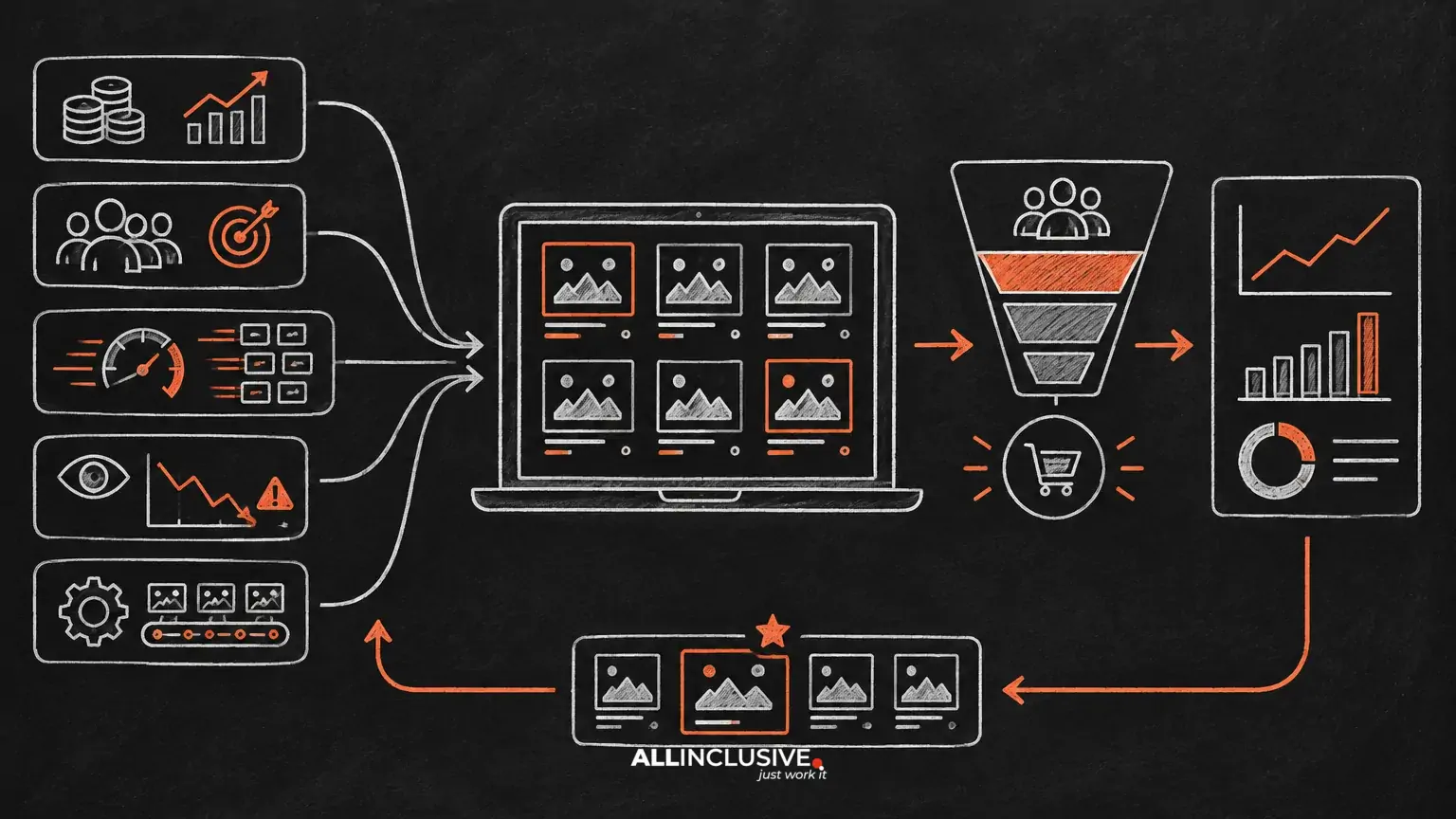
Creative volume is the number of distinct ad assets or meaningful variations your team produces and tests within a defined period. The right amount is not a universal weekly quota. It depends on budget, audience size, delivery concentration, campaign objectives, test design, conversion volume and the time required to create reliable learning.
For most teams, the practical question is not “How many ads should we make?” It is “How much new creative do we need to maintain learning without spreading budget too thin?” A useful plan balances three needs: enough variation to test new ideas, enough continuity to identify what is working, and enough production discipline to avoid creating assets that cannot receive a fair evaluation.
This makes creative volume a media-planning decision as much as a production decision. It belongs within a broader performance creative system, alongside creative strategy, measurement and iteration.
Why creative volume is difficult to plan
Ad platforms can make it easy to launch many variants, but launching more ads does not automatically create more insight. When too many assets enter the same test with limited spend, impressions and conversions are divided. When too few enter the system, the team may overlearn from aging creative or mistake temporary delivery differences for durable performance.
Volume also has several meanings:
- Concept volume: the number of genuinely different strategic ideas, such as a new problem, audience motivation or value proposition.
- Variation volume: executions that change hooks, openings, formats, presenters, visual treatments or copy while retaining the same core idea.
- Production volume: the number of finished assets delivered by a creative team.
- Test volume: the number of assets that can receive enough exposure and conversion data to support a decision.
These numbers should not be treated as interchangeable. A team may produce 20 files but have only three meaningful concepts. Conversely, one strong concept can generate several useful executions for different placements or stages of the customer journey.
The core factors that determine creative volume
1. Spend and expected delivery
Budget affects how quickly an ad can accumulate meaningful exposure and conversion signals. Higher spend may support more concurrent tests, but only when the audience and conversion flow can absorb that spend. Lower spend usually calls for fewer active tests and a clearer prioritization of hypotheses.
Do not set volume from budget alone. Consider how much spend can realistically reach each new asset during the intended evaluation window. If a team launches a large batch but cannot distinguish performance because delivery is thin, the batch is too large for the test environment.
2. Audience size and concentration
A broad audience can support more creative variation than a narrow audience, all else equal. In a small or highly concentrated audience, frequent exposure to many similar assets may accelerate fatigue without creating meaningful strategic diversity.
Audience scale should also be considered by market, funnel stage and campaign. A global account may have substantial total spend but limited delivery in an individual country or segment. Plan creative volume at the level where decisions will actually be made, rather than using account totals that hide uneven distribution.
3. Conversion volume and decision speed
Creative tests need enough signal to inform a decision. The required volume is influenced by the event being evaluated. A team may diagnose early attention signals quickly, while purchase efficiency or qualified-lead quality often takes longer to assess.
This does not mean waiting indefinitely for perfect certainty. It means defining the decision window and the primary success metric before launch. If the business cannot observe meaningful outcomes at the asset level within a reasonable period, reduce simultaneous test volume or use a staged evaluation process.
4. Creative fatigue and delivery pressure
High frequency, declining attention signals, rising acquisition costs or deteriorating conversion quality can indicate that the current creative set is no longer carrying the account effectively. These signals do not prove creative fatigue on their own; audience saturation, offer weakness, tracking changes and auction conditions can produce similar patterns.
Use a fatigue versus audience saturation diagnosis before responding with a large production batch. The correct response may be a new concept, a new audience, a different offer or a change in spend allocation—not simply more versions of the same ad.
5. Production capacity and approval latency
Creative volume must be achievable. Account for briefing, scripting, design, editing, legal review, localization, landing-page coordination and measurement setup. A plan that exceeds operational capacity creates rushed work, delayed launches and inconsistent learning.
Production capacity also affects the right cadence. A smaller team may gain more from a deliberate monthly concept cycle with structured iterations than from an unrealistic weekly target.
A practical framework for setting creative volume
Use the following process to turn creative volume into a manageable operating plan.
Step 1: Define the decision period
Choose the period in which the team will review creative performance—such as a weekly operating review or a monthly planning cycle. The period should match delivery speed and the business’s ability to act on results.
A short review period does not require replacing ads every week. It simply creates a regular point to inspect delivery, attention, conversion and business-quality signals.
Step 2: Map the active creative portfolio
List the concepts and executions currently in market. Group ads by the idea they communicate, not only by file name. Record the audience, funnel stage, format, offer, landing page and primary hypothesis for each group.
This prevents a common mistake: counting five minor edits as five independent creative bets. The portfolio view shows whether the account has genuine strategic diversity or only surface-level variation.
Step 3: Identify the largest source of uncertainty
Decide what the next batch needs to learn. Examples include:
- Which customer problem creates the strongest initial response?
- Which proof point helps qualified prospects continue to conversion?
- Does a direct offer outperform an education-led message?
- Does the current concept fail in the hook, the explanation or the call to action?
- Is performance constrained by the creative or by the landing-page experience?
Creative volume should serve these questions. If the team cannot state the hypothesis, it is probably producing activity rather than useful testable work.
Step 4: Set a batch size that budget can support
Group creative into a batch small enough that each meaningful hypothesis has a chance to receive delivery. The appropriate batch size varies by account. A high-spend, high-volume program may support several concepts at once; a lower-volume program may need a smaller sequence, with new concepts introduced after the first review.
When uncertain, prioritize breadth of strategic ideas over a large number of near-identical edits. Then use the strongest early signals to decide which concepts deserve additional executions.
Step 5: Reserve capacity for iteration
Do not allocate the entire production schedule to net-new concepts. Hold capacity for improving promising ideas. An iteration might preserve the central message while changing the opening, demonstration, proof structure, visual pacing or call to action.
This is where a disciplined creative iteration process becomes more valuable than constant reinvention. The objective is to build on evidence while still creating meaningful variation.
Concepts versus variations: a useful planning distinction
Creative volume planning improves when teams separate the strategic layer from the execution layer.
A concept expresses the underlying reason a prospect should care. For example, a software company might test “reduce reporting time,” “improve forecast confidence” and “standardize operations across teams.” Each is a distinct strategic angle.
A variation changes how that concept is delivered. The same reporting-time concept might appear as a customer story, a screen-recorded workflow, a founder explanation, a comparison, or a problem-first short video.
Start with enough concepts to avoid overcommitting to one hypothesis. Once a concept earns further investment, create variations that explore its strongest communication opportunities. This sequence is generally more informative than producing many executions before knowing which ideas deserve support.
How to know when volume is too low
Creative volume may be too low when:
- The account relies on one concept or one format for an extended period without a clear reason.
- Performance declines and the team has no new hypothesis ready to test.
- Every new asset is a minor cosmetic change rather than a meaningful learning opportunity.
- Media buyers repeatedly extend weak ads because production is not synchronized with media planning.
- Creative reviews focus on individual ads without comparing concepts, audiences and funnel roles.
Low volume is not always a production failure. It can reflect limited conversion data, a narrow audience or insufficient budget to support more tests. In those cases, improve prioritization and measurement before increasing output.
How to know when volume is too high
Volume may be too high when:
- Many ads receive too little delivery to support a meaningful decision.
- Reporting cannot explain which hypothesis each asset was intended to test.
- Design and media teams spend more time organizing files than learning from performance.
- New ads launch before previous tests have been reviewed or documented.
- The portfolio contains many near-duplicates with no clear reason for their differences.
More assets can also create operational noise. Naming, tracking, approvals and landing-page alignment become harder as the portfolio grows. A smaller set of well-defined tests often produces more useful learning than an oversized batch.
A simple operating model for creative volume
Many teams can organize their pipeline into three recurring lanes:
- Explore: introduce new concepts that address important strategic uncertainties.
- Develop: create variations of concepts that show promising attention or conversion quality.
- Maintain: keep dependable assets available while monitoring fatigue, audience response and business outcomes.
The balance between these lanes should change over time. A new account may need more exploration. A mature account with known winning concepts may benefit from more development and maintenance. A sudden performance decline may require temporarily increasing exploration, but only after checking non-creative causes.
Use the creative test matrix to make the exploration and development lanes explicit across hooks, angles, formats and offers.
Measurement: judge volume by learning, not output
Track production metrics such as assets delivered and time to launch, but do not use them as the main definition of success. Pair them with learning metrics:
- Number of clear hypotheses tested.
- Share of assets that received sufficient delivery for the intended decision.
- Time from launch to documented conclusion.
- Number of promising concepts advanced into new iterations.
- Share of spend concentrated in validated versus untested ideas.
Evaluate creative at multiple stages. Early indicators can show whether an asset earns attention, while downstream measures reveal whether it attracts the right users and supports business outcomes. The exact metric set depends on the funnel and measurement reliability. A useful ad creative KPI framework prevents the team from declaring a winner based on a single shallow signal.
Creative Volume: Implementation Checklist
- Set a review period that matches delivery and conversion speed.
- Count concepts separately from executions and file variations.
- Map budget, audience scale and conversion volume before choosing batch size.
- Define the hypothesis and decision metric for every new concept.
- Prioritize strategic diversity before producing large numbers of minor edits.
- Reserve production capacity for iterations of promising ideas.
- Diagnose fatigue, saturation, offer and landing-page issues before scaling output.
- Document what was learned and how the next batch responds to it.
Creative volume works when it is connected to a learning system. The goal is not to maximize the number of ads in production. It is to maintain a healthy flow of distinct hypotheses, supported iterations and dependable assets—at a pace the budget, audience and team can realistically sustain.
For a broader view of how creative planning fits into channel strategy, visit the paid media hub.