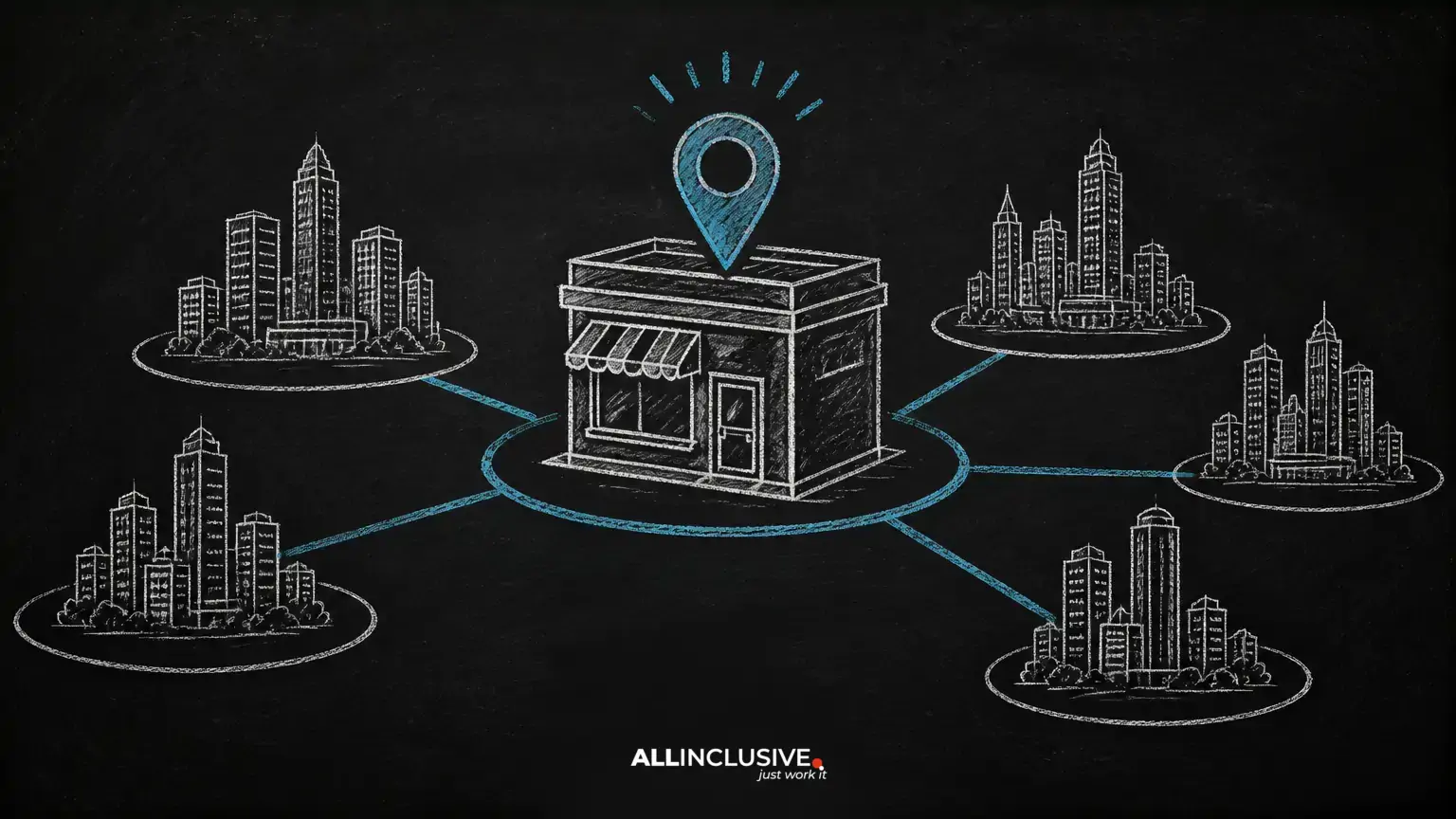
Serving customers in several cities does not automatically mean your website should have a near-identical page for every location. A strong multi-city local SEO strategy begins with a simpler question: can your business genuinely serve people in that area, and can your website provide information that is useful to them?
Search visibility outside your primary location is influenced by relevance, proximity, prominence, competition, and the quality of the page experience. You cannot control every local ranking factor, but you can control whether each location page reflects a real service area, answers local questions, and gives visitors a clear next step.
This guide explains how to build that foundation without relying on repetitive city-name substitutions or large batches of low-value pages.
Start with service-area reality
Before researching keywords, define where the business can actually operate. Consider travel time, licensing requirements, service boundaries, appointment availability, delivery limits, and whether customers in the area are commercially realistic to serve.
A location should not be added to the site simply because it has search demand. If the business cannot reliably serve residents there, a location page may create poor user experiences and misleading expectations.
For businesses with staffed offices, distinguish between an actual business location and a service area. Do not imply that a company has a local office, storefront, or team presence where none exists. Accurate location information supports both trust and local search quality.
Choose cities with evidence, not assumptions
Business owners often have a reasonable sense of which nearby communities are attractive. That knowledge is valuable, but it should be combined with evidence from existing customers, leads, analytics, sales records, and search behavior.
Useful research inputs
- Customer and lead addresses, where collected lawfully and appropriately.
- Service calls, deliveries, consultations, or appointments by area.
- Existing organic impressions and clicks for location-modified queries.
- Conversion rates and revenue by service area.
- Competitor coverage and the type of pages appearing for important searches.
- Seasonality, travel constraints, and capacity during busy periods.
Search Console data can reveal queries and pages that already receive impressions, but impressions are not the same as search volume or demand. Treat the data as directional. Combine it with business outcomes and a manual review of search results before deciding what to publish.
Map location and service intent together
A city page should not attempt to target every service the company offers unless the page can explain those services clearly and the grouping matches how customers search. Organize opportunities by both geography and intent.
For example, a home-services company might find that one nearby city produces interest in emergency repairs, while another produces more research-oriented searches about installation. Those areas may need different page structures, calls to action, examples, and frequently asked questions.
Build a simple planning table before writing:
| Location | Primary service intent | Evidence | Useful local detail | Recommended page |
|---|---|---|---|---|
| City A | Emergency service | Existing calls and relevant queries | Hours, response expectations, service boundaries | Dedicated service-area page |
| City B | Installation | Qualified leads and competitor review | Property types, process, preparation questions | Dedicated service-area page |
| City C | Mixed or unclear | Little evidence | Not yet established | Test through broader service content first |
This prevents a common mistake: creating pages first and trying to invent a purpose for them afterward.
Decide whether a city deserves its own page
A separate page is justified when it serves a distinct need and can offer substantive information that is not merely a rewritten version of another page. A page may be worthwhile when the business has meaningful customers in the area, a distinct service pattern, relevant logistics, or original examples and expertise to share.
A separate page is usually weak when the only change is the city name, a generic paragraph about the community, or a swapped stock image. Publishing many pages with substantially similar content can make the site harder to navigate and less useful to both visitors and search engines.
Questions to ask before publishing
- Can the business clearly explain how it serves this area?
- Is there a meaningful local audience for the service?
- What would a resident of this area need to know before contacting the business?
- Can the page include original details, examples, constraints, or answers?
- Will the page have a distinct purpose in the site’s navigation?
If the answers are mostly no, strengthen an existing service page or create a broader service-area page instead of forcing a new URL.
Analyze the search results before outlining content
Review the results for a small set of representative queries in each target market. The objective is not to copy competing pages. It is to understand the dominant intent and the information users appear to need.
Look for patterns such as:
- Whether results favor service pages, office pages, directories, guides, or map listings.
- Which services are emphasized in titles and headings.
- Whether users need pricing context, response times, qualifications, process details, or appointment information.
- Questions that recur in related searches or customer conversations.
- Whether the market is dominated by businesses with a genuine local presence.
Search results change, and location settings can affect what appears. Record the date and search context during research, then avoid treating one observation as a permanent rule.
Write a genuinely useful local page
The strongest local pages combine service clarity with trustworthy area-specific information. They do not need a long history of the city or generic facts that residents already know. They need details that help someone decide whether the business is appropriate.
Recommended page elements
- A clear statement of the service and the area covered.
- Specific problems the business solves and who the service is for.
- Process information, including what happens before, during, and after an appointment.
- Service limitations, travel considerations, scheduling expectations, or eligibility requirements.
- Original photos, project examples, team information, or documented expertise when available.
- Answers to real customer questions about cost factors, timing, preparation, maintenance, or next steps.
- A prominent and accessible contact method.
Use the location naturally. Repeating the city in every heading or paragraph makes copy harder to read and does not replace useful information. Headings should describe the section’s benefit or subject, not act as keyword containers.
Build a clear internal-link structure
Multi-city pages should fit into a logical site architecture. Link from the main local SEO resource to relevant service-area guidance, and connect each location page to the corresponding core service page. Where appropriate, link back to a broader service page and to closely related location pages.
Use descriptive anchor text that tells visitors what they will find. Avoid creating a long directory of every city in every footer or repeating the same block of links across the site. Links should help users move from general information to a relevant service decision.
For broader technical and strategic support, the SEO services overview provides a natural next step from this topic.
Use structured data carefully
Structured data should describe visible, accurate information on the page. It does not make a thin location page useful, and it should not be used to imply a local office that does not exist.
Before adding local business or service-related markup, confirm the business model, address details, service-area wording, and implementation requirements. Markup should be reviewed after deployment and kept aligned with the visible page. Do not add questions, ratings, reviews, or offers that are not genuinely present and eligible for the relevant result features.
Measure business outcomes, not just rankings
Evaluate each location page using a combination of organic visibility and business value. Useful measures may include qualified inquiries, booked appointments, calls, direction requests where relevant, engagement with contact elements, and revenue or lead quality by area.
Review impressions and clicks in Search Console, but interpret them alongside conversion data. A page can gain impressions without attracting the right customers, while a lower-volume page may produce valuable leads. Track pages and locations consistently so that you can improve, consolidate, or retire weak content.
Common mistakes to avoid
- Publishing dozens of pages with only the city name changed.
- Claiming local offices, teams, addresses, or community involvement that do not exist.
- Adding generic population, history, or landmark paragraphs that do not help customers.
- Creating a page for every possible service and city before validating demand or capacity.
- Using artificial keyword repetition in headings, image text, or calls to action.
- Relying on markup as a substitute for clear content and accurate business information.
- Ignoring pages after publication instead of updating service boundaries, availability, and customer questions.
Conclusion
Ranking in multiple cities is best approached as a service and information problem, not a page-count exercise. Define realistic coverage, validate local demand, study intent, and publish only pages that offer distinct value. When each page helps a real customer understand the service and take an appropriate next step, local SEO becomes more durable and easier to manage.