Customer reviews are one of the most visible signals attached to a local business. They can shape whether a prospective customer clicks, calls, requests directions, or chooses a competitor. But do reviews directly determine local search rankings?
The careful answer is that reviews are relevant to local search performance, but they should not be treated as a guaranteed ranking lever. Search visibility depends on multiple factors, including how well a business matches the search, its location relative to the searcher, the strength and consistency of its online presence, and the usefulness of its website and business profile.
A sustainable review strategy therefore has two goals: make it easier for genuine customers to share useful feedback and use that feedback to improve the customer experience. Ranking gains, when they occur, are a possible result of stronger local relevance and prominence—not a substitute for good operations.
For a broader framework, see our local SEO guide.
What reviews can influence in local search
Reviews can affect local search in several connected ways. Some relate to how a business may be evaluated by search systems; others affect human behavior after a listing appears.
Local prominence
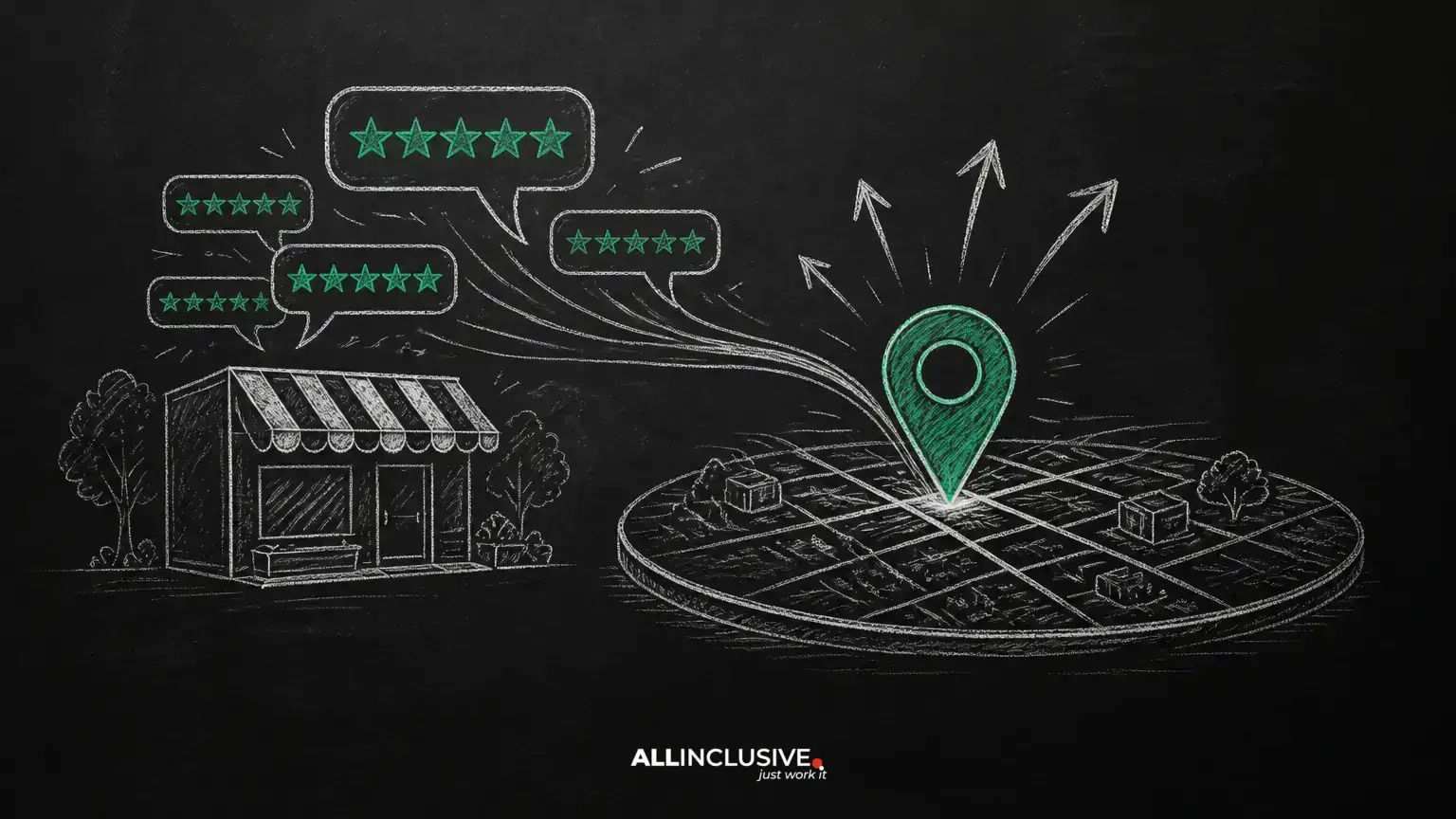
Review activity contributes to the public footprint of a business. A listing with authentic, recent feedback may appear more established than a listing with little or no customer input. Review volume, recency, and overall sentiment can all provide context about a business, although no single review threshold guarantees a particular position.
Searcher confidence and conversions
Reviews often have their clearest effect after visibility has already been earned. People compare ratings, read recent comments, inspect business responses, and look for evidence that a company serves customers like them. A profile that ranks well but appears poorly managed can lose the click to a less prominent competitor.
Language and service context
Customers naturally describe services, products, neighborhoods, problems, and outcomes in their own words. Those descriptions may help searchers understand what a business does. Businesses should not script or manipulate this language, but they can invite honest feedback about the customer’s experience.
What reviews do not prove
It is risky to conclude that a higher star rating or a larger review count automatically produces a higher local ranking. Search results vary by query, location, device, competition, business category, and other factors. A business with many reviews may still be a poor match for a specific search, while a newer business may appear for a nearby or highly relevant query with fewer reviews.
Reviews also cannot compensate for basic listing problems. Incorrect hours, an unsuitable primary category, an inaccurate address, duplicate profiles, weak service pages, or inconsistent business information can all undermine local performance.
Do not promise customers that leaving a review will improve rankings, and do not present a particular rating as a guaranteed requirement. Search platforms can change their systems, and third-party studies may reflect a particular sample rather than a universal rule.
Review quantity, quality, and recency
Review quantity is easy to count, but it is not the same as review quality. A large collection of vague, repetitive comments may be less useful to customers than a smaller set of detailed, recent reviews.
- Quantity: the number of genuine reviews provides social proof and helps a prospective customer compare businesses.
- Rating: the average score offers a quick signal, but it does not explain what happened or how the business handled problems.
- Recency: recent feedback can reassure customers that the current team, service, and location remain active.
- Detail: specific comments about communication, accessibility, turnaround time, or service quality are more useful than generic praise.
- Response quality: thoughtful responses show that the business pays attention to customers rather than merely collecting ratings.
These elements should be evaluated together. A business should focus less on reaching an arbitrary number and more on creating a steady, authentic record of customer experiences.
How to build a compliant review process
1. Improve the experience before requesting feedback
The most dependable review strategy starts offline. Clarify expectations, reduce avoidable delays, communicate changes, and make it easy for customers to obtain help when something goes wrong. A request sent after a disappointing interaction is unlikely to repair the underlying problem.
2. Ask every eligible customer consistently
Use a process that does not selectively request reviews only from people expected to leave positive feedback. A consistent request can be sent after a completed transaction, appointment, delivery, or support interaction. The timing should give the customer enough opportunity to experience the service without interrupting them.
3. Make the next step simple
Provide a direct link to the appropriate review location through a receipt, follow-up email, text message, or account area where appropriate. Explain that honest feedback is welcome. Avoid making customers search for the correct profile or navigate through several unrelated pages.
4. Never manufacture sentiment
Do not buy reviews, write reviews for customers, use fake accounts, offer rewards in exchange for a particular rating, or pressure customers to remove legitimate criticism. These practices damage trust and may violate platform rules or consumer-protection requirements.
5. Protect customer privacy
Do not publish confidential details in a response. Even when a customer identifies themselves publicly, a business should avoid confirming sensitive information about a purchase, medical matter, financial situation, or private conversation.
How to respond to positive and negative reviews
Responses are part of the public customer experience. They should be prompt when practical, specific without exposing private information, and written for both the reviewer and future readers.
For positive reviews
Thank the customer, mention a relevant aspect of the experience, and invite them to return. Avoid copying the same sentence into every response. A brief, human reply is usually more credible than a keyword-heavy template.
For negative reviews
- Acknowledge the concern without becoming defensive.
- Apologize for the experience when appropriate, without making unsupported admissions.
- Offer a private channel for resolution.
- Investigate internally and follow through.
- Update the customer if a meaningful resolution is reached.
A negative review is not automatically a ranking emergency. It is an opportunity to identify a service problem, clarify a misunderstanding, or demonstrate responsible customer care. Flag content only when it appears to violate the platform’s review policies; do not flag criticism simply because it is unfavorable.
How to measure review performance
Track review activity as part of a wider local marketing dashboard. Useful measures include the number of genuine reviews received, average rating trends, time since the latest review, response coverage, recurring service themes, branded search activity, calls, direction requests, and leads from local pages.
Interpret ranking changes carefully. Compare similar queries from consistent locations and time periods, and remember that local results are personalized and can fluctuate. A review campaign should be judged by customer trust and qualified actions, not by a single map position.
A practical review checklist
- Verify that the business profile name, address, phone number, hours, and category are accurate.
- Document when and how customers are invited to leave honest feedback.
- Send requests consistently rather than selectively.
- Use direct, mobile-friendly review links.
- Monitor new reviews and respond in a helpful, privacy-conscious way.
- Share recurring complaints with the team responsible for operations.
- Escalate serious issues privately while keeping the public response concise.
- Review platform policies before introducing incentives or automated requests.
Conclusion
Reviews can support local SEO by strengthening prominence signals, improving customer confidence, and revealing the language customers use to describe their needs. They are not a guaranteed shortcut to higher rankings, and no review count can replace accurate business information, relevant content, a strong customer experience, and sound local SEO fundamentals.
Build a review process around genuine service, consistent invitations, honest feedback, and useful responses. That approach is more durable—and more valuable to customers—than chasing a particular rating or promising a particular search position.
For related guidance, see contact Allinclusive.