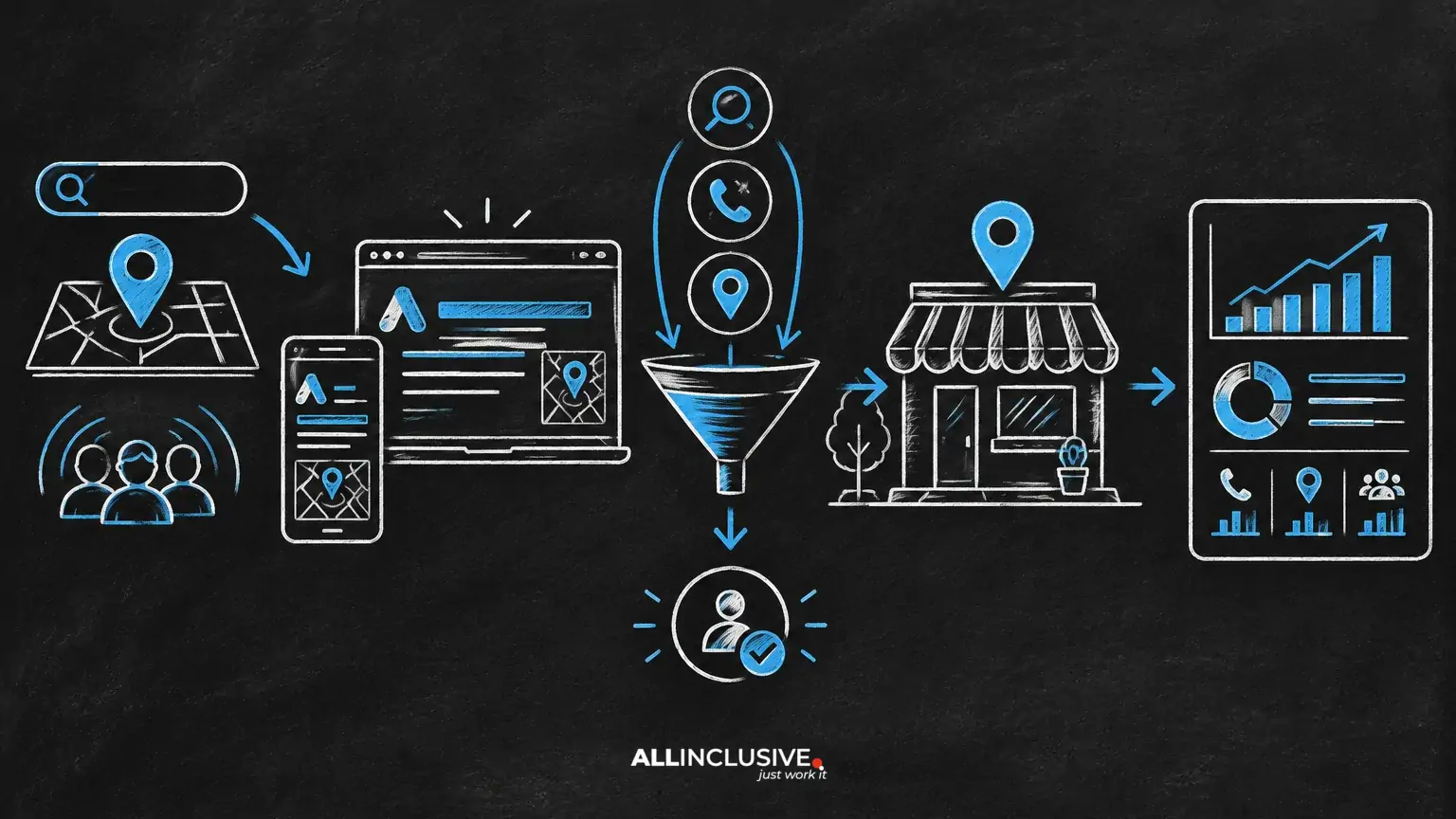
Google Ads for local business growth works best when campaigns are built around real customer actions: calls, bookings, quote requests, store visits and qualified enquiries. The goal is not simply to appear for searches containing a city or neighborhood. It is to reach people with relevant location intent, give them a clear next step and measure what happens after the click.
This makes local paid search a commercial investigation decision, not a one-size-fits-all setup exercise. A service-area company, multi-location retailer, nonprofit and appointment-led practice may all use Google Ads, but they need different campaign structures, conversion definitions and budget controls.
What local Google Ads should accomplish
A local campaign should connect four elements:
- Demand: the problem, product or service people are actively searching for.
- Location: where the customer is, where they want service or where the business operates.
- Action: the next step that indicates commercial value, such as a call, form submission, booking or direction request.
- Feedback: reliable data showing which searches, ads and locations produce useful outcomes.
Clicks are useful for diagnosing delivery, but they are not the business objective. A campaign that generates inexpensive traffic from outside the service area can look efficient while producing no sales. Conversely, a higher-cost click from a nearby searcher may be valuable if it leads to a qualified conversation.
Start with service area and customer intent
Before choosing keywords, document where the business can actually serve customers. Separate physical-location businesses from service-area businesses and from organizations that serve customers remotely.
For a storefront, relevant signals may include searches for the product near a location, opening-hour queries or directions. For a plumber, electrician or legal practice, the important signal may be a service search combined with a geographic modifier or a user located within a practical travel area. For a nonprofit, location may indicate where a program is available, but the conversion could be a donation, volunteer registration or application rather than a purchase.
Build a coverage map that answers:
- Which locations or regions are eligible?
- Are there areas where travel time, licensing or inventory makes leads unsuitable?
- Should different locations have separate budgets, landing pages or phone numbers?
- Are there hours when calls can be answered or appointments fulfilled?
- Which locations have different offers, capacity or business priorities?
Do not create thin pages or campaigns for every nearby city simply to capture geographic variations. Local targeting should reflect genuine operational coverage and a useful customer experience.
Choose campaign structure based on business decisions
There is no universal “local campaign” structure. The right approach depends on how the business manages budget, inventory, leads and locations.
Single-location businesses
A single-location business can often organize campaigns around major service or product categories. Separate brand and non-brand activity when the distinction matters for reporting and budget control. Keep location targeting focused enough to prevent spend in areas the business cannot serve.
Multi-location businesses
Multiple locations introduce a reporting and governance problem. Campaigns may be divided by location, service category or both, but every split should support a real decision. Separate locations when budgets, offers, operating hours, landing pages or lead ownership differ. Avoid excessive fragmentation if it prevents campaigns from receiving enough useful conversion data.
Service-area businesses
For mobile providers, service boundaries matter more than storefront proximity. Campaigns should make the service area clear in ad messaging and landing-page content. If different regions have different pricing, availability or response times, those differences should be reflected in the campaign and conversion reporting.
Nonprofits and community organizations
Nonprofits often need to distinguish between fundraising, program applications, volunteer recruitment and awareness. These actions should not automatically be treated as equivalent conversions. The GSC query “google ads for non-profits” also points to a related need: organizations should assess eligibility, policy requirements and measurement constraints separately from ordinary local lead generation.
For a broader overview of how paid channels fit together, see the paid media guide.
Build keyword coverage around intent
Local keyword research should begin with customer language, not a list of every possible place name. Group queries by the action or problem they express.
- Service intent: “emergency roof repair,” “family dentist” or “commercial cleaning.”
- Product intent: “buy replacement windows” or “office furniture store.”
- Location intent: “near me,” a city or neighborhood, a landmark, or a search performed close to the business.
- Appointment or contact intent: “book,” “schedule,” “quote,” “consultation” or “call.”
- Research intent: “cost,” “reviews,” “types” or “how it works.”
Use match and negative-keyword controls as part of a testing process rather than assuming one setting will solve relevance. Review actual search terms, identify irrelevant themes and protect budget from jobs, products, locations or audiences the business cannot support.
Brand searches deserve their own decision framework. They may help protect visibility and route existing demand, but they should not be used to make non-brand acquisition look more efficient. The guide to brand campaigns in Google Ads covers the trade-offs in more detail. For acquisition, compare performance against a clear non-brand baseline; the non-brand search campaign guide provides a useful framework.
Write ads that qualify as well as attract
Local ad copy should answer three questions quickly: what is offered, where it is available and what the searcher should do next.
Useful proof points can include:
- Specific services or products rather than broad claims.
- Service areas that accurately reflect coverage.
- Appointment, quote or availability language when relevant.
- Operational details such as same-day availability only when the business can consistently support them.
- Relevant trust signals, guarantees or credentials only when they are accurate and permitted.
Qualification is often as important as persuasion. If a business serves only commercial customers, say so. If a service requires a minimum project size or operates only during certain hours, make the landing page and conversion path clear. This can reduce low-quality enquiries even if it lowers raw click volume.
Make the landing page match local intent
Local paid traffic should arrive on a page that supports the specific decision behind the search. A generic homepage may be appropriate in limited cases, but it often forces users to reconstruct the information promised by the ad.
A strong local landing page usually includes:
- The service or product category in clear language.
- The locations or service area actually covered.
- A visible phone number or enquiry action.
- Relevant hours, response expectations and availability.
- Evidence that helps the visitor evaluate fit, such as process details, reviews or qualifications where appropriate.
- A concise form that asks only for information needed to respond.
Use location-specific pages only when they provide genuinely useful, accurate information. Do not duplicate nearly identical pages for every town or suburb. Poor page quality can waste paid traffic and create a misleading experience even when targeting is technically correct.
Measure calls and lead quality, not just forms
Local businesses frequently receive meaningful conversions by phone. Tracking form submissions alone can therefore understate campaign value. At minimum, establish a consistent method for identifying calls generated from paid search and distinguish answered, missed, qualified and unqualified conversations where the business can do so responsibly.
Other conversion actions may include:
- Completed bookings or appointment requests.
- Quote or consultation requests.
- Calls that meet a meaningful duration or qualification threshold.
- Store directions or location-page engagement, interpreted cautiously.
- Donations, applications or volunteer registrations for nonprofits.
Not every measurable interaction should be used as a primary optimization signal. A button click, page view or short call may indicate interest, but it may not represent business value. Classify actions as primary outcomes, secondary diagnostics or imported offline outcomes.
Where lead volume allows, connect advertising data to the next stage of the sales process. A lead that becomes a scheduled appointment, completed job or accepted case is more informative than a raw form count. This is especially important when local businesses have uneven close rates by service, location or lead source.
Use location and time controls carefully
Geographic and scheduling controls should reflect operations, not assumptions. A business can target a service area and still receive searches from people outside it, travelers, researchers or users planning a future visit. Monitor actual traffic and lead locations, then refine exclusions and messaging based on evidence.
Time-of-day adjustments also require operational context. Reducing spend outside call-center hours may make sense when calls are the primary conversion and no answering process exists. It may be counterproductive when users can book online or when search demand is strong before staff arrive. Consider whether the landing page offers a useful after-hours path before restricting delivery.
Budgeting: protect coverage before chasing volume
Budget decisions should follow business economics and capacity. Estimate the maximum acceptable cost for a qualified lead or acquired customer, then account for conversion rates between clicks, enquiries, qualified leads and closed business. These are planning assumptions, not universal benchmarks; validate them with the organization’s own data.
Prioritize spend where:
- The business can serve the demand reliably.
- The customer value supports the expected acquisition cost.
- The conversion path is measurable.
- Sales or operations can respond quickly enough.
- There is a clear reason to expand or reduce coverage.
Do not judge local campaigns solely by average cost per click. A lower click cost can come from weaker intent, broader geography or less competitive queries. Review cost alongside qualified lead rate, close rate, revenue or mission outcomes.
A practical optimization cadence
Weekly or near-term review
- Check spend against budget and delivery by location.
- Review search terms for irrelevant services, jobs, products or areas.
- Confirm calls, forms and bookings are being recorded.
- Look for broken landing-page, phone or scheduling paths.
Monthly review
- Compare qualified outcomes by campaign, service and location.
- Evaluate ad and landing-page messages against actual lead quality.
- Review impression coverage for priority services without treating visibility as the final goal.
- Identify locations with capacity constraints or poor follow-up.
- Test one meaningful change at a time where possible.
For a broader operating rhythm, see the PPC management checklist. If the account supports a more complex B2B sales process, the framework in Google Ads for B2B may also help with lead-quality and pipeline measurement.
When local Google Ads may not be the first investment
Paid search is not always the immediate answer. If a business has no capacity to answer leads, no viable service area, an unclear offer or an unmeasured conversion path, more traffic may amplify operational problems. Fix the offer, response process, landing page and tracking foundation before scaling spend.
Google Ads can also complement, rather than replace, local organic visibility, reputation management, partnerships and direct-response follow-up. Paid search is most useful when it captures demand the business can serve and routes it into a process that can convert that demand into a meaningful outcome.
Final decision framework
Before launching or restructuring Google Ads for local business activity, confirm five things:
- The target geography matches genuine service coverage.
- Keywords and ads reflect the customer’s actual intent.
- The landing page makes the local offer and next step obvious.
- Calls, forms, bookings and other meaningful outcomes are measured consistently.
- Optimization is based on qualified business results, not clicks alone.
When those conditions are in place, local paid search becomes easier to manage and easier to evaluate. The account is no longer just buying nearby visibility; it is creating a measurable path from local intent to customer action.
For broader strategic context, see our paid search resource.