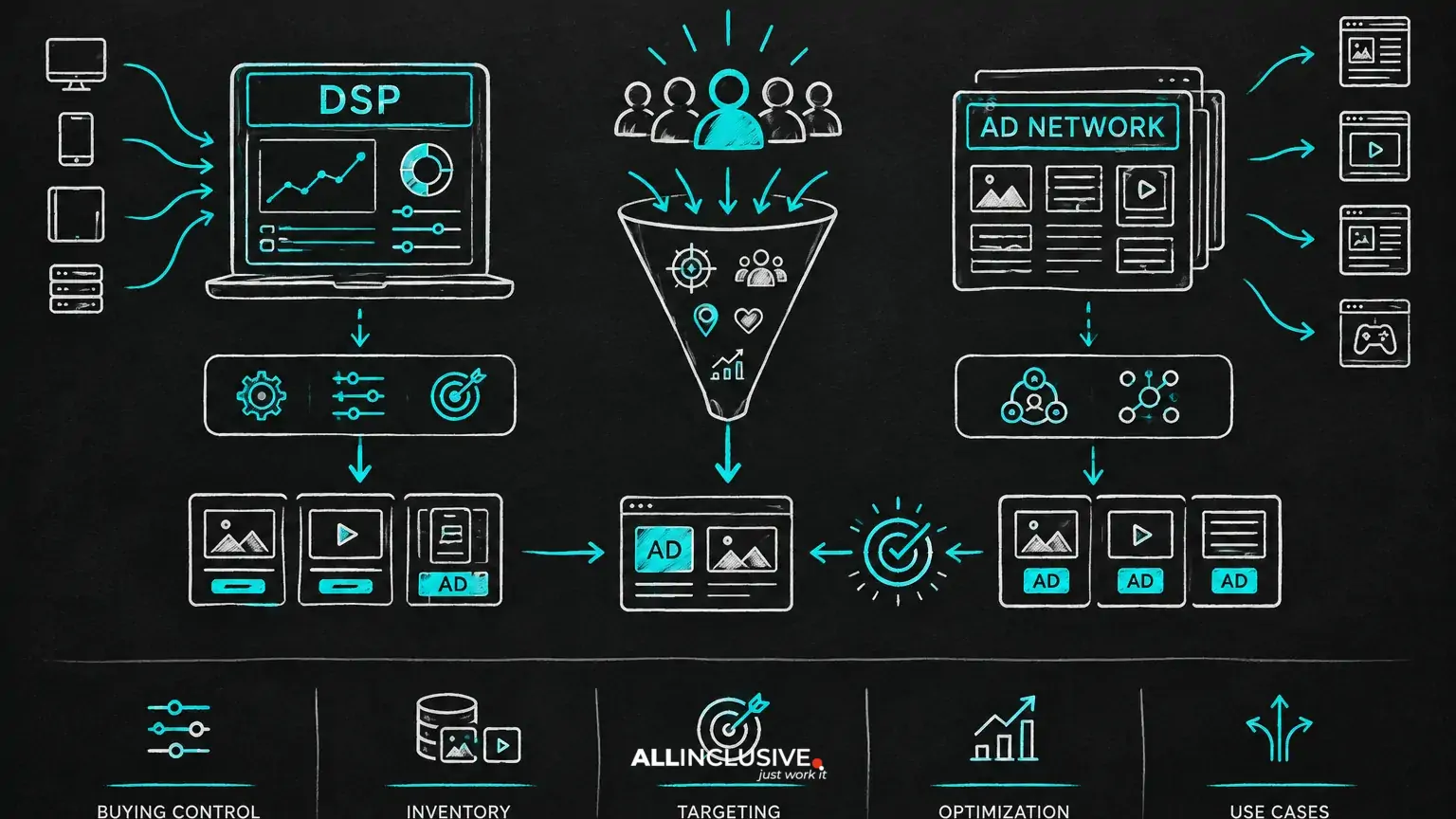
A demand-side platform (DSP) and an ad network can both help advertisers buy digital media, but they are not the same type of tool. The simplest distinction is this: a DSP is technology that lets advertisers buy and optimize media across multiple sources, while an ad network aggregates publisher inventory and sells access to defined packages or audiences.
That difference affects control, transparency, targeting, optimization, reporting and operational complexity. A DSP is often the better fit when an advertiser needs flexible, data-driven buying across exchanges and inventory sources. An ad network may be more practical when a campaign needs a curated audience, a particular environment or a simpler buying workflow.
This guide explains dsp vs ad network decision-making in practical terms, without treating one option as universally superior.
What is a DSP?
A demand-side platform is a buying platform used by advertisers, agencies or trading teams to purchase digital advertising inventory programmatically. The platform connects a buyer’s campaign settings with available opportunities from sources such as ad exchanges, supply-side platforms and other inventory marketplaces.
When an eligible impression becomes available, the DSP can evaluate the opportunity against campaign rules, audience signals, bid logic, budget constraints and brand-safety requirements. If the opportunity meets those conditions, the platform may submit a bid through the relevant auction or buying mechanism.
DSPs commonly support capabilities such as:
- Cross-site, app, video, audio, connected TV or digital out-of-home buying, depending on the platform and inventory access
- Audience, contextual, geographic, device and frequency-based targeting
- Automated bidding and budget allocation
- Creative rotation and campaign-level testing
- Conversion, reach and exposure reporting
- Inventory, domain, app and supply-path controls
The exact features vary by provider. A DSP is not a guarantee of complete inventory access or perfect transparency; buyers still need to understand the platform’s data sources, supply relationships, fees, reporting methodology and controls.
What is an ad network?
An ad network is an intermediary that aggregates advertising inventory from multiple publishers or properties and packages it for sale to advertisers. The network may organize inventory by audience, content category, geography, device, placement type or other commercial criteria.
Instead of giving the buyer broad access to a buying ecosystem, an ad network typically offers defined inventory or audience products. Examples can include a category-specific network, a regional network, a vertical network or a network focused on a particular format.
Ad networks may provide:
- Preassembled publisher or audience packages
- Direct relationships with selected publishers
- Managed campaign setup and optimization
- Placement or category-level reporting
- Access to specialized environments that may be difficult to buy efficiently alone
The term “ad network” covers a wide range of business models. Some networks operate with substantial automation and granular controls, while others are primarily sales and packaging organizations. Buyers should therefore evaluate the specific network rather than assume all networks work alike.
DSP vs. ad network: the main differences
1. Buying model
A DSP is generally a technology layer through which a buyer can evaluate and purchase individual impressions or other addressable opportunities across connected supply sources. The campaign team configures objectives, targeting and bidding parameters, and the platform applies those rules at scale.
An ad network generally sells access to aggregated inventory or a defined media package. The network may decide how delivery is distributed across participating publishers or placements. This can simplify execution, but it may provide less control over each individual opportunity.
2. Inventory access
DSP inventory can span multiple exchanges, supply partners and formats, depending on the platform’s integrations and the buyer’s agreements. This breadth can support reach and diversification, but it also requires more active supply-quality management.
An ad network usually offers a more curated or bounded inventory pool. That can be useful when context, publisher relationships or a specialized audience matters more than maximum marketplace breadth.
3. Targeting and data
DSPs typically combine campaign inputs with available first-party, contextual, geographic, device, modeled or marketplace audience signals. The available options depend on consent, jurisdiction, inventory, data-provider relationships and platform policy.
Ad networks may offer audience targeting based on their own publisher relationships, contextual classification or packaged segments. The targeting can be effective, but the buyer should ask how the audience is defined, refreshed, measured and delivered.
In either model, targeting labels should not be accepted at face value. Ask what signal is used, where it is applied, whether it is deterministic or modeled, and how performance is attributed.
4. Control and transparency
DSPs often provide more configurable controls over bids, frequency, pacing, inventory exclusions, creative rules, supply paths and optimization events. They may also expose more granular reporting, although the depth of reporting varies.
Ad networks can provide strong operational support and curated access, but reporting may be aggregated at the package, publisher or placement level. Before launch, confirm whether you can review domains or apps, understand delivery by environment, apply exclusions and reconcile spend against the contracted media.
5. Optimization
DSP optimization is usually driven by campaign objectives and signals such as conversions, qualified visits, viewability, completion, reach or cost efficiency. Optimization may occur through automated bidding, budget shifts, audience refinement, inventory controls or creative testing.
Ad-network optimization may be performed by the network’s team, through predefined rules or through a buyer-facing interface. This can reduce workload, but it can also limit the buyer’s ability to inspect and change the underlying logic. Clarify who makes optimization decisions and how frequently they are reviewed.
6. Fees and commercial structure
A DSP may involve platform, data, verification, supply or service costs in addition to media spend. The exact structure depends on the provider, agreement and buying model.
An ad network may present a more consolidated media rate or package price, but the buyer should still seek clarity on margins, technology charges, data costs, managed-service fees and any minimum commitments. Comparing only the headline CPM can hide meaningful differences in working media, quality and reporting.
When a DSP is usually the better fit
A DSP is often appropriate when the campaign requires:
- Multiple formats, channels or inventory sources in one buying workflow
- Granular audience, contextual or geographic controls
- Flexible bidding against a defined business outcome
- Frequency management across participating environments
- Transparent testing of creative, audiences, supply paths or landing pages
- In-house or agency expertise to manage setup, measurement and optimization
For example, a business launching a multi-market consideration campaign may use a DSP to test contextual groups, first-party audiences, video environments and connected TV inventory while applying different frequency and measurement rules to each channel.
However, a DSP introduces responsibility. The buyer must configure campaigns carefully, validate conversion signals, monitor quality and understand how the platform charges for and reports on media.
When an ad network is usually the better fit
An ad network may be a practical choice when the campaign needs:
- Access to a clearly defined publisher category or specialized audience
- A simpler managed buying process
- Direct support from a sales or campaign team
- A specific media package with predictable placement parameters
- Reach in an environment where a curated relationship is more valuable than broad exchange access
For example, a B2B advertiser promoting an industry conference may value a network focused on relevant trade publications or professional content. The network’s contextual and publisher relationships could be more important than the ability to bid across the entire open market.
That convenience should not replace due diligence. Confirm where ads appear, how delivery is controlled, what reporting is available and whether the network can support independent verification.
How to choose between a DSP and an ad network
Start with the campaign objective
Define whether the primary goal is reach, qualified traffic, lead generation, completed video views, sales, incremental exposure or another measurable outcome. A DSP may provide more flexibility for continuous optimization, while an ad network may be well suited to a focused placement or audience package.
Assess operational capacity
Consider who will build audiences, manage exclusions, monitor pacing, review supply quality and interpret performance. If the team lacks programmatic experience, a managed DSP service or reputable ad network may reduce execution risk. If the organization needs direct control and has the necessary expertise, a self-serve DSP may be more appropriate.
Define the required level of transparency
List the reporting fields required before selecting a partner. These may include publisher or app, format, device, geography, placement, viewability, invalid traffic, completion, conversion and cost information. Do not assume that a platform or network offers every field by default.
Match measurement to the buying model
Decide how success will be measured and whether the partner can support that methodology. Consider attribution windows, modeled conversions, offline outcomes, lift studies, reach and frequency measurement, and the role of post-view activity. Measurement should be agreed before launch rather than retrofitted after delivery.
Review supply quality and brand controls
Ask how inventory is sourced and filtered. Review domain and app controls, content categories, fraud and viewability measurement, verification partners, placement exclusions and supply-path information where available. For a deeper overview of these issues, see programmatic brand safety controls.
DSP vs. Ad Network: Implementation Checklist
- Write a channel brief: Document the objective, audience, geography, formats, budget, timing and required outcomes.
- Separate strategy from mechanics: Decide the audience and measurement approach first, then determine which platform or partner can execute it.
- Validate tracking: Confirm that pixels, server-side events, analytics tags or offline conversion imports are working before optimizing toward them.
- Set quality rules: Establish inventory exclusions, frequency limits, viewability expectations and brand-safety requirements in advance.
- Build a test plan: Define which variables will be compared, how long the test will run and what decision threshold will guide the next step.
- Reconcile delivery: Compare platform, ad-server, verification and analytics data where appropriate, and investigate material discrepancies.
- Document learnings: Record which audiences, contexts, formats, supply sources and creative messages contributed to the result.
How DSPs and ad networks can work together
The choice does not always have to be either-or. An advertiser may use a DSP for broad, addressable buying and optimization while using a specialized ad network for curated publisher access or a high-value contextual package.
The key is to define each partner’s role. Avoid buying the same inventory through overlapping paths without a reason, and establish rules for audience duplication, frequency management, measurement and budget allocation. A supply-path review can help determine whether a network adds unique value or simply introduces another layer between the buyer and publisher.
Advertisers new to the category may first benefit from a foundational explanation of what programmatic advertising is, then use that knowledge to evaluate platform and partner options.
DSP vs. Ad Network: Decision Summary
The difference between a DSP and an ad network is primarily one of control, access and operating model. A DSP gives buyers a technology-driven way to evaluate and optimize opportunities across connected inventory sources. An ad network packages aggregated inventory or audience access, often with a more curated or managed experience.
Choose a DSP when flexibility, cross-channel control, granular optimization and scalable measurement are central requirements. Choose an ad network when specialized inventory, publisher relationships or operational simplicity are more important. In both cases, evaluate the actual supply, data, controls, fees and measurement—not just the label.
For broader channel planning and execution context, explore Allinclusive’s paid media resources.
For broader strategic context, see our programmatic advertising resource.