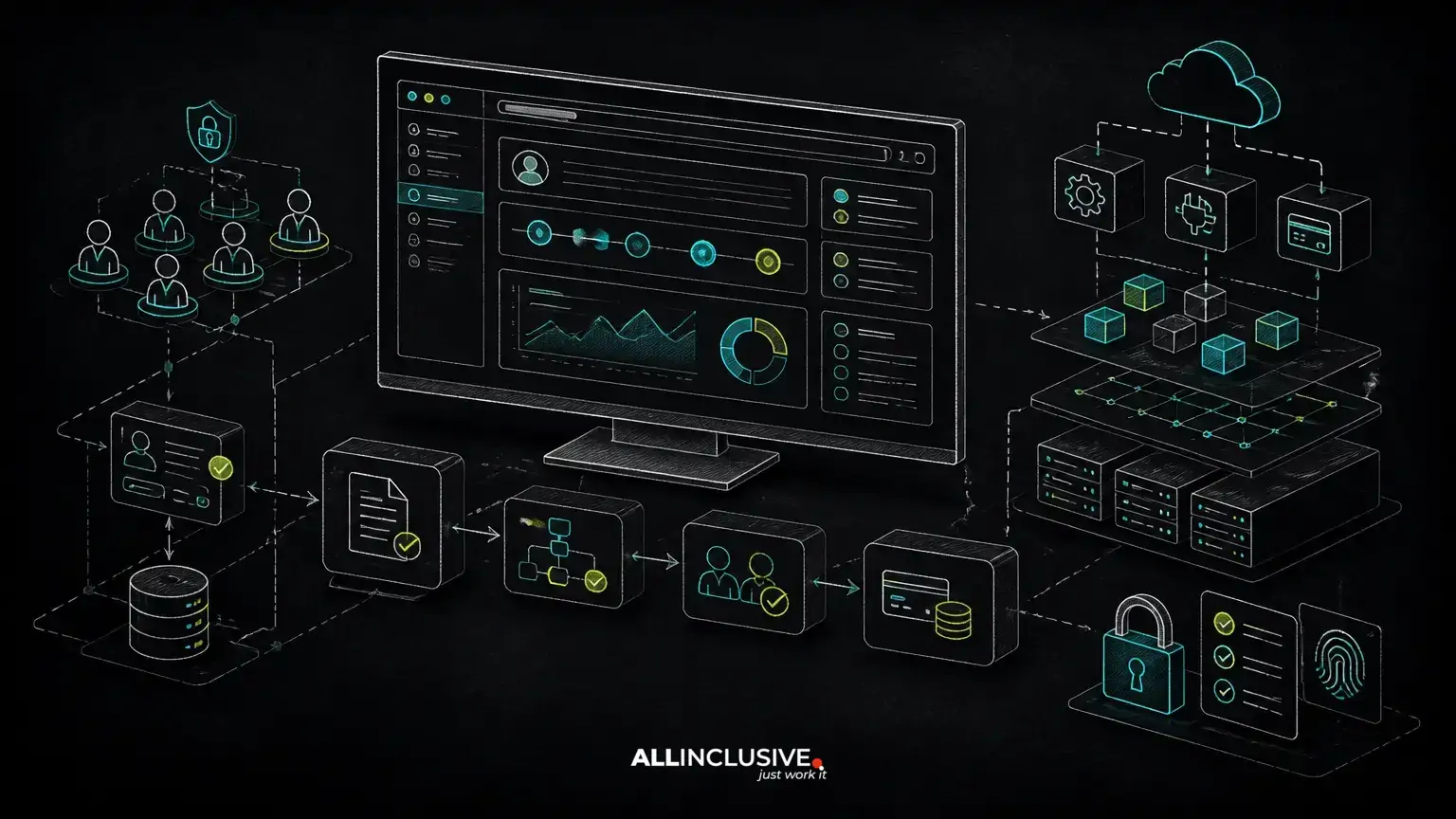
The right dedicated product squad size is usually large enough to own a meaningful product area, but small enough to make decisions quickly. For many software products, that means starting with a core team of three to six people: a product or delivery owner, one or more engineers, and the design, quality or platform expertise required by the work. More complex products may need several coordinated squads rather than one oversized team.
Headcount is only a starting point. A strong squad has clear ownership, complementary skills, enough seniority to resolve routine issues, and a working relationship that supports continuous delivery. A seven-person team with unclear accountability can be less effective than a four-person team with the right boundaries.
This article explains how to choose squad size by product stage, technical scope, operating model and risk. It also compares dedicated squads with project outsourcing, staff augmentation and in-house hiring.
What a dedicated product squad is responsible for
A dedicated product squad is a stable, cross-functional team assigned to a product or product area over an extended period. Rather than receiving a narrowly defined project and handing over the result, the squad participates in discovery, implementation, release preparation, feedback analysis and ongoing improvement.
Its responsibility should be expressed in outcomes or product areas, not just a list of technologies. Examples include:
- Owning the checkout and subscription experience.
- Building and operating a customer-facing analytics module.
- Modernizing a PHP application while continuing feature delivery.
- Developing an internal workflow platform used by several business teams.
- Taking a production AI feature from prototype validation to monitored operation.
This model works best when the team can make day-to-day technical and delivery decisions without waiting for a separate vendor, department or handoff group. The client still owns product direction and business priorities, while the squad owns execution within an agreed scope of responsibility.
For broader context on how this model fits into an engineering organization, see Allinclusive’s dedicated product teams overview.
Typical dedicated product squad sizes
There is no universal staffing formula, but several patterns are useful for planning.
Two to three people: a focused core team
A two- or three-person squad can work for a narrowly defined product area, an early validation stage or a maintenance-heavy system. A common setup might include a senior full-stack engineer, a second engineer and a product or delivery lead shared with another team. Design and quality support may be part-time or brought in for specific activities.
This size has low communication overhead and can be cost-conscious. It also has limited resilience. A holiday, illness or departure can remove a substantial part of the team’s capacity. It may struggle with simultaneous discovery, feature delivery, testing, infrastructure work and production support.
Use a small core when the product boundary is clear and the organization has access to specialist support. Do not treat a small team as a complete substitute for missing product decisions or operational ownership.
Four to six people: a balanced delivery squad
Four to six people is often a practical starting point for a dedicated product squad with genuine cross-functional ownership. The team may include:
- A product owner, product manager or delivery lead.
- Two to four software engineers, depending on the system and roadmap.
- A designer, quality engineer, data specialist or platform engineer, either dedicated or regularly embedded.
This structure provides enough engineering capacity for parallel work without requiring many layers of coordination. It can support backlog refinement, implementation, testing, release preparation and technical maintenance within the same operating rhythm.
For a Laravel or PHP product, for example, the team might combine backend and full-stack expertise with frontend, testing and deployment capability. A Python-heavy data or AI product may require different emphasis, such as data pipelines, evaluation workflows, model integration and observability. The team size should follow the product risks rather than the technology label.
Seven to nine people: a larger squad with a specific reason
A squad of seven to nine people can be appropriate when the product has multiple interfaces, demanding operational requirements or a substantial delivery roadmap. It may include dedicated design, quality assurance, platform or data expertise alongside several engineers.
At this size, communication costs become more visible. Work can split into subgroups, decisions may take longer and people may lose awareness of adjacent changes. A larger squad needs explicit ownership boundaries, written decisions, predictable planning and a delivery lead who actively manages dependencies.
If the team is growing because unrelated product areas are being added, splitting into two smaller squads may be healthier than continuing to add members. If it is growing because the same product area genuinely requires parallel capabilities, retain the larger structure but define who owns each workflow and technical boundary.
Ten or more people: consider multiple squads
A team of ten or more can still operate, but it is often better understood as a small product group. At this point, the question is not simply how many people to assign. It is how to create independent units with clear missions and limited dependencies.
One squad might own customer onboarding while another owns billing or platform capabilities. Shared architecture, design systems and operational standards can be coordinated through lightweight communities of practice or designated technical ownership rather than constant joint meetings.
Size the squad around ownership, not workload alone
Estimated workload is useful, but it should not be the only sizing input. A squad needs enough capability to own the complete path from product decision to reliable operation.
Assess the product boundary
A good product boundary has a recognizable user workflow, a clear business outcome and manageable technical dependencies. “Build the whole platform” is too broad for one squad. “Own account provisioning and permissions” is easier to staff and govern.
When a team owns a bounded area, it can make better trade-offs between speed, quality and maintainability. It also becomes easier to identify gaps: perhaps the squad needs stronger UX support, more deployment experience or additional domain knowledge.
Map the delivery capabilities required
List the capabilities needed during a normal delivery cycle:
- Product discovery and prioritization.
- User experience and interaction design.
- Frontend and backend implementation.
- Data modeling and integration work.
- Automated and exploratory testing.
- Deployment, monitoring and incident response.
- Security, privacy and compliance review where applicable.
Not every capability requires a full-time person. A designer or security specialist may support several squads, while the squad still needs a reliable way to obtain that support before decisions become blocked.
Account for operational responsibility
A product squad that only builds features can appear adequately staffed until the first production issue arrives. If the team is expected to monitor releases, troubleshoot incidents, manage migrations or respond to customer-impacting defects, those responsibilities must be included in its capacity and seniority mix.
This is especially important for custom-made software with integrations, background jobs or data workflows. A team may need fewer feature developers but stronger platform and operational coverage if reliability risk is high.
Seniority matters as much as headcount
Two squads with the same number of people can have very different delivery capacity. A team with one experienced technical decision-maker can move more independently than a larger group that requires external approval for architecture, estimation and production changes.
A practical mix often includes at least one engineer who can reason across application design, data, testing and deployment. Other engineers can then contribute at different levels without making the team dependent on a separate architect for every decision.
Senior product or delivery leadership matters as well. A squad cannot compensate for an unclear product strategy simply by adding developers. If priorities change weekly, acceptance criteria are vague or business stakeholders are unavailable, more headcount may increase unfinished work rather than throughput.
How squad size changes communication and continuity
Communication overhead rises as more people and dependencies are added. A small squad can often resolve a decision in a short discussion. A larger group needs more structured planning, documentation and decision ownership.
Useful operating practices include:
- A single visible backlog with explicit priorities.
- Named owners for product, technical and operational decisions.
- Short written records for architecture and scope decisions.
- A regular delivery cadence with demonstrations and review.
- Clear escalation paths for blockers and production issues.
- Planned overlap between incoming and outgoing team members.
Continuity is also a sizing concern. A squad that is technically large but frequently changes composition may have less effective capacity than a smaller stable team. Repeated onboarding consumes time, weakens domain knowledge and increases the risk of inconsistent implementation.
Before starting, define access, environments, documentation, product context and stakeholder availability. The guide on onboarding an external development team covers the preparation needed to make that transition productive.
Dedicated squad versus other delivery models
Dedicated squad versus project outsourcing
Project outsourcing is organized around a defined deliverable, timeline or scope. It can be appropriate when requirements are stable and the handoff boundary is clear. A dedicated squad is better suited to products where priorities evolve, feedback changes the roadmap or ongoing technical ownership matters.
The trade-off is that a dedicated model requires more active product collaboration. The client must provide direction, access to users or business stakeholders, and timely decisions. In return, the team can adjust implementation as evidence changes instead of treating every change as a new project negotiation.
Dedicated squad versus staff augmentation
Staff augmentation adds individuals to an existing team. It preserves internal processes and can fill a known skills gap quickly. However, the client remains responsible for team coordination, product context, architecture and delivery management.
A dedicated squad provides a broader operating unit with its own engineering coordination and shared context. It is useful when an organization needs product capacity and execution ownership, not just another developer in an established team.
Dedicated squad versus in-house hiring
In-house hiring can build long-term institutional knowledge and direct organizational control. It also involves recruiting, management, retention and the time required to assemble complementary skills.
A dedicated external squad can provide a stable cross-functional capability while the client continues to build its internal organization. The decision depends on strategic knowledge retention, expected product lifespan, management capacity, hiring conditions and how much delivery responsibility should remain internal. See the comparison of a dedicated development team versus in-house hiring for additional criteria.
Warning signs that the squad is too small
A squad may be undersized when:
- Critical work stops whenever one person is unavailable.
- Testing, documentation or operational maintenance is repeatedly deferred.
- The same engineer becomes the only source of architecture or deployment knowledge.
- Product discovery and feature implementation compete for the same limited time.
- Incidents regularly interrupt planned delivery.
- Stakeholders cannot get reliable visibility into progress or risk.
The solution may be additional people, but it may also be narrower scope, better automation, stronger product prioritization or dedicated specialist support. Add capacity only after identifying the constraint.
Warning signs that the squad is too large
A squad may be oversized when:
- Several people work on the same area without clear ownership.
- Planning meetings consume more time than decision-making warrants.
- Small changes require coordination across multiple subgroups.
- People are assigned to the squad but wait for work or context.
- Dependencies and handoffs are increasing despite added headcount.
- The team cannot state which product outcome it owns.
In these cases, split the product boundary, clarify responsibilities or reduce work in progress before adding more process. A smaller number of autonomous teams is often easier to manage than one large pool of specialists.
A practical way to choose the starting size
Before forming a squad, write down five decisions:
- What product area will the squad own? Define the users, workflows and systems in scope.
- What must it deliver in the first delivery cycle? Include discovery, implementation, testing and release work.
- What can go wrong? Identify operational, security, data and integration risks.
- Which capabilities must be continuous? Distinguish full-time roles from scheduled specialist support.
- Which decisions can the squad make independently? Clarify product, architecture, scope and production authority.
Start with the smallest team that can own the agreed boundary responsibly. Review the structure after the team has real delivery evidence, not after a single planning exercise. Add capacity when a sustained constraint is visible; split the team when dependencies and coordination are limiting progress.
For organizations evaluating a Serbia-based product engineering partner, Allinclusive can help define a cross-functional model around the product’s roadmap, technical architecture and ownership expectations. Explore the broader software development capability or contact the team to discuss the right starting structure.