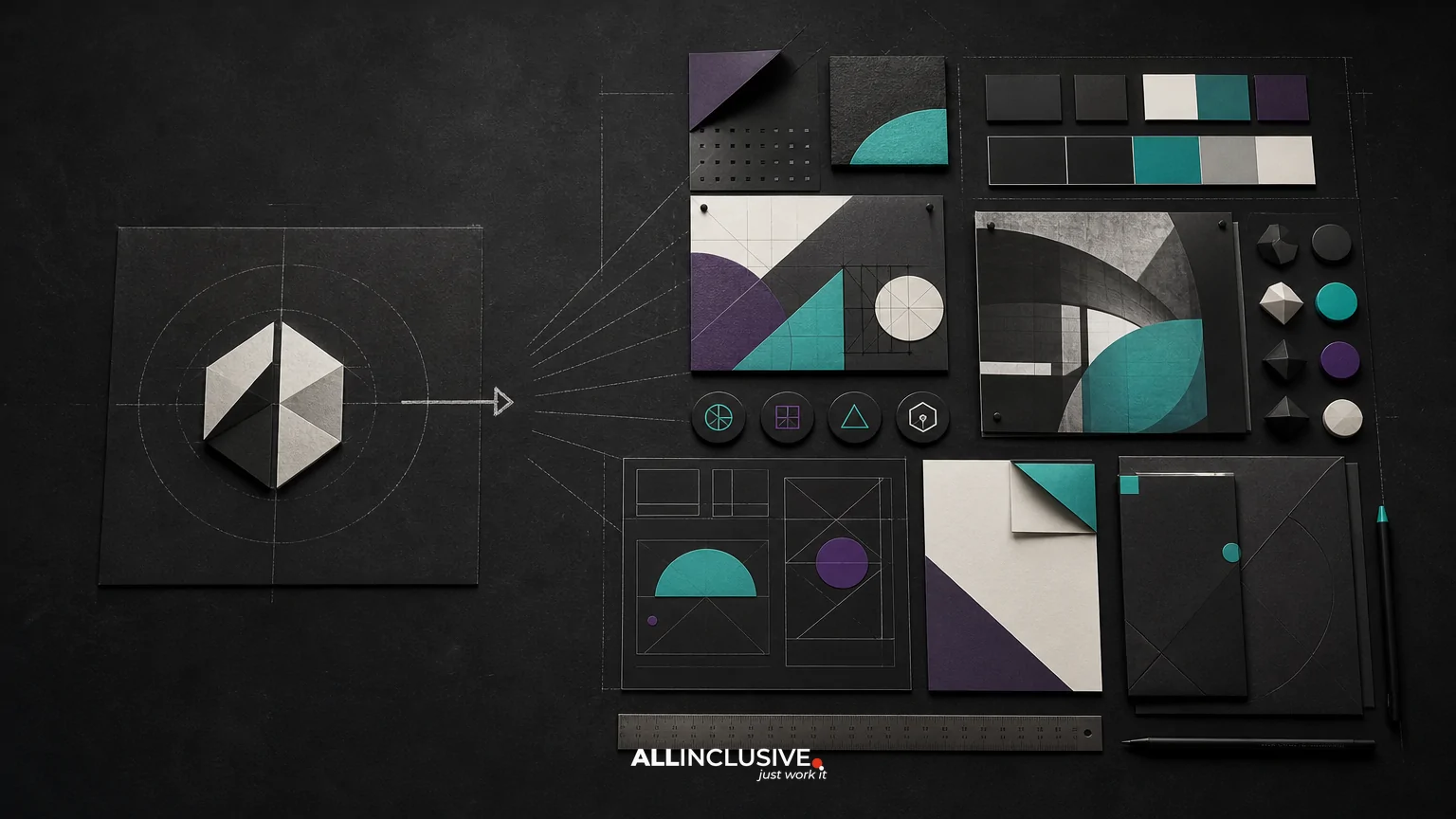
When comparing brand identity vs logo design, the simplest distinction is scope: a logo is a recognizable mark, while a brand identity is the broader visual system that helps a business present itself consistently across channels.
A logo may be the most visible element of that system, but it cannot define every visual decision on its own. A complete identity can include the logo, typography, color, imagery, iconography, motion principles, templates, brand guidelines, and rollout support. The right choice depends on your business stage, communication needs, and how many people or teams will use the brand.
Brand identity vs logo design at a glance
| Consideration | Logo design | Brand identity |
|---|---|---|
| Primary purpose | Create a distinctive visual mark | Create a coordinated visual system |
| Typical scope | Symbol, wordmark, lockups, and basic usage files | Logo plus typography, color, imagery, layout, icons, motion, templates, and guidelines |
| Best fit | A new or existing business that needs a focused mark | An organization managing multiple channels, teams, products, or audiences |
| Main output | Logo files and variations | A repeatable system for creating branded communications |
| Primary trade-off | Lower scope, but more decisions remain unresolved | Greater investment, with more consistency and flexibility over time |
What is included in logo design?
Logo design focuses on creating the central identifier for a business, product, service, or initiative. The work typically begins with positioning or creative direction, followed by concept development, refinement, and preparation of final assets.
Common logo design deliverables
- Primary logo or wordmark
- Alternate horizontal, vertical, or stacked lockups
- Symbol or icon, when relevant
- Light, dark, monochrome, and full-color versions
- Basic spacing or minimum-size guidance
- File formats for print and digital use
File preparation matters. A useful logo package may include vector files for scaling, raster files for common digital applications, and versions suited to light and dark backgrounds. However, the exact deliverables vary by project and should be confirmed before approval.
A logo project does not necessarily establish how the brand should use photography, illustrations, typography, color combinations, presentation layouts, social graphics, or campaign assets. Those decisions may remain open unless they are explicitly included in the scope.
What is included in brand identity design?
Brand identity design translates a brand’s positioning into a coordinated visual language. It answers not only “What does the logo look like?” but also “How should the business look and feel wherever people encounter it?”
Core brand identity components
- Logo system: primary and secondary marks, responsive versions, color treatments, and usage rules.
- Typography: type families, hierarchy, pairing principles, and guidance for headlines, body copy, captions, and digital interfaces.
- Color: primary and supporting palettes, contrast considerations, and practical combinations for different applications.
- Imagery: photography direction, illustration style, image treatment, cropping, and subject-matter guidance.
- Iconography and graphic elements: a coherent approach to symbols, patterns, shapes, textures, or supporting visual devices.
- Layout and composition: principles for spacing, grids, alignment, hierarchy, and recurring page or screen structures.
- Motion: animation behavior, transitions, pacing, or logo movement when the brand appears in video and digital products.
- Templates: practical starting points for presentations, proposals, social content, documents, campaigns, or internal communications.
- Brand guidelines: documentation that explains how the system works and helps teams apply it consistently.
Not every identity project needs every component. A small professional-services firm may need a logo, type system, color palette, presentation template, and concise guidelines. A technology company with a product interface may also need UI patterns, motion, iconography, and digital accessibility considerations.
How the two scopes overlap
Logo design is often one workstream within a brand identity project. In a broader engagement, the logo may be developed first or refined alongside the rest of the system so that the mark works with the selected type, colors, imagery, and layouts.
The overlap can create confusion when proposals use terms such as “visual identity,” “logo package,” or “brand kit” without listing deliverables. Ask for a written scope rather than relying on the project label. Two providers can use the same name for substantially different work.
What a logo cannot solve by itself
A strong logo can improve recognition, but it does not automatically create a consistent brand experience. Without supporting rules, teams may use different fonts, colors, image treatments, or layouts across materials.
A logo alone also may not answer practical questions such as:
- Which typefaces should be used for marketing, presentations, and digital products?
- How much color variation is acceptable?
- What kinds of photography or illustration feel appropriate?
- How should the identity work in a small social avatar or a large trade-show graphic?
- How should internal teams and outside vendors apply the brand?
- What should happen when a new product, campaign, or market is introduced?
These are system questions. They become more important as the number of channels, contributors, and customer touchpoints increases.
When logo design may be enough
A logo-focused project may be a reasonable choice when the business needs a clear mark and the surrounding visual decisions are already defined or intentionally flexible.
- You are launching a small business with limited initial communications.
- You need to replace an outdated or technically unusable logo without changing the broader identity.
- You have an established visual system but need a logo for a new product or initiative.
- Your internal team already owns typography, color, imagery, templates, and brand standards.
- You are testing a concept before committing to a wider identity investment.
Even in these cases, clarify whether the project includes basic usage guidance, alternate configurations, and production-ready files. A narrowly defined scope can still be professionally prepared.
When a complete brand identity is the better fit
A broader identity is usually more appropriate when the business needs alignment across several applications or wants a system that others can use without repeatedly asking for design decisions.
- The company is launching, repositioning, or entering a new market.
- The current logo looks acceptable, but the brand feels inconsistent across channels.
- Several teams or vendors create customer-facing materials.
- The business has multiple products, locations, audiences, or offerings.
- Marketing needs repeatable templates rather than one-off designs.
- The brand must work across print, web, social, presentations, packaging, events, or product interfaces.
- A merger, acquisition, or organizational change requires a shared visual language.
For a wider overview of the work involved, see brand identity design services. The objective is not to collect more assets; it is to create a system that supports clear decisions and reliable execution.
Cost and trade-offs: logo design versus brand identity
The price difference between the two is driven by scope, strategy, complexity, stakeholder involvement, and the number of applications being addressed. A logo project generally has fewer design components and approval points. A brand identity project requires more discovery, system development, testing, documentation, and often implementation support.
Comparing quotes only by the headline price can be misleading. Review:
- The number of concepts and revision rounds
- Whether discovery or positioning work is included
- Which logo variations and file formats are supplied
- Whether typography, color, imagery, and layout are defined
- Whether templates are editable and in which software
- The depth and format of the guidelines
- Whether rollout support or production supervision is included
- What rights, licenses, and third-party assets require separate attention
For a more detailed budgeting discussion, read brand identity design cost considerations. Treat any estimate as scope-dependent rather than as a universal market benchmark.
How to compare proposals accurately
Before selecting a direction, convert each proposal into a deliverables checklist. Look for specific language instead of broad promises such as “complete branding” or “full visual identity.”
Questions to ask
- Is the engagement for a logo, a visual identity, or both?
- Which brand touchpoints will be explored during the process?
- Will the system include typography, color, imagery, iconography, and layout rules?
- Are templates included, and will they be editable by the people who need them?
- How will the identity be documented and handed off?
- Are digital, print, presentation, and social applications included?
- What happens if the business needs a new channel after launch?
- Who is responsible for licensing fonts, photography, illustrations, or other assets?
If you are evaluating process as well as scope, the brand identity design process guide can help you map discovery, concept development, refinement, documentation, and rollout to your internal needs.
A practical decision framework
Use the following sequence to choose the appropriate level of work:
- List the next 12 months of touchpoints. Include website pages, sales materials, presentations, social channels, events, packaging, product screens, and internal templates.
- Identify who will create or approve them. More contributors usually increase the value of clear rules and reusable templates.
- Separate recognition from consistency. If the main problem is a missing or outdated mark, logo design may address it. If the problem is uneven execution, consider an identity system.
- Define the minimum viable system. Prioritize the components that will be used immediately instead of commissioning unused assets.
- Plan for expansion. Ask whether the system can support new products, campaigns, formats, or markets without requiring a redesign.
This framework can also reveal a staged path: a focused logo and foundational rules now, followed by additional templates, guidelines, or applications as the organization grows.
How brand guidelines fit into the decision
Brand guidelines are the operating instructions for an identity. They can be brief or extensive, depending on the complexity of the organization and the number of people applying the system.
A useful guide may explain logo clear space, incorrect usage, typography hierarchy, color combinations, image direction, layout principles, and examples of the system in context. Guidelines are most valuable when they help people make decisions, not when they simply archive finished artwork.
If documentation is your primary need, review the separate scope for brand guidelines design. It may be relevant when the identity already exists but is inconsistently applied.
Common mistakes to avoid
- Choosing by deliverable count alone: Ten poorly connected assets are not necessarily more useful than a focused system.
- Assuming a logo redesign fixes every brand issue: Messaging, positioning, customer experience, and design applications may need separate attention.
- Skipping real-world testing: Review concepts at small sizes, in presentations, on mobile screens, and in common production formats.
- Underestimating handoff: Files without naming conventions, guidance, or editable templates can create avoidable friction.
- Documenting rules without examples: Teams often need applied examples to understand how principles work in practice.
- Designing for one channel only: A system should reflect the environments in which the business actually communicates.
Final takeaway
Logo design creates a mark. Brand identity creates the larger visual system that makes the mark useful, recognizable, and consistent across business communications. Choose logo design when the need is focused and the surrounding system is already clear. Choose brand identity when multiple touchpoints, teams, or growth plans require shared visual rules.
For commercial planning, compare your needs against the scope of brand identity design, and use the broader design services overview to place the project within your wider communication needs.