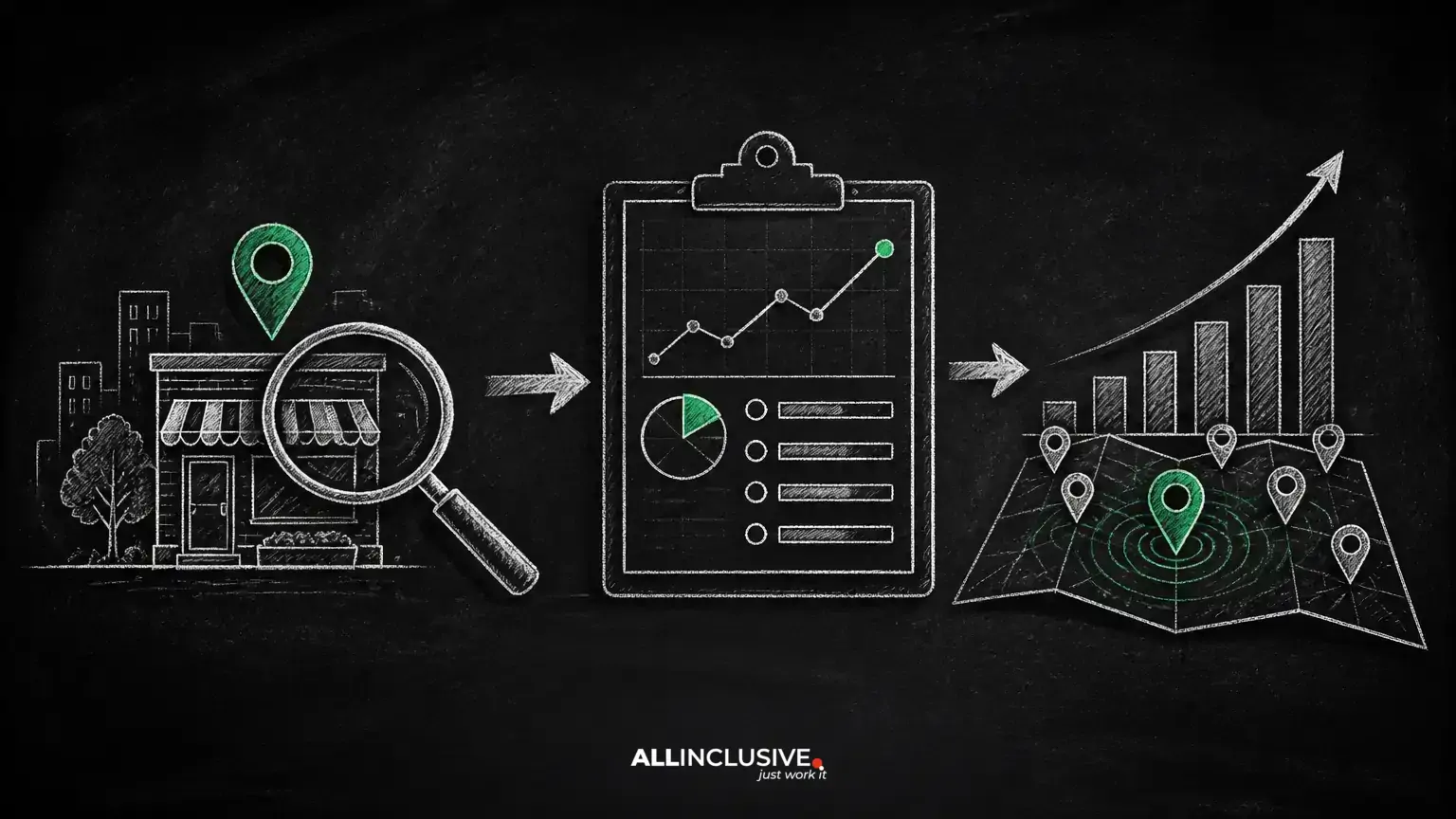
Local SEO reporting should answer a straightforward business question: is your visibility in the places that matter leading to more useful customer actions? A report that only lists keyword positions may look detailed while providing little guidance about what to do next.
A stronger system combines search visibility, local presence, website engagement, and business outcomes. It also separates meaningful changes from normal fluctuations and makes comparisons fair across locations, devices, services, and time periods.
This guide presents a durable framework for measuring local SEO. It is designed for a single-location business, a service-area company, or a brand with multiple branches.
Start with business goals, not a dashboard
Before selecting metrics, define the outcome local search is meant to support. A restaurant may care about calls, direction requests, reservations, and visits to its menu. A home-services company may prioritize qualified calls and completed lead forms. A professional practice may focus on appointment requests and searches for specific services.
These goals determine what should appear in the report. If the business does not accept online purchases, ecommerce revenue is not an appropriate primary KPI. If several locations serve different areas, one blended number can conceal important differences.
Use a simple measurement hierarchy
- Business outcomes: qualified leads, bookings, calls, purchases, or other agreed actions.
- Local visibility: presence in relevant map results, organic results, branded searches, and service-location queries.
- Engagement: website visits, calls, form starts, direction requests, and interactions with location information.
- Operational inputs: profile completeness, review activity, local landing-page improvements, citations, and technical fixes.
The lower levels help explain performance, but they should not replace the outcomes the business actually values.
Build a useful local keyword set
Keyword tracking is helpful when it represents real customer journeys. Create groups based on intent rather than collecting a long, unstructured list of phrases.
Organize terms by intent
- Service terms: searches for the product or service itself.
- Problem terms: searches describing a need, symptom, or task.
- Location terms: searches that include a city, neighborhood, district, or other service area.
- Action modifiers: phrases such as “nearby,” “open now,” “appointment,” “quote,” or “emergency,” where relevant.
- Brand terms: searches containing the business name, location name, or branded service.
Do not assume every variation deserves equal attention. A smaller set of clearly grouped, commercially relevant queries is easier to interpret than hundreds of loosely related terms.
Search results can vary by location, device, personalization, and time. Treat ranking data as directional evidence, not a guarantee that every searcher sees the same result. Record the tracking location and device so comparisons remain consistent.
Measure local visibility in context
Local visibility has several surfaces. A business may appear in a map result, an organic result, a branded knowledge area, or a directory result. Reporting should distinguish these surfaces where possible.
Track map and organic visibility separately
Map visibility and traditional organic visibility are related but not interchangeable. A business can improve its local presence while its standard organic rankings remain stable, or the reverse can happen. Separate reporting makes it easier to identify which type of work deserves attention.
For each keyword group, consider recording:
- Whether a local result appears for the query.
- The business’s presence or position in that local result.
- Organic visibility for the relevant service or location page.
- Competitor presence and recurring result types.
- Changes over a consistent reporting period.
Avoid presenting an average rank as the main conclusion. Averages can hide the difference between high-value service terms and low-value informational queries. Show trends by intent group and location instead.
Account for geography
Local rankings can change significantly across a city or service area. A single rank checked from a business address does not describe visibility across the entire market. Use a consistent set of representative areas, and document how those areas were selected.
For a multi-location business, report each branch independently before creating an overall summary. A strong aggregate result may be driven by one location while another is losing visibility.
Connect visibility to customer actions
Visibility is valuable because it can create opportunities for contact or purchase. The next step is to connect local search exposure with actions that can be measured responsibly.
Useful engagement measures may include:
- Organic sessions to service and location pages.
- Calls from tracked website or profile pathways, where tracking is configured accurately.
- Completed contact, quote, booking, or appointment forms.
- Clicks to directions, menus, pricing, or other high-intent pages.
- New users who visit a location page and then complete a conversion.
Interpret these numbers with care. A platform’s interaction count, analytics session, and internal lead record may use different definitions. Document the source and definition of every important metric so the report does not compare unlike measurements.
Use conversion quality, not just volume
More leads are not automatically better. If possible, distinguish qualified inquiries from spam, duplicates, job applicants, existing-customer requests, and irrelevant contacts. A modest increase in qualified opportunities may be more valuable than a large increase in low-quality submissions.
When offline outcomes are available, connect leads to booked appointments, completed jobs, or revenue using a consistent process. If that connection is not yet possible, label lead counts as proxy metrics rather than presenting them as confirmed revenue.
Report reviews and local profile activity carefully
Reviews can influence trust and customer choice, but review counts alone do not prove that local SEO improved. Treat them as part of the customer experience and local presence picture.
A useful review section may include:
- New reviews during the reporting period.
- Average rating, shown with its measurement date.
- Response coverage and response quality, reviewed manually.
- Recurring themes in customer feedback.
- Operational issues that require a business response.
Do not encourage customers to post misleading reviews or offer incentives in ways that violate applicable platform rules. The reporting goal is to identify authentic feedback and service improvements, not to manufacture signals.
Create a report people can act on
A useful monthly or quarterly report is selective. It should make the most important movement easy to see and explain what happens next.
A practical report structure
- Executive summary: state the most important gains, losses, risks, and recommended actions.
- Business outcomes: show leads, calls, bookings, or other agreed KPIs with comparison periods.
- Local visibility: summarize map and organic visibility by location and intent group.
- Engagement: report meaningful page visits and local actions.
- Work completed: list updates to pages, profiles, technical elements, and local assets.
- Next actions: assign priorities, owners, and expected measurement windows.
Use annotations for major changes, such as a new location page, tracking modification, seasonal promotion, service change, or profile update. Without annotations, a trend line can be easy to misread.
Choose comparison periods intelligently
Month-over-month comparisons can be useful for operational monitoring, but they may be misleading for businesses with strong seasonality. Where appropriate, compare with the same period in the previous year or with a defined baseline. State which comparison is being used.
Do not declare success or failure from one short-term movement. Search demand, competition, weather, promotions, staffing, and tracking changes can all affect local results. Look for consistent patterns and corroborating business data.
Common local SEO reporting mistakes
- Reporting rankings without outcomes: a position does not reveal whether qualified customers acted.
- Blending locations: combined data can hide a struggling branch.
- Changing measurement rules: inconsistent tracking makes trends unreliable.
- Overloading the report: excessive metrics make priorities harder to identify.
- Ignoring data quality: duplicate listings, spam leads, missing tracking, or attribution gaps can distort conclusions.
- Claiming causation too quickly: a coincidental increase after an update is not proof that the update caused it.
Turn reporting into a recurring improvement cycle
Reporting should lead to decisions. At the end of each period, identify the largest opportunity, the most credible explanation for the change, and the next test or improvement to implement.
Examples include improving a service page that receives relevant impressions but few actions, clarifying location information when visitors struggle to find a branch, correcting inconsistent business details, or investigating a location that performs materially below its peers.
Keep a change log with dates, affected URLs, locations, and implementation notes. This creates context for future analysis without assuming that every movement has one identifiable cause.
For a broader view of how local visibility fits into an overall search strategy, explore Allinclusive’s local SEO resources and review the wider SEO services available for search strategy and optimization needs.
Conclusion
Effective local SEO reporting is not a collection of vanity metrics. It is a consistent method for connecting relevant visibility with customer actions, comparing locations fairly, and choosing the next practical improvement. Start with business goals, segment data by intent and geography, document measurement definitions, and keep the final report focused on decisions. When the reporting process is clear, local SEO becomes easier to evaluate and improve over time.